KYIV, Ukraine (AP) — Ukrainian President Volodymyr Zelenskyy had no time to hold a traditional news conference during a whirlwind, 36-hour trip across Europe this week, so he improvised.
For the first time since Russia's full-scale invasion of his country, Zelenskyy — who usually takes reporters’ questions in person while trotting the globe — communicated with the news media via group chat. While flying between London and Brussels, he answered a long list of questions from Ukrainian and international reporters, relaying audio clips on WhatsApp.
His chosen mode of communication was, if not unprecedented, at the very least extremely rare for a world leader.
The low drone of the aircraft blended with his hoarse, tired-sounding voice, yet his message cut through clearly: Amid uncertain negotiations to end the war, Ukraine, he said, cannot surrender land.
“Undoubtedly, Russia insists for us to give up territories,” he said in a crackling message late Monday. “According to the law, we don’t have such a right … and to be frank, we don’t have a moral right either.”
With the outlook for negotiations changing by the day, Zelenskyy’s team set out on a jam-packed schedule to shore up support in Europe.
Zelenskyy met the leaders of Britain, Germany and France in London, and the heads of NATO and the European Union in Brussels, before traveling on to Rome for talks with the Italian prime minister and Pope Leo XIV.
A key issue being discussed is whether Ukraine should cede Russian‑occupied territory in return for security guarantees, but the talks have been complicated by uncertainty about the Trump administration’s commitment to European security.
Since the start of the war, Zelenskyy has shown a desire to communicate in real-time in whatever way is necessary.
When Kyiv came under siege shortly after Russia launched its full-scale invasion in 2022, Zelenskyy tried to reassure the public through what appeared to be a cellphone video with three top officials — perhaps his best-known address.
“We are all here,” he said at the time. “Our soldiers are here, the citizens of our country are all here protecting our independence, and we are going to continue to do so.”
Since then, Zelenskyy has made frequent communication a strategic priority in a sleep-defying cycle of video messages, remote speeches to Western parliaments and conferences, late-night posts and high-security public appearances.
Monday night’s WhatsApp exchange wound down as his plane landed in Brussels, just before he was whisked into his next round of meetings.
He asked reporters: “How did you like this format? If it works for you, then when we have the opportunity, we’ll share our thoughts and decisions this way again.”
It didn't take long. By Tuesday evening, Zelenskyy had sent reporters more audio messages on WhatsApp to explain how talks to end the war were proceeding with its Western allies.
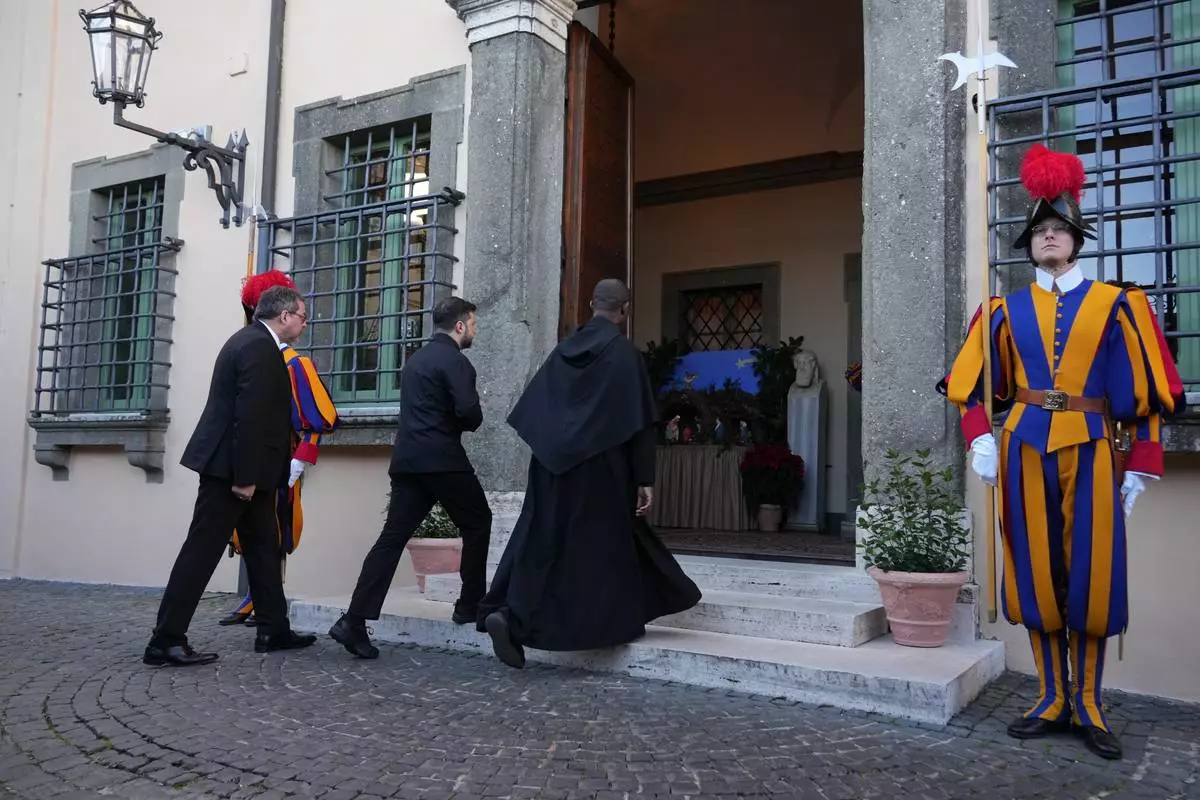
Ukraine President Volodymyr Zelenskyy, center, walks past Swiss guards as he arrives to meet with Pope Leo XIV in Castel Gandolfo, Italy, Tuesday, Dec. 9, 2025. (AP Photo/Andrew Medichini)
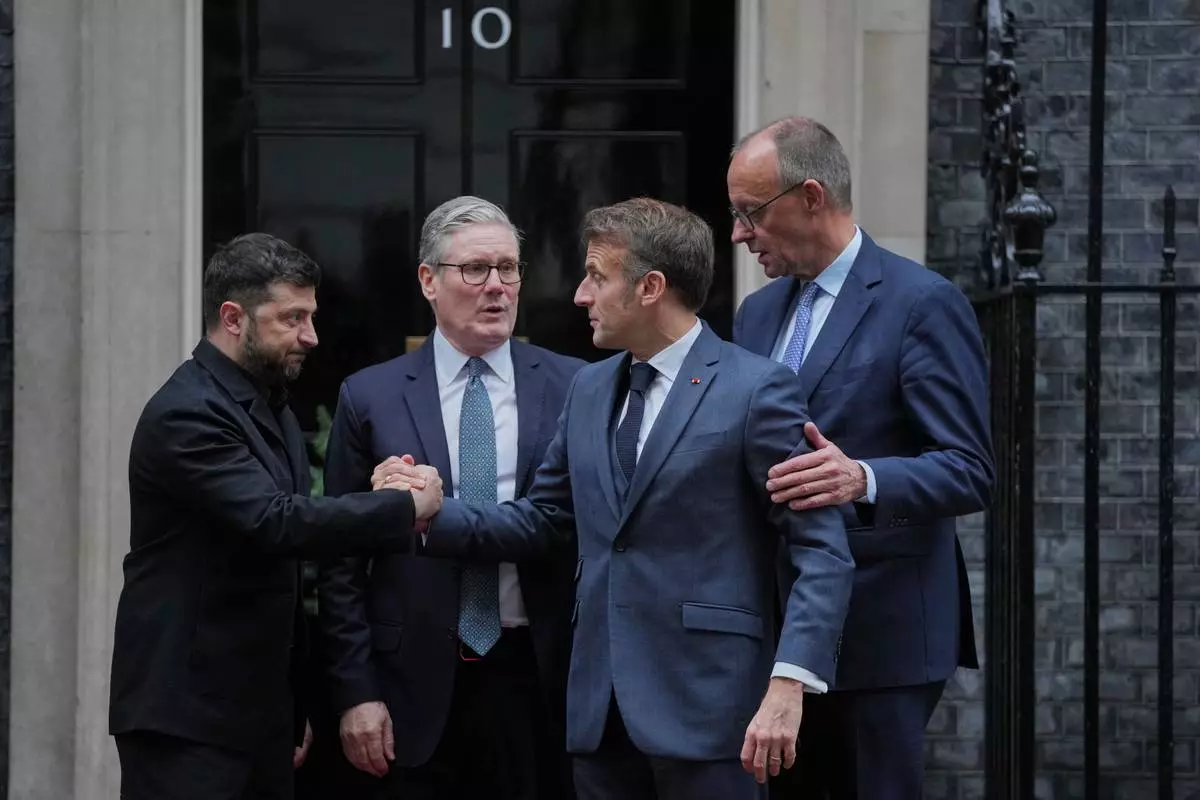
Ukrainian President Volodymyr Zelenskyy, left, with Britain's Prime Minister Keir Starmer, French President Emmanuel Macron, and German Chancellor Friedrich Merz pose on the doorstep of 10 Downing Street, London, Monday, Dec. 8, 2025, following a meeting of the leaders inside. (AP Photo/Kin Cheung)
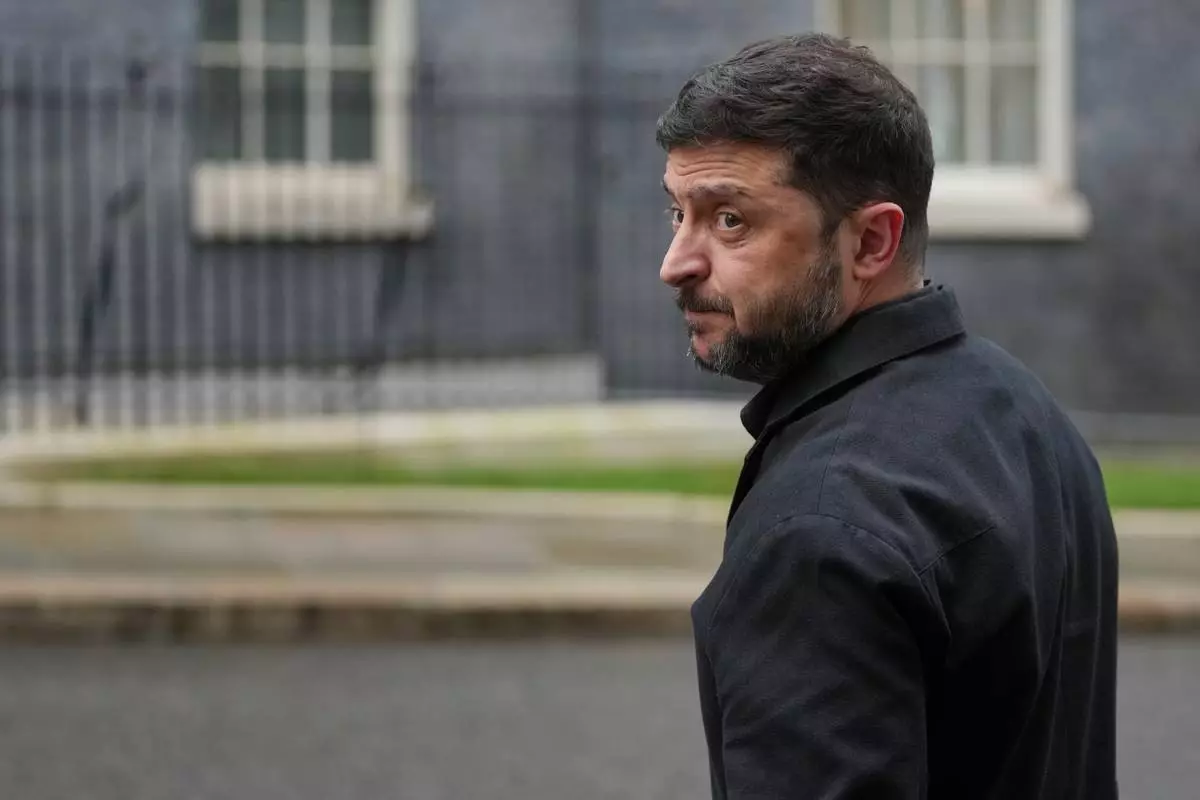
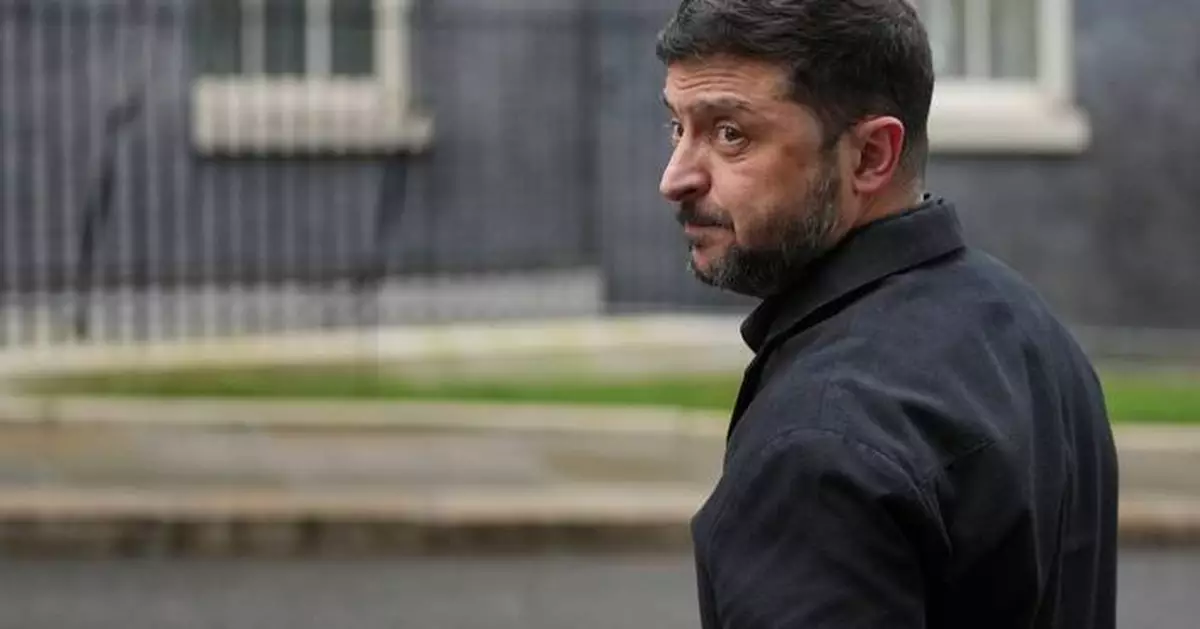
Ukrainian President Volodymyr Zelenskyy, looks back at the media as he walks to meet Britain's Prime Minister Keir Starmer in Downing Street, London, Monday, Dec. 8, 2025. (AP Photo/Kin Cheung)
DUBAI, United Arab Emirates (AP) — Iran responded to U.S. President Donald Trump’s address to Americans on the war with new missile attacks targeting Israel and the Gulf Arab states Thursday, underlining Tehran’s insistence that it rejected Washington’s outreach for a ceasefire while maintaining its grip on the Strait of Hormuz.
Britain planned to hold a call Thursday with nearly three dozen countries about how to reopen the strait, through which 20% of all oil and natural gas traded passes in peacetime. The 35 countries, including all G7 industrialized democracies except the U.S., as well as the United Arab Emirates and Bahrain, signed a declaration last month demanding Iran stop blocking the strait. The call will discuss “diplomatic and political measures” that could restore shipping once the fighting is over.
Washington has insisted that Iran allow ships to freely transit the strait, but Trump this week has said it is not up to the U.S. to force it, and in his address encouraged countries that receive oil through Hormuz to “build some delayed courage” and go “take it.”
In his address, Trump said the U.S. would hit Iran “extremely hard over the next two to three weeks,” while also insisting American “core strategic objectives are nearing completion.”
Iran's military said defiantly on Thursday that its armament facilities are hidden and will never be reached by Israeli or American attacks.
“The centers you think you have targeted are insignificant,” said Lt. Col. Ebrahim Zolfaghari, a spokesman for the Iranian military’s Khatam Al-Anbiya Central Headquarters.
Just before Trump began his nearly 20-minute address on Wednesday, explosions were heard in Dubai as air defenses worked to intercept an Iranian missile barrage. Less than a half hour after the president was done, Israel said its military was working to intercept incoming missiles.
Sirens sounded in Bahrain, home to the U.S. Navy's 5th Fleet, immediately after the speech.
Following a joint statement in March condemning Iranian attacks on unarmed commercial vessels that called upon Iran to “cease immediately its threats, laying of mines, drone and missile attacks and other attempts to block the strait,” the 35 signatories were to hold a virtual meeting Thursday hosted by British Foreign Secretary Yvette Cooper.
Though the oil and gas that typically transits the Strait of Hormuz primarily is sold to Asian nations, Japan and South Korea were the only two countries from the region that were joining.
“Trump’s message was that the United States can sustain its own economic and energy ecosystem, while countries dependent on regional exports will either have to buy from the United States or manage the Strait themselves,” the New York-based Soufan Center think tank wrote after the address.
“While Trump explicitly thanked U.S. allies in the Persian Gulf for their cooperation and allyship, an expedited U.S. withdrawal without securing the strait will leave many of these countries, whose economies are dependent on energy exports, in the lurch.”
No country appears willing to try and open the strait by force while the war is raging. British Prime Minister Keir Starmer said the group “will assess all viable diplomatic and political measures we can take to restore freedom of navigation, guarantee the safety of trapped ships and seafarers and to resume the movement of vital commodities.”
Bahrain, which now holds the presidency of the United Nations Security Council, has been working to get the world body to address the crisis as well.
Though Iran has allowed a trickle of ships through the strait, it remains largely closed. Iran has also been repeatedly attacking Gulf Arab energy infrastructure, sending oil prices skyrocketing and giving rise to broader economic problems worldwide.
Following Trump's speech, Brent crude, the international standard, rose again and was at $108 in early spot trading, up nearly 50% from Feb. 28 when Israel and the U.S. started the war with their attacks on Iran.
The rising energy prices and stock market jitters have been putting increasing domestic pressure on Trump, who used his address to offer a defense of the war while also suggesting it was close to winding down.
He acknowledged American service members who had been killed and said: “We are going to finish the job, and we’re going to finish it very fast. We’re getting very close.”
The U.S. has presented Iran with a 15-point plan for a ceasefire, but Trump didn’t say anything about the diplomatic efforts or bring up his April 6 deadline for Iran to reopen the Strait of Hormuz or face severe retaliation from the U.S.
More than 1,900 people have been killed in Iran during the war, while 19 have been reported dead in Israel. More than two dozen people have died in Gulf states and the occupied West Bank, while 13 U.S. service members have been killed.
More than 1,200 people have been killed in Lebanon and more than 1 million displaced, according to authorities. Ten Israeli soldiers have also died there.
Weissert reported from Washington and Rising reported from Bangkok.
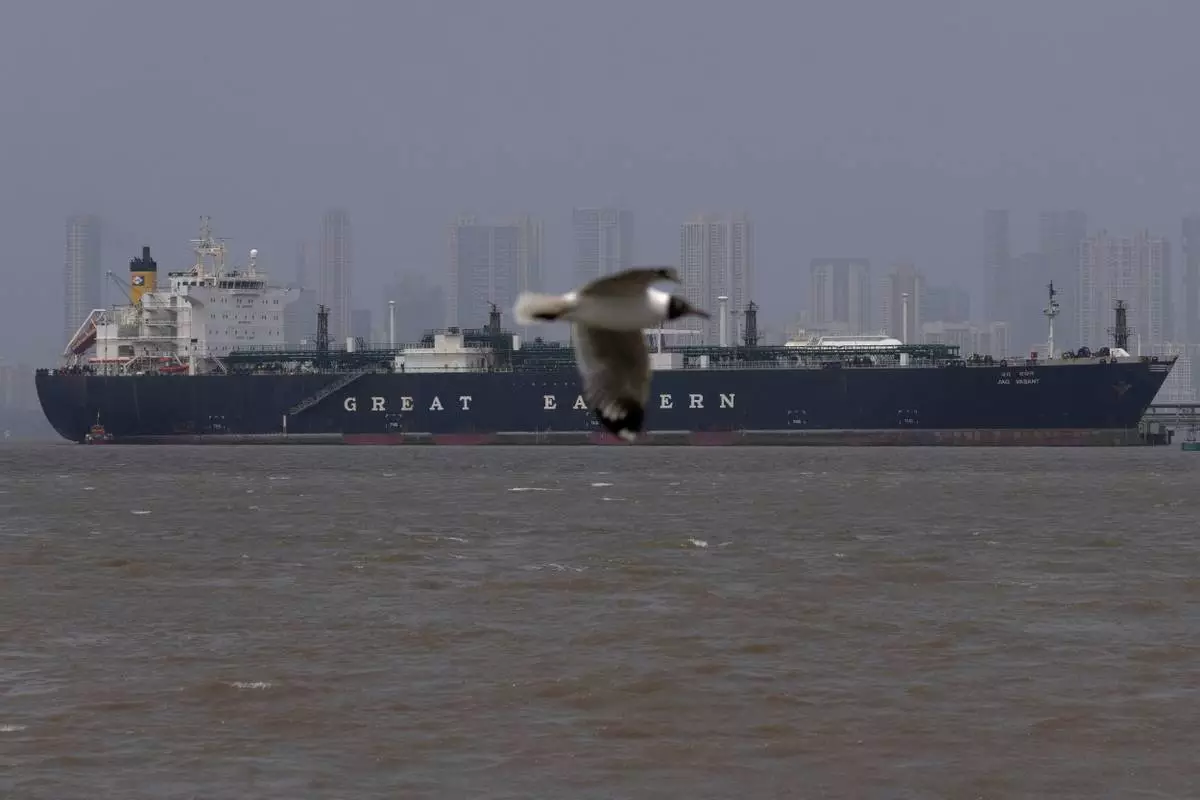
The Indian flagged LPG carrier Jag Vasant transporting liquefied petroleum gas, is seen at the Mumbai Port in Mumbai, India, after it arrived clearing the Strait of Hormuz, Wednesday, April 1, 2026. (AP Photo/Rafiq Maqbool)
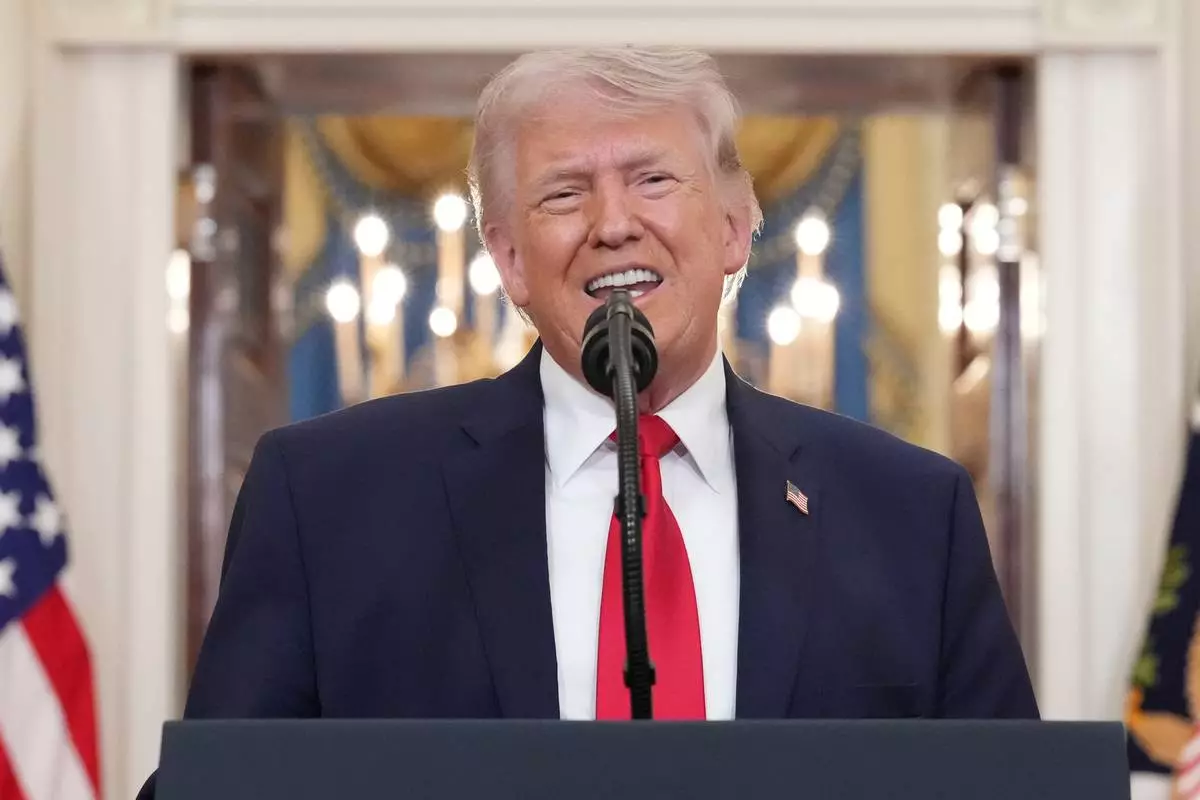
President Donald Trump speaks about the Iran war from the Cross Hall of the White House on Wednesday, April 1, 2026, in Washington. (AP Photo/Alex Brandon, Pool)
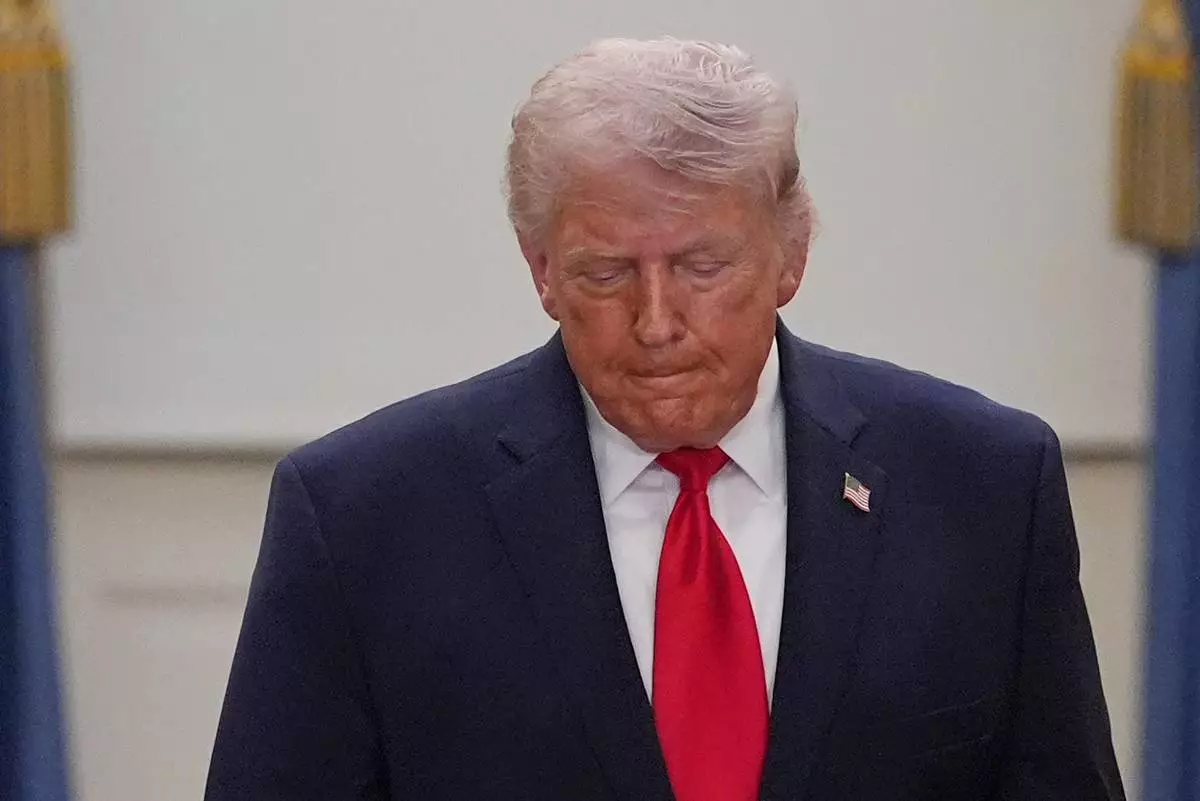
President Donald Trump walks from the Blue Room to speak about the Iran war from the Cross Hall of the White House on Wednesday, April 1, 2026, in Washington. (AP Photo/Alex Brandon, Pool)
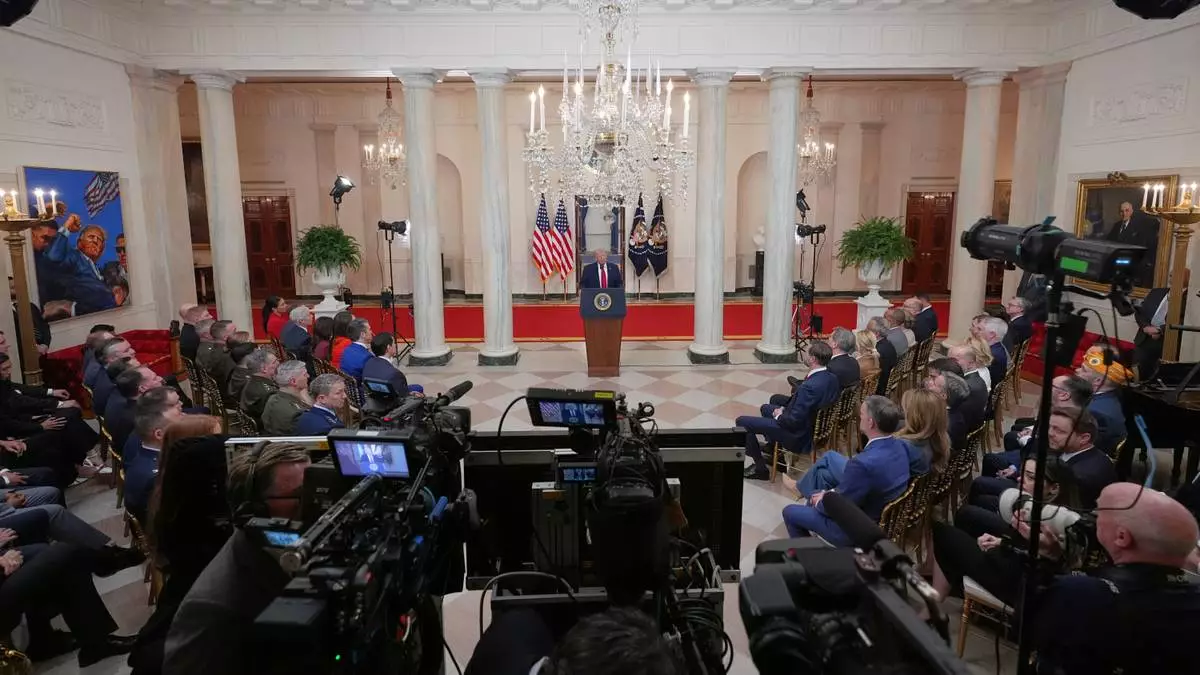
President Donald Trump speaks about the Iran war from the Cross Hall of the White House on Wednesday, April 1, 2026, in Washington. (AP Photo/Alex Brandon, Pool)
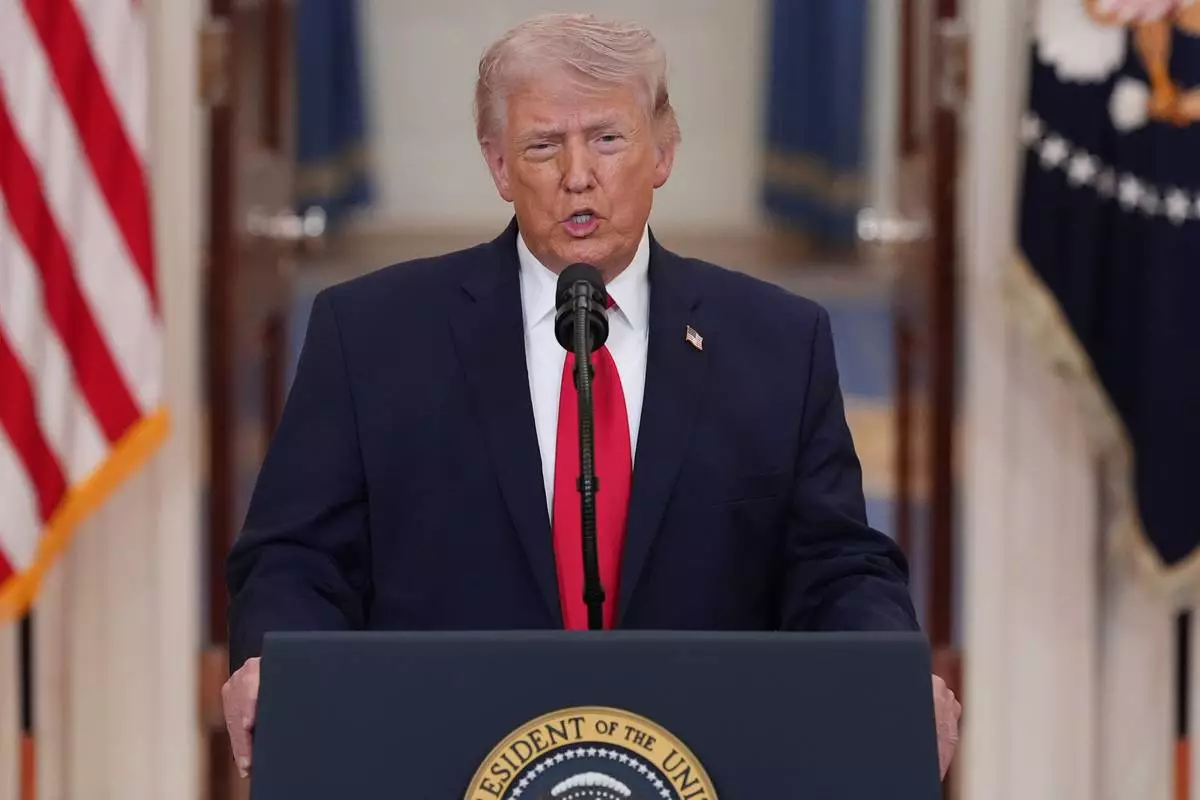
President Donald Trump speaks about the Iran war from the Cross Hall of the White House on Wednesday, April 1, 2026, in Washington. (AP Photo/Alex Brandon, Pool)