Skip to Content Facebook Feature Image

North Korea's ruling elite prepares for once-in-5-years party meeting

News

North Korea's ruling elite prepares for once-in-5-years party meeting
News

News

North Korea's ruling elite prepares for once-in-5-years party meeting

2025-12-10 13:29 Last Updated At:13:40

SEOUL, South Korea (AP) — North Korean leader Kim Jong Un and other top officials have gathered to discuss preparations for the ruling party's first full congress in five years, state media reported Wednesday. The top-level meeting will set new priorities as the U.S. and South Korea seek a resumption of talks with North Korea.

The Korean Central News Agency reported that Kim presided over a plenary meeting of the Workers Party's Central Committee on Tuesday. It said participants began discussing unspecified key issues related to the party congress and reviewing this year's state policies.

KCNA gave no further details, but observers say the plenary meeting will likely last a few days and set an official agenda for the party congress, which is expected to be held in January or February.

The congress, the top decision-making organ of the Workers’ Party, was revived by Kim in 2016 after a 36-year hiatus. Experts say Kim aimed to increase the party’s authority as part of efforts to solidify his grip on power.

The focus of outside attention on the congress is whether Kim will respond to U.S. and South Korean efforts to improve ties. North Korea has steadfastly rebuffed the U.S. and South Korea's calls to resume talks since Kim's high-stakes nuclear diplomacy with President Donald Trump collapsed in 2019, but some experts say Kim could return to talk with the U.S. next year.

In an apparent response to Trump's repeated outreach, Kim suggested in September that he could return to talks if the U.S. drops “its delusional obsession with denuclearization” of North Korea.

Meanwhile, South Korea's military said North Korea fired several artillery rounds off the North's west coast on Tuesday. Observers say the artillery launches were likely part of the North Korean military's wintertime training.

Last year, Kim declared that his country was abandoning its long-standing goal of peaceful unification with South Korea and ordered the rewriting of the North’s constitution to mark the South as a permanent enemy.
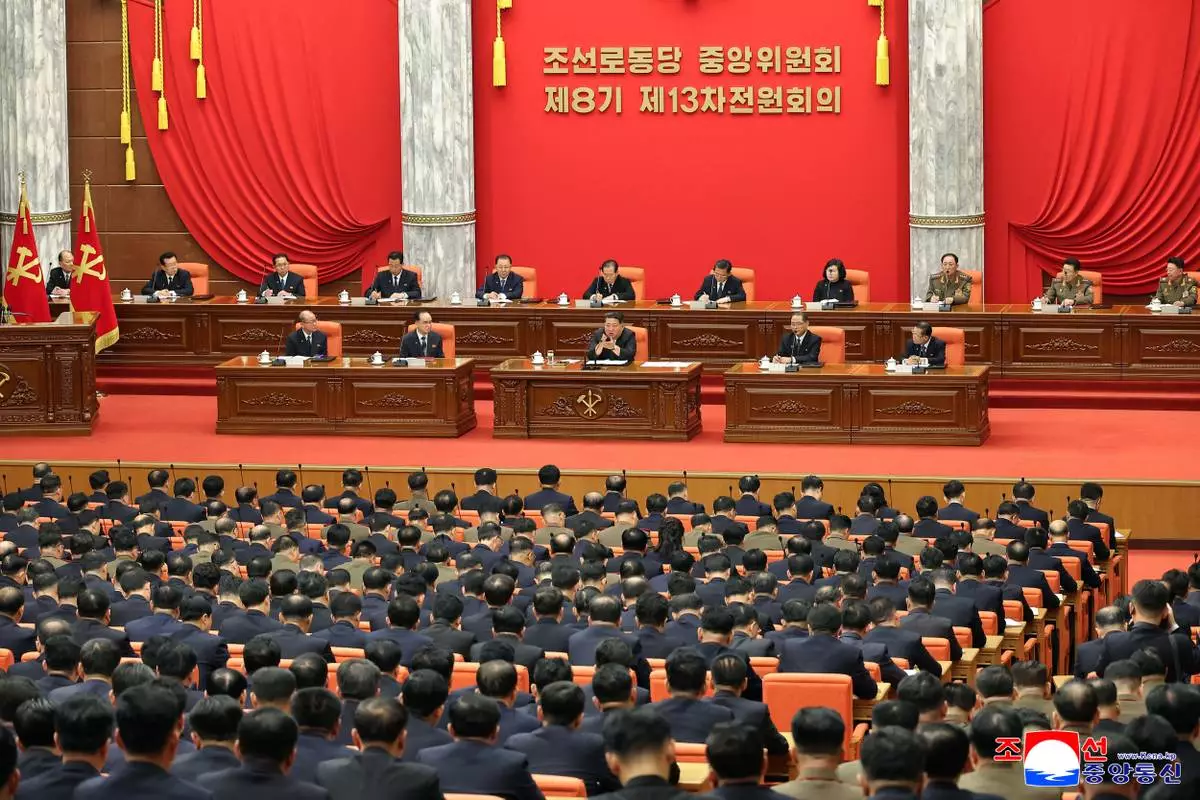
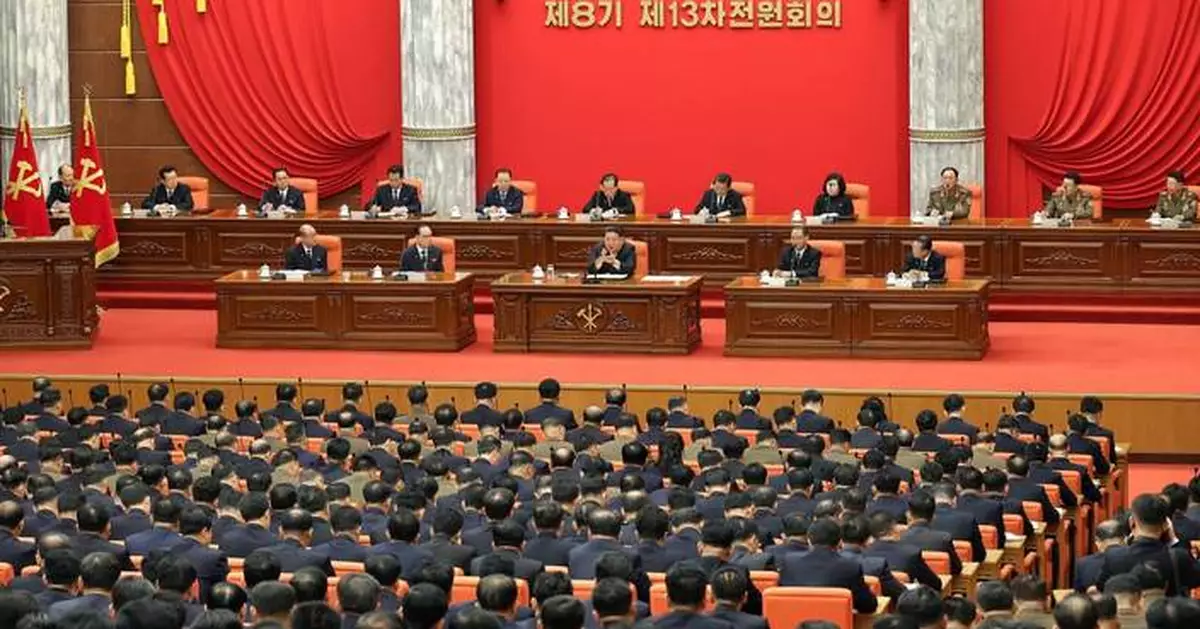
In this photo provided by the North Korean government, North Korean leader Kim Jong Un, center, attends a plenary meeting of the Workers Party's Central Committee in North Korea, Tuesday, Dec. 9, 2025. Independent journalists were not given access to cover the event depicted in this image distributed by the North Korean government. The content of this image is as provided and cannot be independently verified. Korean language watermark on image as provided by source reads: "KCNA" which is the abbreviation for Korean Central News Agency. (Korean Central News Agency/Korea News Service via AP)

In this photo provided by the North Korean government, North Korean leader Kim Jong Un, center, attends a plenary meeting of the Workers Party's Central Committee in North Korea, Tuesday, Dec. 9, 2025. Independent journalists were not given access to cover the event depicted in this image distributed by the North Korean government. The content of this image is as provided and cannot be independently verified. Korean language watermark on image as provided by source reads: "KCNA" which is the abbreviation for Korean Central News Agency. (Korean Central News Agency/Korea News Service via AP)

LATAKIA, Syria (AP) — The woman, a member of Syria 's Alawite religious minority, was walking home on a sunny July day in her town on the Mediterranean coast when three gunmen stopped her and pulled her into their van. It was the start of a week of torment.

They drove her to a town in northern Syria three hours away, where they locked her in a room in an abandoned building. Over the coming days she was raped twice, she told The Associated Press.

“You Alawite women were born to be our sabaya,” she said one of the rapists told her, using an Arabic term common among Sunni Muslim extremists for women taken in war as sex slaves. The woman, in her mid-30s, gave her account on condition of anonymity for fear of reprisals.

Since the fall of former Syrian President Bashar Assad a year ago, dozens of women from the Alawite religious sect — to which Assad belonged — have been subjected to kidnappings and sexual assault, according to rights groups. In many cases, the attacks appear to be by Sunni extremists and jihadis motivated by sectarian hate.

That has raised suspicions some are allies or former allies of Hayat Tahrir al-Sham, the Islamist insurgent force that overthrew Assad and was led by Ahmed al-Sharaa, now Syria’s interim president. Foreign jihadi fighters and Syrian extremists fought alongside HTS during Syria’s yearslong civil war.

Rights groups say the attacks on Alawite women appear to be the acts of individuals, not systematic. But rights workers and victims say Syria's new authorities are not doing enough to stop the attacks. In response to public outcry, the government set up a committee to look into reported kidnappings but said it largely found the reports false.

Agnes Callamard, secretary-general of Amnesty International, said the kidnappings “cannot be denied.”

The problem, she said, “cannot be pushed away because it’s disturbing or because it’s undermining the message and the image of authorities."

Syria's Interior Ministry spokesman did not respond to repeated questions on the assaults.

The AP interviewed two rape victims and one kidnapping victim, in addition to family members of four others subjected to assaults that in three cases included rape. All spoke on condition they remain anonymous, fearing reprisals. One said she feared authorities would not protect her and later asked the AP not to cite her account.

All women and relatives interviewed by the AP said they informed security forces about what happened to them and authorities took their testimonies. It was not clear if the authorities followed up further or if any arrests were made.

Amnesty International said earlier this year it had received credible reports of at least 36 Alawite women and girls abducted between February and July. The kidnappings took place in the heartland of the Alawite population, in coastal Latakia and Tartous provinces and neighboring Homs and Hama.

Although on a much smaller scale, the attacks recall dark memories of the Islamic State group’s enslavement of thousands of Yazidi women for rape a decade ago in Iraq. Some Sunni extremists consider Alawites heretics and believe it is religiously permitted to take their women as sex slaves. Others have targeted Alawites in revenge for atrocities against Sunnis during the 54-year rule of the Assad family, when there were widespread reports of sexual violence against women in detention centers.

The attacks against women have intensified since March, when clashes between Assad supporters and security forces spiraled into sectarian atrocities in which hundreds of civilians were killed, mostly Alawites at the hands of pro-government fighters.

The Interior Ministry committee investigated 42 cases of alleged kidnappings, but only found one to be a real abduction, ministry spokesman Nour al-Din al-Baba said in mid-November. The committee found that the rest were false claims or instances where a woman ran off with a romantic partner or fled domestic abuse, or cases of blackmail or prostitution, he said, without providing evidence.

The ministry report "has nothing to do with reality,” says Rami Abdurrahman, who heads the Britain-based Syrian Observatory for Human Rights, a war monitor.

The woman snatched in the van said her three abductors were Syrians wearing black uniforms, though she couldn’t see distinctive insignia on them. During the drive, they passed several checkpoints but were waved through without being stopped or searched, she said.

Dozens of armed men were in the building where she was held, she said. "I felt like it’s done, I will be dead. I did not expect to return at all,” she said.

On the third day, a masked man raped her. Later, a man the gunmen called Abu Mohammed came and ordered them to release her, saying her kidnapping was getting too much attention on social media. The next day, she was raped again by a masked man, though she could not tell if it was the same man.

After a week in captivity, the gunmen dropped her off in a village in Hama province. A woman found her and took her into her home, where she called a relative.

After returning home, she went to a gynecologist and discovered she was pregnant. She managed to get an abortion, although abortion is illegal in Syria.

Her husband at first accepted what happened to her, but within days he suddenly changed his mind and decided to divorce her and married another woman. “He was not a man up to the responsibility,” she said.

Now living with her young son, she said she wanted to leave Syria.

“I live in constant fear,” she said.

Another woman said two of her female relatives, one of them a teenager, were taken by foreign fighters from a street in March. According to the relative’s account, the two were held in the basement of a house several hours away. There, the teenager was raped by the same man for 10 days until he left. The other woman was raped by another person for about two months, after which they were set free.

Another victim, who was 19, said she was taken in early July by three masked foreign fighters – an Iraqi and two non-Arabs.

“You Alawites are filthy infidels,” one of the men told her. When she tried to argue and begged for her life, he hit her head against the windshield until she bled.

She was locked in a basement of the Iraqi's home. He threatened to kill her if she didn't let him touch her. When she started screaming, he left, fearing neighbors would hear, she said.

She said she tried to kill herself by breaking a glass and cutting her vein, but the cut was not deep enough.

The next day, the Iraqi told her that his “emir,” a term used by jihadis to refer to their leader, had decided to set her free “on the condition that you learn about Islam.” The next morning, he put her in the car with his wife and children. On the way, he told her not to tell people she had been kidnapped but to say she’d left home of her own will to learn about Islam. They stopped and he bought her sweets from a store, then dropped her off at a taxi station in Idlib city, she said.

Not long after returning home, a state investigator came to her family home and questioned her about what happened. She identified the Iraqi through security footage from the sweets shop. But it is not known if he was arrested, and officials did not comment when asked.

Fearing reprisals, the family fled Syria.

Associated Press writer Sarah El Deeb in Beirut and Ghaith Alsayed in Damascus, Syria contributed to this report.

FILE- Syrian security forces inspect vehicles at a checkpoint, following a recent wave of violence between Syrian security forces and gunmen loyal to former President Bashar Assad, as well as subsequent sectarian attacks, in Latakia, in Syria's coastal region, March 11, 2025. (AP Photo/Ghaith Alsayed, File)

FILE- Syrian security forces inspect vehicles at a checkpoint, following a recent wave of violence between Syrian security forces and gunmen loyal to former President Bashar Assad, as well as subsequent sectarian attacks, in Latakia, in Syria's coastal region, March 11, 2025. (AP Photo/Ghaith Alsayed, File)

FILE - Syrian Alawite families who fled the clashes in Syria carry their luggage as they cross a river marking the border between Syria and northern Lebanon near the village of Heker al-Daher in Akkar province, Lebanon, March 11, 2025. (AP Photo/Hussein Malla, File)

FILE - Syrian Alawite families who fled the clashes in Syria carry their luggage as they cross a river marking the border between Syria and northern Lebanon near the village of Heker al-Daher in Akkar province, Lebanon, March 11, 2025. (AP Photo/Hussein Malla, File)

FILE - Children on the top of an ousted Syrian government forces tank that was left on a street in an Alawite neighbourhood, in Homs, Syria, Dec. 26, 2024. (AP Photo/Leo Correa, File)

FILE - Children on the top of an ousted Syrian government forces tank that was left on a street in an Alawite neighbourhood, in Homs, Syria, Dec. 26, 2024. (AP Photo/Leo Correa, File)

FILE - Members of the Alawite minority gather outside the Russian air base in Hmeimim, near Latakia in Syria's coastal region, March 11, 2025, as they seek refuge there after recent violence and retaliatory killings in the area. (AP Photo/Omar Albam, File)

FILE - Members of the Alawite minority gather outside the Russian air base in Hmeimim, near Latakia in Syria's coastal region, March 11, 2025, as they seek refuge there after recent violence and retaliatory killings in the area. (AP Photo/Omar Albam, File)

Recommended Articles