Skip to Content Facebook Feature Image

Hamas says Israel must end violations before Gaza ceasefire moves to second phase

HotTV

HotTV

HotTV

Hamas says Israel must end violations before Gaza ceasefire moves to second phase

2025-12-10 12:33 Last Updated At:17:58

Hamas leader Hossam Badran said Tuesday that there will be no movement towards the second phase of the Gaza ceasefire agreement until Israel ends its continued violations.

The U.S.-sponsored ceasefire, in effect since October 10, halted the war that began on October 7, 2023, but remains fragile as Israel and Hamas accuse each other of breaching the agreement.

In a press statement, the Hamas political bureau member stressed that any discussion on progressing to the next phase of ceasefire must be preceded by clear international pressure on Israel to fully implement the commitments of the first phase.

Badran said that "various parties monitoring the Palestinian file" agree Israel has not fulfilled any of its obligations, noting that it continues to close the Rafah crossing in both directions, obstruct deliveries of tents and caravans for displaced families, sharply restrict humanitarian aid entering the Gaza Strip, and carry out killings in the enclave.

He also rejected remarks by Israeli army chief Eyal Zamir describing the "yellow line" demarcation as a "new borderline" inside Gaza, saying the comments expose Israel's "non-compliance with the ceasefire terms."

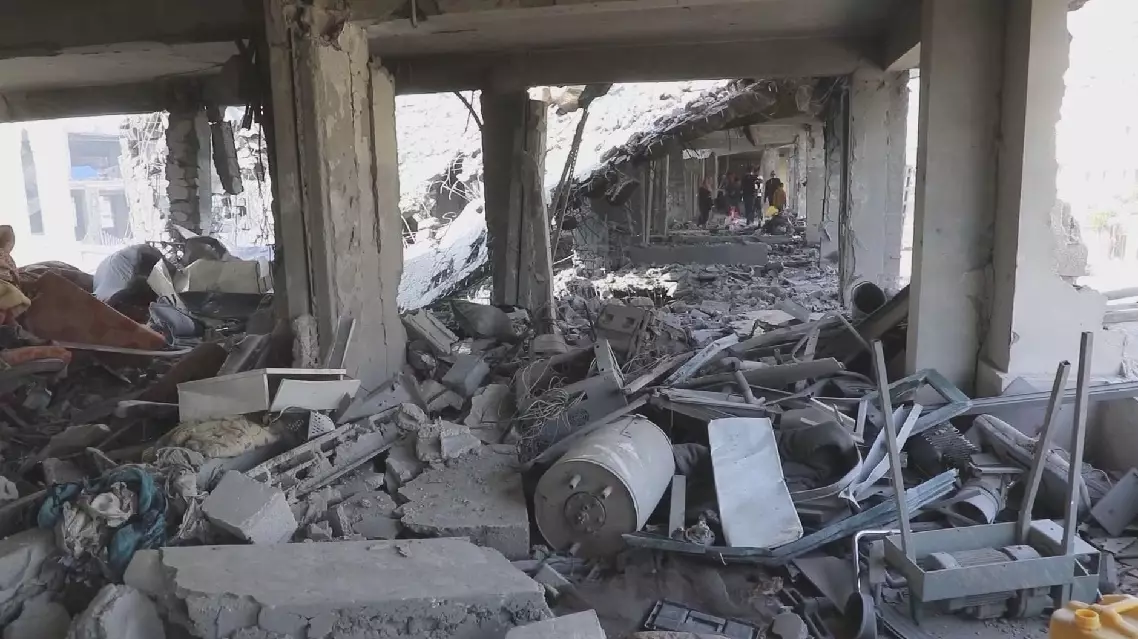
Badran added that the Israeli army's ongoing demolition of Palestinian homes within the "yellow line" amounts to a continuation of military operations that were supposed to halt on the first day of the agreement, saying such violations "remain ongoing without any real commitment."

On Sunday, Zamir claimed the "yellow line" serves as a "new borderline," functioning as a forward defensive line and an area of operational activity. The line marks the zone where Israeli troops have remained stationed in Gaza since the ceasefire took effect.
Hamas says Israel must end violations before Gaza ceasefire moves to second phase


Hamas says Israel must end violations before Gaza ceasefire moves to second phase
Displaced families in the Gaza Strip are turning to primitive building methods to create shelters with mud and rubble given the onset of the cold winter, as Israeli restrictions block the entry of construction materials.

Two years of brutal war have left vast areas of Gaza in ruins. With construction materials barred from entering, stalling reconstruction, families are left with little choice but to rebuild homes using only mud, water and any debris they can salvage.

Among them is former potter Jaafar Atallah, who is displaced from Gaza City's Al-Tuffah neighborhood where his home has been destroyed. He is now in Al-Zawaida in central Gaza, using his clay working skills to shape mud bricks to build a house for himself and his family.

"Our home was destroyed, and no one is rebuilding it or offering us any help. With the crossing closed to construction materials, we turned to mud to build a room of mud bricks instead of the tents that were flooded by rain and were at times, unbearably cold," said Jaafar.

Across central Gaza, scenes of families gathering stones from the ruins of their flattened homes and mixing them with mud to build small rooms that offer more protection from the rain and cold than their flimsy tents have been frequently seen.

"We are building this house by collecting stones from our destroyed houses and using mud pushed up by Israeli bulldozers because it's the cheapest option. Other materials, like zinc sheets or metal pipes, are too expensive. We had no choice but to build this way to protect our children," said Mahdi Al-Saafin, a displaced Palestinian from Al-Bureij Camp.

Palestinian officials have warned that thousands of displaced families across the strip are still living in worn-out tents that offer little protection from the winter cold.

"It's very tragic that citizens of Gaza are still living in tents. These are now old tents that haven't been replaced for a long time. And these tents are not good enough to save the young children, the women or the elderly, everybody from the heat of the sun or [the cold of] winter," said Yahya Al-Sarraj, mayor of Gaza City

According to estimates from the United Nations in April this year, 92 percent of Gaza's housing units have been damaged or destroyed with around 436,000 homes affected.

With ongoing Israeli restrictions on the entry of construction materials into Gaza, families have reverted to simpler methods of building with mud and rubble to create basic winter shelters, their only refuge amid the widespread destruction.

Gazans build shelters with mud, rubble to withstand winter cold

Gazans build shelters with mud, rubble to withstand winter cold

Recommended Articles