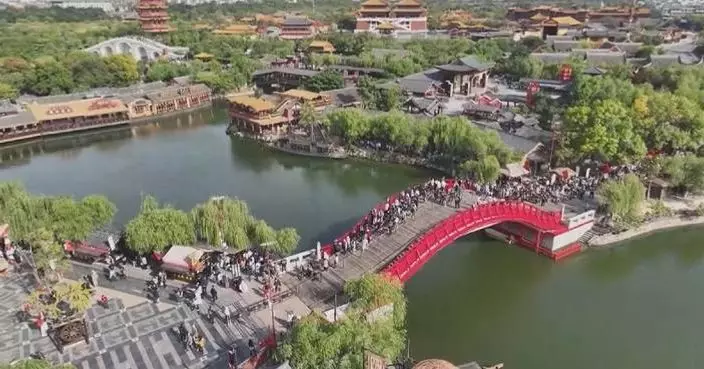
China's low-altitude economy continues to reach new heights as more cities across the country make full use of their related resources to reach a wider range of application scenarios, from traffic monitoring to tourism.
Referring to activities involving both manned and unmanned aircraft operating in airspace up to 3,000 meters above the ground, China has recognized the low-altitude economy as a key strategic emerging sector, as its development continues to gather pace.
In Shiyan City of central China's Hubei Province, staff at the city's data bureau are using drones to act as scouts patrolling the skies, keeping an eye on traffic at intersections and highways and being alert to respond to any situations which may unfold.
"It only takes five minutes for the drones to arrive at the scene and send back live footage, which has shortened the speed of our response and handling by an average of three to five times compared to the past," said Meng Yuxiao, a staff member at the city's Zhangwan District data bureau.
The city's self-developed fleet of drones known as "air traffic butlers" are playing a key role in monitoring the low-altitude airspace from 120 meters to 300 meters above the ground. Each airspace zone is split into its own section and assigned a unique identification code, with an "air traffic light" system being put in place to enable orderly navigation for low-altitude unmanned aircraft and drones.
"We've arranged 83 drone patrol routes. Over 100 patrolling tasks can be completed in one day," said Shi Jing, another staff member at the data bureau.
Different regions across China have been adopting different approaches in how they are utilizing the advantages afforded by the low-altitude economy.
The tech hub of Hangzhou in the eastern Zhejiang Province has emphasizes the integration of low-altitude tourism alongside the digital economy, introducing immersive cultural tourism products from an aerial perspective supported by a digital scheduling platform.
South China's Guangdong Province, meanwhile, is rapidly building multiple low-altitude application bases to establish a multifunctional support network for smart logistics, aerial mobility, and emergency response mechanisms.
Experts say these steps point to an exciting future as more places across the country explore how best to advance the sector in order to benefit their respective regions.
"The low-altitude economy represents the most vibrant frontier in China's efforts to open up application scenarios. Across provinces, municipalities, counties, and even scenic spots, systematic approaches to opening-up the low-altitude economy are being actively explored," said Cheng Chengqi, a professor at the aerospace engineering department under Peking University's college of engineering.
According to forecasts from China's civil aviation authority, the total scale of the country's low-altitude economy is expected to top 3.5 trillion yuan (almost 500 billion U.S. dollars) by 2035, highlighting its massive market potential.

China steps up utilization of low-altitude economy with wider application scenarios
South China's Guangdong Province is accelerating its transformation into an international medical tourism hub, positioning itself as a destination for patients worldwide seeking affordable, high-quality care.
The push follows a joint initiative announced in late March by nine Chinese government departments, including the Ministry of Commerce, aimed at boosting spending by foreign tourists and enhancing exports of tourism services as part of broader efforts to expand the country's service sector.
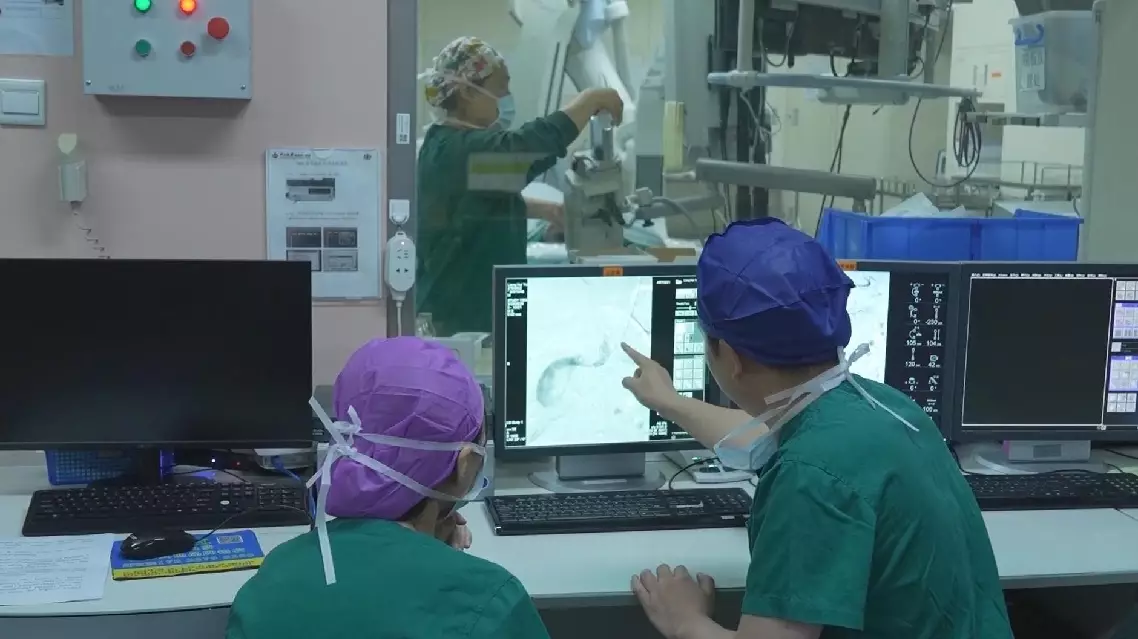
Every day, some of the most complex surgeries are performed here. Li Zilun, deputy director of the division of vascular surgery at the First Affiliated Hospital of Sun Yat‑sen University, is among the doctors capable of carrying out these intricate procedures.
He recently completed surgery on a patient with an aortic aneurysm, a condition often described as a "time bomb" in the body’s main artery, increasingly common in aging societies around the globe. Li also specializes in highly difficult and pioneering procedures, including repairing leaks caused by failed grafts.
"This was a very challenging case. And then, we implanted the covered stent to eliminate the endoleak. Actually, the outcome was pretty good. The patient will be discharged today," said Li Zilun.
The ability to handle such complex cases -- combining international techniques with domestically produced devices -- is drawing patients from around the world to seek treatment. In addition, high safety standards and low costs are also major draws.
"Our government is encouraging innovation. So, lots of physicians -- including our vascular surgeons -- we are actively involved in the innovation that helps to increase the effectiveness and safety, and also bring down the cost," said Li.
This hospital is one of the first in Guangdong to be designated by the provincial health commission as a pilot site for building an international medical service hub.
The growing number of patients has pushed the hospital to explore new ways to transform every step -- from treatment to payment and everything in between -- into a seamless experience, reducing waiting times and delivering better care for patients.
"I think it's fast. When the patient come here for just about, I think, one week, you can solve the problem," said Xiao Haipeng, president of the First Affiliated Hospital of Sun Yat-sen University.
The hospital is also deepening its international cooperation with top-tier medical institutions, including those at Harvard University.
"Not just for China, for the whole globe, we are facing health care challenges -- emerging infectious disease and chronic, lung infectious diseases, and also the aging population, also the shortage of healthcare workforce," said Xiao.
In response to these challenges, China is promoting its own solutions, including aggressive innovation in artificial intelligence (AI)-driven workflows, while stepping up research and development investment and global engagement along the way.
"In recent years, the innovation in Western medicine is dramatically growing. An example of my hospital -- in the past few years, we have 140 innovations and seven of them are international leading innovations," said Xiao.
As global demand for medical tourism grows, China is positioning itself as a new destination. Official data shows that the number of foreign patients in Guangdong increased by 20 percent last year. Among them, the growth in inpatient admissions was even faster, rising by 76 percent.
Guangdong fast-tracks pilot for int'l medical service hub