The annual Central Economic Work Conference was held in Beijing from Wednesday to Thursday as Chinese leaders decided priorities for the economic work in 2026.
Xi Jinping, general secretary of the Communist Party of China (CPC) Central Committee, Chinese president and chairman of the Central Military Commission, delivered an important speech at the conference.
In his speech, Xi reviewed the country's economic work in 2025, analyzed the current economic situation and arranged next year's economic work.
The meeting noted that 2025 is a truly extraordinary year, and the main targets for economic and social development will be successfully achieved.
China's economy has forged ahead against pressure, and achieved new and higher-quality growth, with sustained efforts made to build the modern industrial system, and new strides in reform and opening-up, the meeting said.
Positive progress has been made in resolving risks in key areas, and people's well-being has been better secured, the meeting noted.
As the 14th Five-Year Plan (2021-2025) is set to approach a successful conclusion, the meeting noted that over the past five years, China has effectively navigated various shocks and challenges, and achieved new major accomplishments in the cause of the Party and the country.
It is necessary to fully tap the economic potential, continue to pursue both policy support and reform and innovation, ensure both market vitality and effective regulation, combine investment in physical assets with investment in human capital, and respond to external challenges by strengthening internal capabilities, the meeting said.
Noting that there are still long-standing and new challenges in China's economic development, and the impact of changes in the external environment has deepened while risks and hidden dangers persist in some key areas, the meeting said that these issues can be resolved through efforts, and the underlying conditions and fundamental trends sustaining China's long-term economic growth remain unchanged. To do a good job in economic work next year, the conference stressed the need to fully and faithfully apply the new development philosophy, move faster to forge a new development paradigm and focus on promoting high-quality development.
China will adhere to the general principle of pursuing progress while ensuring stability, better coordinate domestic economic work with struggles in the international economic and trade arena, and ensure both development and security.
The country will implement more proactive and impactful macroeconomic policies, formulate more far-sighted, more targeted and better-coordinated policies, continuously expand domestic demand and optimize supply, and develop new quality productive forces according to local conditions.
Efforts will be made to develop a unified national market and continuously prevent and defuse risks in key areas.
It is imperative to secure the steady development of employment, businesses, markets and expectations, getting the 15th Five-Year Plan (2026-2030) off to a good start.
As for policy orientation for next year, the conference stressed the need to intensify counter- and cross-cyclical adjustments, and make macroeconomic governance more effective.
China will continue to implement a more proactive fiscal policy and maintain necessary fiscal deficits, overall debt levels and expenditure scale, while standardizing tax incentives and fiscal subsidy policies.
Greater attention should be given to addressing local fiscal difficulties, and Party and government bodies will continue to keep their belts tightened.
China will continue implementing a moderately loose monetary policy, and employ various monetary policy tools such as reserve requirement ratios and interest rates in a flexible and efficient manner to maintain ample liquidity.
China will guide financial institutions to scale up support for domestic demand expansion, sci-tech innovation, micro, small and medium enterprises, and other key areas.
The RMB exchange rate will be kept generally stable at an adaptive, balanced level, the meeting said, adding that China will make macro policy orientations more consistent and effective, and refine expectations management mechanisms to bolster social confidence.
Li Qiang, Zhao Leji, Wang Huning, Cai Qi, Ding Xuexiang and Li Xi, members of the Standing Committee of the Political Bureau of the CPC Central Committee, attended the conference.
Premier Li Qiang made a concluding speech, putting forward requirements for doing a good job in the economic work next year.
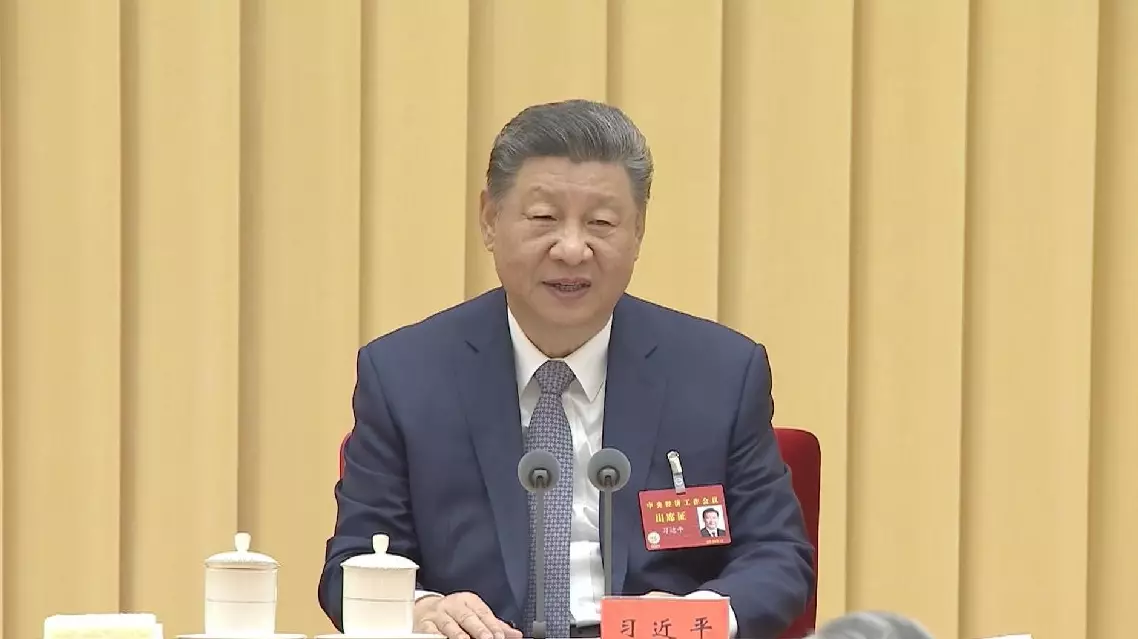
China holds Central Economic Work Conference to plan for 2026