SALT LAKE CITY--(BUSINESS WIRE)--Dec 11, 2025--
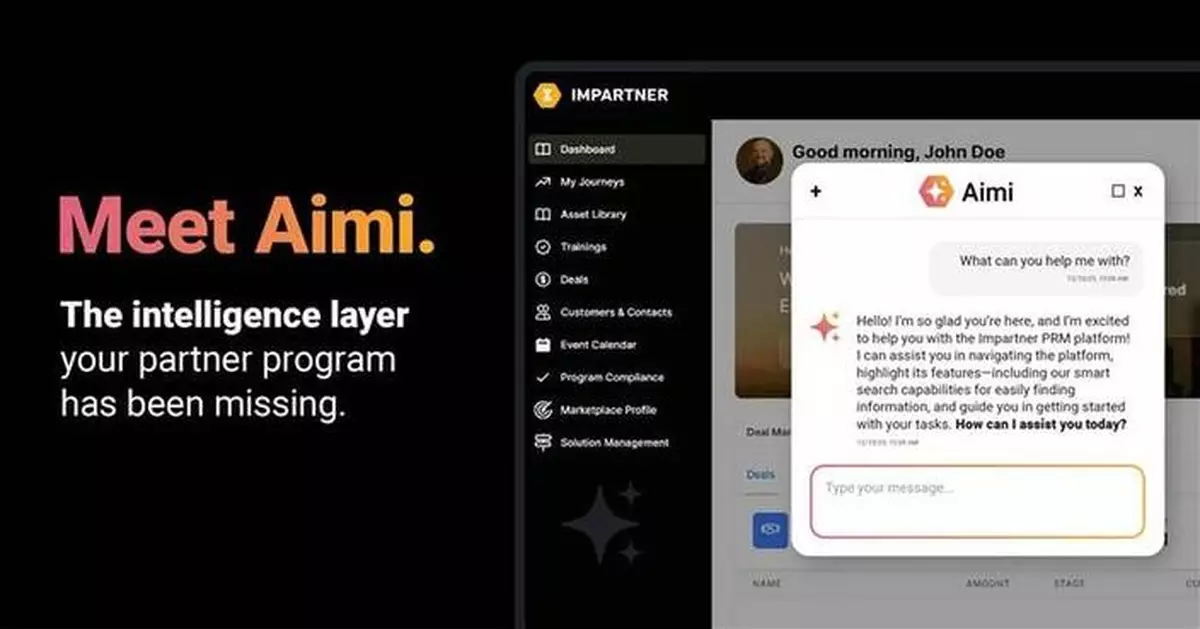
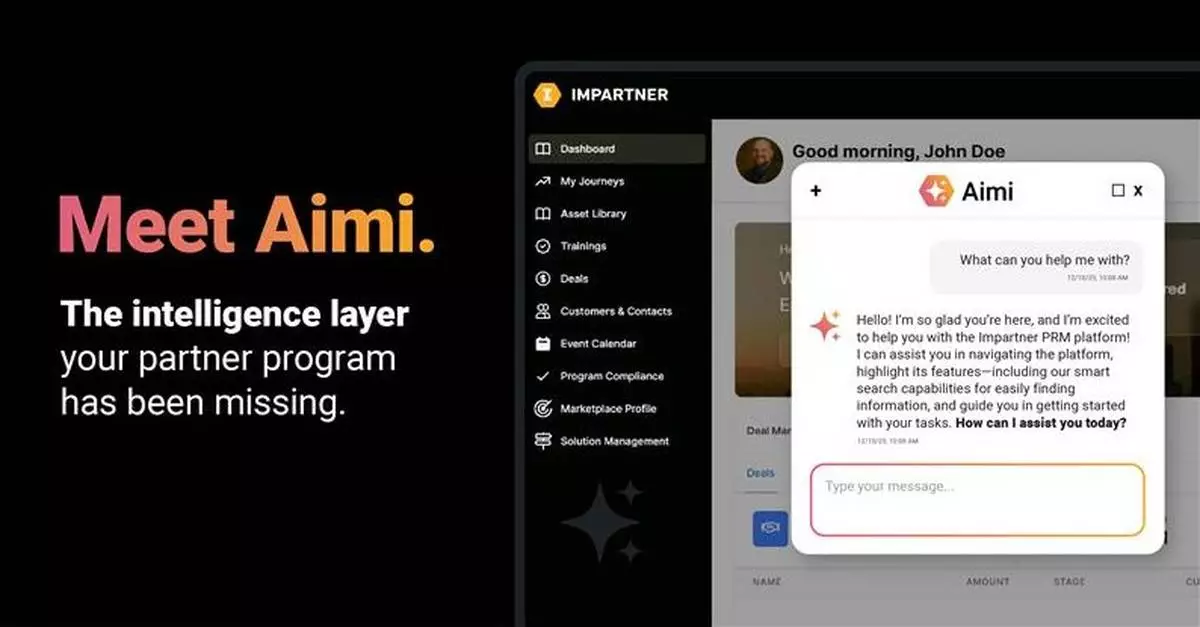
Impartner, the global leader in partner management and partner marketing automation, today announced the release of Aimi (Artificial Impartner Intelligence), a new AI engine embedded in the Impartner platform, designed to improve partner productivity and strengthen the operational foundation supporting enterprise partner revenue motions.
This press release features multimedia. View the full release here: https://www.businesswire.com/news/home/20251211496082/en/
Aimi addresses the most requested automations from market leaders, delivering three core capabilities: intelligent content creation and translation, natural-language record creation using text or voice, and instant access to knowledge and assets through a virtual assistant connected to the asset library. These capabilities allow users to complete tasks faster, reduce friction, and make partner engagement more intuitive and responsive, revealing business insights long present in their channel data that were previously inaccessible without AI intelligence.
Built to serve the needs of large and complex partner programs, Aimi reflects Impartner’s deliberate approach to AI development. Instead of adding generic chat features, Impartner focused on precise integration points that meaningfully improve program efficiency, data quality and user experience. Aimi recognizes required fields in customized deal registration flows, prompts users conversationally for missing details, filters noise in voice inputs, and adapts to each user’s configuration to ensure accuracy in record creation and administrative processes. This AI-first, automation-driven approach also supports a low-touch, high-efficiency revenue model, enabling partners to generate results with minimal manual effort, while Voice-to-Action is designed to fully meet the needs of an increasingly mobile, device-driven workforce, setting a new standard for partner engagement.
As part of Impartner’s broader AI strategy, Aimi is supported by AI-enabled capabilities trained specifically on Impartner solutions. Together these innovations demonstrate Impartner’s commitment to embedding intelligence across its platform and services, giving customers faster answers, more intuitive workflows, and a smarter, more efficient partner experience. This approach strengthens operations, improves program performance, and increases the value organizations can generate from their channel investments.
Aimi’s release demonstrates Impartner’s commitment to making AI capabilities a cornerstone of customer value, elevating both the partner and customer experience by providing in-app insights and supporting customer enablement in governance and change management.
“Our goal is to make partner and administrator workflows significantly simpler,” said Impartner’s VP of Product Management, Robert Harris. “With Aimi, someone can say ‘Create a deal for Acme Corp’ and the system will naturally gather the missing details, validate the required fields for that customer and complete the submission. We didn’t want an AI tool that only works in perfect conditions. We built it to adapt to real workflows and environments.”
The newest solution in Impartner’s suite, Aimi builds on the momentum of recent releases including HyperscalerGTM and PMaaS to strengthen the foundation for partner revenue orchestration. It deepens engagement across the transaction flow, aligns the lead-to-deal experience, and brings consistency to the motions that connect partner enablement, opportunity management, and co-selling. By unifying these workflows, Aimi helps teams manage and track partner-driven revenue with greater precision.
To learn more or schedule a demo, visit: https://impartner.com/aimi-impartner-ai/
About Impartner
Impartner is the global leader in partner ecosystem management solutions, helping companies transform how they engage, enable, and grow their partner networks. With purpose-built technologies for partner relationship management (PRM) and partner marketing automation (PMA), Impartner empowers organizations to streamline operations, drive demand, and accelerate revenue by delivering measurable ROI from channel programs. Millions of partners across the globe rely on Impartner daily, making it the most adopted PRM platform in the world. From onboarding and guided journeys to performance insights and business planning, Impartner delivers automation and best practices that scale. Learn more at impartner.com.
Impartner Unveils Aimi, the Enterprise AI Engine Designed to Elevate Partner Revenue
SAN FRANCISCO--(BUSINESS WIRE)--Oct 20, 2026--
As families prepare to pass wealth to the next generation, new research from Wells Fargo Wealth & Investment Management finds that the greatest hurdles are often not financial but personal, centered on the conversations, expectations, and planning decisions that accompany wealth transfer.
This press release features multimedia. View the full release here: https://www.businesswire.com/news/home/20261020922136/en/
The 2026 Wealth Transfer Study surveyed more than 800 Baby Boomer parents and nearly 800 adult children (Gen X and Millennials) from families with at least $1 million in investable assets.
Notably, the study finds meaningful disconnects between parents and their adult children when it comes to inheritance, family communication, estate planning, and financial preparedness. Across several measures, adult children express greater concern and less certainty about the transfer of family wealth.
"When we think about wealth transfer, it's easy to focus on the numbers," said Heather Hunt-Ruddy, Central Divisional leader at Wells Fargo Advisors. “But underneath most wealth-transfer conversations are really questions about whether a family will get along, what family members think they will inherit, and whether everyone is ready to receive that inheritance.”
Families Value Inheritance Conversations. Most Still Aren't Having Them
Although parents and adult children overwhelmingly agree that discussions about inheritance and wealth transfer are important, many families have yet to move beyond basic conversations.
More than eight in 10 adult children (82%) say inheritance discussions would help them better prepare for the future, while 80% of parents believe conversations about money help younger generations make better financial decisions.
Yet many adult children say they still lack visibility into their families' plans. More than half (57%) wish there were greater transparency around money in their families, and 42% say finances remain a topic that is often avoided.
More than three-quarters of parents say they are comfortable discussing key elements of their wealth-transfer plans, but only 21% report having detailed conversations about their estate plans with their children. Nearly one-third (29%) have had little to no meaningful discussions at all.
The 'Elephant' in the Estate Plan
The study points to a central reason inheritance conversations stall; both generations worry that raising the subject could send the wrong message.
Adult children are often reluctant to initiate the discussion. A majority (61%) worry that discussing money could make them seem like they want their parent’s wealth, while 53% say they would feel uncomfortable asking about it directly.
Parents face a different set of concerns. Nearly one-third (32%) are unsure how much to disclose, while others worry about demotivating their kids (25%), fostering entitlement (22%), or sharing plans that may change (20%).
"Families find themselves in a stalemate," Hunt-Ruddy said. "The next generation doesn't want to appear greedy. Parents don't want to send the wrong message. The result is that important conversations get postponed indefinitely."
Estate Plans Are in Place, but Critical Information Gaps Remain
Many parents report having taken steps to document their intentions, but the research suggests those plans are not always fully shared or understood.
Nearly all parents (93%) say they know how much wealth they expect to pass on, and 79% have specified that amount in a written financial plan. Yet only 54% of adult children say their parents have told them how much they are likely to inherit.
The information gap extends to the estate plan itself. While 81% of parents report having all necessary estate-planning documents in place, only 66% of adult children believe their parents have completed those documents. Even among parents with all documents in place, 44% of them say they do not fully understand what their estate plan does.
Adult children lack clarity about the responsibilities they may eventually be asked to assume. More than one in five do not know whether they have been named as an executor or trustee (22%) or been given power of attorney for healthcare or financial matters (22%).
"The challenge facing many families isn't a lack of planning," said Lorne Maltenfort, national director, Private Wealth Planning at Wealth & Investment Management. "It's a lack of shared understanding and alignment. Documents alone don't create preparedness. Successful wealth transfer also requires context, communication, and clarity around roles and responsibilities."
Family Businesses Reveal the Same Challenge at a Larger Scale*
One of the clearest examples of misaligned expectations emerged among family business owners, revealing a significant gap between owners’ intentions and their heirs’ expectations.
While two-thirds (67%) of business owners’ adult children expect the family business will eventually be passed to them or their siblings, fewer than one in five (19%) business owners expect to transfer ownership to their children. Instead, many owners anticipate selling to an outside buyer (24%) or gradually winding down the business (36%).
That difference represents a 48-percentage-point gap between generations.
"The family business findings are a powerful reminder that assumptions can take root when conversations don't happen," Maltenfort said. "Many children assume they're preparing to inherit a business. Many parents have entirely different plans. Neither perspective is necessarily wrong, but surprise is not a good succession strategy."
The Empty Seat at the Table
The study suggests many families are actively looking for guidance, particularly adult children who remain largely excluded from conversations with their parents’ financial advisors.
More than eight in 10 adult children (84%) say speaking with their parents' financial advisor would help them feel more prepared for the future. Notably, 83% say they would feel more confident if their parents' advisor continued working with them after their parents are gone — suggesting many adult children value continuity with an advisor who already understands their family's financial history and goals.
Yet only about one-third of parents (34%) say their advisor has met with their adult children, and just 14% say those meetings happen regularly.
"The next generation doesn't just want information. They want involvement," Hunt-Ruddy said. "Families can benefit when advisors help create opportunities for meaningful conversations before wealth changes hands."
Legacy Means More Than Money
Despite differing perspectives on communication, preparedness, and inheritance, parents and adult children agree on one important point: wealth means more than dollars and cents.
More than eight in 10 parents (86%) and adult children (84%) say the most important thing passed from one generation to the next is values, not money.
Both generations place high importance on trust, family security, communication, and creating opportunities for future generations.
"Financial assets are only one part of the legacy families leave behind," Maltenfort said. "Relationships, purpose, values, and opportunity are equally as important—and preserving them requires families to be clear about what they want their wealth to accomplish.”
Learn more
For families ready to start the conversation, the Great Wealth Transfer Toolkit walks you through important considerations to help define goals, facilitate family discussions, and create a plan that reflects both financial priorities and family values.
About the Wells Fargo Wealth & Investment 2026 Wealth Transfer Study
The Wells Fargo Wealth & Investment Management 2026 Wealth Transfer Study was conducted by Versta Research on behalf of Wells Fargo. The study included online surveys of 817 Baby Boomer parents ages 61 to 79 with at least $1 million in investable assets who expect to transfer wealth to their children, and 787 adult children ages 29 to 60 whose parents have at least $1 million in investable assets. The parent sample included an oversample of households with more than $3 million in investable assets, including households with more than $10 million. Survey responses were weighted by asset level using Federal Reserve Survey of Consumer Finances data to reflect the broader population of affluent U.S. households. Interviews were conducted online between May 11 and June 10, 2026. Findings are intended to provide insight into how affluent families are approaching wealth transfer, inheritance, estate planning, financial preparedness, and legacy planning.
*The survey of parents included 65 who are business owners and the survey of adult children included 181 whose parents are business owners.
About Wealth & Investment Management
Wealth & Investment Management (WIM) offers financial products and services through bank and brokerage affiliates of Wells Fargo & Company and is one of the largest wealth managers in the U.S., with $2.5 trillion in client assets. WIM provides personalized wealth management, brokerage, wealth planning, lending, private banking, trust, and fiduciary products and services to affluent, high-net worth, and ultra-high-net worth clients. WIM operates through advisors in Wells Fargo Advisors, independent brokerage offices, and digitally through Intuitive Investor® and WellsTrade®. Private Wealth is an exclusive and personalized service and product offering for qualifying clients of Wealth & Investment Management (WIM).
Bank products and services are available through Wells Fargo Bank, N.A. Wells Fargo Bank, N.A., is a bank affiliate of Wells Fargo & Company.
Investment products and services are offered through Wells Fargo Advisors. Wells Fargo Advisors is a trade name used by Wells Fargo Clearing Services, LLC, and Wells Fargo Advisors Financial Network, LLC, Members SIPC, separate registered broker-dealers and non-bank affiliates of Wells Fargo & Company. WellsTrade® and Intuitive Investor®accounts are offered through Wells Fargo Clearing Services LLC.
About Wells Fargo Advisors
Wells Fargo Advisors provides advice and guidance to help clients maximize all aspects of their financial lives. Our vast network of financial advisors, one of the nation’s largest, serves investors through locations in all 50 states and the District of Columbia. Wells Fargo Advisors is a part of Wealth & Investment Management (WIM), one of the largest wealth managers in the U.S. WIM offers financial products and services through bank and brokerage affiliates of Wells Fargo & Company. Investment products and services are offered through Wells Fargo Advisors. Wells Fargo Advisors is a trade name used by Wells Fargo Clearing Services, LLC, and Wells Fargo Advisors Financial Network, LLC, Members SIPC, separate registered broker-dealers and non-bank affiliates of Wells Fargo & Company.
www.wellsfargoadvisors.com
About Wells Fargo
Wells Fargo & Company (NYSE: WFC) is a leading financial services company that has approximately $2.3 trillion in assets. We provide a diversified set of banking, investment and mortgage products and services, as well as consumer and commercial finance, through our four reportable operating segments: Consumer Banking and Lending, Commercial Banking, Corporate and Investment Banking, and Wealth & Investment Management. Wells Fargo ranked No. 38 on Fortune’s 2026 rankings of America’s largest corporations. News, insights, and perspectives from Wells Fargo are also available at Wells Fargo Stories.
Additional information may be found at www.wellsfargo.com
LinkedIn: https://www.linkedin.com/company/wellsfargo
PM-04062028-5994686
News Release Category: WF-ERS

Wells Fargo red sign displayed on a city building exterior