MIAMI (AP) — The oil tanker was navigating near the coast of Guyana recently when its location transponder showed it starting to zigzag. It was a seemingly improbable maneuver and the latest digital clue that the ship, the Skipper, was trying to obscure its whereabouts and the valuable cargo stored inside its hull: tens of millions of dollars’ worth of illicit crude oil.
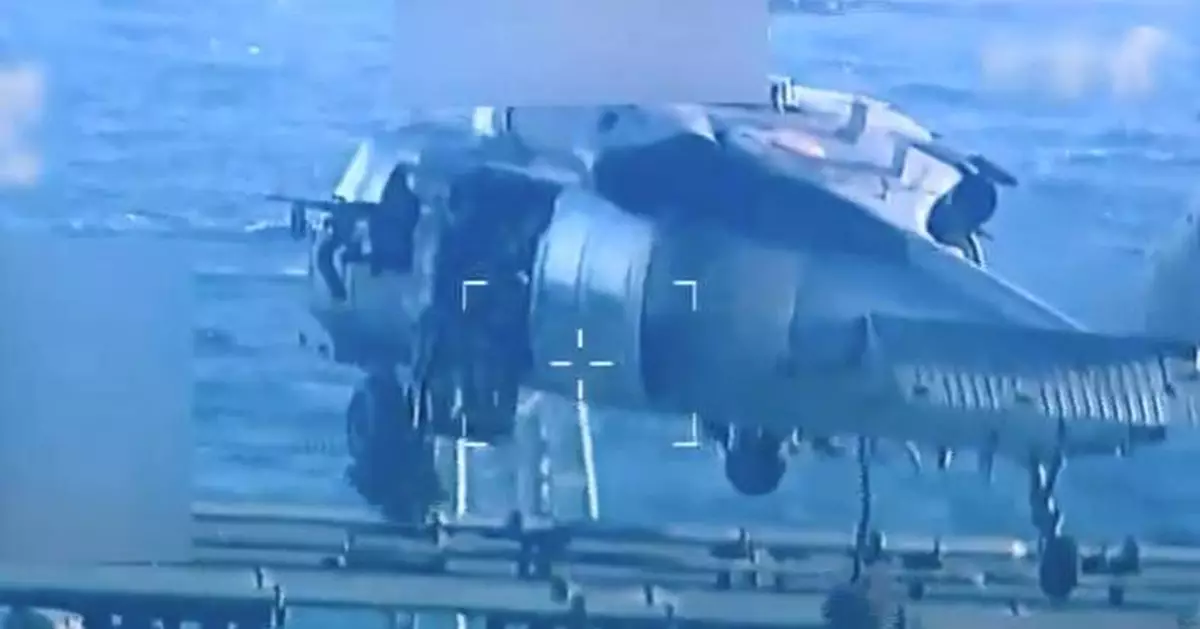
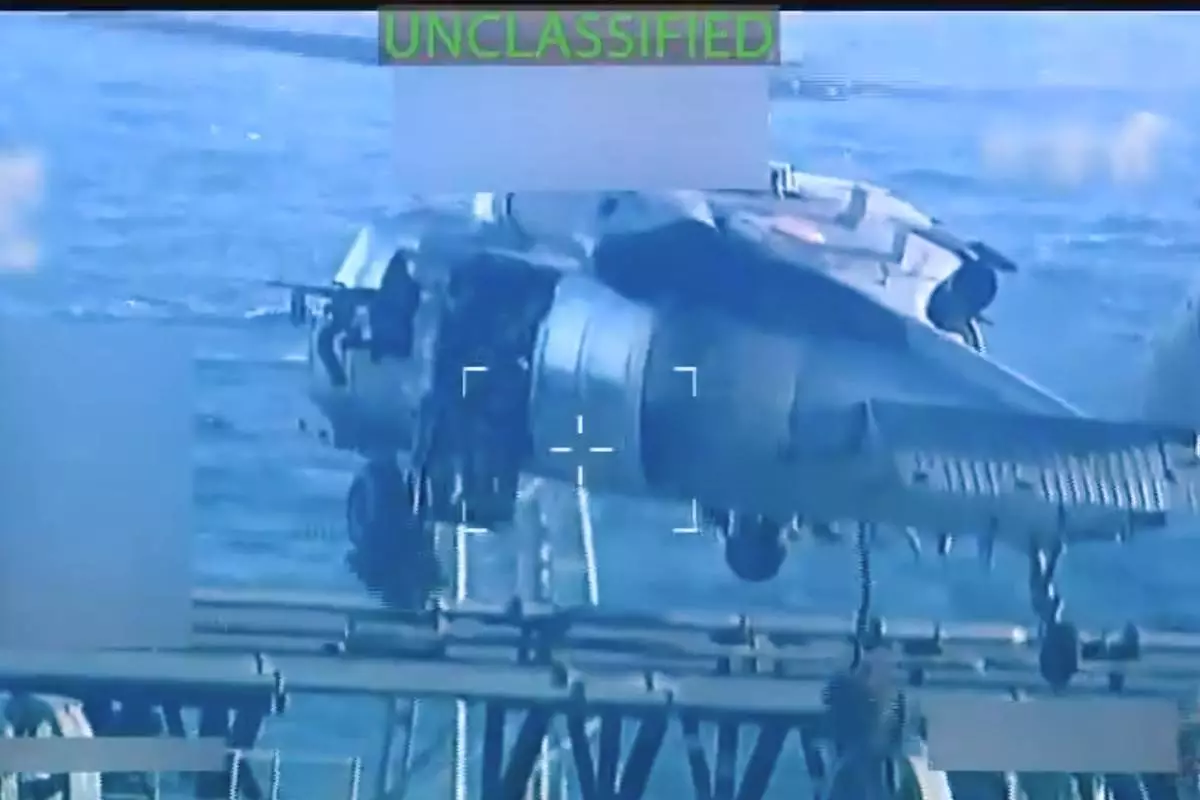
On Wednesday, U.S. commandos fast-roping from helicopters seized the 332-meter (1,090-feet) ship — not where it appeared to be navigating on ship tracking platforms but some 360 nautical miles to the northwest, near the coast of Venezuela.
The seizure marked a dramatic escalation in President Donald Trump's campaign to pressure strongman Nicolás Maduro by cutting off access to oil revenues that have long been the lifeblood of Venezuela's economy. It could also signal a broader U.S. campaign to clamp down on ships like the Skipper, which experts and U.S. officials say is part of a shadowy fleet of rusting oil tankers that smuggle oil for countries facing stiff sanctions, such as Venezuela, Russia and Iran.
“There are hundreds of flagless, stateless tankers that have been a lifeline for revenues, sanctioned oil revenues, for regimes like Maduro’s, Iran and for the Kremlin,” said Michelle Weise Bockmann, a senior analyst at Windward, a maritime intelligence firm that tracks such vessels. “They can no longer operate unchallenged.”
Since the first Trump administration imposed punishing oil sanctions on Venezuela in 2017, Maduro's government has relied on scores of such oil tankers to smuggle their crude into global supply chains.
The ships cloak their locations by altering their automated identification system — a mandatory safety feature intended to help avoid collisions — to either go entirely dark or to “spoof” their location to appear to be navigating sometimes oceans away, under a false flag or with the fake registration information of another vessel.
The dark fleet expanded following U.S. sanctions on Russia over its 2022 invasion of Ukraine. Experts say many of the ships are barely seaworthy, operate without insurance and are registered to shell companies that help conceal their ownership.
The vessels often transfer their cargoes to other ships while at sea, further obscuring their origins, experts said.
For the most part, Maduro's government has succeeded in using such tactics to get its oil to market. The country's oil production has increased about 25% over the last two years, according to OPEC data. Still, Wednesday's seizure could mark a turning point, experts said, foreshadowing a possible oil blockade that could deter smuggling from even some of the shipping industry's worst actors
“The cost of doing business with Venezuela just went way up,” said Claire Jungman, director of maritime risk and intelligence at Vortexa, an oil analytics firm. “These are very risk-tolerant operators, but even they don't want to lose a hull. A physical seizure is an entirely different category of risk than falsifying paperwork and bank fines.”
The Skipper’s final weeks hiding in the Caribbean were reconstructed by Windward, which uses satellite imagery relied on by U.S. officials mapping the movements of the dark fleet.
The U.S. sanctioned the Skipper in November 2022, when it was known as the M/T Adisa, for its alleged role in a network of dark vessels smuggling crude on behalf of Iran’s Revolutionary Guard and Lebanon’s Hezbollah militant group. The network was reportedly run by a Switzerland-based Ukrainian oil trader who was also sanctioned, the U.S. Treasury Department said at the time.
In recent months, the ship has sailed to China with a cargo of Iranian oil, and it has also been linked to illicit cargoes from Russia, according to Windward. At the time of its seizure, Windward reported, the tanker was digitally manipulating its tracking signals to falsely indicate it was sailing off the coast of Guyana, which shares a border with Venezuela, and adjacent to a massive offshore oil field being developed by Exxon with strong U.S. support. It has also been falsely flying the Guyana flag, according to international ship registries, a major violation of maritime rules.
Windward reported that the Skipper is one of about 30 sanctioned tankers operating near Venezuela, many of them vulnerable to U.S. interception because they are falsely flagged, making them stateless under international maritime law.
“It's quite audacious,” said Bockmann, the Windward analyst. “Here’s this falsely flagged Guyana ship purporting to be in a Guyana oil field. It's quite bizarre.”
The Skipper departed Venezuelan waters early this month with about 2 million barrels of heavy crude, roughly half of it belonging to a Cuban state-run oil importer, according to documents from the state-owned company PDVSA that were provided to The Associated Press on the condition of anonymity because the person did not have permission to share them.
The high risk generates huge opportunities for profits — black market Venezuelan oil costs about $15 less per barrel than its legitimate crude, according to Francisco Monaldi, a Venezuelan oil expert at Rice University in Houston.
Monaldi said he expects the price of illicit Venezuelan crude to drop because fewer buyers will be willing to risk having the cargo seized. However, he cautioned that it's too early to know if the U.S. will impose a full blockade on Venezuelan oil, such as the one the U.S. led against Iraq following its 1990 invasion of Kuwait.
“It depends if this is just a one-off event or something more systematic,” he said.
Monaldi said one possible brake on Trump carrying out additional U.S. seizures is the impact it could have on gas prices at a time when Americans are concerned about high living costs. Although Venezuela's oil production has dwindled as a result of underinvestment to less than 1% of global output, commodity prices are notoriously volatile and traders may be worried that the aggressive tactics in Venezuela could be attempted elsewhere, he said.
For Maduro, who called the seizure an “act of international piracy,” the stakes couldn't be higher. Oil has long been the lifeblood of Venezuela’s economy, generating enormous wealth but also creating a deep reliance on natural resources. Reflecting that double-edged dependence, the founder of OPEC, a Venezuelan by the name of Juan Pablo Pérez Alfonzo, in 1975 referred to the country’s vast oil deposits as the “Devil’s Excrement.” Oil prices were down 2% Thursday.
“At this hour, as I speak to you, the crew of that ship, that vessel, carrying 1.9 million barrels to international markets, are kidnapped, they’re missing, nobody knows where they are,” Maduro said during a televised government event Thursday. “They kidnapped the crew, stole the ship, and have ushered in a new era — the era of criminal naval piracy in the Caribbean.”
On Thursday, the leader of the U.S.-backed Venezuelan opposition, Maria Corina Machado, applauded the Trump administration’s decision to seize the tanker.
“The regime is using the resources, the cash flows that come from illegal activities, including the black market of oil, not to give food for hungry children, not for teachers who earn one dollar a day, not to hospitals,” Machado told reporters in Norway’s capital, where she was awarded the Nobel Peace Prize. “They use those resources to repress and persecute our people.”
Biesecker reported from Washington. AP Writer Regina Garcia Cano contributed to this report from Caracas, Venezuela.
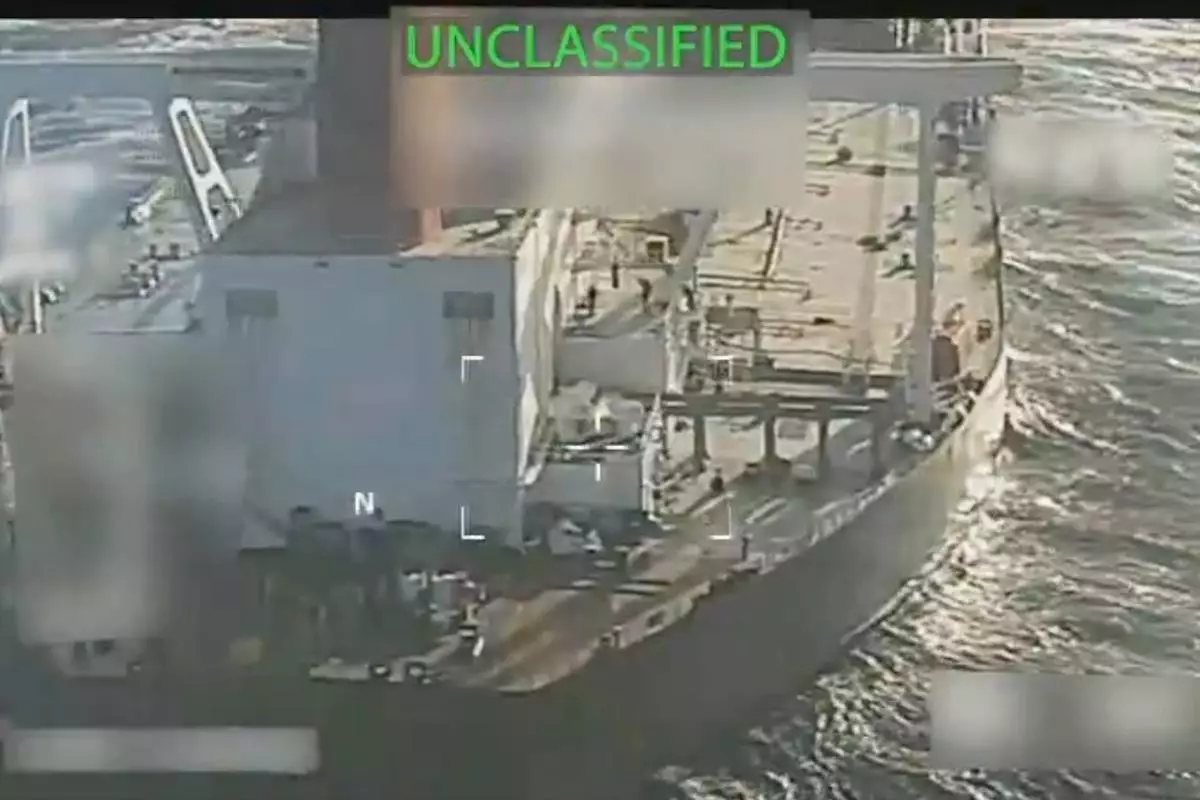
This image from video posted on Attorney General Pam Bondi's X account, and partially redacted by the source, shows an oil tanker being seized by U.S. forces off the coast of Venezuela, Wednesday, Dec. 10, 2025. (U.S. Attorney General's Office/X via AP)
This image from video posted on Attorney General Pam Bondi's X account, and partially redacted by the source, shows an oil tanker being seized by U.S. forces off the coast of Venezuela, Wednesday, Dec. 10, 2025. (U.S. Attorney General's Office/X via AP)