Skip to Content Facebook Feature Image

New Zealand beats West Indies by 9 wickets in the 2nd test; leads the series 1-0

Sport

New Zealand beats West Indies by 9 wickets in the 2nd test; leads the series 1-0
Sport

Sport

New Zealand beats West Indies by 9 wickets in the 2nd test; leads the series 1-0

2025-12-12 11:10 Last Updated At:11:20

WELLINGTON, New Zealand (AP) — Jacob Duffy took 5-38 as New Zealand’s weakened attack bowled out the West Indies for 128 on the third day Friday to set up a nine-wicket win in the second test.

New Zealand leads the three-match series 1-0 after the first test was drawn. The third test begins on Dec. 18.

Duffy claimed his second five-wicket bag of the series as the West Indies were left with an overall lead of only 55 after trailing by 73 runs on the first innings.

New Zealand reached 56-1 in only 10 overs, losing Tom Latham (9) along the way. Devon Conway was 28 not out at the end and Kane Williamson was 16, hitting a four off Anderson Phillip for the winning runs minutes before the schedule tea break.

Pacer Michael Rae and wicketkeeper-batter Mitch Hay also made major contributions to New Zealand’s win after being called up to make their test debuts in an injury-hit team.

Hay scored a match-high 61 in as New Zealand made 278 in its first innings in reply to the West Indies’s 205. Rae took 3-66 in the first innings and 3-45 in the second, match figures of 6-106.

New Zealand’s bowling attack, already depleted by injuries to Matt Henry, Will O’Rourke and Nathan Smith and the absences of Kyle Jamieson and Ben Sears was further weakened when Blair Tickner suffered a dislocated left shoulder in a fielding mishap after taking 4-32 in the first innings. He was playing his first test in two years.

Pressure again fell on Duffy, who bowled 19 overs in the West Indies first innings and 17.2 of the 46.2 overs bowled in the second innings. That came after he was called to bowl 43 overs in the second innings of the first test and 60 overs in that match after injuries to Henry and Smith left New Zealand with only two fit pacers.

“I guess to lose (Tickner) like that . . . he bowled great in the first innings and I thought the way the guys bowled today was awesome,” Duffy said. “I thought it was a great team performance and we got the job done. Day three, how good?”

The West Indies made 205 after being sent in Wednesday on a light green pitch at the Basin Reserve which provided pace, bounce and a little movement on all three days. Shai Hope top-scored with 47 and John Campbell made 44.

Hay’s maiden half century and Devon Conway’s 60 helped New Zealand establish a significant first innings lead.

The West Indies resumed at 32-2 Friday, still 41 runs behind after losing Campbell and nightwatchman Anderson Phillip late on the second day.

New Zealand captured four wickets in the first session, including the wicket of Hope to take full command of the match. The West Indies’ slump began when Brandon King (22) was run out in a mix-up with Kavem Hodge.

The West Indies were 98-6 at lunch, only 25 in front.

Duffy claimed the vital wicket of Justin Greaves, whose monumental double century in the first test earned the West Indies a draw after they were set 531 to win. New Zealand appealed when the ball struck Greaves on the pad, but their appeal was declined. They reviewed and the replay showed the ball hitting leg stump.

The end came quickly. Duffy dismissed Tevin Imlach (5), Rae removed Jayden Seales (0), then Rae caught Ojay Seales in the deep off Duffy to end the innings.

“I think the batting is a bit of a concern, coming from the first test, having a beautiful second innings,” West Indies captain Roston Chase said. “Our batters never capitalized on the conditions.

“I thought we got some starts in the first innings but no one really went big and in the second innings no one got a start.”

AP cricket: https://apnews.com/hub/cricket

New Zealand's Jacob Duffy, left, celebrates after taking the wicket of the West Indies' Tagenarine Chanderpaul on Day 4 of their cricket test match in Christchurch, New Zealand, Friday, Dec. 5, 2025. (Chris Symes/Photosport via AP)

New Zealand's Jacob Duffy, left, celebrates after taking the wicket of the West Indies' Tagenarine Chanderpaul on Day 4 of their cricket test match in Christchurch, New Zealand, Friday, Dec. 5, 2025. (Chris Symes/Photosport via AP)

West Indies' Justin Greaves, right, raises his bat after scoring 200 runs against New Zealand on Day 5 of their cricket test match in Christchurch, New Zealand, Saturday, Dec. 6, 2025. (Andrew Cornaga/Photosport via AP)

West Indies' Justin Greaves, right, raises his bat after scoring 200 runs against New Zealand on Day 5 of their cricket test match in Christchurch, New Zealand, Saturday, Dec. 6, 2025. (Andrew Cornaga/Photosport via AP)
President Donald Trump said U.S. forces will keep hitting Iran “very hard” in the next two or three weeks and bring the country “back to the Stone Ages,” even as he touted the success of U.S. operations and argued that all of Washington’s objectives have so far been met or exceeded.

Trump said Iran would continue to face a barrage of attacks in the short term.

“We are going to hit them extremely hard over the next two to three weeks,” Trump said. “We’re going to bring them back to the Stone Ages, where they belong.”

Trump didn’t say anything about negotiations with Iran or bring up the April 6 deadline he set for Iran to open the Strait of Hormuz, the critical waterway for global oil and gas transport. He has threatened to attack Iran's energy infrastructure if the strait was not reopened.

Trump also did not offer a clear path to end the supply disruptions that have sent energy prices soaring. He did not mention the possibility of sending U.S. ground troops into Iran, or NATO, the trans-Atlantic alliance he has railed against for not helping the U.S. secure the waterway.

Oil rose more than 4% and Asian stocks fell after the comments. Oil prices were sharply higher following Trump’s remarks. Brent crude, the international standard, jumped 4.9% to $106.16 per barrel. Benchmark U.S. crude rose 4% to $104.15 a barrel.

U.S. gas prices jumped past an average of $4 a gallon for the first time since 2022 on Tuesday, as the Iran war continues to push fuel prices higher worldwide. Analysts say those high fuel costs will trickle into groceries as businesses’ transportation and packaging costs pile up.

Here is the latest:

Democrats are criticizing Trump’s primetime address to the American people on the war in Iran as “incoherent” and as doing little to answer “the most basic questions the American people,” according to statements from two Democratic lawmakers released on Wednesday.

Sen. Mark Warner, D-Va., noted that Trump owed Americans more answers about a conflict that has driven up prices on gas “alongside rising prices for diesel, fertilizer, aluminum, and other essentials, with consequences that will continue to ripple through the economy for a long time to come” in his statement.

Meanwhile, Sen. Chris Murphy, D-Conn., released a statement that said the “speech was grounded in a reality that only exists in Donald Trump’s mind.”

Murphy went on to add that “no one in America, after listening to that speech, knows whether we are escalating or deescalating.”

Oil rose more than 4% and Asian stocks fell after U.S. President Donald Trump said in his first national address since the Iran war began that the U.S. will keep hitting Iran very hard.

Trump also said the United States will “finish the job” in Iran and that military operations could wrap up soon.

Tokyo’s Nikkei 225 was down 1.4% to 53,004.81 in early Asia trading on Thursday. South Korea’s Kospi lost 3.4% to 5,292.36. Hong Kong’s Hang Seng fell 0.8% to 25,082.59.

U.S. futures were down more than 0.7%.

Oil prices were sharply higher following Trump’s remarks. Brent crude, the international standard, jumped 5% to $106.22 per barrel. Benchmark U.S. crude rose 4.2% to $104.36 a barrel.

Members of civic groups hold signs against the U.S. and Israel attacks on Iran near the U.S. Embassy in Seoul, South Korea, Wednesday, April 1, 2026. (AP Photo/Lee Jin-man)

Members of civic groups hold signs against the U.S. and Israel attacks on Iran near the U.S. Embassy in Seoul, South Korea, Wednesday, April 1, 2026. (AP Photo/Lee Jin-man)

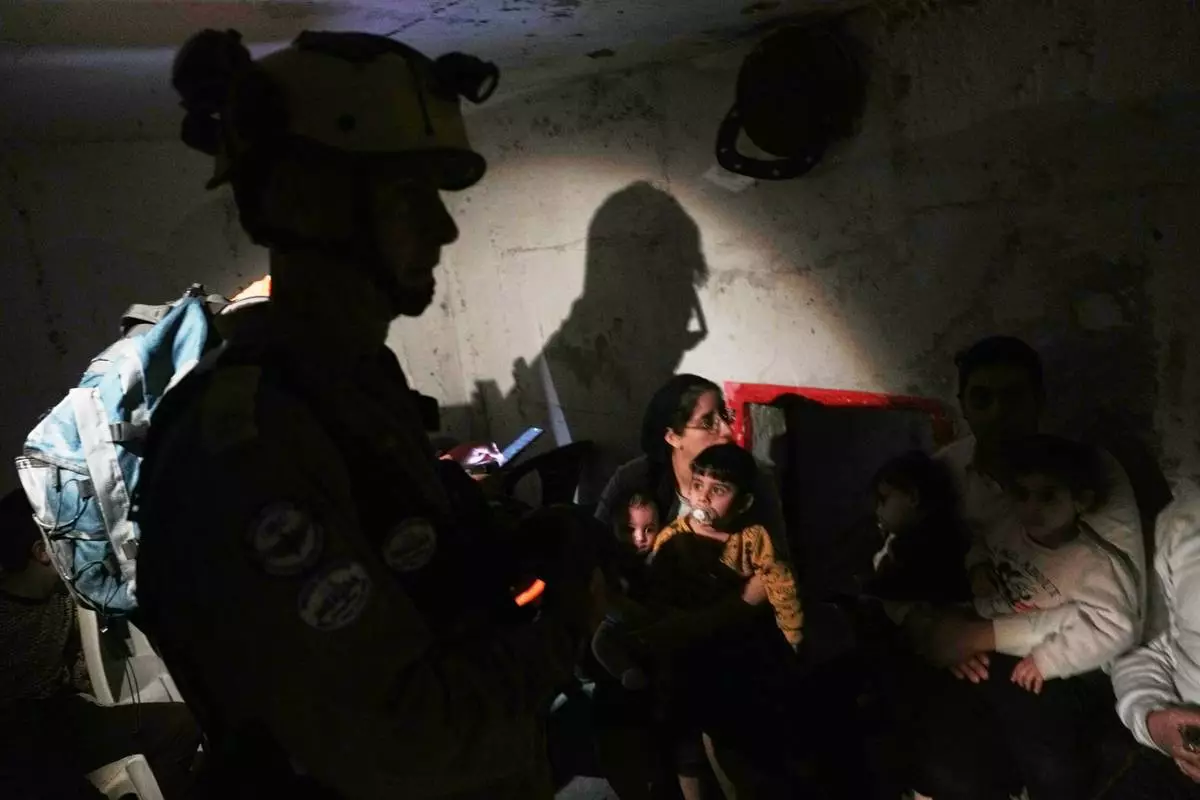
Israel's rescue teams and residents take shelter as sirens sounds next to a site struck by an Iranian missile in Bnei Brak, Wednesday, April 1, 2026. (AP Photo/Oded Balilty)

Israel's rescue teams and residents take shelter as sirens sounds next to a site struck by an Iranian missile in Bnei Brak, Wednesday, April 1, 2026. (AP Photo/Oded Balilty)

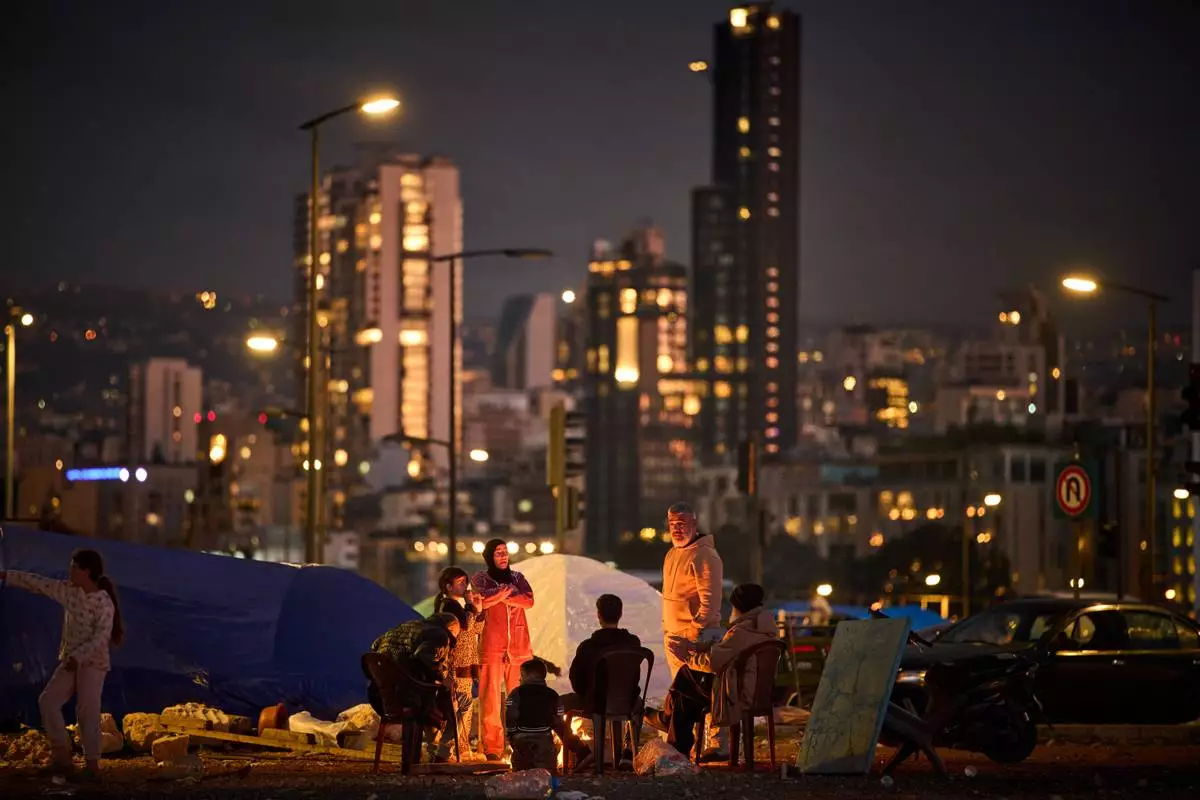
A family who fled Israeli shelling in southern Lebanon warm themselves by a bonfire next to tents used as shelters in Beirut, Lebanon, Tuesday, March 31, 2026. (AP Photo/Emilio Morenatti)

A family who fled Israeli shelling in southern Lebanon warm themselves by a bonfire next to tents used as shelters in Beirut, Lebanon, Tuesday, March 31, 2026. (AP Photo/Emilio Morenatti)

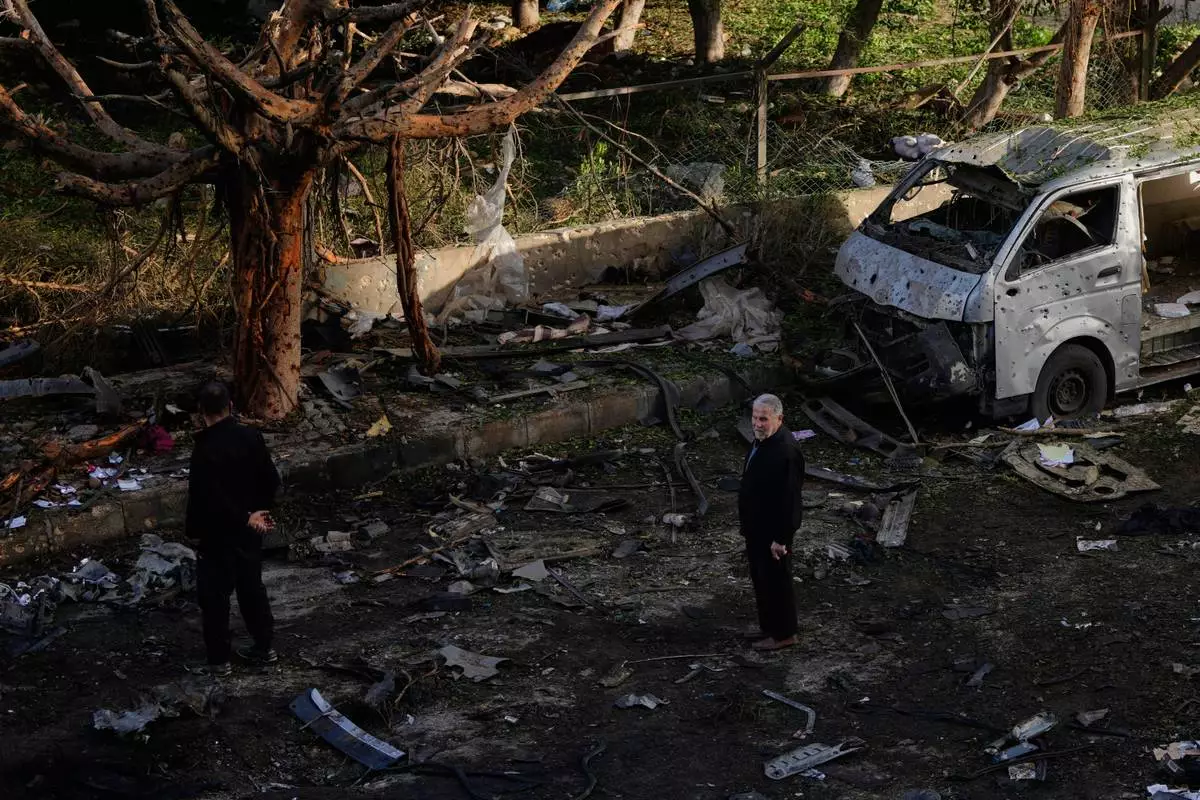
People stand near a damaged van beside scattered debris following an Israeli strike in Beirut, Lebanon, Wednesday, April 1, 2026. (AP Photo/Hassan Ammar)

People stand near a damaged van beside scattered debris following an Israeli strike in Beirut, Lebanon, Wednesday, April 1, 2026. (AP Photo/Hassan Ammar)

A firefighter extinguishes a car at the site of Israeli airstrikes, in Beirut, Lebanon, Wednesday, April 1, 2026. (AP Photo/Hussein Malla)

A firefighter extinguishes a car at the site of Israeli airstrikes, in Beirut, Lebanon, Wednesday, April 1, 2026. (AP Photo/Hussein Malla)

Recommended Articles