Skip to Content Facebook Feature Image

Analyst recaps Asian stock markets' Friday performance

China

China

China

Analyst recaps Asian stock markets' Friday performance

2025-12-12 22:06 Last Updated At:12-13 01:27

Both Hong Kong stocks and Tokyo stocks ended higher Friday on buying following the Federal Reserve's decision to cut the policy rate for the third straight time, according to a market analyst.

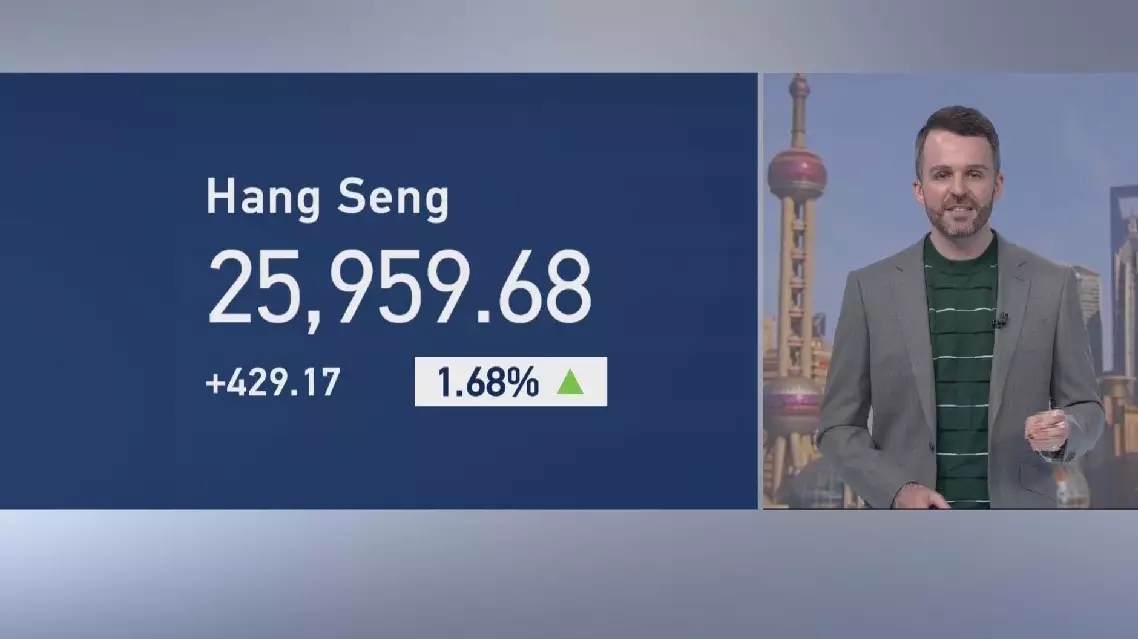
The Hang Seng Index up 1.75 percent to close at 25,976.79 points. The Hang Seng China Enterprises Index gained 1.62 percent to end at 9,079.35 points, and the Hang Seng Tech Index rose 1.87 percent to end at 5,638.05 points.

The Nikkei stock index, the 225-issue Nikkei Stock Average, ended up 687.73 points, or 1.37 percent, from Thursday at 50,836.55. The broader Topix index, meanwhile, finished 66.59 points, or 1.98 percent, higher at 3,423.83, marking a record high close.

Timothy Pope, a market analyst, recapped stock market performances in Hong Kong on Friday. He noted that Asian stock markets got a boost this week, riding on a U.S. Federal Reserve rate cut and fresh economic policy signals from China.

"In Hong Kong, the markets were up more strongly. The Hang Seng added one and three quarter percent by the end of today's session. There was a certain amount of cheer in the region following the U.S. Fed's quarter-point rate cut. But this didn't come as any kind of surprise to the markets, it was signaled pretty clearly in advance. Property stocks were doing well in Hong Kong as well after the Central Economic Work Conference committed to stabilizing China's property market. We saw there's an index of Chinese mainland developers that are listed in Hong Kong, it was up more than one and a half percent at one stage. It did slip back a little bit by the close of trade. It was up something like 0.7 percent by the end. One stock not joining in that fun, though, was China Vanke, which shed more than 1 percent. Investors are waiting to see the outcome of a bondholder vote this afternoon on whether to grant the developer extensions on a couple of onshore notes, so we'll see how that goes. Mining and textile also did well on the Hang Seng today, though," said Pope.

"In Japan, we saw the Nikkei 225 add 1.4 percent. It was mirroring Wall Street's post-rate-cut gains. The focus in Tokyo, though, is going to switch from U.S. interest rates over to Japanese interest rates next week, because the Bank of Japan is due to update its policy rate on December 19. So we can probably expect to see trade slow down a little on the Japanese markets ahead of that announcement. Still today, we saw the vast bulk of the Nikkei stocks trading higher. The market was making gains actually despite losses for some of the big heavyweight chip stocks like Tokyo Electron and Advantest. They both fell but this time they didn't manage to drag the whole market down," he said.
Analyst recaps Asian stock markets' Friday performance

Analyst recaps Asian stock markets' Friday performance

The heartbreaking story of 96-year-old Peng Zhuying, one of the last living survivors from the Japanese military's "comfort women" system in the Chinese mainland, has been shared in a moving documentary produced by the China Global Television Network (CGTN).

Peng remains one of only seven registered survivors in the Chinese mainland of the Japanese military's "comfort women" system, a brutal state-enforced regime of sexual slavery during World War II, victimizing over 400,000 women across Asia.

She is also the only living survivor who is officially documented as a victim of both sexual slavery and of Japan's chemical warfare during the Japanese militarists' war of aggression against China.

Eight decades on, Peng has bravely shared the story of her horrifying experiences in the CGTN original documentary "Last Daughters," which reveals the deep scars left by war and captures the quiet strength and warmth that endured, even in the darkest depths of human suffering.

Blinded by mustard gas at age nine and mutilated at 14 before being forced into a military brothel during the war, Peng was able to survive despite facing these unimaginable hardships in her young life.

Nowadays, Peng lives in a narrow alleyway, a humble dwelling with one room and one kitchen in central China's Hunan Province. Her door opens directly in front of a refurbished public toilet.

Born by the Yangtze River, Peng lost her eyesight as a child when Japanese mustard gas bombs fell on her hometown.

"I lost my eyesight when I was nine. The Japanese army struck Yueyang with bombs carrying poison. After I inhaled the mustard gas, I developed a fever, and then lost my eyesight," said Peng.

In the summer of 1938, Peng's mother and infant brother died from the killer gas. Her 13-year-old sister, Peng Renshou, was betrayed to Japanese soldiers while fleeing.

Before she passed away, Peng Renshou said the Japanese soldiers threatened to burn down a house with 50 people inside unless she surrendered. She had no choice. Brutally gang-raped until left unconscious, she survived but became infertile.

Three years later, the then 14-year-old Peng Zhuying suffered the same fate.

"It began with my sister's suffering. She was only 13. When my time came, I was 14, maybe 15. When they came for me, I resisted and refused to go. The Japanese broke two of my toes with sticks. After my toes were broken, I was dragged to the 'comfort women station' in Guozhen Town. I was violated there," said Peng.

After her release, with the help of villagers, when troops marched on Changsha, Peng bled relentlessly from her severe injuries.

"After I returned, I began having gynecological issues. I had persistent bleeding and none of the treatments helped. I was filled with hatred. I thought to myself, I've gotten this illness and it won't get better, so I would rather die. Later on, I received treatment from a doctor named Liu from the Red Cross. The doctor gave me pills and injections, and eventually my bleeding stopped," she said.

A CT scan taken last year revealed a calcified fetus in her womb, which had remained inside Peng Zhuying's body for 80 years.

Survivor of Japan's wartime sexual slavery, chemical attacks bravely shares story in CGTN documentary

Survivor of Japan's wartime sexual slavery, chemical attacks bravely shares story in CGTN documentary

Recommended Articles