Skip to Content Facebook Feature Image

Trump was unable to insult his way to victory in Indiana redistricting battle

News

Trump was unable to insult his way to victory in Indiana redistricting battle
News

News

Trump was unable to insult his way to victory in Indiana redistricting battle

2025-12-13 09:06 Last Updated At:09:10

If Indiana Republican senators had any doubt about what to do with President Donald Trump's redistricting proposal, he helped them make up their minds the night before this week's vote.

In a social media screed, Trump accused the state's top senator of being “a bad guy, or a very stupid one."

More Images
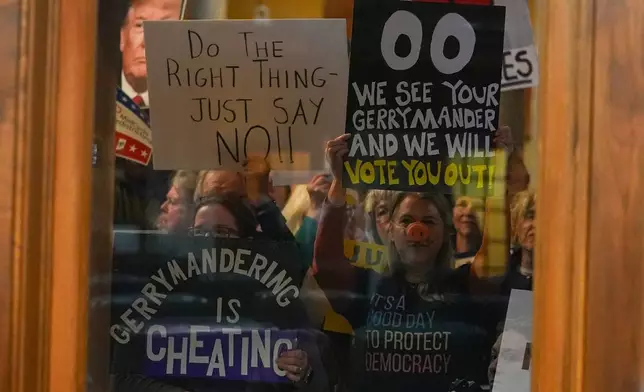
Protesters are seen through a window in the Senate Chamber during dissuasion before a vote to redistrict the state's congressional map, Thursday, Dec. 11, 2025, at the Statehouse in Indianapolis. (AP Photo/Michael Conroy)
Protesters are seen through a window in the Senate Chamber during dissuasion before a vote to redistrict the state's congressional map, Thursday, Dec. 11, 2025, at the Statehouse in Indianapolis. (AP Photo/Michael Conroy)

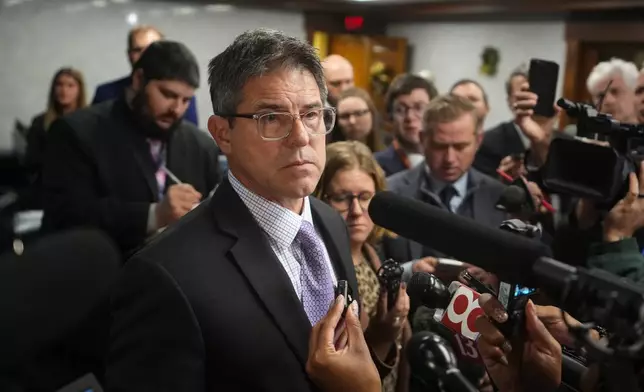
Indiana Senate President Pro Tem Rodric Bray takes a question after a bill to redistrict the state's congressional map was defeated, Thursday, Dec. 11, 2025, at the Statehouse in Indianapolis. (AP Photo/Michael Conroy)
Indiana Senate President Pro Tem Rodric Bray takes a question after a bill to redistrict the state's congressional map was defeated, Thursday, Dec. 11, 2025, at the Statehouse in Indianapolis. (AP Photo/Michael Conroy)
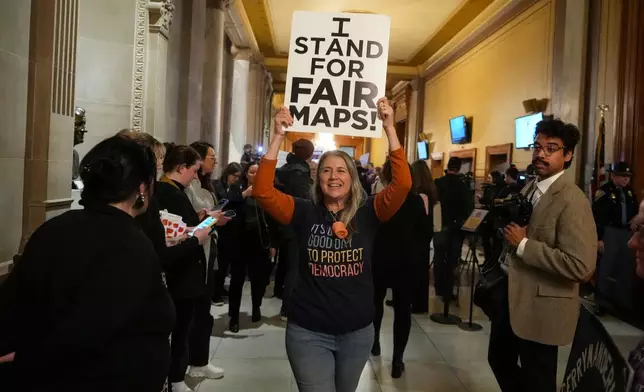
A protester celebrates as they walk outside the Indiana Senate Chamber after a bill to redistrict the state's congressional map was defeated, Thursday, Dec. 11, 2025, at the Statehouse in Indianapolis. (AP Photo/Michael Conroy)

A protester celebrates as they walk outside the Indiana Senate Chamber after a bill to redistrict the state's congressional map was defeated, Thursday, Dec. 11, 2025, at the Statehouse in Indianapolis. (AP Photo/Michael Conroy)

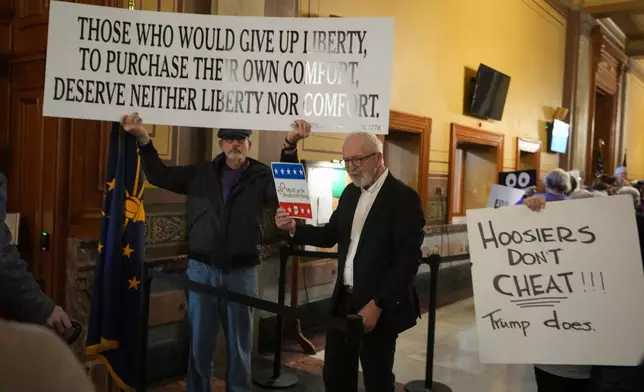
Protestors hold signs outside the Indiana Senate chamber before a vote to redistrict the state's congressional map at the Statehouse in Indianapolis, Thursday, Dec. 11, 2025. (AP Photo/Michael Conroy)
Protestors hold signs outside the Indiana Senate chamber before a vote to redistrict the state's congressional map at the Statehouse in Indianapolis, Thursday, Dec. 11, 2025. (AP Photo/Michael Conroy)

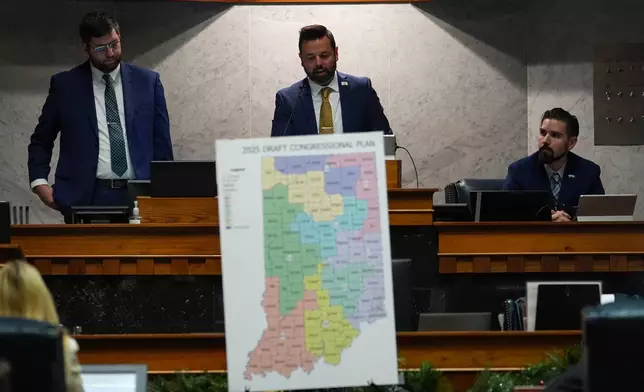
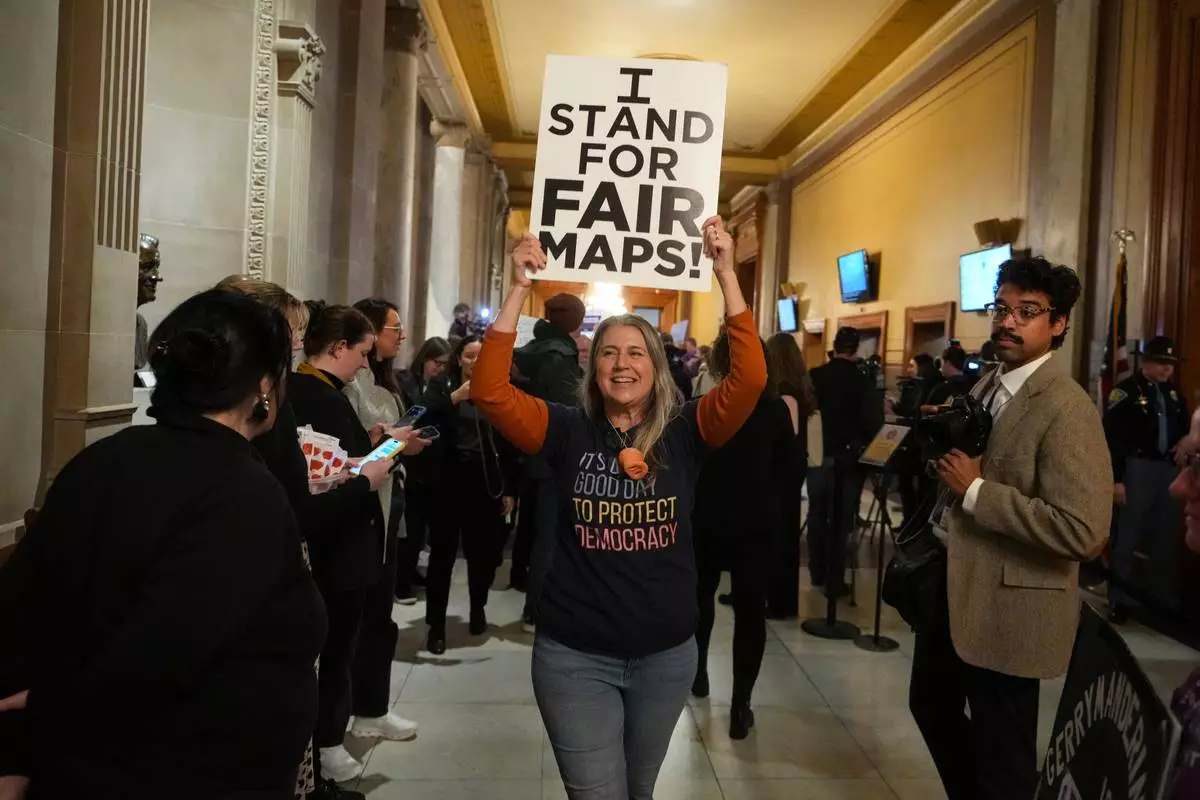
Indiana Lt. Gov. Micah Beckwith announces the results of a vote to redistrict the state's congressional map, Thursday, Dec. 11, 2025, at the Statehouse in Indianapolis. (AP Photo/Michael Conroy)

Indiana Lt. Gov. Micah Beckwith announces the results of a vote to redistrict the state's congressional map, Thursday, Dec. 11, 2025, at the Statehouse in Indianapolis. (AP Photo/Michael Conroy)

“That kind of language doesn’t help,” said Sen. Travis Holdman, a banker and lawyer from near Fort Wayne who voted against the plan.

He was among 21 Republican senators who dealt Trump one of the most significant political defeats of his second term by rejecting redistricting in Indiana. The decision undermined the president's national campaign to redraw congressional maps to boost his party's chances in the upcoming midterm elections.

In interviews after Thursday's vote, several Republican senators said they were leaning against the plan from the start because their constituents didn't like it. But in a Midwest nice rebuttal to America's increasingly coarse political discourse, some said they simply didn't like the president's tone, like when he called senators “suckers.”

“I mean, that’s pretty nasty,” said Sen. Jean Leising, a farm owner from Oldenburg who works at her daughter’s travel agency.

Trump didn't seem to get the message. Asked about the vote, the president once again took aim at Indiana's top senator, Rodric Bray.

“He’ll probably lose his next primary, whenever that is," Trump said. "I hope he does, because he’s done a tremendous disservice.”

Sen. Sue Glick, an attorney from La Grange who also opposed redistricting, brushed off Trump's threat to unseat lawmakers who defied him.

“I would think he would have better things to do,” she said. “It would be money better spent electing the individuals he wants to represent his agenda in Congress.”

The president tried to brush off the defeat, telling reporters he “wasn’t working on it very hard."

But the White House had spent months engaged in what Republican Sen. Andy Zay described as “a full-court press.”

Vice President JD Vance met with senators twice in Indiana and once in Washington. White House aides frequently checked in over the phone.

Holdman said the message behind the scenes was often more soothing than Trump's social media attacks.

“We were getting mixed messages," he said. “Two days before the vote, they wanted to declare a truce on Sen. Bray. And the next day, there’s a post on Truth Social that didn’t sound like truce language to me.”

Some of Trump's other comments caused backlash too. For example, he described Minnesota Gov. Tim Walz as “retarded,” which upset Sen. Mike Bohacek because his daughter has Down syndrome. Bohacek had been skeptical of redistricting and decided to vote no in response.

The White House did not respond to questions about outreach to senators, but it distanced itself from conservative allies who claimed Trump had threatened to withhold money from the state.

"President Trump loves the great state of Indiana," said spokesman Davis Ingle, who insisted Trump "has never threatened to cut federal funding and it’s 100% fake news to claim otherwise.”

Regardless, Trump had struggled to get traction despite months of pressure.

Holdman said he turned down an invitation to the White House last month because he had a scheduling conflict.

“Plus, by then it was a little too late,” he said.

Leising said she missed a call from a White House official the day before a vote while she was in a committee meeting. She didn't try to call back because she wasn't going to change her mind.

Mitch Daniels, a former Indiana governor and a Republican, had a straightforward explanation for what happened.

“Folks in our state don’t react well to being bullied,” he said.

Daniels’ successor as governor, Mike Pence, fielded calls from senators during the redistricting debate, according to a person with knowledge of the situation who requested anonymity to disclose private conversations.

The person declined to describe Pence’s advice. Pence has been at odds with Trump ever since he, while serving as his vice president, refused to help Trump overturn his election defeat to Joe Biden on Jan. 6, 2021.

Some Republicans lashed out at senators for defying Trump.

"His life was threatened — and he was nearly assassinated," Indiana Lieutenant Gov. Micah Beckwith wrote on social media. “All for what? So that Indiana politicians could grow timid.”

The message to the president, Beckwith said, was “go to hell.”

But senators who opposed redistricting said they were just listening to their constituents. Some believed the unusual push to redraw districts was the equivalent of political cheating. Others didn't like that Washington was telling Indiana what to do.

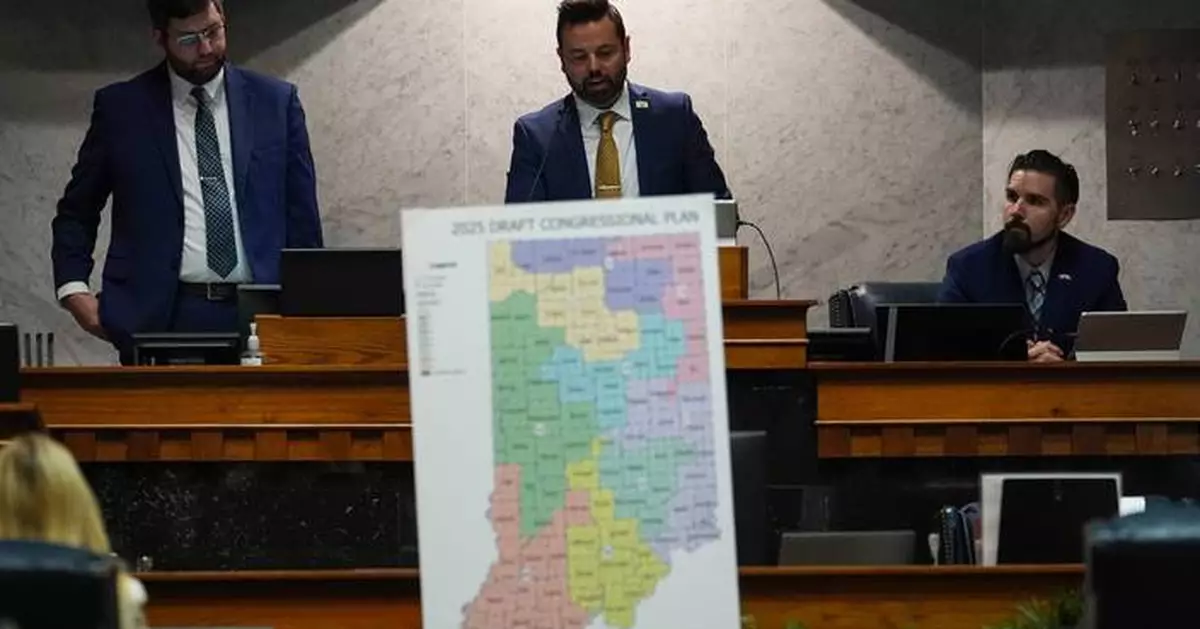
The proposed map would have divided Indianapolis into four pieces, grafting pieces of the city onto other districts to dilute the influence of Democratic voters. But in small towns near the borders with Kentucky and Ohio, residents feared the state's biggest metropolitan area would gain influence at their expense.

“Constituents just didn’t want it,” Holdman said.

During Thursday's vote on the Senate floor, some Republicans seemed torn about their decision.

Sen. Greg Goode, who is from Terre Haute, said he had spoken twice to Trump on the phone while weighing the redistricting plan. He declared his “love” for the president but decried “over-the-top pressure.”

Goode said he wouldn't vote for the proposal.

“I’m confident my vote reflects the will of my constituents," he said.
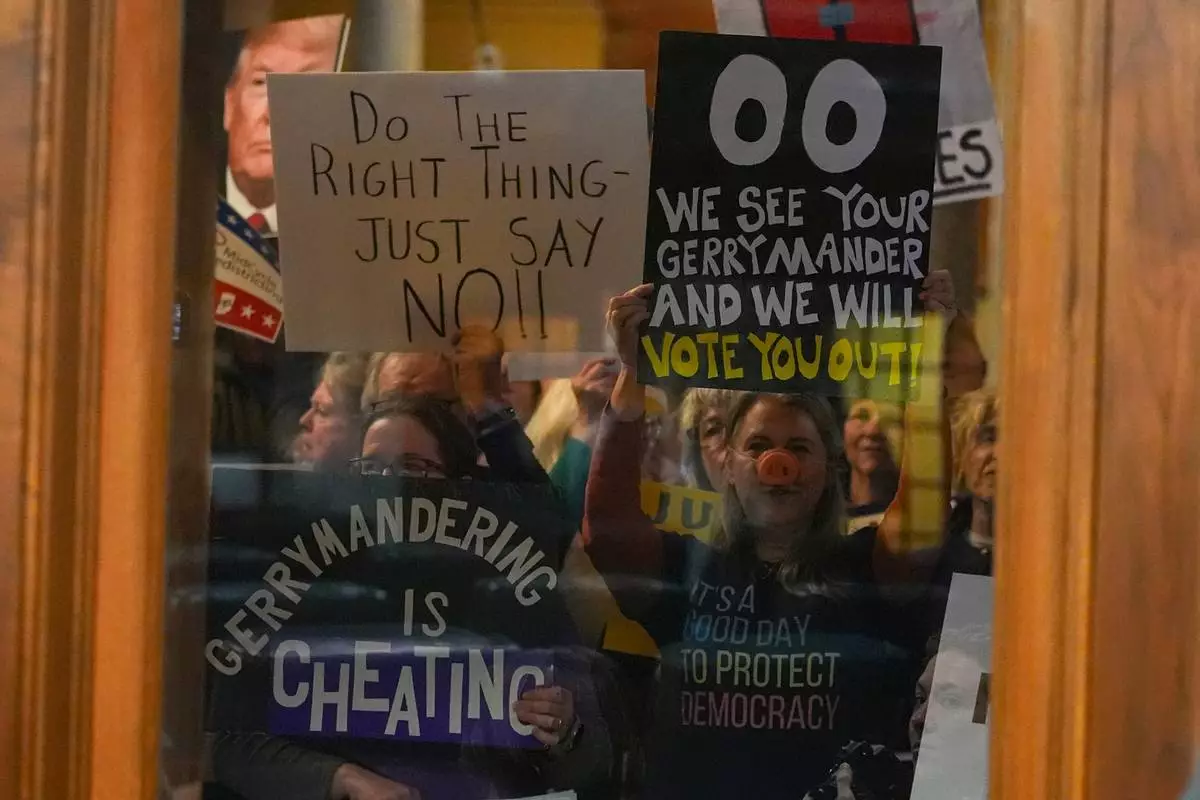
Protesters are seen through a window in the Senate Chamber during dissuasion before a vote to redistrict the state's congressional map, Thursday, Dec. 11, 2025, at the Statehouse in Indianapolis. (AP Photo/Michael Conroy)

Protesters are seen through a window in the Senate Chamber during dissuasion before a vote to redistrict the state's congressional map, Thursday, Dec. 11, 2025, at the Statehouse in Indianapolis. (AP Photo/Michael Conroy)

Indiana Senate President Pro Tem Rodric Bray takes a question after a bill to redistrict the state's congressional map was defeated, Thursday, Dec. 11, 2025, at the Statehouse in Indianapolis. (AP Photo/Michael Conroy)
Indiana Senate President Pro Tem Rodric Bray takes a question after a bill to redistrict the state's congressional map was defeated, Thursday, Dec. 11, 2025, at the Statehouse in Indianapolis. (AP Photo/Michael Conroy)

A protester celebrates as they walk outside the Indiana Senate Chamber after a bill to redistrict the state's congressional map was defeated, Thursday, Dec. 11, 2025, at the Statehouse in Indianapolis. (AP Photo/Michael Conroy)

A protester celebrates as they walk outside the Indiana Senate Chamber after a bill to redistrict the state's congressional map was defeated, Thursday, Dec. 11, 2025, at the Statehouse in Indianapolis. (AP Photo/Michael Conroy)

Protestors hold signs outside the Indiana Senate chamber before a vote to redistrict the state's congressional map at the Statehouse in Indianapolis, Thursday, Dec. 11, 2025. (AP Photo/Michael Conroy)
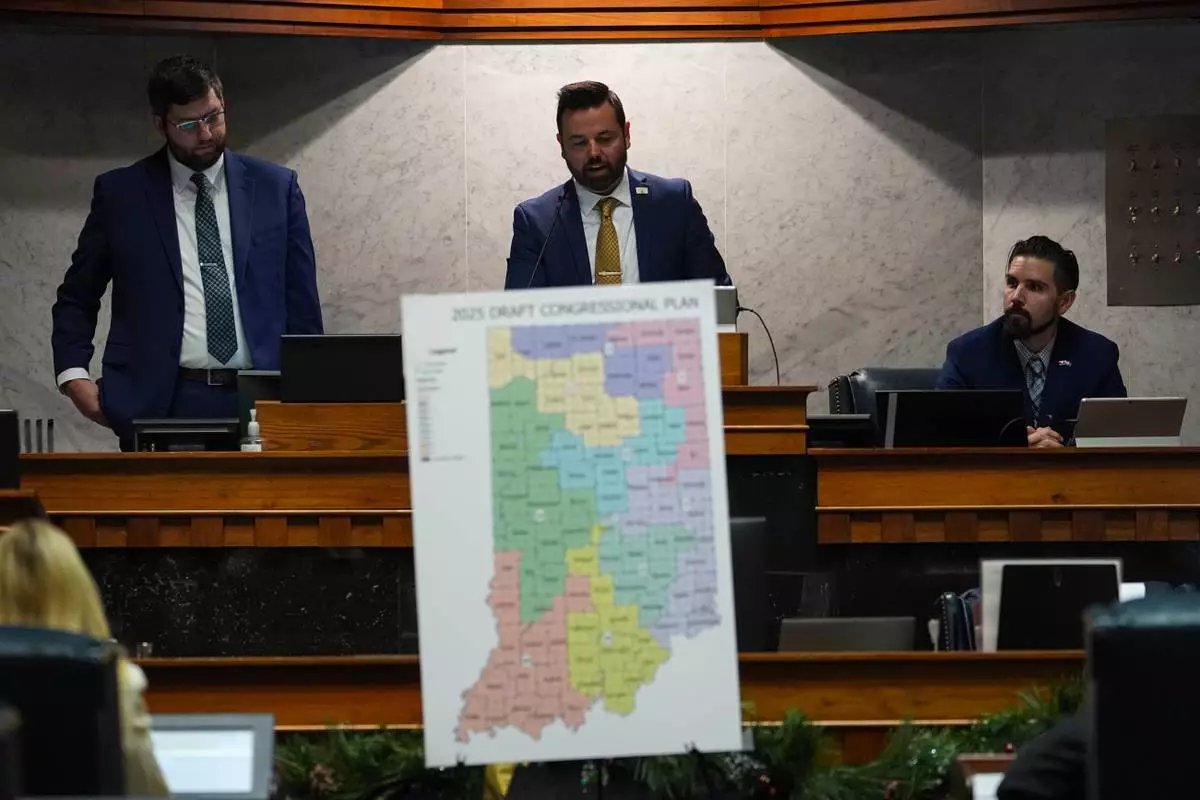
Protestors hold signs outside the Indiana Senate chamber before a vote to redistrict the state's congressional map at the Statehouse in Indianapolis, Thursday, Dec. 11, 2025. (AP Photo/Michael Conroy)

Indiana Lt. Gov. Micah Beckwith announces the results of a vote to redistrict the state's congressional map, Thursday, Dec. 11, 2025, at the Statehouse in Indianapolis. (AP Photo/Michael Conroy)

Indiana Lt. Gov. Micah Beckwith announces the results of a vote to redistrict the state's congressional map, Thursday, Dec. 11, 2025, at the Statehouse in Indianapolis. (AP Photo/Michael Conroy)

WASHINGTON (AP) — The U.S. removed Brazilian Supreme Court Justice Alexandre de Moraes from its sanctions list on Friday after initially adding him over his role in leading the trial against former Brazilian President Jair Bolsonaro.

De Moraes’ wife and the Lex Institute, which she leads, were also taken off the list, according to documents from the Treasury Office of Foreign Assets Control. Brazil's government celebrated the move, which came after a weekend phone conversation between President Donald Trump and President Luiz Inácio Lula da Silva.

The Trump administration had sanctioned the judge in July, accusing him of using his position to authorize arbitrary pretrial detentions and suppress freedom of expression in Brazil.

A senior Trump administration official said the sanctions were lifted since the U.S. saw the passage of an important amnesty bill by Brazil’s lower house as a signal that lawfare conditions in Brazil are improving. The official spoke on the condition of anonymity to discuss the administration's views on foreign policy interests.

The move represents a thawing of sorts in the frosty relationship between the two governments and follows a number of meetings and calls that both have described in positive terms. Trump had seen Lula's predecessor Bolsonaro as an ally, with the Brazilian leader even dubbed the “Trump of the Tropics" when he came into office.

“This is a victory of Brazil's judiciary,” de Moraes said Friday evening at an event in Sao Paulo. “Brazil's judiciary did not bow to threats, cohersion and it will never do so. It carried on with unbias, seriousness and courage. It is a victory for national sovereignty. President Lula from the start said this country will not give in to any invasion to Brazil's democracy.”

Bolsonaro was accused of masterminding a plot to stay in power despite his 2022 election defeat to current President Luiz Inácio Lula da Silva — similar charges to what Trump faced after a mob of his supporters attacked the U.S. Capitol in 2021 to stop Democrat Joe Biden from taking the White House.

Bolsonaro was convicted and sentenced to more than 27 years in prison. The embattled 70-year-old leader started serving his sentence last month while still requesting to be put on house arrest due to his poor health. The massive upheaval his allies expected upon his arrest did not materialize, though he remains a politically powerful figure ahead of next year's elections.

Brazil's current government characterized the lifting of sanctions as a “big defeat” for Bolsonaro's family.

“It was Lula who put this repeal (of the sanctions) on Donald Trump’s desk, in a dignifying and sovereign dialogue,” said Gleisi Hoffmann, Brazil’s minister for institutional relations. “It is a big defeat for the family of Jair Bolsonaro, traitors who have conspired against Brazil and the judiciary.”

Lula’s leftist administration has long accused Eduardo Bolsonaro, a lawmaker and son of the former president, of misleading Trump on de Moraes and other members of the court. For his part, Eduardo Bolsonaro said he received the news of the sanctions being lifted from de Moraes “with regret.”

The younger Bolsonaro, who announced in March that he would start living in the U.S. in order to lobby the Trump administration to help his father avoid jail, said he would continue to fight for Jair Bolsonaro.

“The lack of internal cohesion and the insufficient support for initiatives pursued abroad contributed to the worsening of the current situation,” Eduardo Bolsonaro wrote on his social media channels, after Trump's reversal. “We sincerely hope that President Donald Trump's decision will be successful in defending the strategic interests of the American people, as is his duty."

In initially sanctioning de Moraes, the Treasury Department had cited the Global Magnitsky Human Rights Accountability Act, which targets perpetrators of human rights abuse and corrupt officials. De Moraes said the use of the act against him was “illegal and regrettable.”

Also in July, the Trump’s administration imposed a 40% tariff on Brazilian products on top of a 10% tariff imposed earlier, justifying the tariffs by saying that Brazil’s policies and criminal prosecution of Bolsonaro constituted an economic emergency.

Political consultant Thomas Traumann, the author of a recent book on Brazil’s political divisions, said the move shows “the U.S. government wants a normal relationship with Brazil’s, even though it is a leftist administration."

“Trump removed almost all tariffs it had increased, stopped discussing politics with Lula, now it is all about security and trade, and he managed to make Brazil’s government somewhat neutral in other Latin American affairs, especially Venezuela,” Traumann said. “This is a process to show Brazil needs to be treated differently in the region.”

The two leaders started mending fences at the United Nations' General Assembly in September, which was followed by their first private meeting in Malaysia in October and subsequent phone conversations.

The Brazilian president has said he wasn't only trying to reverse the increase on tariffs but also to end the sanctions on de Moraes and some members of his government who were also hit by the measure.

Separately, Lula has urged Latin American states to help avoid a conflict in Venezuela as the Trump administration orders military action against vessels allegedly linked to drug cartels.

Last month, Trump signed an order to remove the additional import tariffs on some agribusiness products. The U.S. ran a $6.8 billion trade surplus last year with Brazil, according to the U.S. Census Bureau.

Savarese reported from Sao Paulo.

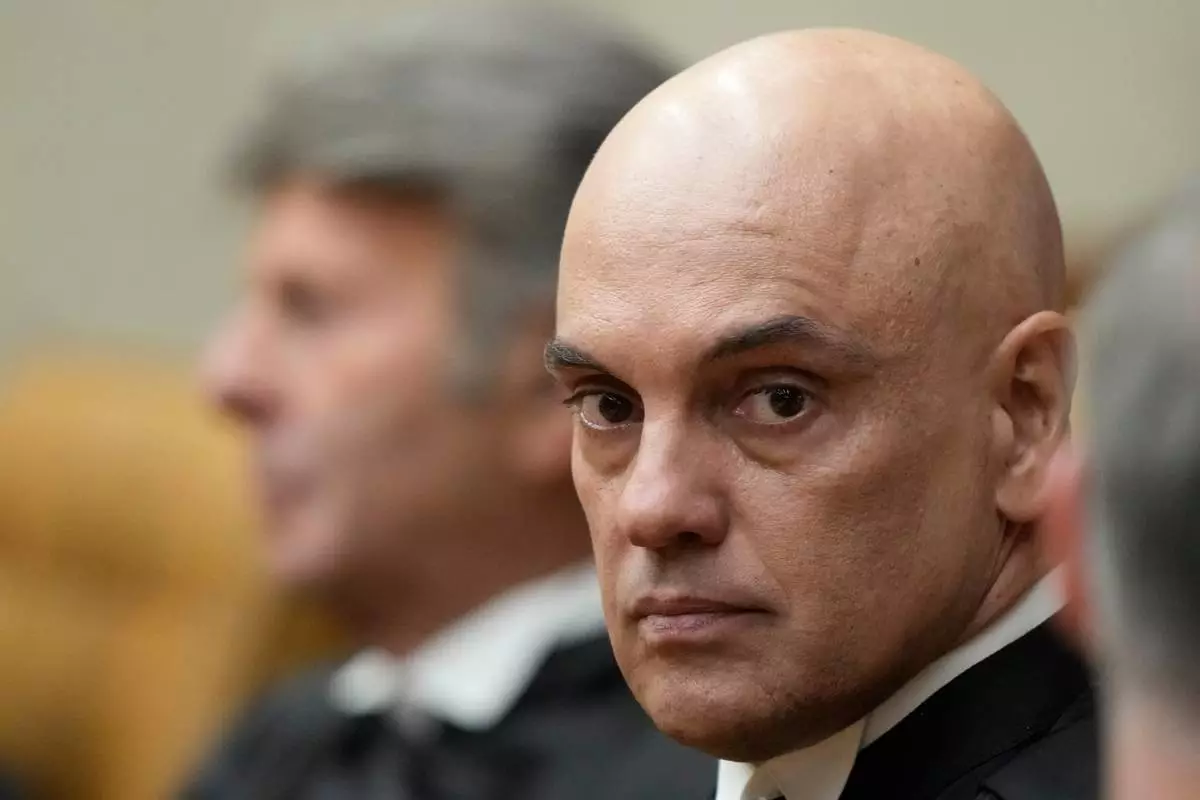
FILE - New Vice President of the Supreme Court, Judge Alexandre de Moraes, attends his swearing-in ceremony in Brasilia, Brazil, Sept. 29, 2025. (AP Photo/Eraldo Peres, File)

FILE - New Vice President of the Supreme Court, Judge Alexandre de Moraes, attends his swearing-in ceremony in Brasilia, Brazil, Sept. 29, 2025. (AP Photo/Eraldo Peres, File)

Recommended Articles