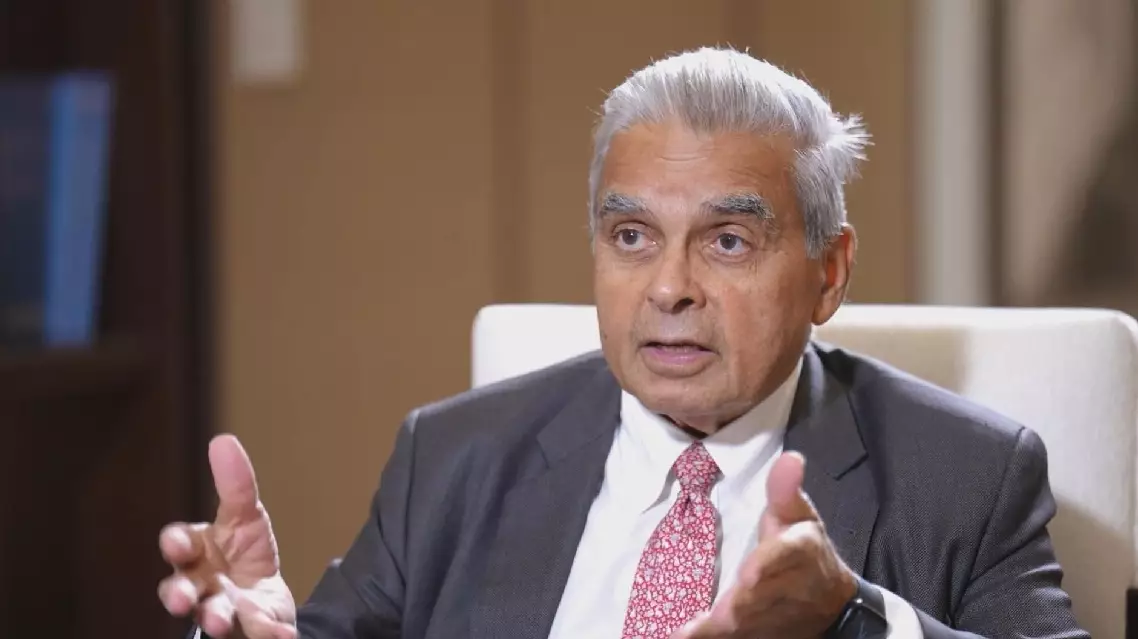
China's Five-Year Plans, working as a visible hand of good governance, is indispensable for the country's long-term high-quality development, said Kishore Mahbubani, former permanent representative of Singapore to the United Nations.
China's annual Central Economic Work Conference was held in Beijing from Wednesday to Thursday, setting priorities for economic work in 2026, a year marking the beginning of China's 15th Five-Year Plan for national socioeconomic development in the 2026-2030 period.
In an exclusive interview with China Central Television (CCTV) in Shanghai, Mahbubani commended China as a country with a comprehensive long-term strategy.
"The first person to alert me to the fact that China thinks long term and strategically was Henry Kissinger, and in fact I got his permission to cite him in my book 'Has China Won' for saying that 'It's China that has a comprehensive long-term strategy.' At the same time, I think what you mentioned about the Five-Year Plans is very much part of that long-term strategy," Mahbubani said, referring to late U.S. Secretary of State Henry Kissinger (1923-2023).
"I do remember that there was a time when many economists were saying, especially when the Cold War ended. They said 'Five-Year Plans are a thing of the past. That's so old fashion. You must get rid of them. Let the markets do everything.' Right? That was the conventional wisdom. But now look at this, now we learn that markets alone are not enough to make long-term decisions. The markets don't think long term, which is why you need Five-Year Plans," he said.
"There's a very (well-known economist). He's a good friend of mine. He is in Harvard, Amartya Sen. He said for countries to develop, you need the invisible hand of free markets and the visible hand of good governance. And that's the secret of China's development model that it has an invisible hand of free markets, some of the competition in EVs and batteries is so astounding, vicious competition, amazing. And yet, at the same time, you still have a strong guiding hand of the government, making sure that the markets don't go off course," said the former senior diplomat.
"So that's why I think it's good that China is continuing with its Five-Year Plans. And then for the next one, I think the emphasis on high-quality development is a very wise decision, because right now it's not just about growth per se, it's about the quality of the growth, impact on the environment, impact on people's lives, and it's good to look at everything comprehensively," he continued.
The Five-Year Plans are a set of social and economic development initiatives that map out China's strategies for growth in a five-year period. The plans usually include numerical growth targets such as annual gross domestic product (GDP) goals and offer policy guidelines for reforms. The first Five-Year Plan was released in 1953.
China's Five-Year Plans indispensable for long-term high-quality development: former senior diplomat
China's Five-Year Plans indispensable for long-term high-quality development: former senior diplomat