The Shenzhen-Zhongshan Link, a 24-kilometer cross-sea passage in south China, has greatly enhanced connectivity in the Guangdong-Hong Kong-Macao Greater Bay Area (GBA) and provided a model for global development ambitions.
The link, featuring two bridges, two artificial islands, and an underwater tunnel, drastically reduces the time it takes to travel between Zhongshan and the technology hub of Shenzhen, two cities situated on opposite sides of the Pearl River Estuary in south China's Guangdong Province.
A trip that once took two hours now takes approximately 30 minutes.
"The Shenzhen–Zhongshan Link is 24 kilometers in total length. The underwater tunnel section is 6.8 kilometers long, followed by the bridge section. Traveling from Shenzhen to Zhongshan, vehicles first go through the tunnel and then onto the bridge. Now, the eight-lane underwater tunnel in both directions is the world's largest steel-shell concrete immersed tunnel," said Liao Wenlong, an engineer for China Communications Construction Company.
Since opening in June 2024, the link has already carried over 42 million vehicles.
"In fact, our Shenzhen-Zhongshan Link, in the context of the GBA layout, resembles the shape of an 'A'. The link itself is the horizontal line in the middle of that 'A'. It is the most core, the most critical transportation corridor," said Liao.
The link is a landmark project under China's 14th Five-Year Plan (2021-2025). With its instillation, the high-tech powerhouses of Shenzhen and Dongguan cities now directly connect to the manufacturing hubs of Zhongshan and Zhuhai cities, cutting transport costs by 20 percent or more.
"With the opening of the Shenzhen-Zhongshan Link, and considering the cost advantage, we have kept our manufacturing base in Zhongshan City and our headquarters in Shenzhen City. I might now drive the route two or three times a day. If the link had not opened, taking the Humen Bridge route would take about two hours even under relatively smooth traffic conditions," said Liao Lei, a commuter.
Crossing the expansion joint marks the beginning of the Shenzhen-Zhongshan Bridge section.
"Crossing the Shenzhen-Zhongshan Bridge, one of the two bridges of the link, every day, my mood is also uplifted. The sky is blue, the sea water is azure blue. I can only describe it with the word 'beautiful'," Deng Changqin, a truck driver.
Each tower of the bridge stands over 90 meters above the water, tall enough for 300,000-ton vessels to sail beneath.
The mega-project has been strengthening connections across the GBA and setting the stage for the next Five-Year Plan (2026-2030) to boost regional integration further.
Over the past five years, China's transport network has made a historic leap. Between 2021 and 2025, the country added more than 30,000 kilometers of high-grade highways.
Currently, China's total road network stretches over 5.49 million kilometers, the largest in the world, enough to circle the equator more than 130 times. High-standard expressways now connect every province, and over 90 percent of county-level cities are linked by major roads. Smart highways, digital tolling and green logistics corridors are transforming the way people and goods move, from bustling coastal cities to inland towns.
According to experts, the link's significance extends far beyond the GBA, demonstrating a replicable model and offering valuable experience for similar future developments worldwide.
"China demonstrates the value of long-term planning, centralized coordination, and large-scale investment in public infrastructure. China's expansion today is not only about physical connectivity; it is about enabling a more efficient, equitable, and innovation-driven economy," said John Quelch, executive vice chancellor of Duke Kunshan University.
"This cross-sea integrated project of bridges, artificial islands, tunnels, and an underwater interchange, a clustered engineering marvel, provides a comprehensive Guangdong Solution and Chinese Experience for similar bay areas around the world to build similar projects," said Zhang Changliang, deputy director and chief engineer of Shenzhen–Zhongshan Link Management Center.
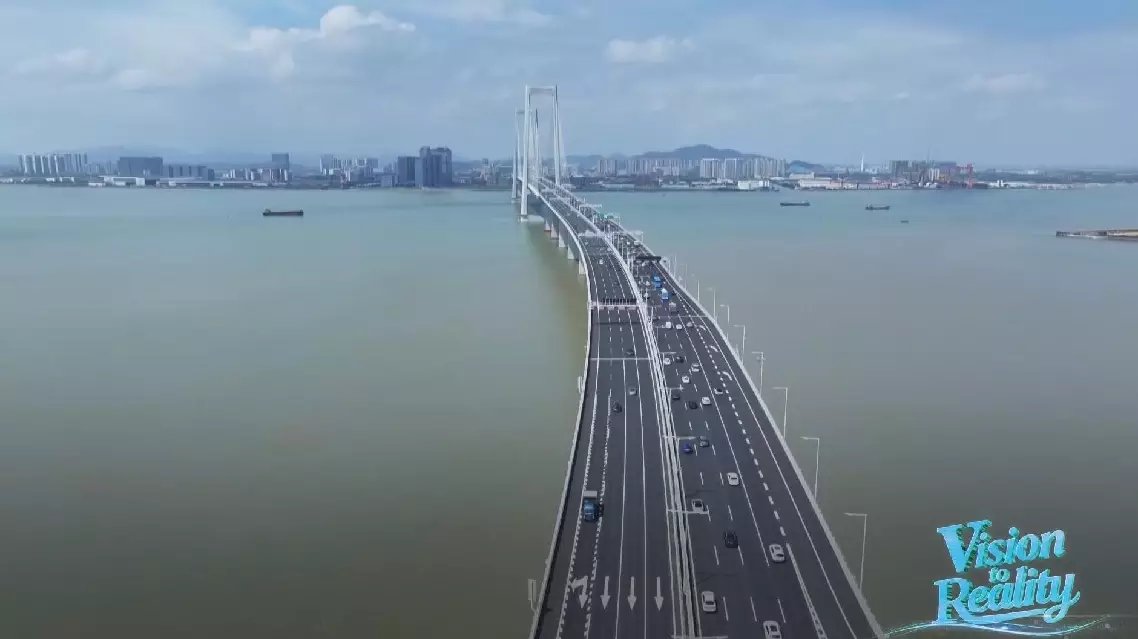
Shenzhen-Zhongshan Link facilitates Greater Bay Area connectivity