Skip to Content Facebook Feature Image

Canadians honor Nanjing Massacre victims, condemn rising militarism

China

China

China

Canadians honor Nanjing Massacre victims, condemn rising militarism

2025-12-14 10:20 Last Updated At:10:37

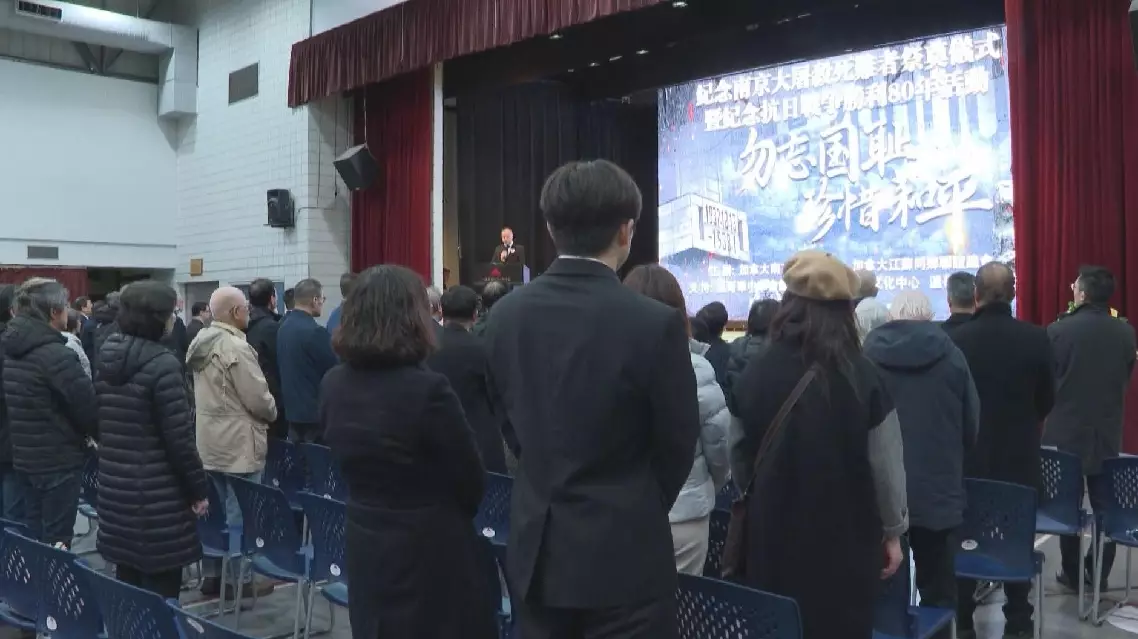
Chinese communities across Canada held memorials on Friday for the victims of the 1937 Nanjing Massacre, marking China's national memorial day and calling for vigilance against the resurgence of militarism.

The ceremonies coincided with the 12th National Memorial Day in China, which commemorates the 300,000 victims killed by Japanese troops during the 1937 Nanjing Massacre. This year's memorial holds special significance as it also marks the 80th anniversary of the end of World War II.

At 18:00 local time (10:00 Beijing time) on Friday, attendees across Canada observed a moment of silence to honor the massacre victims and fallen heroes of Chinese People's War of Resistance against Japanese Aggression. Speakers paid tribute to the victims, denounced provocative remarks by some Japanese politicians regarding China's Taiwan region, and voiced firm opposition to foreign interference in China's internal affairs.

"Some people are trying to revive militarism. They claim that a crisis in the Taiwan Strait would be their business too. I believe this is just the prelude to reviving military aggression. Chinese people at home and abroad must remain on high alert and resolutely fight back against any such rhetoric," said Ma Zaixin, advisor to the Canadian Alliance of Chinese Associations.

As part of the memorial events, attendees also visited a themed photo exhibition titled "Remember History, Cherish Peace," which featured historical images.

"Seeing these photos just now was truly heartbreaking. Our compatriots gave their lives, and yet justice has still not been served for them," said Teresa Wat, member of the Legislative Assembly of British Columbia, Canada.
Canadians honor Nanjing Massacre victims, condemn rising militarism
Canadians honor Nanjing Massacre victims, condemn rising militarism
The closure of Poipet border crossing, the largest land border crossing between Thailand and Cambodia, has left large numbers of people stranded on both sides of the border and unable to return home amid continuing clashes.

At the Thai side of the border on Saturday, security personnel carried out strict checks on all vehicles and people at a distance of about 500 meters from the Poipet crossing, and only those holding Cambodian documents and relevant personnel were allowed access to the area.

"I have been in Thailand for about three to four years, working in a factory. Now the situation at the border is not good, so I want to go back to my hometown," said one of the stranded Cambodian nationals.

Another more than 20 Cambodian nationals failed to go home through the Poipet border crossing on Saturday, and were later picked up by a kind-hearted Thai local, who said that many groups of Cambodians had tried to cross the border every day but failed recently.

"They have no place to sleep, and they would be bitten by mosquitoes if sleeping outdoors, so I want to take them to my place. They just can't go through this checkpoint," said the local.

Thai Foreign Minister Sihasak Phuangketkeow said at a press conference Saturday that 6,000 to 7,000 Thai nationals were stranded on the Cambodian side of the Poipet border checkpoint.

Closure of Poipet border crossing leaves many stranded amid clashes

Closure of Poipet border crossing leaves many stranded amid clashes

Recommended Articles