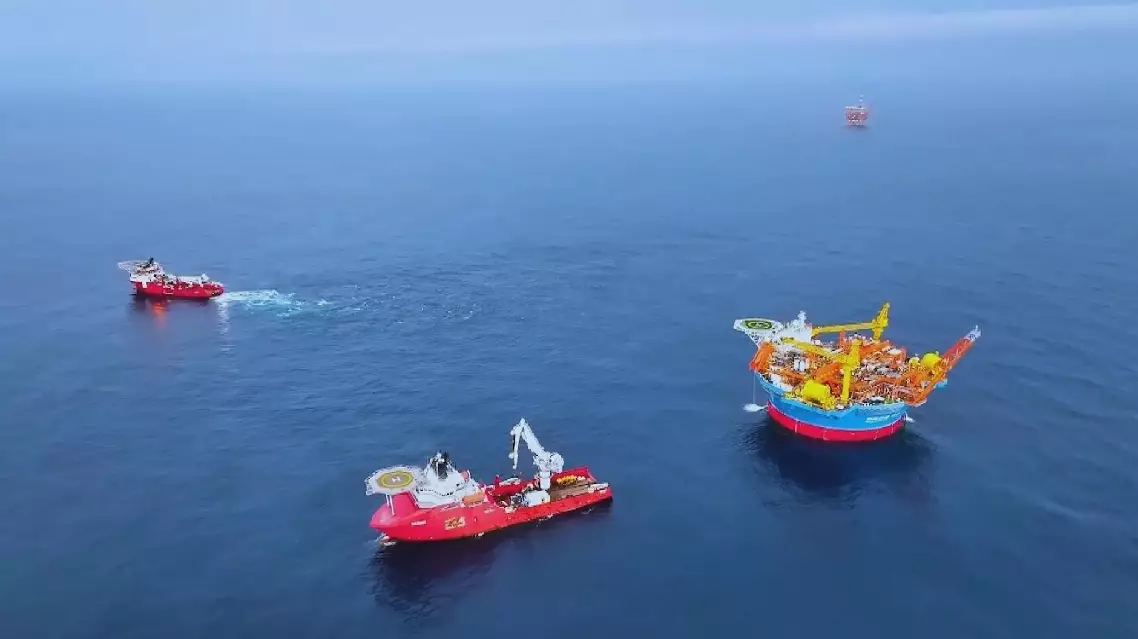
China National Offshore Oil Corporation announced on Sunday that the secondary development project of the Liuhua Oilfield in the eastern part of the South China Sea, the country's first deepwater oilfield, has fully commenced operation, marking China's achievement of a breakthrough in overcoming world-class challenges in the development of deep-water reef limestone oilfields.
The full-scale entry into operation of the project signified a milestone in China's strengthening of its capabilities to develop complex deepwater oil and gas reservoirs, with daily crude oil production reaching a record-high of 3,900 tons. The development meant a leap in the deep-water oil and gas exploration.
The secondary development project comprises two oilfields, the Liuhua 11-1 and the Liuhua 4-1, situated in an area with an average water depth of approximately 305 meters. The project involves 32 production wells.
As the largest offshore reef limestone oilfield in China in terms of proven geological reserves, the Liuhua 11-1 has produced more than 20 million tons of crude oil since it was put into operation in 1996, and 140 million tons of crude oil reserves are still hidden deep in the seabed.
Deepwater reef limestone reservoirs are recognized globally as one of the most challenging in terms of exploration and extraction. Such reefs have very complicated internal structures that consist of caves of varying sizes, dense, sponge-like pores, and a complex network of fractures.
During the initial development phase, the water cut of most production wells in the Liuhua Oilfield surged to over 90 percent within just one year, leading to a significant drop in crude oil output. Stabilizing oil production and controlling water levels, along with improving oil recovery, therefore became crucial for the secondary development of the Liuhua Oilfield.
"After 10 years of efforts to tackle hard technological problems, we have innovatively developed four new extraction processes and two new construction engineering methods, and explored a set of oil stabilization and water control technology systems suitable for special offshore geological conditions. This has effectively improved the crude oil recovery rate and extraction efficiency of the reef limestone oilfield, extending the extraction life of this offshore oilfield by 30 years," said Dai Ling, chief engineer of the Liuhua Oilfield project under China National Offshore Oil Corporation (CNOOC).
Production data show that crude oil production in the Liuhua oilfield secondary development project exceeded expectations, and the overall water cut at production wells decreased significantly, fully demonstrating the reliability of the water control and oil stabilization technology applied.
In recent years, CNOOC has successfully tackled world-class technical challenges of operation in conventional deep water, ultra-deep water, and high-temperature, high-pressure environments, developing a deep-water technology system with independent intellectual property rights. The company now possesses all-round operational capabilities that span from deep water to ultra-deep water and extend from the equatorial regions to the polar areas.
To date, China's deepwater oil and gas production has exceeded 12 million tons of oil and gas equivalent.
China makes breakthrough in deep-water reef limestone oil extraction