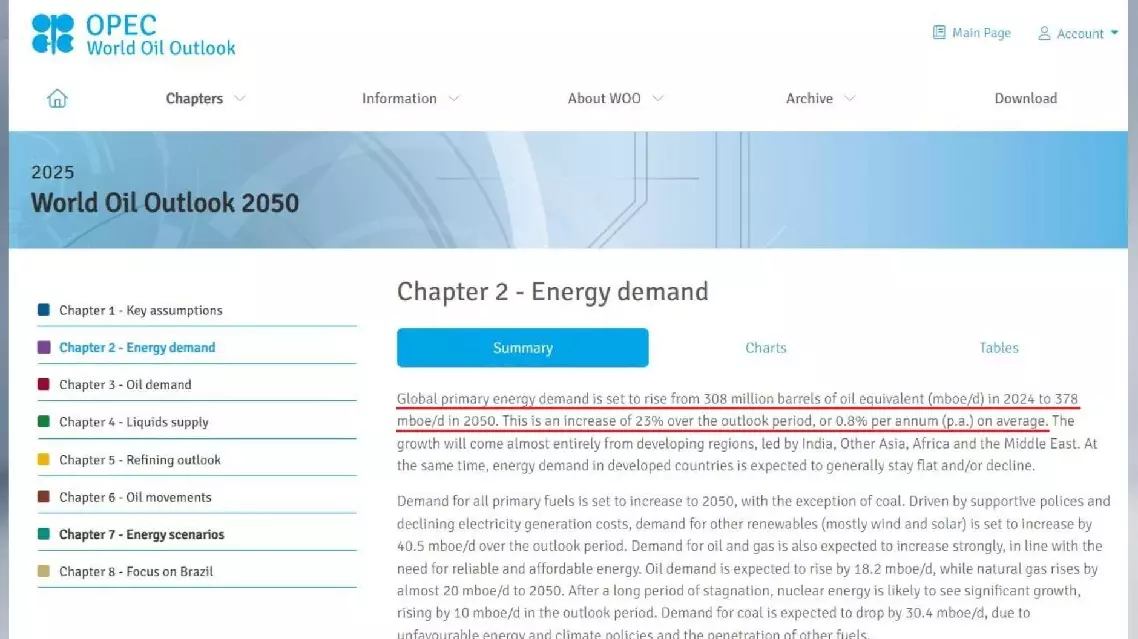
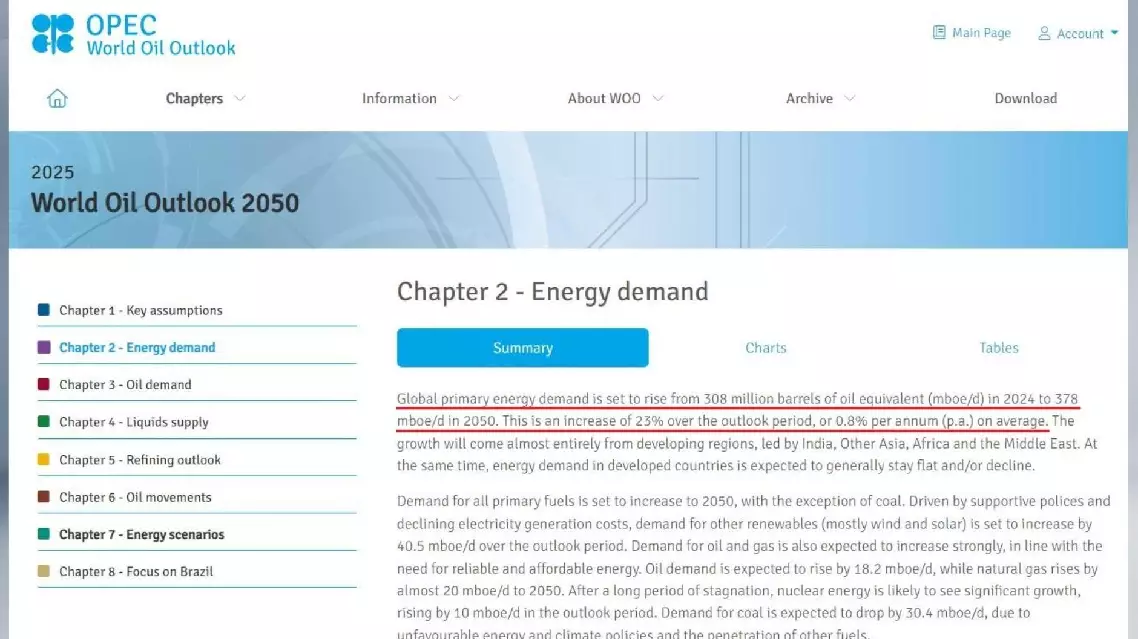
The Organization of the Petroleum Exporting Countries (OPEC) released its latest World Oil Outlook 2050 on Sunday, projecting a 23-percent increase in global energy demand by mid-century.
The report emphasizes that meeting this rising demand and tackling associated challenges will require a comprehensive approach leveraging all forms of energy, advanced technologies, and broad social engagement.
According to the outlook, oil will remain the largest single source of energy through 2050, accounting for just under 30 percent of the global energy mix. Combined, oil and natural gas are expected to sustain a majority share of the world's energy consumption, representing more than half of the total between 2024 and 2050.
The report highlights a stark regional divide in energy trends as nearly all of the projected growth in energy demand will come from developing countries. In contrast, energy consumption in developed nations is expected to remain flat or decline over the same period.

OPEC forecasts 23 pct rise in global energy demand by 2050
OPEC forecasts 23 pct rise in global energy demand by 2050
OPEC forecasts 23 pct rise in global energy demand by 2050
Chinese Premier Li Qiang on Thursday presided over a State Council executive meeting that studied work on building a unified national market and reviewed and approved a plan for the development of a modern emergency response system during the 15th Five-Year Plan period (2026-2030).
Noting that building a unified national market is essential to advancing high-quality development, the meeting called for deepening institutional frameworks in areas such as property rights protection, market access, fair competition, social credit and market exit mechanisms.
The meeting also urged efforts to advance high-standard connectivity of market infrastructure to facilitate smooth economic circulation and effectively reduce logistics costs across society.
Emergency management is critical to protecting people's lives and property, the meeting said. It called for accelerating the development of a modern emergency response system, deepening reform and innovation in emergency management, and improving coordinated response mechanisms.
Efforts should be made to strengthen risk prevention at the source, enhance monitoring, forecasting and early warning, and accelerate a shift in governance toward proactive prevention, according to the meeting.
A draft revision of the Law on the People's Bank of China was also discussed and approved in principle at the meeting, which decided to submit the draft to the Standing Committee of the National People's Congress for deliberation.
Chinese premier chairs State Council executive meeting