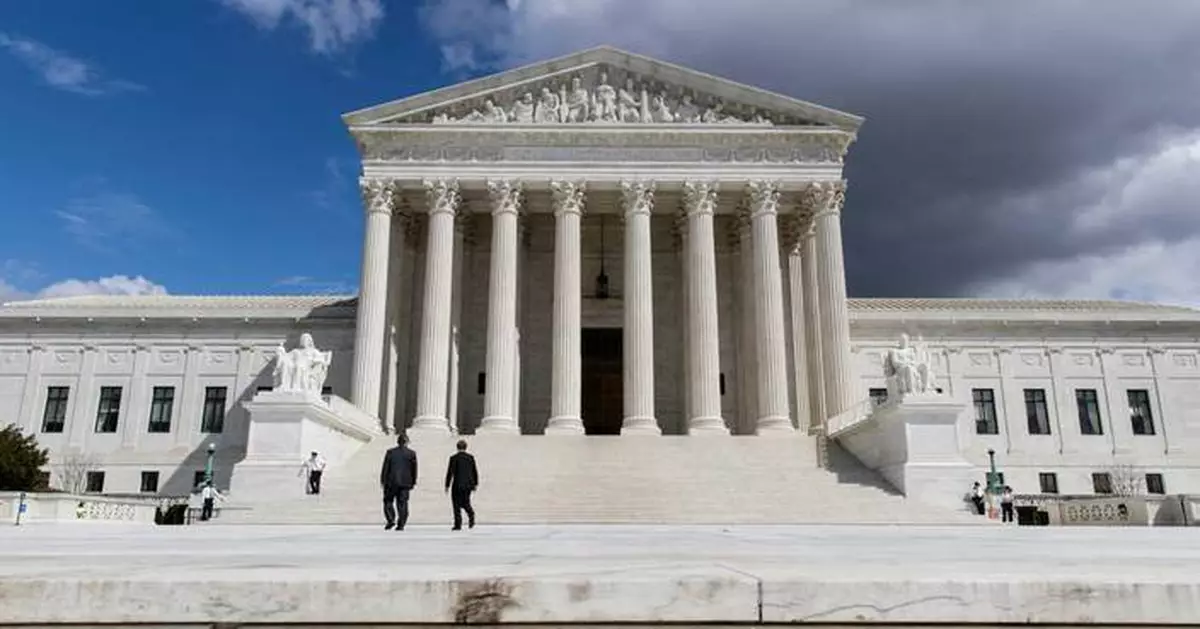
WASHINGTON (AP) — The Supreme Court on Monday agreed to hear the appeal of a Black death row inmate from Mississippi whose case was handled by a prosecutor with a history of dismissing Black jurors for discriminatory reasons.
A federal judge had previously overturned the murder conviction of the inmate, Terry Pitchford, but an appeals court reversed that ruling.
The justices stepped into the case involving the same prosecutor, former District Attorney Doug Evans, who was at the center of a high court case that resulted in a 2019 decision that overturned the death sentence and conviction of Curtis Flowers.
The case will be argued in the spring.
U.S District Judge Michael P. Mills held that the judge who oversaw Pitchford’s trial didn’t give the man’s lawyer enough chance to argue that the prosecution was improperly dismissing Black jurors.
Mills wrote that his ruling was partially motivated by Evans' actions in prior cases.
Pitchford was sentenced to death for his role in the 2004 killing of Reuben Britt, the owner of the Crossroads Grocery, just outside Grenada in northern Mississippi.
In Pitchford’s case, judges and lawyers whittled down the original jury pool of 61 white and 35 Black members to a pool with 36 white and five Black members, in part because so many Black jurors objected to sentencing Pitchford to death. Then prosecutors struck four more Black jurors, leaving only one Black person on the final jury.
The Supreme Court tried to stamp out discrimination in the composition of juries in Batson v. Kentucky in 1986. The court ruled then that jurors couldn’t be excused from service because of their race and set up a system by which trial judges could evaluate claims of discrimination and the race-neutral explanations by prosecutors.
When the Supreme Court ruled in favor of Flowers, Justice Brett Kavanaugh wrote that Evans had engaged in a “relentless, determined effort to rid the jury of Black individuals."
Flowers was tried six times in the shooting deaths of four people. He was released from prison in 2019 and the state dropped the charges against him the following year, after Evans turned the case over to state officials.
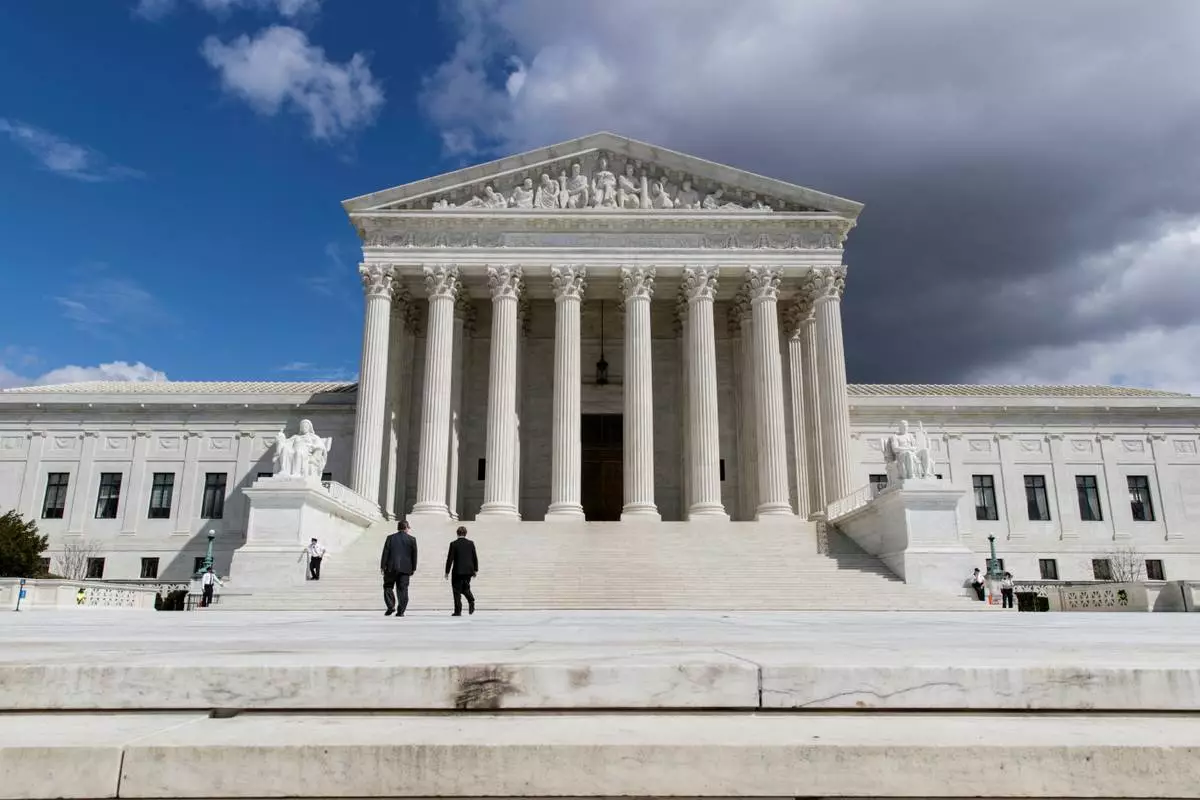
FILE - The Supreme Court Building is seen in Washington on March 28, 2017. (AP Photo/J. Scott Applewhite, File)
NEW YORK (AP) — Wall Street is drifting in mixed trading on Monday at the start of a week full of economic reports that could drive where interest rates, and thus stock prices, go.
The S&P 500 was virtually unchanged in morning trading, coming off its first losing week in the last three. The Dow Jones Industrial Average was up 5 points, or less than 0.1%, as of 10 a.m. Eastern time, and the Nasdaq composite was 0.2% lower.
Helping to keep the overall market in check were stocks in the artificial-intelligence industry, which were mixed following their scary swings last week.
Nvidia, the chip company that’s become the face of the AI boom, rose 1.1%. It was one of the strongest forces pushing upward on the S&P 500 Monday after dropping 4.1% last week.
But Oracle sank another 4.3% following its 12.7% tumble last week, which was its worst in more than seven years. Broadcom fell 2.7%.
AI stocks have been shaky on worries that all the billions of dollars flowing into chips and data centers may not produce a big-enough payoff of profits and productivity to make it worth it. The doubts are causing cracks for the industry, whose earlier surges was the main driver for the U.S. market’s rally to records.
Besides AI, the main focus on Wall Street this week will be what several big updates on the U.S. economy’s health say.
On Tuesday will come the jobs report for November, and economists expect it to show employers added 40,000 more jobs than they cut during the month. Thursday will bring an update on the inflation that U.S. consumers are feeling, and economists expect it to show inflation was at 3.1% last month, still higher than households and policymakers would like.
Such data is under the microscope because the Federal Reserve is trying to figure out if a slowing job market or high inflation is the bigger problem for the economy. The Fed is in a potentially tough spot because fixing one of those problems by moving interest rates would likely worsen the other in the short term.
The hope on Wall Street is that the job market weakens, but only by a little: enough to get the Fed to lower interest rates but not so much that a recession swamps the economy. Wall Street loves lower rates because they can give the economy and prices for investments a boost, even if they also may worsen inflation.
“With the Fed still appearing to be more focused on labor-market weakness than inflation, we’re likely facing a ‘bad news is good’ scenario for the jobs report,” according to Chris Larkin, managing director, trading and investing, at E-Trade from Morgan Stanley.
“As long as the numbers don’t suggest employment is falling off a cliff,” that would mean the market would likely welcome soft numbers, he said.
The spotlight will be brightest on the unemployment rate, not the overall job growth numbers, because the latter is feeling downward pressure from a drop-off in immigrant workers. Economists expect Tuesday’s report to show the unemployment rate at 4.4%, which would keep it near its highest and worst level since 2021.
Treasury yields eased in the bond market ahead of the updates. A report earlier on Monday morning also said that a measure of manufacturing strength in New York state unexpectedly weakened, when economists expected to see continued growth.
The yield on the 10-year Treasury fell to 4.15% from 4.19% late Friday.
Elsewhere on Wall Street, shares of iRobot tumbled 66.8% after the maker of Roomba vacuums said holders of its stock will likely face a total loss after it filed for Chapter 11 bankruptcy protection over the weekend. The company has reached an agreement with its primary contract manufacturer, Picea, to buy it through a court-supervised process.
In stock markets abroad, indexes rose in Europe following weaker finishes in Asia.
Indexes fell 1.3% in Hong Kong and 0.6% in Shanghai after the Chinese government reported a drop in investment in factory equipment, infrastructure and other fixed assets. It’s the latest signal that demand in the world’s second-largest economy remains weak.
Japan’s Nikkei 225 sank 1.3% after a quarterly survey of big manufacturers by the central bank showed a slight improvement in sentiment. That could encourage the Bank of Japan to go ahead with a hike to interest rates.
AP Business Writer Elaine Kurtenbach contributed.
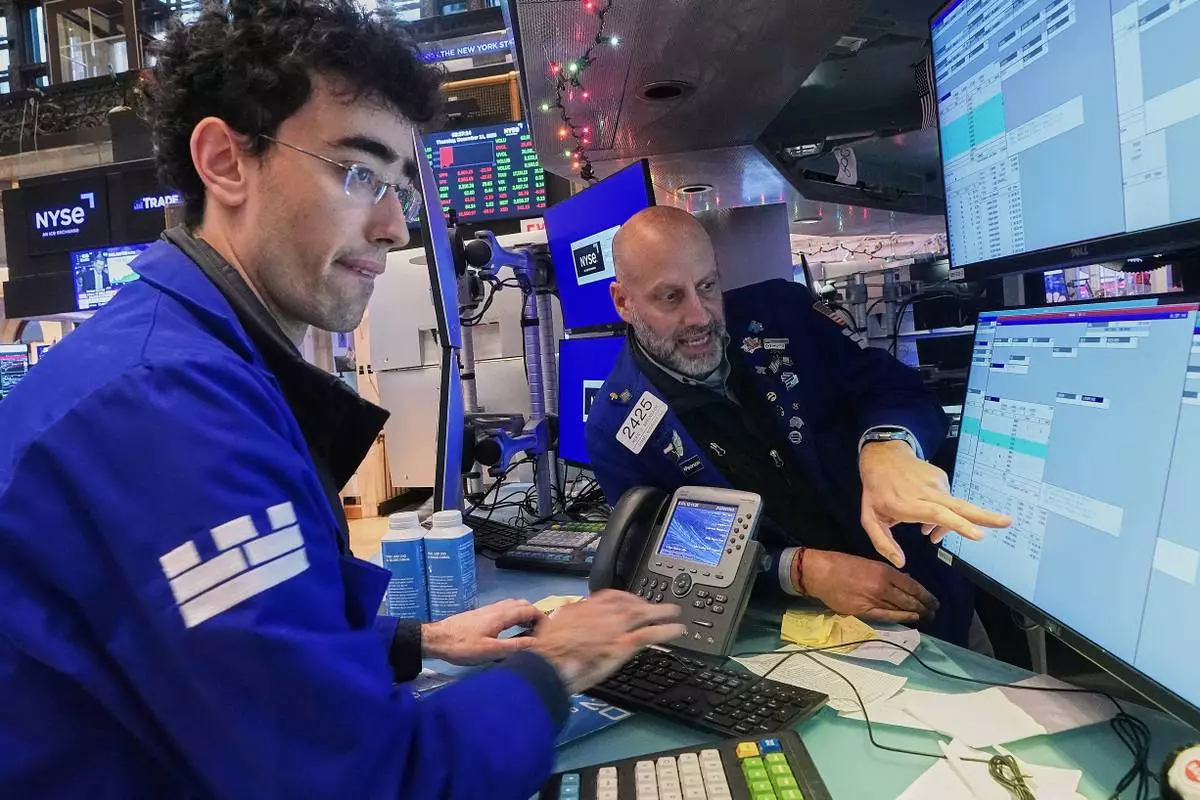
Specialists Alex Weitzman, left, and Meric Greenbaum work on the floor of the New York Stock Exchange, Thursday, Dec. 11, 2025. (AP Photo/Richard Drew)

A currency trader watches monitors near a screen showing the Korea Composite Stock Price Index (KOSPI), left, and the foreign exchange rate between U.S. dollar and South Korean won at the foreign exchange dealing room of the Hana Bank headquarters in Seoul, South Korea, Monday, Dec. 15, 2025. (AP Photo/Ahn Young-joon)

A currency trader passes by a screen showing the Korea Composite Stock Price Index (KOSPI), left, and the foreign exchange rate between U.S. dollar and South Korean won at the foreign exchange dealing room of the Hana Bank headquarters in Seoul, South Korea, Monday, Dec. 15, 2025. (AP Photo/Ahn Young-joon)

A currency trader works near a screen showing the Korea Composite Stock Price Index (KOSPI), top center left, and the foreign exchange rate between U.S. dollar and South Korean won, top center, at the foreign exchange dealing room of the Hana Bank headquarters in Seoul, South Korea, Monday, Dec. 15, 2025. (AP Photo/Ahn Young-joon)
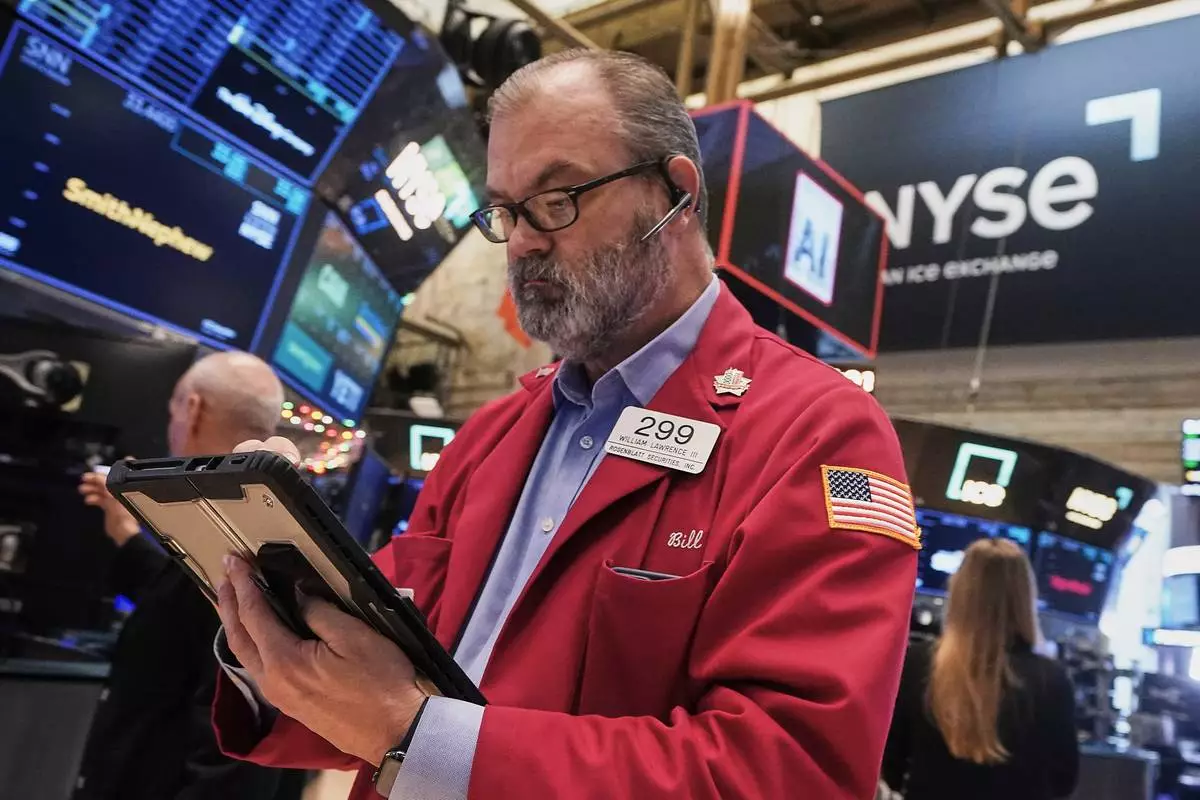
Trader William Lawrence works on the floor of the New York Stock Exchange, Thursday, Dec. 11, 2025. (AP Photo/Richard Drew)