WASHINGTON (AP) — President Donald Trump filed a lawsuit Monday seeking $10 billion in damages from the BBC, accusing the British broadcaster of defamation as well as deceptive and unfair trade practices.
The 33-page lawsuit accuses the BBC of broadcasting a “false, defamatory, deceptive, disparaging, inflammatory, and malicious depiction of President Trump,” calling it “a brazen attempt to interfere in and influence” the 2024 U.S. presidential election.
It accused the BBC of “splicing together two entirely separate parts of President Trump’s speech on January 6, 2021” in order to ”intentionally misrepresent the meaning of what President Trump said.”
The BBC did not immediately respond to a request for comment from The Associated Press.
The broadcaster had apologized last month to Trump over the edit of the Jan. 6 speech. But the publicly funded broadcaster rejected claims it had defamed him, after Trump threatened legal action.
BBC chairman Samir Shah had called it an “error of judgment,” which triggered the resignations of the BBC’s top executive and its head of news.
The speech took place before some of Trump’s supporters stormed the U.S. Capitol as Congress was poised to certify President-elect Joe Biden’s victory in the 2020 election that Trump falsely alleged was stolen from him.
The BBC had broadcast the hourlong documentary — titled “Trump: A Second Chance?” — days before the 2024 U.S. presidential election. It spliced together three quotes from two sections of the 2021 speech, delivered almost an hour apart, into what appeared to be one quote in which Trump urged supporters to march with him and “fight like hell.” Among the parts cut out was a section where Trump said he wanted supporters to demonstrate peacefully.
Trump said earlier Monday that he was suing the BBC “for putting words in my mouth.”
“They actually put terrible words in my mouth having to do with Jan. 6 that I didn’t say, and they’re beautiful words, that I said, right?" the president said unprompted during an appearance in the Oval Office. "They’re beautiful words, talking about patriotism and all of the good things that I said. They didn’t say that, but they put terrible words.”
The president's lawsuit was filed in Florida. Deadlines to bring the case in British courts expired more than a year ago.
Legal experts have brought up potential challenges to a case in the U.S. given that the documentary was not shown in the country.
The lawsuit alleges that people in the U.S. can watch the BBC's original content, including the “Panorama” series, which included the documentary, by using the subscription streaming platform BritBox.
The 103-year-old BBC is a national institution funded through an annual license fee of 174.50 pounds ($230) paid by every household that watches live TV or BBC content. Bound by the terms of its charter to be impartial, it typically faces especially intense scrutiny and criticism from both conservatives and liberals.
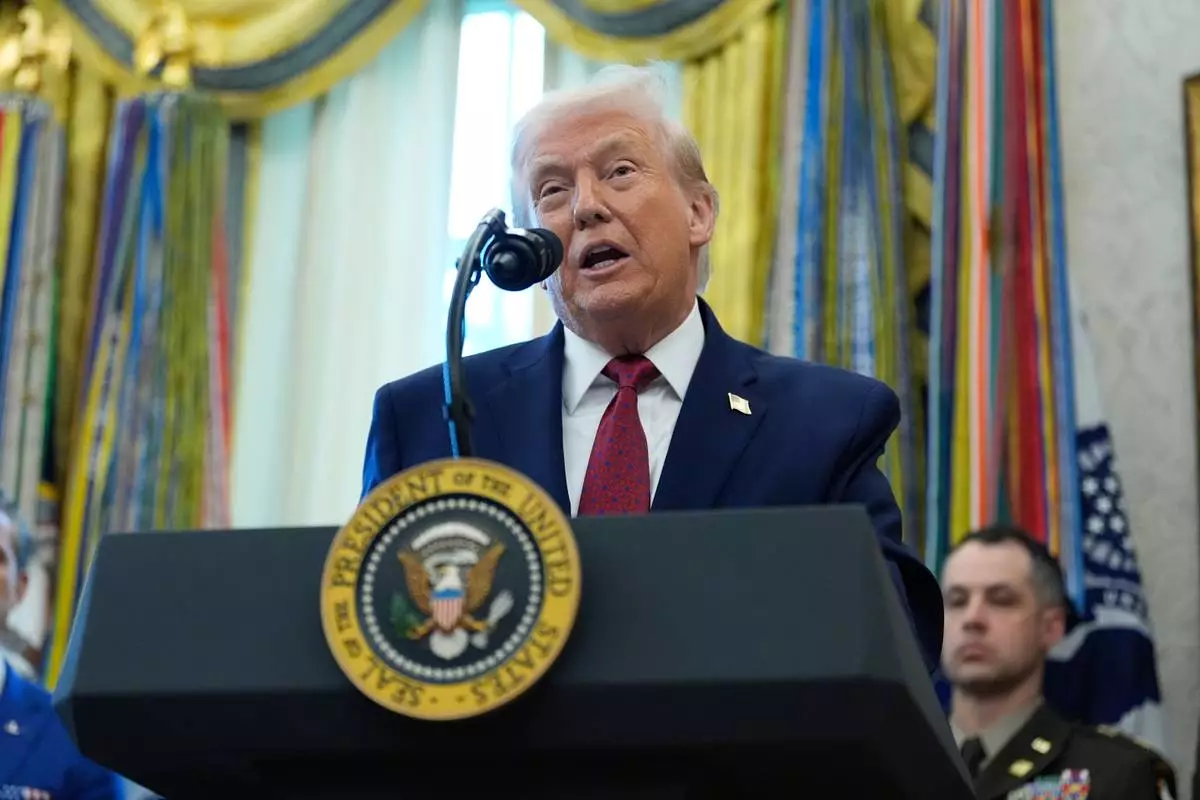
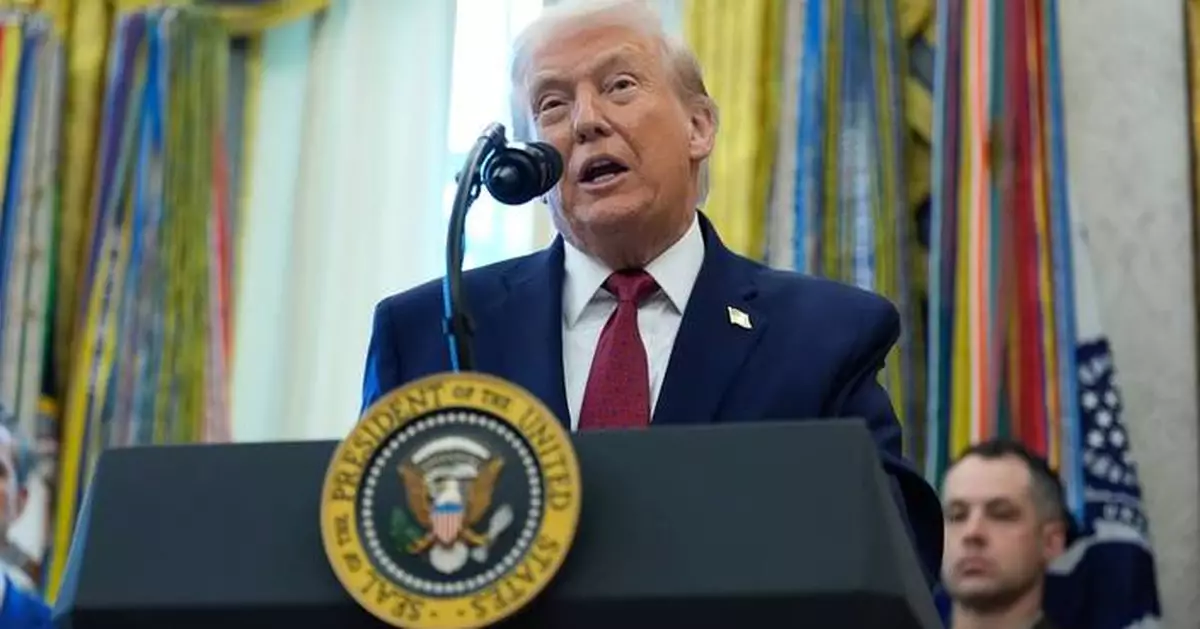
President Donald Trump speaks during a Mexican Border Defense Medal presentation in the Oval Office of the White House, Monday, Dec. 15, 2025, in Washington. (AP Photo/Alex Brandon)
On a recent December day, Mark Latino and a handful of his workers spun sheets of vinyl into tinsel for Christmas tree branches. They worked on a custom-made machine that’s nearly a century old, churning out strands of bright silver tinsel along its 35-foot (10-meter) length.
Latino is the CEO of Lee Display, a Fairfield, California-based company that his great-grandfather founded in 1902. Back then, it specialized in handmade velvet and silk flowers for hats. Now, it's one of the only companies in the United States that still makes artificial Christmas trees, producing around 10,000 each year.
Tariffs shone a twinkling light this year on fake Christmas trees — and the extent to which America depends on other countries for its plastic fir trees.
Prices for fake trees rose 10% to 15% this year due to the new import taxes, according to the American Christmas Tree Association, a trade group. Tree sellers cut their orders and paid higher tariffs for the stock they brought in.
Despite those issues, tree companies say they aren’t likely to shift large-scale production back to the U.S. after decades in Asia. Fake trees are labor-intensive and require holiday lights and other components the U.S. doesn’t make, said Chris Butler, CEO of the National Tree Co., which sells more than 1 million artificial trees each year.
Americans are also very price-sensitive when it comes to holiday décor, Butler said.
“Putting a ‘Made in the U.S.A.’ sticker on the box won’t do any good if it’s twice as expensive,” Butler said. “If it’s 20% more expensive, it won’t sell.”
About 80% of the U.S. residents who put up a Christmas tree this year planned to use a fake one, according to the American Christmas Tree Association. That percentage has been unchanged for at least 15 years.
Mac Harman, the founder and CEO of Balsam Brands, which sells hundreds of thousands of Balsam Hill trees each year, said Americans like to set up their trees on Thanksgiving and leave them up for weeks, which dries out fresh-cut trees. Others prefer fake trees because they’re allergic to the mold spores on real trees, he said.
Americans also like convenience; 80% of the fake trees sold each year have the lights already strung on them, Butler said.
That preference is one reason artificial tree production shifted away from the U.S., first to Thailand in the early 1990s and to China about a decade later. Winding lights around the branches is time-consuming and tedious, Harman said.
“Where are we going to get 15,000 people in America who want to string lights on Christmas trees?” Harman said.
It takes an hour or two to make an artificial Christmas tree, from molding and cutting the needles to tying branches together and attaching the lights, Butler said. Workers in China, where 90% of fake trees are made, are paid $1.50 to $2 per hour, he said.
Harman said the workers who wrap the lights on Balsam Hill's trees are so efficient “it's like watching an Olympian.”
One of Balsam Brands’ Chinese partners employs 15,000 to 20,000 people; another in Indonesia has up to 10,000, he said. Many are seasonal workers, since orders for Christmas décor slow down between October and February.
Balsam Brands, which is based in Redwood City, California, studied whether it could make faux trees in Ohio during the first Trump administration, when President Donald Trump threatened -– but eventually delayed –- tariffs on imported Christmas décor, Harman said.
The company hired consultants and considered automating some work. But it concluded a tree that currently sells for $800 would cost $3,000 if it was made in the U.S. Harman said Balsam couldn’t even find a U.S. company to make the pair of gloves it includes in each box for fluffing out branches.
Lee Display employs three or four people for most of the year, adding more during the holiday rush to help with installations and displays. About half its business is making custom displays for companies such as Macy’s, while the other half is selling directly to consumers.
Latino said he likes that he can produce an order quickly instead of waiting for it to ship from overseas.
“You have more control over it. I like to think that everything here is either my fault or my mistake or my careful planning and skill,” he said.
The tariffs still affected Lee Display. Latino's son James, who leads business development and marketing, said the company didn’t import lights or decorations from China this year and relied on items it already had in stock. It's getting low on lights, so next year it will have to pay more to import them, he said.
Some artificial tree companies are branching out so they’re less reliant on China. National Tree Co., which is based in Cranford, New Jersey, moved some manufacturing to Cambodia in 2024, and could source all its trees from outside China by next year if it wanted to, Butler said.
But diversifying their suppliers didn't make those companies immune from the impact of tariffs either. In April, the Trump administration threatened a 49% tariff against products from Cambodia. That rate was eventually reduced to 19%. Tariffs on artificial trees from China also bounced around but now average 20%, according to the American Christmas Tree Association.
Butler said his company imported fewer trees this year and also raised prices by 10%. He said he used a lot of the money to offer customer discounts since demand was weak because of consumer worries about the economy.
“It’s a discretionary item. People say, ‘I can wait one more year,’” Butler said.
Balsam Brands cut its workforce by 10%, canceled travel, froze raises and even stopped serving lunch in the office once a week to absorb the impact of tariffs, Harman said. It also raised tree prices by 10%.
Harman said his sales are down 5% to 10% this year in the U.S. but up 10% or more in Germany, Australia, Canada and France. That tells him tariffs have decreased U.S. demand.
“If a merry Christmas is measured in how many decorations people put up, by that measure it's going to be a slightly less merry Christmas,” he said.
AP Video Journalist Terry Chea contributed from Fairfield, California.
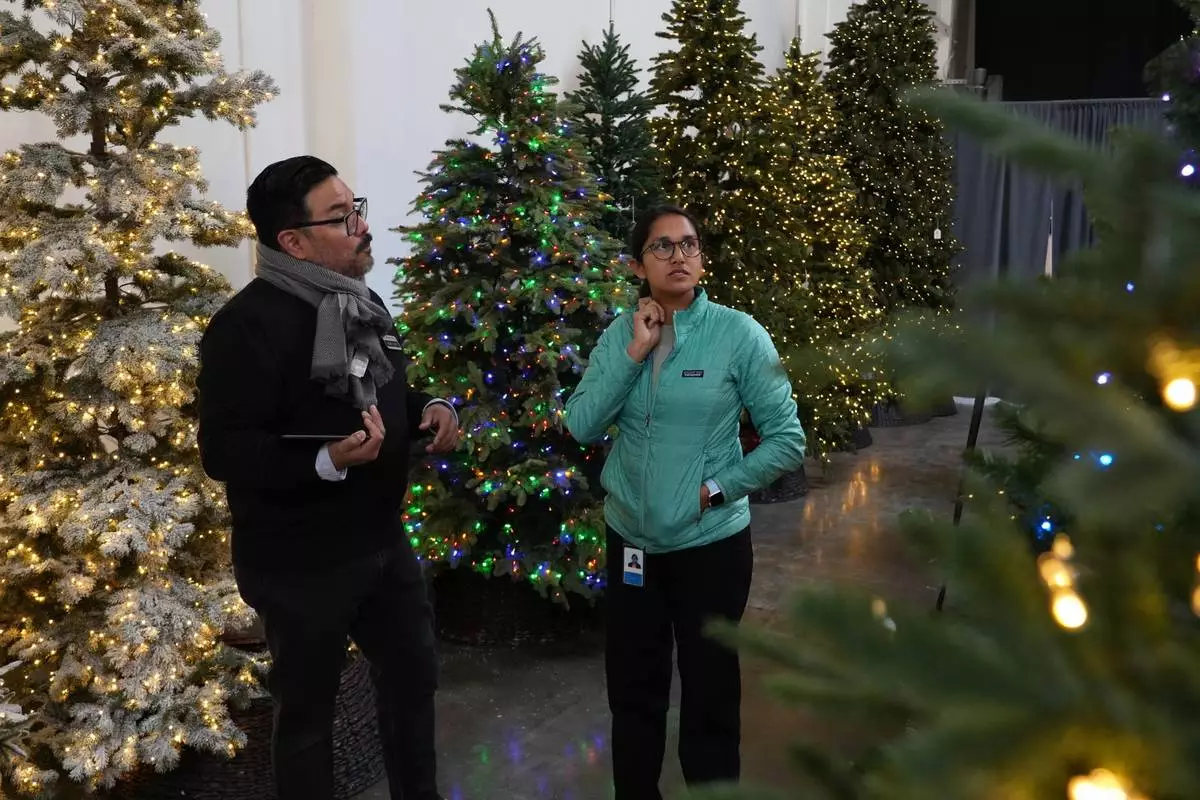
Anjali Bisaria shops for an artificial Christmas tree at the Balsam Hill outlet store in Burlingame, Calif. on Dec. 10, 2025. (AP Photo/Terry Chea)
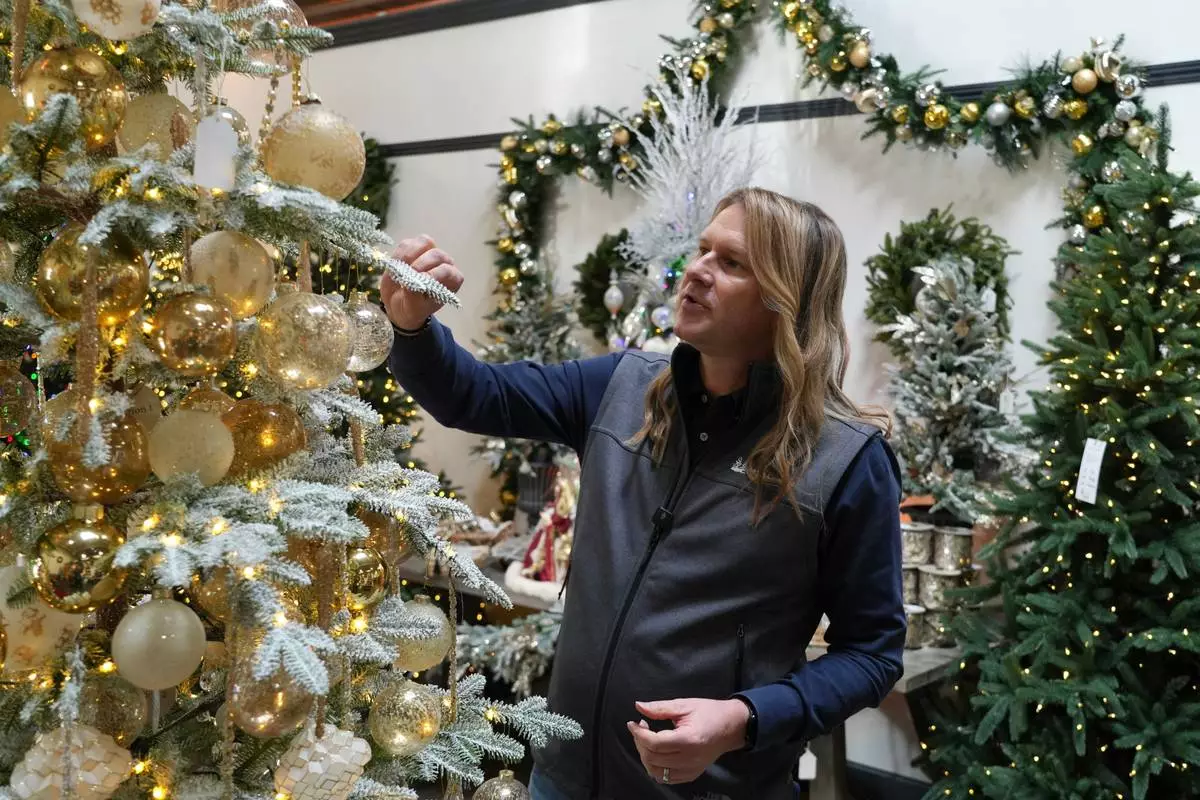
Mac Harman, founder and CEO of Balsam Hill, looks at artificial Christmas trees at the company's outlet store in Burlingame, Calif. on Dec. 10, 2025. (AP Photo/Terry Chea)
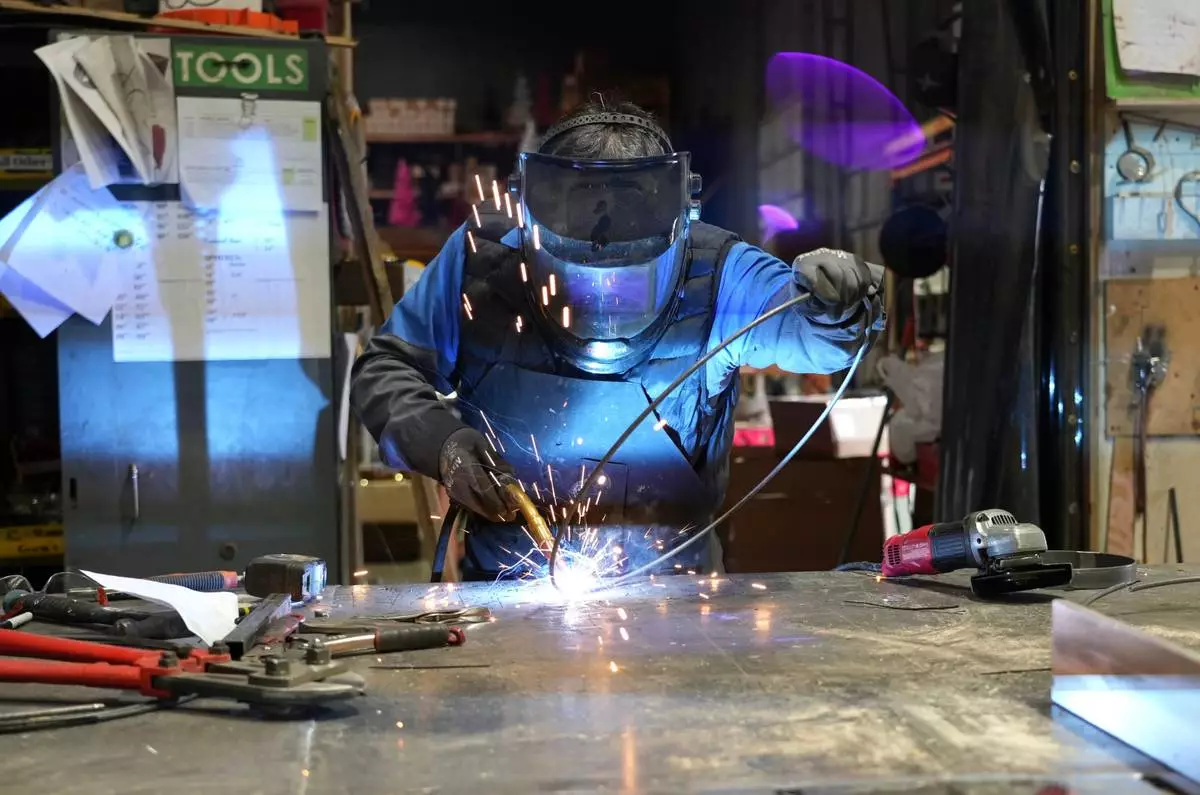
Juan Gonzalez assembles an artificial Christmas wreath at Lee Display's warehouse, in Fairfield, Calif., Tuesday, Dec. 9, 2025. (AP Photo/Terry Chea)
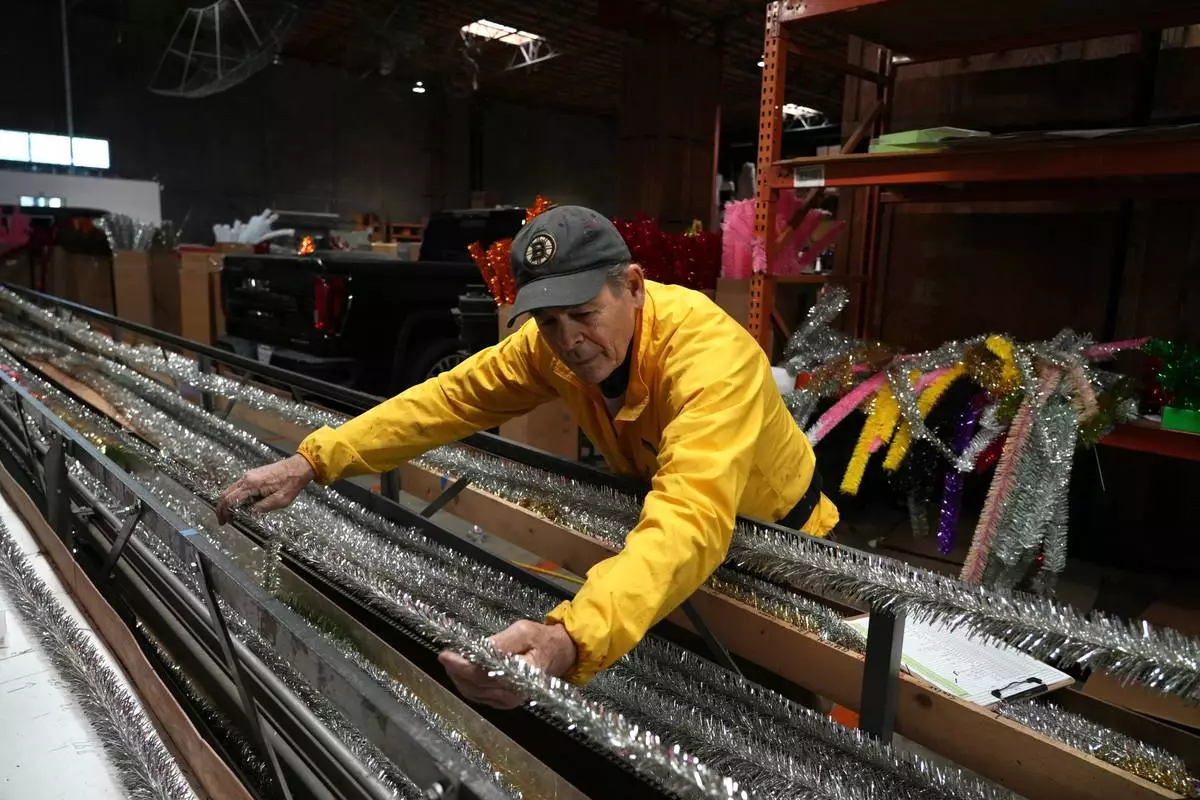
Mark Latino, CEO of Lee Display, works with a machine that makes tinsel brush for artificial Christmas trees at the company's warehouse, in Fairfield, Calif., Tuesday, Dec. 9, 2025. (AP Photo/Terry Chea)
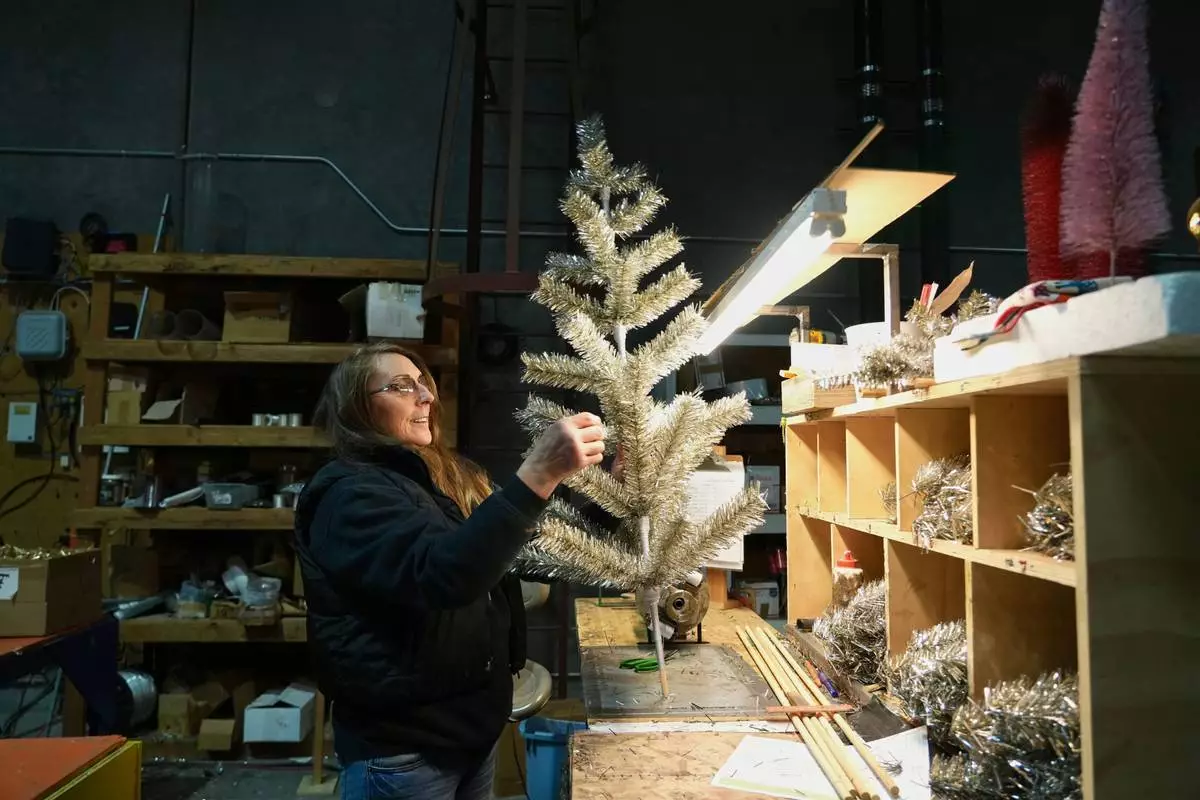
Melissa Webb assembles an artificial Christmas tree at Lee Display's warehouse, in Fairfield, Calif., Tuesday, Dec. 9, 2025. (AP Photo/Terry Chea)