The small town of Poipet, located on the Thailand-Cambodia border, has come to a standstill since the latest round of conflict broke out in early December, disrupting the supply of essential daily necessities and leaving local businesses facing uncertainty about their future.
The Poipet crossing, the largest land border gateway between the two Southeast Asian countries, is now quiet, with only military and police forces present.
On December 13, Cambodia's Ministry of Interior announced the suspension of all border crossings with Thailand, accusing the Thai side of causing civilian casualties and damaging residential areas and infrastructure in "indiscriminate attacks."
On Monday, in a market at the Thai side of the Poipet crossing, the streets were deserted, and shops were closed with their doors locked and chairs upside down on tables.
Amid escalating clashes and fierce exchanges of fire along the border, the local government issued an evacuation order on December 8.
Among those affected is textile trader Saeyang, who returned to his store after fleeing to Bangkok for a week due to the conflict. He expressed his homesickness and a desire to clean up his shop, but noted that business was no longer viable, leaving him no choices but to go to Bangkok.
"This incident has a significant impact [on us]. Now that all the border crossings and markets have been closed, it's completely impossible to do business. If the conflicts and exchanges of fire along the border continue, I will have to move to another place to do business. I might go to Bangkok and work there," he said.
The conflict's spillover has engulfed the entire border service sector, with hotels, which formerly relied on one-day cross-border tours, among the first hit.
"My hotel is located in Aranyaprathet in Sa Kaeo Province in the border area. Both our employees and guests must leave, which led to a 90-percent reduction in revenue, leaving the hotel with basically no income," said Cham, a hotel manager.
In response to the unrest, the Thai military has imposed a strict curfew in four border counties of Sa Kaeo, prohibiting outdoor activities from 19:00 to 05:00 daily.
At a nearby convenience store, shelves that typically stocked fresh produce, including milk, fruits, and vegetables, were completely empty.
A clerk explained that deliveries had been suspended because night-time operations were not permitted, and it was difficult to preserve fresh goods. The store's operating hours have also been reduced to 07:00 to 16:00.
The economic toll of the Thai-Cambodian conflict is starkly evident in data from Thailand's Ministry of Commerce. From January to May this year, monthly cross-border trade averaged a steady 16 billion Thai baht (approximately 507.83 million U.S. dollars). After clashes erupted in July, trade collapsed to mere 11 million baht per month, less than one-thousandth of its prior level. Notably, Thailand's imports from Cambodia dropped to zero in September, data showed.
According to reports from both countries on Tuesday, the latest round of border clashes has resulted in the deaths of 17 Thai soldiers and 15 Cambodian civilians.
The conflict reignited on December 7, with the two sides accusing each other of firing first.
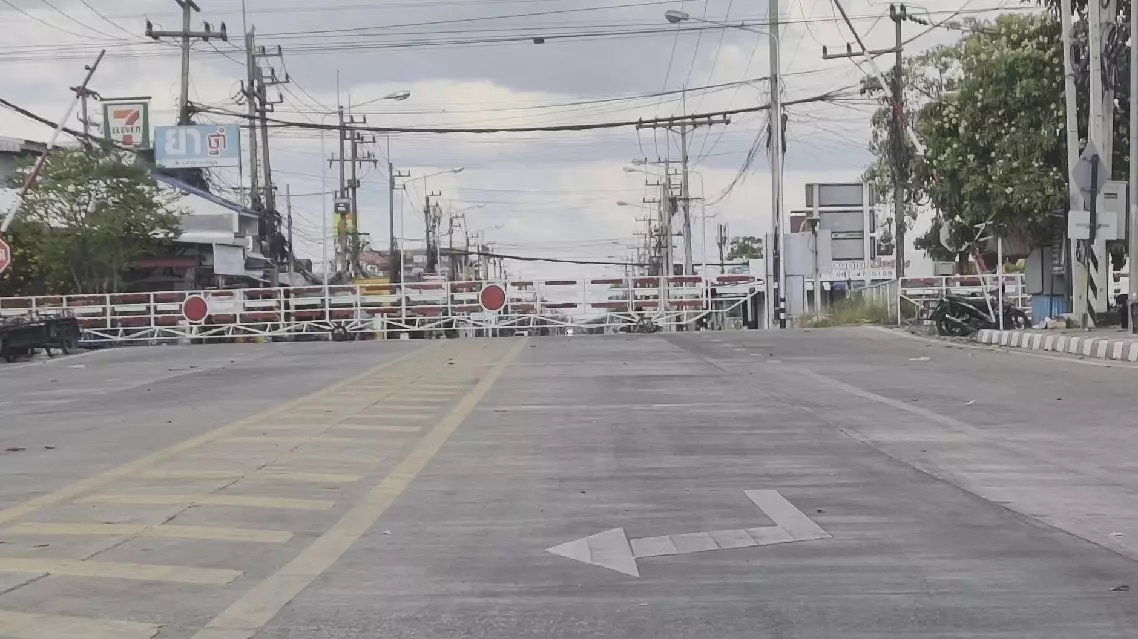
Border town grinds to halt amid ongoing Thailand-Cambodia border clashes
Iran's official news agency IRNA on Wednesday evening published the full text of a recently finalized memorandum of understanding (MoU) between Tehran and Washington on ending the war.
According to the released text, by signing the MoU, Iran and the United States, along with their allies, will jointly agree to end the war and military operations on all fronts, including Lebanon, immediately and permanently, and undertake from now on not to initiate any war or military operation against each other, refrain from the threat or use of force against each other and guarantee Lebanon's territorial integrity and national sovereignty.
Iran and the United States commit to respecting each other's sovereignty and territorial integrity and refraining from interfering in each other's internal affairs, IRNA said, quoting the MoU.
It said Iran and the United States also commit to holding negotiations and reaching a final agreement within a maximum period of 60 days, extendable by mutual consent.
According to IRNA, immediately upon the MoU's signing, the United States will begin to lift its anti-Iran naval blockade and stop any harassment or obstruction against the country, and will fully end the blockade within 30 days.
It said during this period, traffic by vessels will return to the pre-war level to be restored by Iran, and the United States also undertakes to withdraw its military forces from areas around Iran within 30 days after the final agreement.
The report said by signing the MoU, Iran will make arrangements to the best of its ability to provide safe passage for commercial ships free of charge, only for a period of 60 days, from the Persian Gulf to the Gulf of Oman and vice versa, adding that commercial ships' passage will commence immediately and will be established within 30 days given the need for removing technical and military obstacles and demining by Iran.
Besides, Iran will hold discussions with Oman on the future management and maritime services in the Strait of Hormuz in accordance with applicable international law and the sovereign rights of the waterway's coastal states, and will also exchange views with other Gulf littoral states, IRNA said.
It said that the United States commits, along with its regional partners, to developing a definitive and mutually agreed-upon plan for Iran's reconstruction and economic development by providing at least 300 billion U.S. dollars, and the plan's executive mechanism will be finalized as part of the final agreement within 60 days.
IRNA said it is stipulated in the MoU that the United States will provide all necessary approvals, waivers, and permissions for relevant financial transactions.
In addition, the report added, the United States commits to lifting all types of sanctions against Iran, including the resolutions of the UN Security Council and the Board of Governors of the International Atomic Energy Agency (IAEA), and all unilateral U.S. sanctions, both the primary and secondary ones, on a timetable to be agreed as part of the final agreement.
According to IRNA, Iran and the United States recognize the fundamental importance of the issue of lifting sanctions and express their intention to immediately address these issues in negotiations to reach a mutual agreement.
By signing the MoU, the report said, Iran reaffirms its commitment not to develop or purchase nuclear weapons, and Tehran and Washington have agreed to resolve the issue pertaining to Tehran's stockpile of enriched uranium through a mutually agreed mechanism and in accordance with the timetable set out in the peace deal at least by means of on-site dilution under the IAEA's supervision.
The two sides also agree to discuss the issue of enrichment and other mutually agreed matters related to Iran's nuclear needs on the basis of a framework to be agreed in the final agreement.
According to the MoU, Iran and the United States agree to maintain the status quo until the final agreement is reached; Tehran will maintain the status quo of its nuclear program, and Washington will not impose any new sanctions or deploy additional military forces to the region.
IRNA said under the MoU, the United States undertakes that immediately upon the signing of the deal and until the termination of sanctions, U.S. Department of the Treasury will issue waivers for the export of Iranian crude oil, petroleum products, and derivatives, and all associated services, including banking transactions, insurance, and transportation.
It added that Washington also commits to fully making available any restricted or frozen Iranian funds and assets upon the MoU's implementation, stressing that the two sides will mutually agree on the procedures to release the funds during the upcoming negotiations, and the United States undertakes to issue all necessary licenses and authorizations accordingly.
It has been stipulated in the MoU that an executive mechanism will be established to monitor the successful implementation of the deal and future compliance with the final deal.
According to IRNA, following the MoU signing, Iran and the United States will start negotiations on the final deal, which will be endorsed by a binding UN Security Council resolution.
Iran, the United States, and Pakistan early Monday announced the finalization of the MoU on ending the war following weeks of negotiations.
Iran's Foreign Ministry spokesman Esmaeil Baghaei said early Thursday in an interview with state-run IRIB TV that Iranian President Masoud Pezeshkian and his U.S. counterpart, Donald Trump, had digitally signed the MoU.
On Feb. 28, Israel and the United States launched joint attacks on Tehran and other Iranian cities. Iran responded with waves of missile and drone attacks targeting Israel and U.S. bases and assets in the region, and tightened its grip on the Strait of Hormuz, barring safe passage of vessels belonging to or affiliated with Israel and the United States.
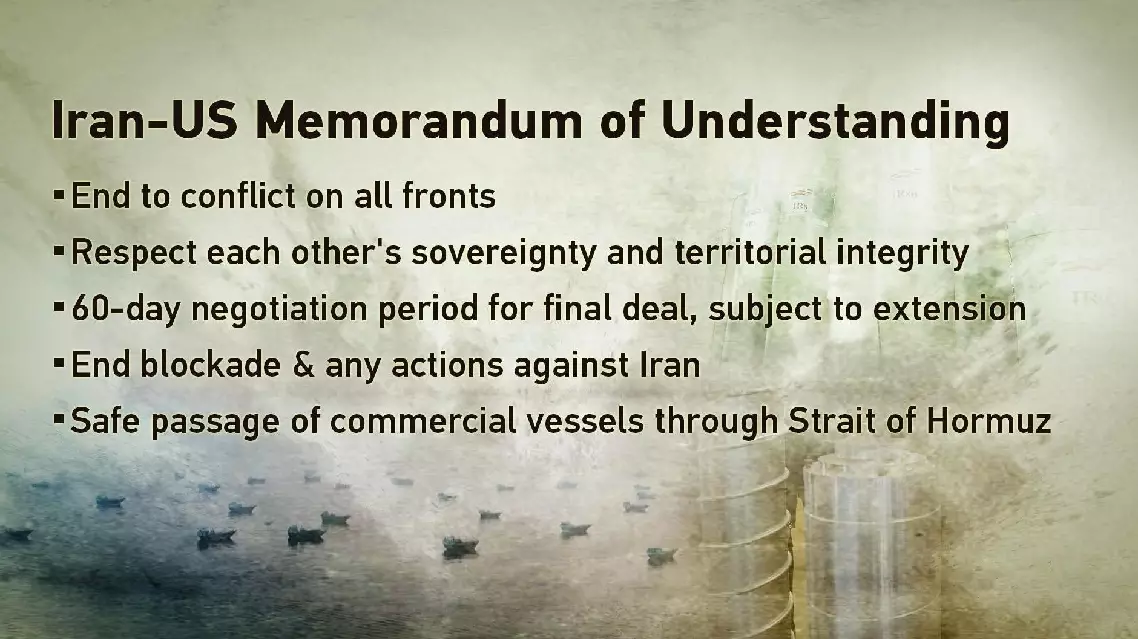
Iran's official news agency releases full text of U.S.-Iran MoU