Skip to Content Facebook Feature Image

16 states sue Trump administration again over billions in withheld electric vehicle charging funds

News

16 states sue Trump administration again over billions in withheld electric vehicle charging funds
News

News

16 states sue Trump administration again over billions in withheld electric vehicle charging funds

2025-12-17 05:25 Last Updated At:05:30

DETROIT (AP) — Sixteen states and the District of Columbia are suing the Trump administration for what they say is the unlawful withholding of over $2 billion in funding for two electric vehicle charging programs.

A federal lawsuit filed Tuesday in Seattle is the latest legal battle that Democratic-led states are pursuing over funding for EV charging infrastructure that they say was obligated to them by Congress under former President Joe Biden, but that the Department of Transportation and Federal Highway Administration are “impounding.”

“The Trump administration’s illegal attempt to stop funding for electric vehicle infrastructure must come to an end,” California Attorney General Rob Bonta said in a release. “This is just another reckless attempt that will stall the fight against air pollution and climate change, slow innovation, thwart green job creation, and leave communities without access to clean, affordable transportation."

President Donald Trump's administration has been hostile to EVs and has dismantled several Biden-era policies friendly to cleaner cars and trucks in favor of policies that align with Trump’s oil and gas industry agenda.

Transportation Department officials did not immediately respond to request for comment.

The Trump administration in February ordered states to halt spending money for EV charging that was allocated in the bipartisan infrastructure law passed under the previous administration.

Several states filed a lawsuit in May against the administration for withholding the funding from the $5 billion National Electric Vehicle Infrastructure program for a nationwide charging buildout. A federal judge later ordered the administration to release much of the funding for chargers in more than a dozen states.

Transportation Secretary Sean Duffy later issued revised guidance intended to streamline funding applications for states and make charger deployment more efficient. At least four states — Georgia, Illinois, Maryland, and Wisconsin — have announced awards under the vehicle infrastructure program, according to Loren McDonald, chief analyst at EV data firm Chargeonomics, who tracks the state awards.

Tuesday's separate lawsuit, filed in the U.S. District Court for the Western District of Washington, addresses withholding of funds for two other programs: $1.8 billion for the Charging and Fueling Infrastructure Grant program, as well as about $350 million for the Electric Vehicle Charger Reliability and Accessibility Accelerator program.

The lawsuit is led by attorneys general from California and Colorado, joined by the attorneys general of Arizona, Delaware, Illinois, Maryland, Massachusetts, Michigan, New Jersey, New York, Oregon, Rhode Island, Vermont, Washington, Wisconsin and the District of Columbia, and the governor of Pennsylvania. All are Democrats.

After returning to office in January, Trump immediately ordered an end to what he has called Biden's “EV mandate.” While Biden targeted for half of new vehicle sales in the U.S. to be electric by 2030, his policies did not force American consumers to buy EVs or automakers to sell them.

Biden did set stringent tailpipe emissions and fuel economy rules in an effort to encourage more widespread EV adoption, as the auto industry would have had to meet both sets of requirements with a greater number of EVs in their sales mix. Under the Biden administration, consumers could also receive up to $7,500 in tax incentives off the price of an EV purchase, a program that congressional Republicans ended last fall.

The Trump administration has proposed rolling back both tailpipe emissions rules and the gas mileage standards and eliminated fines to automakers for not meeting those standards.

Trump has also repeated incorrect information about the status of the federal charging programs; without all of the funds available, only a fraction of what was obligated has been spent so far.

“We had to have an electric car within a very short period of time, even though there was no way of charging them and lots of other things,” Trump said in a Dec. 3 press conference about the proposed weakened fuel economy rules. “In certain parts of the Midwest, they spent -- to build nine chargers they spent $8 billion. So, that wasn’t working out too well.”

The lawsuit comes amid those regulatory changes and as the pace of EV sales have slowed in the U.S. as mainstream buyers remain concerned about both charging availability and the price of the vehicles.

New EVs sold for an average of $58,638 last month, compared with $49,814 for a new vehicle overall, according to auto buying resource Kelley Blue Book.

Automakers, meanwhile, have responded to consumers accordingly.

Earlier this week, Ford Motor Co. announced it was pivoting away from its once-ambitious, multi-billion dollar electrification strategy in lieu of more hybrid-electric and more fuel-efficient gasoline-powered vehicles.

In the spring, Honda Motor Co. also said it would take a significant step back from its EV efforts.

Associated Press writer Matthew Daly in Washington contributed to this report.

Alexa St. John is an Associated Press climate reporter. Follow her on X: @alexa_stjohn. Reach her at ast.john@ap.org.

Read more of AP’s climate coverage.

The Associated Press’ climate and environmental coverage receives financial support from multiple private foundations. AP is solely responsible for all content. Find AP’s standards for working with philanthropies, a list of supporters and funded coverage areas at AP.org.
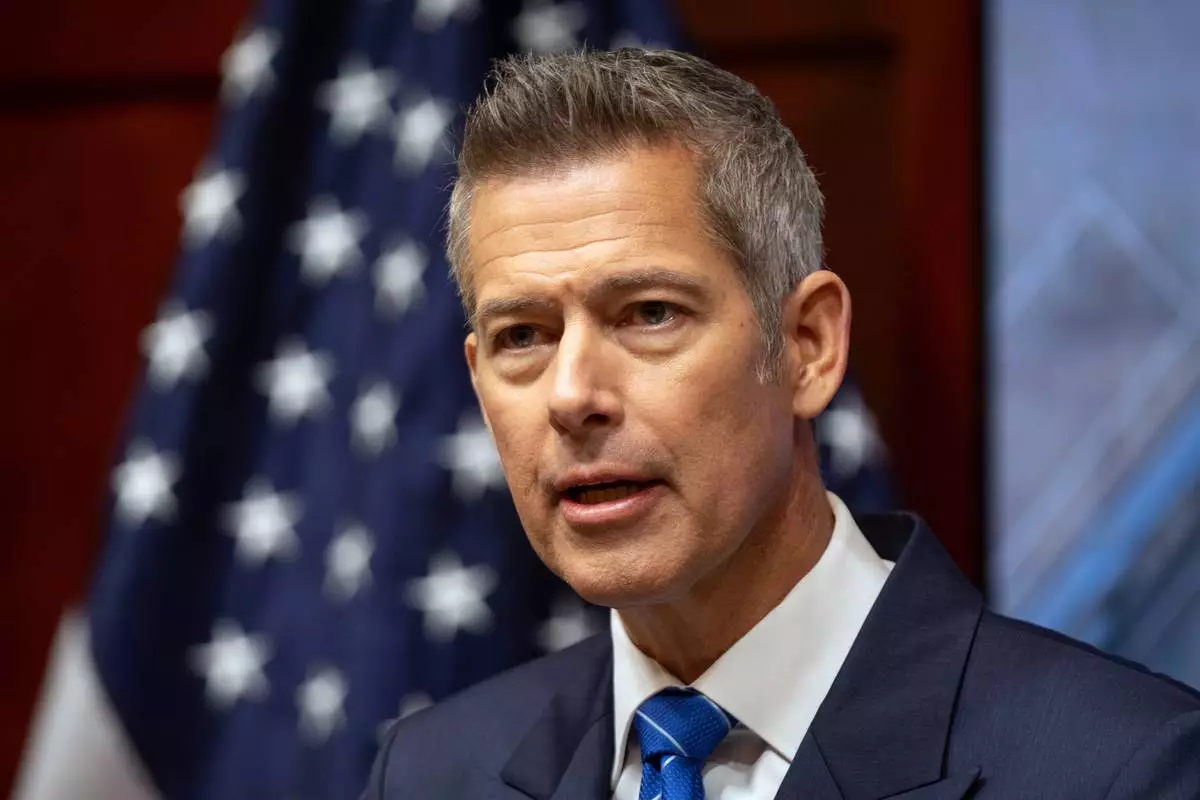
Transportation Secretary Sean Duffy speaks during a news conference at the Department of Transportation in Washington, Friday, Dec. 12, 2025. (AP Photo/Mark Schiefelbein)

Transportation Secretary Sean Duffy speaks during a news conference at the Department of Transportation in Washington, Friday, Dec. 12, 2025. (AP Photo/Mark Schiefelbein)

NEW YORK (AP) — The U.S. stock market drifted through a mixed day of trading Tuesday after reports on the economy did little to clear uncertainty about where interest rates may be heading.

The S&P 500 slipped 0.2% and remains a bit below its all-time high set last week. The Dow Jones Industrial Average dipped 302 points, or 0.6%, and the Nasdaq composite rose 0.2%.

Treasury yields eased in the bond market after one report said the U.S. unemployment rate was at its worst level since 2021, but employers also added more jobs last month than economists expected. A separate report, meanwhile, said an underlying measure of strength for revenue at U.S. retailers grew more in October than economists expected.

The mixed data meant little change in traders’ hopes that the Federal Reserve may continue to cut interest rates further in 2026. What the Fed does with interest rates is a top driver for financial markets because lower rates can boost the economy and prices for investments, even if they also may worsen inflation.

A report coming on Thursday will show how bad inflation was last month, and economists expect it to show prices for U.S. consumers continue to rise faster than anyone would like.

A report released on Tuesday after U.S. stocks began trading suggested price pressures are rising sharply, with average selling prices for businesses climbing at one of the fastest rates since the middle of 2022. The preliminary data from S&P Global also said growth for overall business activity slowed to its weakest level since June.

“Higher prices are again being widely blamed on tariffs, with an initial impact on manufacturing now increasingly spilling over to services to broaden the affordability problem,” according to Chris Williamson, chief business economist at S&P Global Market Intelligence.

On Wall Street, the sharpest losses came from companies in the oil business as prices for crude kept sliding.

Expectations that companies are pumping more than enough oil to meet the world’s demand have sent the price for a barrel of benchmark U.S. crude to its lowest level since 2021. It fell 2.7% Monday, as did Brent crude, the international standard. U.S. crude settled at $55.27 per barrel, while Brent settled at $58.92.

That drove APA’s stock down 5.2%. Marathon Petroleum sank 4.7% and Halliburton dropped 4.3% for some of Wall Street’s larger losses.

Artificial-intelligence technology stocks, meanwhile, were mixed after dominating the market in recent days.

Oracle rose 2%, and Broadcom added 0.4%. They both had dropped to sharp losses last week, even though both reported stronger profits for the latest quarter than analysts expected.

But CoreWeave, which rents out access to top-of-the-line AI chips, fell 3.9%.

Questions remain about whether all the spending underway on AI technology will produce the kind of profits and productivity that will make it worth the expense.

Elsewhere on Wall Street, Pfizer fell 3.4% after giving a forecast for profit in 2026 that was below what some analysts expected. Its forecast for revenue next year was close to analysts’ expectations.

Kraft Heinz added 0.7% after saying Steve Cahillane, who was most recently CEO of Kellanova, will join as CEO on Jan. 1. After Kraft Heinz splits into two companies, which is expected to happen in the second half of 2026, Cahillane will lead the one that will hold onto the Heinz, Philadelphia and Kraft Mac & Cheese brands.

All told, the S&P 500 fell 16.25 points to 6,800.26. The Dow Jones Industrial Average dropped 302.30 to 48,114.26, and the Nasdaq composite rose 54.05 to 23,111.46.

In stock markets abroad, indexes fell across much of Europe and Asia.

Japan’s Nikkei 225 dropped 1.6% ahead of an expected hike to interest rates by the Bank of Japan later this week.

Other markets in Asia also had some of the world’s sharper swings. South Korea’s Kospi dropped 2.2%, while indexes fell 1.5% in Hong Kong and 1.1% in Shanghai.

In the bond market, the yield on the 10-year Treasury fell to 4.14% from 4.18% late Monday.

AP Business Writers Matt Ott and Elaine Kurtenbach contributed.

Specialists Alex Weitzman, left, and Meric Greenbaum work on the floor of the New York Stock Exchange, Thursday, Dec. 11, 2025. (AP Photo/Richard Drew)

Specialists Alex Weitzman, left, and Meric Greenbaum work on the floor of the New York Stock Exchange, Thursday, Dec. 11, 2025. (AP Photo/Richard Drew)

A television displays a news conference with Fed chairman Jerome Powell on the floor at the New York Stock Exchange in New York, Wednesday, Dec. 10, 2025. (AP Photo/Seth Wenig)

A television displays a news conference with Fed chairman Jerome Powell on the floor at the New York Stock Exchange in New York, Wednesday, Dec. 10, 2025. (AP Photo/Seth Wenig)

Traders work on the floor at the New York Stock Exchange in New York, Wednesday, Dec. 10, 2025. (AP Photo/Seth Wenig)

Traders work on the floor at the New York Stock Exchange in New York, Wednesday, Dec. 10, 2025. (AP Photo/Seth Wenig)

Currency traders pass by a screen showing the Korea Composite Stock Price Index (KOSPI), top center left, and the foreign exchange rate between U.S. dollar and South Korean won, top center, at the foreign exchange dealing room of the Hana Bank headquarters, in Seoul, South Korea, Friday, Dec. 5, 2025. (AP Photo/Ahn Young-joon)

Currency traders pass by a screen showing the Korea Composite Stock Price Index (KOSPI), top center left, and the foreign exchange rate between U.S. dollar and South Korean won, top center, at the foreign exchange dealing room of the Hana Bank headquarters, in Seoul, South Korea, Friday, Dec. 5, 2025. (AP Photo/Ahn Young-joon)

Recommended Articles