EAST LANSING, Mich. (AP) — Jaxon Kohler had 16 points and 13 rebounds, and No. 9 Michigan State never trailed while rolling to a 92-69 victory over Toledo on Tuesday night.
Kohler's double-double was his sixth of the season. Jeremy Fears Jr., who came in averaging a Division I-best 9.5 assists per game, had 15 points and eight assists.
Coen Carr and Kur Teng added 14 points apiece for Michigan State (10-1). Carson Cooper added eight points and nine rebounds as the Spartans recorded season highs in scoring and rebounding.
Sonny Wilson had 29 points, five assists and four steals to lead Toledo (5-6), which has lost three straight. Leroy Blyden Jr. had 10 points and Sean Craig scored eight.
The Spartans out-rebounded the Rockets 54-24. Michigan State's 18 offensive rebounds led to 17 points. The Spartans also scored 36 points on the fast break, compared to Toledo's 16.
Sloppy play by the Spartans, particularly in the second half, was the only thing that prevented an even more lopsided margin. Michigan State committed 15 turnovers, while Toledo had just four.
Kohler had 14 points and 10 rebounds by halftime as the Spartans led 58-28 at the break to set a season high in first-half points.
The Spartans are 7-3 all-time against the Rockets.
Toledo: Hosts Lourdes on Saturday.
Michigan State: Plays Oakland in Detroit on Saturday.
Get poll alerts and updates on the AP Top 25 throughout the season. Sign up here and here (AP News mobile app). AP college basketball: https://apnews.com/hub/ap-top-25-college-basketball-poll and https://apnews.com/hub/college-basketball

Toledo guard Sonny Wilson (3), left, shoots against Michigan State forward Jaxon Kohler (0) during the first half of an NCAA college basketball game, Tuesday, Dec. 16, 2025, in East Lansing, Mich. (AP Photo/Al Goldis)

Michigan State forward Jaxon Kohler (0) shoots against Toledo guard Phoenix Glassnor (23), left, and forward Sean Craig (7) during the first half of an NCAA college basketball game, Tuesday, Dec. 16, 2025, in East Lansing, Mich. (AP Photo/Al Goldis)

Michigan State forward Jordan Scott (6), left, pulls down a rebound against Toledo forward Sean Craig (7) during the first half of an NCAA college basketball game, Tuesday, Dec. 16, 2025, in East Lansing, Mich. (AP Photo/Al Goldis)
WASHINGTON (AP) — The Trump administration announced Tuesday it was expanding travel restrictions to an additional 20 countries and the Palestinian Authority, doubling the number of nations affected by sweeping limits announced earlier this year on who can travel and emigrate to the U.S.
The Trump administration included five more countries as well as people traveling on documents issued by the Palestinian Authority to the list of countries facing a full ban on travel to the U.S. and imposed new limits on 15 other countries.
The move is part of ongoing efforts by the administration to tighten U.S. entry standards for travel and immigration, in what critics say unfairly prevents travel for people from a broad range of countries. The administration suggested it would expand the restrictions after the arrest of an Afghan national suspect in the shooting of two National Guard troops over Thanksgiving weekend.
People who already have visas, are lawful permanent residents of the U.S. or have certain visa categories such as diplomats or athletes, or whose entry into the country is believed to serve the U.S. interest, are all exempt from the restrictions. The proclamation said the changes go into effect on Jan. 1.
In June, President Donald Trump announced that citizens of 12 countries would be banned from coming to the United States and those from seven others would face restrictions. The decision resurrected a hallmark policy of his first term.
At the time the ban included Afghanistan, Myanmar, Chad, the Republic of Congo, Equatorial Guinea, Eritrea, Haiti, Iran, Libya, Somalia, Sudan and Yemen and heightened restrictions on visitors from Burundi, Cuba, Laos, Sierra Leone, Togo, Turkmenistan and Venezuela.
On Tuesday, the Republican administration announced it was expanding the list of countries whose citizens are banned from entering the U.S. to Burkina Faso, Mali, Niger, South Sudan and Syria. The administration also fully restricted travel on people with Palestinian Authority-issued travel documents, the latest U.S. travel restriction against Palestinians. South Sudan was also facing significant travel restrictions already.
An additional 15 countries are also being added to the list of countries facing partial restrictions: Angola, Antigua and Barbuda, Benin, Ivory Coast, Dominica, Gabon, Gambia, Malawi, Mauritania, Nigeria, Senegal, Tanzania, Tonga, Zambia and Zimbabwe.
The restrictions apply to both people seeking to travel to the U.S. as visitors or to emigrate there.
The Trump administration said in its announcement that many of the countries from which it was restricting travel had “widespread corruption, fraudulent or unreliable civil documents and criminal records” that made it difficult to vet their citizens for travel to the U.S.
It also said some countries had high rates of people overstaying their visas, refused to take back their citizens whom the U.S. wished to deport or had a “general lack of stability and government control,” which made vetting difficult. It also cited immigration enforcement, foreign policy and national security concerns for the move.
The Afghan man accused of shooting the two National Guard troops near the White House has pleaded not guilty to murder and assault charges. In the aftermath of that incident, the administration announced a flurry of immigration restrictions, including further restrictions on people from those initial 19 countries who were already in the U.S.
The news of the expanding travel ban is likely to face fierce opposition from critics who have argued that the administration is using national security concerns to collectively keep out people from a wide range of countries.
“This expanded ban is not about national security but instead is another shameful attempt to demonize people simply for where they are from," said Laurie Ball Cooper, vice president of U.S. Legal Programs at the International Refugee Assistance Project.
Advocates for Afghans who supported the United States' two-decade long war in Afghanistan also raised alarms Tuesday, saying the updated travel ban no longer contains an exception for Afghans who qualify for the Special Immigrant Visa. That’s a visa category specifically for Afghans who closely assisted the U.S. war effort at great risk to themselves.
No One Left Behind, a longtime agency advocating for the Special Immigrant Visa program, said it was “deeply concerned” about the change. The organization said it appreciated the president's commitment to national security but allowing Afghans who'd served the U.S. to enter the U.S. — after extensive vetting — also contributes to the country's security.
“Though intended to allow for review of inconsistent vetting processes, this policy change inadvertently restricts those who are among the most rigorously vetted in our history: the wartime allies targeted by the terrorists this proclamation seeks to address,” the organization said in a statement.
Countries that were newly placed on the list of banned or restricted countries said late Tuesday that they were evaluating the news. The government of the island nation of Dominica in the Caribbean Sea said it was treating the issue with the “utmost seriousness and urgency” and was reaching out to U.S. officials to clarify what the restrictions mean and address any problems.
Antigua and Barbuda’s ambassador to the United States, Ronald Saunders, said the “matter is quite serious" and he'll be seeking more information from U.S. officials regarding the new restrictions.
The Trump administration also upgraded restrictions on some countries — Laos and Sierra Leone — that previously were on the partially restricted list and in one case — Turkmenistan — said the country had improved enough to warrant easing some restrictions on travelers from that country. Everything else from the previous travel restrictions announced in June remains in place, the administration said.
The new restrictions on Palestinians come months after the administration imposed limits that make it nearly impossible for anyone holding a Palestinian Authority passport from receiving travel documents to visit the U.S. for business, work, pleasure or educational purposes. The announcement Tuesday goes further, banning people with Palestinian Authority passports from emigrating to the U.S.
In justifying its decision Tuesday, the administration said several “U.S.-designated terrorist groups operate actively in the West Bank or Gaza Strip and have murdered American citizens.” The administration also said the recent war in those areas had “likely resulted in compromised vetting and screening abilities."
__
Anika Kentish in Saint John’s, Antigua, contributed to this report.
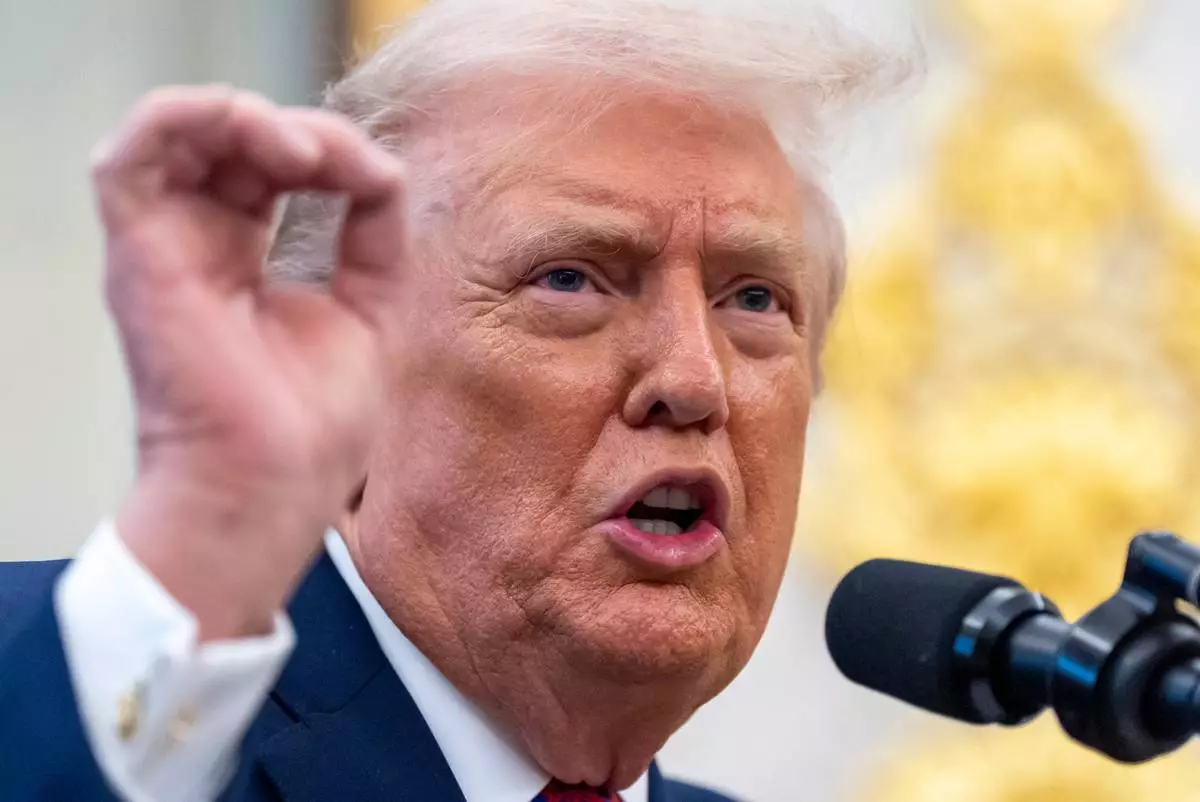
President Donald Trump speaks during a Mexican Border Defense Medal presentation in the Oval Office of the White House, Monday, Dec. 15, 2025, in Washington. (AP Photo/Alex Brandon)