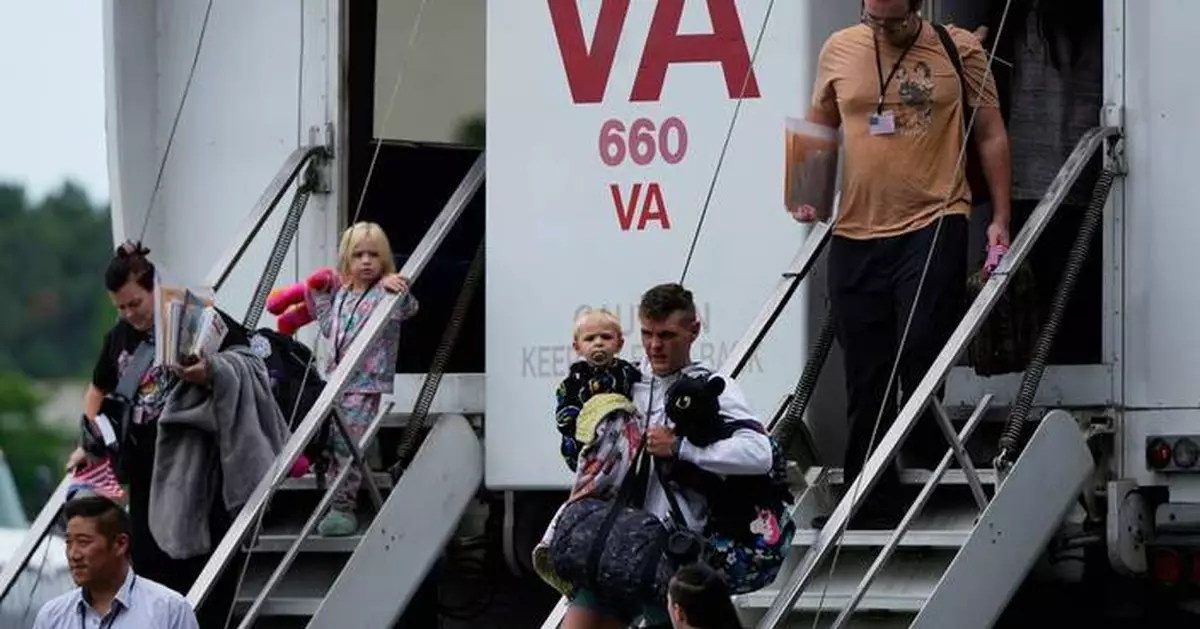
JOHANNESBURG (AP) — A center in South Africa processing applications for the United States refugee program was raided by immigration and law enforcement officers and seven Kenyan nationals were arrested for working there illegally, South Africa's Home Affairs Ministry said Wednesday.
The center in Johannesburg was processing applications by white South Africans under the Trump administration's new program giving them priority for refugee status in the U.S.
The Kenyans were working at the center alongside U.S. officials despite entering South Africa on tourist visas which did not allow them to work, the Home Affairs Ministry said in a statement. It said no U.S. officials were arrested in the raid Tuesday and it was not a diplomatic site.
The raid is bound to increase tensions between the U.S. and South Africa. U.S. President Donald Trump has been especially critical of the South African government since he returned to office, claiming the country is violently persecuting its white Afrikaner minority and also pursuing an anti-American foreign policy.
Trump’s widely rejected claims over the treatment of Afrikaners in South Africa led to his administration setting up the program offering them refugee status in the U.S.
South Africa's government has said that white South Africans do not meet the criteria for refugee status because there is no persecution but says it won't stop them applying for relocation under the U.S. program.
The South African Home Affairs Ministry didn't immediately say who the Kenyans worked for, but the U.S. government contracted a Kenya-based company, RSC Africa, to process the refugee applications by white South Africans, according to the U.S. Embassy in South Africa. RSC is operated by Church World Service, a U.S.-based nongovernment organization offering humanitarian aid and refugee assistance across the world.
The statement by South Africa's Home Affairs Ministry said Kenyan nationals had previously been denied visas to travel to South Africa to work on the U.S. refugee program and questioned why the workers who entered the country on tourist visas were working at the refugee application site alongside U.S. officials.
“The presence of foreign nationals apparently coordinating with undocumented workers naturally raises serious questions about intent and diplomatic protocol,” the ministry said.
It said South Africa's Foreign Ministry had started “formal diplomatic engagements with both the United States and Kenya to resolve this matter.”
The seven Kenyan nationals were given deportation orders and banned from entering South Africa for a five-year period, South African authorities said.
Imray reported from Cape Town, South Africa.
AP Africa news: https://apnews.com/hub/africa
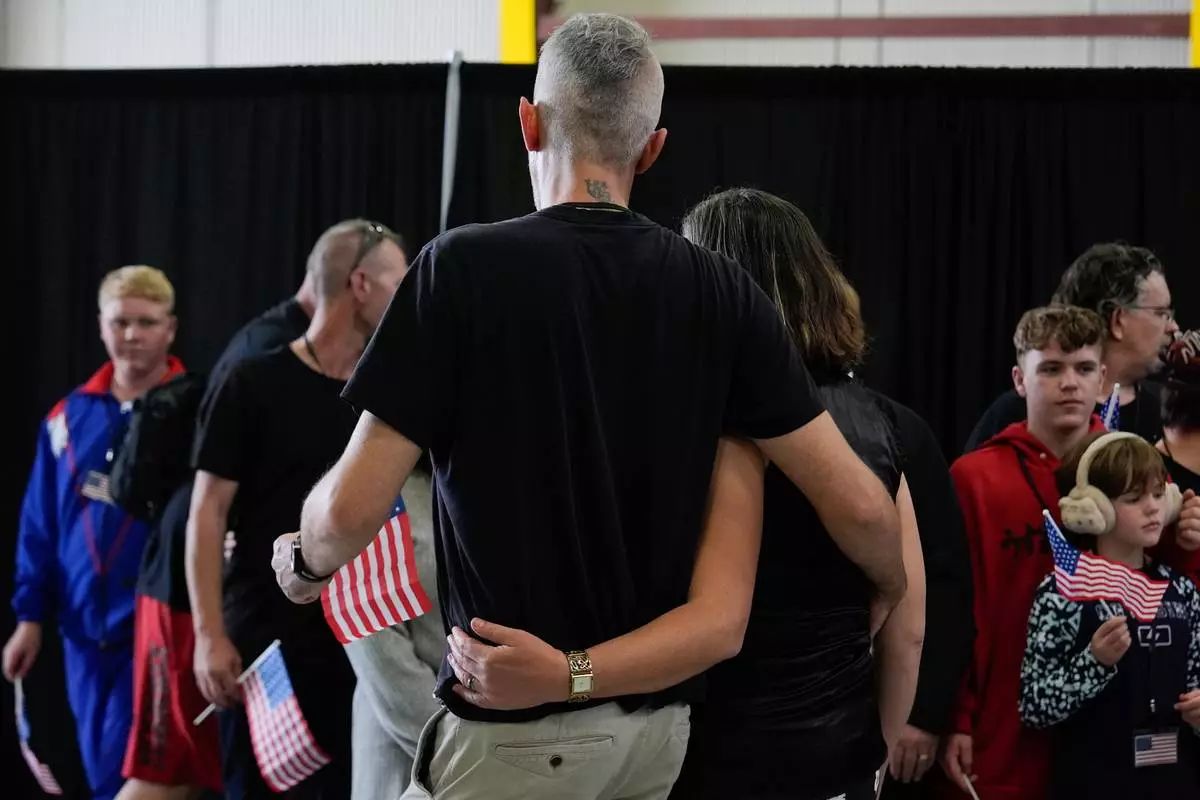
FILE - Refugees from South Africa arrive, Monday, May 12, 2025, at Dulles International Airport in Dulles, Va. (AP Photo/Julia Demaree Nikhinson, File)

FILE - Refugees from South Africa, arrive Monday, May 12, 2025, at Dulles International Airport in Dulles, Va. (AP Photo/Julia Demaree Nikhinson, File)
BANGKOK (AP) — Shares advanced Wednesday in Europe and Asia as strong buying of technology shares helped lift some benchmarks, while the price of U.S. crude briefly surged more than 2% after President Donald Trump ordered a blockade of all “sanctioned oil tankers” into Venezuela.
Trump's move followed the seizure by U.S. forces last week of an oil tanker off Venezuela’s coast, an unusual move that followed a buildup of military forces in the region as his administration ramps up pressure on the country’s authoritarian leader Nicolás Maduro.
The future for the S&P 500 edged 0.1% higher and that for the Dow Jones Industrial Average was virtually unchanged.
In Germany, the DAX added 0.3% to 24,138.73, while the CAC 40 in Paris was up 0.1% to 8,115.18. Britain's FTSE 100 surged 1.4% to 9,817.65.
Tokyo's Nikkei 225 gained 0.3% to 49,512.28 as traders awaited a decision on an interest rate hike by the Bank of Japan later in the week.
Adding to expectations for a rate hike, Japan reported its exports rose 6% in November from a year earlier, as shipments to the U.S. rose for the first time since March. A trade deal with the Trump administration that set tariffs on imports from Japan at a baseline rate of 15%, down from the initial plan for a 25% helped boost exports of cars and chemicals, among other key manufactured goods.
Hong Kong's Hang Seng climbed 0.9% to 25,468.78, while the Shanghai Composite index jumped 1.2% to 3,870.28.
In South Korea, the Kospi advanced 1.4% to 4,056.41, lifted by computer chip maker SK Hynix, which gained 4%, and a 5% jump for Samsung Electronics.
Australia's S&P/ASX 200 gave up 0.2% to 8,585.20.
On Tuesday, U.S. stocks drifted through a mixed day of trading after reports on the U.S. economy did little to clear up uncertainty about where interest rates may be heading.
One report said the U.S. unemployment rate was at its worst level since 2021 in November, but employers also added more jobs last month than economists expected. A separate report, meanwhile, said an underlying measure of strength for revenue at U.S. retailers grew more in October than economists expected.
The S&P 500 slipped 0.2%, staying a bit below its all-time high set last week. The Dow Jones Industrial Average dipped 0.6% and the Nasdaq composite rose 0.2%.
The varied economic data left intact traders’ hopes that the Federal Reserve may continue to cut interest rates in 2026. What the Fed does with interest rates is a top driver for financial markets because lower rates can boost the economy and prices for investments, even if they also may worsen inflation.
A report coming on Thursday will show how bad inflation was last month, and economists expect it to show prices for U.S. consumers continue to rise faster than anyone would like.
A report released on Tuesday suggested price pressures are rising sharply, with average selling prices for businesses climbing at one of the fastest rates since the middle of 2022. The preliminary data from S&P Global also said growth for overall business activity slowed to its weakest level since June.
Overhanging the markets are questions about whether all the spending underway on AI technology will produce the kind of profits and productivity that will make it worth the expense.
The sharpest losses on Wall Street came from companies in the oil business as prices for crude skidded. Expectations that companies are pumping more than enough oil to meet the world’s demand sent the price for a barrel of benchmark U.S. crude to its lowest level since 2021.
Early Wednesday, U.S. crude was up 99 cents, or 1.8%, at $56.26 per barrel. Brent crude, the international standard, picked up 96 cents, or 1.6%, to $59.88 per barrel.
In other dealings early Wednesday, the U.S. dollar rose to 155.48 Japanese yen from 154.73 yen. The euro slipped to $1.1717 from $1.1748.
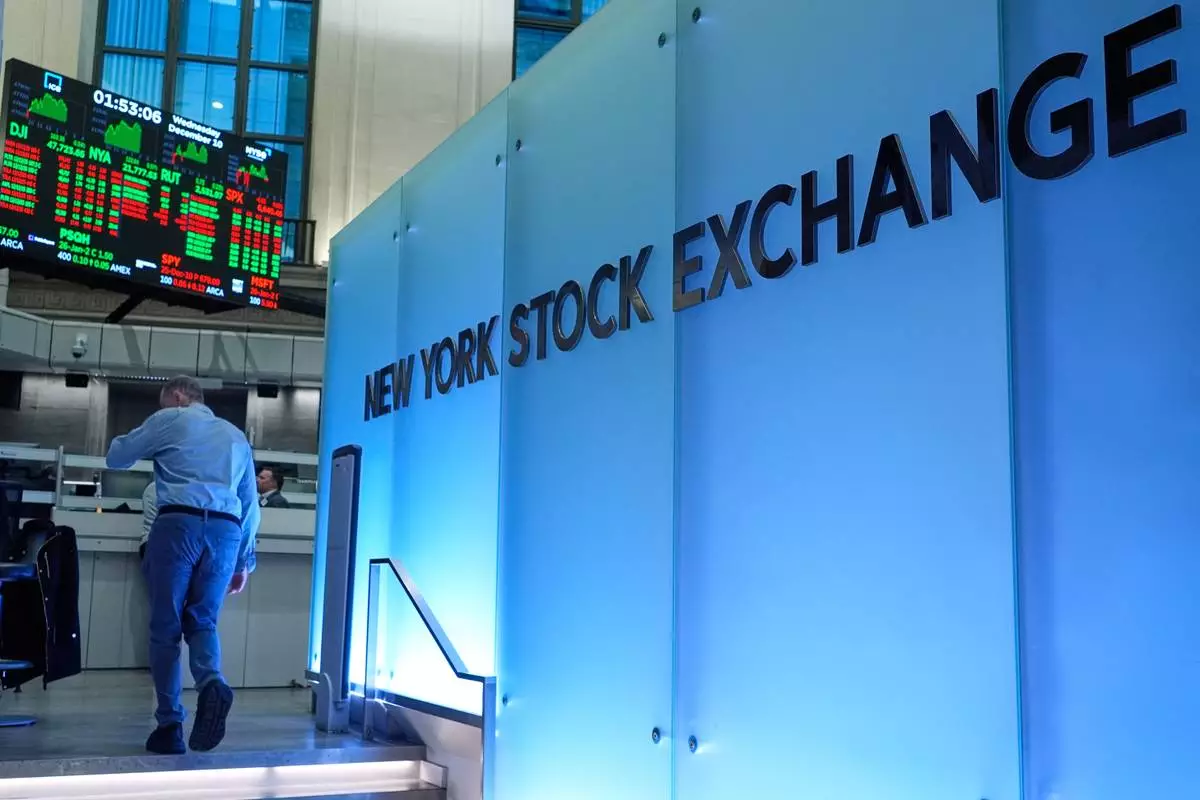
Traders work on the floor at the New York Stock Exchange in New York, Wednesday, Dec. 10, 2025. (AP Photo/Seth Wenig)

Currency traders work near a screen showing the Korea Composite Stock Price Index (KOSPI), left, at the foreign exchange dealing room of the Hana Bank headquarters, in Seoul, South Korea, Wednesday, Dec. 17, 2025. (AP Photo/Ahn Young-joon)

A currency trader watches monitors near a screen showing the Korea Composite Stock Price Index (KOSPI) at the foreign exchange dealing room of the Hana Bank headquarters, in Seoul, South Korea, Wednesday, Dec. 17, 2025. (AP Photo/Ahn Young-joon)

A currency trader stands near a screen showing the Korea Composite Stock Price Index (KOSPI), top left, and the foreign exchange rate between U.S. dollar and South Korean won at the foreign exchange dealing room of the Hana Bank headquarters, in Seoul, South Korea, Wednesday, Dec. 17, 2025. (AP Photo/Ahn Young-joon)