Skip to Content Facebook Feature Image

Court blocks Michigan ban on conversion therapy on free speech grounds

News

Court blocks Michigan ban on conversion therapy on free speech grounds
News

News

Court blocks Michigan ban on conversion therapy on free speech grounds

2025-12-18 07:55 Last Updated At:08:10

DETROIT (AP) — A federal appeals court on Wednesday blocked Michigan's ban on conversion therapy for minors who are LGBTQ+, declaring it violates the First Amendment rights of therapists and counselors.

In a 2-1 opinion, the court said the law illegally restricts speech that reflects the moral beliefs of therapists. It set aside a lower court's ruling and granted a preliminary injunction sought by Catholic Charities of Jackson, Lenawee and Hillsdale Counties.

“The Michigan law discriminates based on viewpoint — meaning the law permits speech on a particular topic only if the speech expresses a viewpoint that the government itself approves,” Judge Raymond Kethledge wrote, joined by Judge Joan Larsen.

They noted that the law permits counseling that helps someone undergoing a gender transition.

The court's decision comes more than two months after the U.S. Supreme Court heard arguments in a Colorado case that could resolve the issue nationwide.

In a dissent, Judge Rachel Bloomekatz said the 6th U.S. Circuit Court of Appeals should have waited for the Supreme Court to act.

The Michigan bill was passed by the Democratic-controlled Legislature and signed into law in 2023 by Democratic Gov. Gretchen Whitmer, who said conversion therapy is a “horrific practice.” Therapists could lose their license if they violate the law. More than 20 states have a similar law.

LGBTQ+ rights advocates have cited research suggesting conversion therapy can increase the risk of suicide and depression.

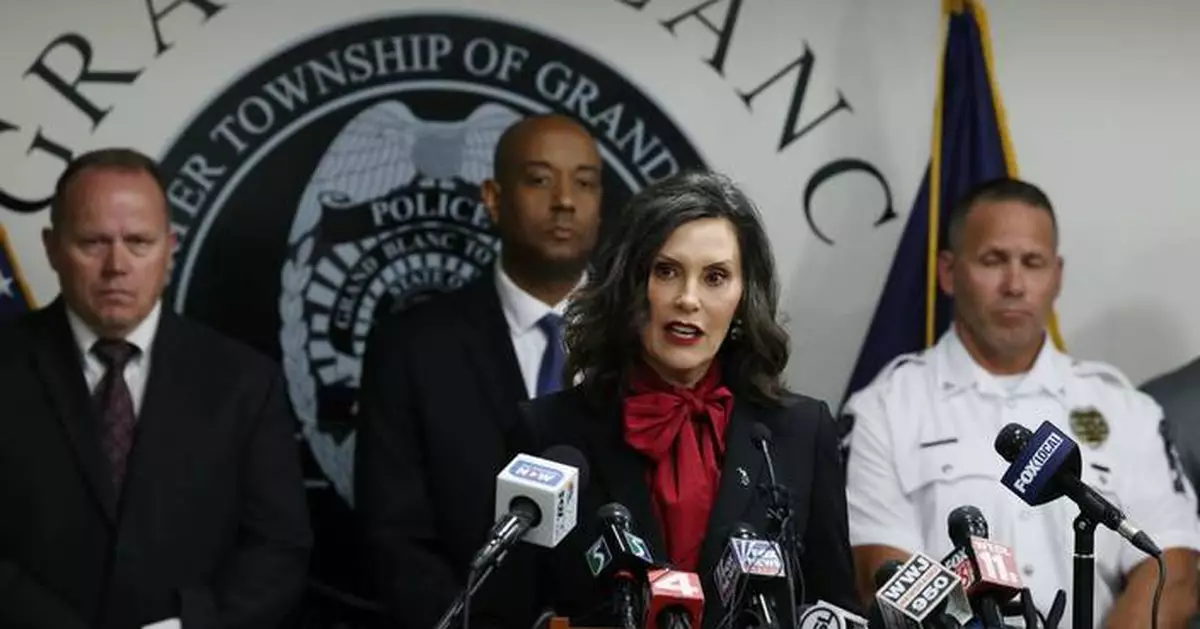
FILE - Michigan Gov. Gretchen Whitmer addresses the media during a news conference, Sept. 29, 2025, in Grand Blanc Township, Mich. (AP Photo/Carlos Osorio, File)

FILE - Michigan Gov. Gretchen Whitmer addresses the media during a news conference, Sept. 29, 2025, in Grand Blanc Township, Mich. (AP Photo/Carlos Osorio, File)

CARACAS, Venezuela (AP) — U.S. President Donald Trump's threat to cut off Venezuelan oil sales could devastate a country already wrangling with years of spiraling crises.

The prospect added to Venezuelans' collective anxiety over their country's future on Wednesday. But after years of political, social and economic challenges, Venezuelans also treated the threat like another inconvenience — even when it could bring back the shortages of food, gasoline and other goods that defined the country over the last decade.

“Well, we’ve already had so many crises, shortages of so many things — food, gasoline — that one more ... well, one doesn’t worry anymore,” Milagro Viana said while waiting to catch a bus in Caracas, the country's capital.

Trump on Tuesday announced he was ordering a blockade of all “sanctioned oil tankers” into Venezuela, ramping up pressure on Venezuelan President Nicolás Maduro, who has been charged with narcoterrorism in the United States.

Trump’s escalation came after U.S. forces last week seized an oil tanker off Venezuela’s coast after a buildup of military forces in the region.

Venezuela has the world’s largest proven oil reserves and produces about 1 million barrels a day. The country's economy depends on the industry, with more than 80% of output exported.

Maduro’s government has relied on a shadowy fleet of unflagged tankers to smuggle crude into global supply chains since 2017, when the first Trump administration began imposing sanctions on Venezuela's oil industry.

In a post on social media announcing the blockade, Trump alleged that Venezuela was using oil to fund drug trafficking and other crimes. He vowed to continue the military buildup until Venezuela gives the U.S. oil, land and other assets.

On Wednesday, Trump demanded that Venezuela return assets it seized from U.S. oil companies years ago, justifying anew his announcement a day earlier of a “blockade” against tankers hauling crude to or from the South American country that face American sanctions.

David Smilde, a Tulane University professor who has studied Venezuela for more than three decades, said a full implementation of Trump’s threat will cause a huge economic contraction because oil represents 90% of the country’s exports.

“This is a country that traditionally imports a lot, not just finished goods, but most intermediate goods — everything from toilet paper to food containers,” Smilde said. “If you don’t have foreign currency coming up, that just brings the whole economy to a halt.”

That could lead to price increases as well as shortages of food and other basic goods. Fuel could also become scarce because some of the tankers ship Venezuela fluids that are used to produce gasoline for the local market.

“Things are going to get tough here,” Pedro Arangura said while waiting for a remittance store to open. “We have to put up with it. Nobody wants it, but it’s going to happen.”

Arangura said material difficulties could lead to Maduro’s ouster, echoing what Venezuela’s opposition has been telling supporters in recent months.

Nearby, Ismael Chirino, like Arangura, said he believes the population will “resist” whatever challenges result from Trump's latest move. But, Chirino said, people will do so to maintain Maduro in office.

“We held on. We didn’t have gas, we didn’t have gasoline, we didn’t have money, and yet, we withstood all of that,” Chirino said, referring to the second half of the 2010s, when the country's economy came undone and shortages were widespread. “I think they need to think very carefully if the U.S. wants to take over our wealth and all our territory."

The White House has said the military buildup, which began in the Caribbean and later expanded to the eastern Pacific Ocean, is meant to stop the flow of drugs into the U.S. The operation has killed at least 95 people, with Venezuelans among them.

Maduro has denied the drug accusations. He and his allies have repeatedly said that the operation’s true purpose is to force a government change in Venezuela. They have also claimed that the U.S. is after Venezuela's vast oil and mineral resources.

Smilde said Trump’s threat was a gift to Chavismo, the political movement that Maduro inherited from the late President Hugo Chávez, his predecessor and mentor. Chávez became president in 1999 with promises to uplift the poor and used an oil bonanza in the 2000s to push a self-described socialist agenda.

“There are few actions that any U.S. president has taken in the last 25 years that have better fit Chavismo’s line than Donald Trump’s tweet last night,” Smilde said. “They have been saying this from the beginning, ‘The U.S. wants our oil.’ So, finally, the discourse has the evidence.”

Follow AP’s coverage of Latin America and the Caribbean at https://apnews.com/hub/latin-america

People ride a boat along the coast in Macuto, Venezuela, Wednesday, Dec. 17, 2025. (AP Photo/Ariana Cubillos)

People ride a boat along the coast in Macuto, Venezuela, Wednesday, Dec. 17, 2025. (AP Photo/Ariana Cubillos)

Residents and fisherman stand near Macuto beach in Venezuela, Wednesday, Dec. 17, 2025. (AP Photo/Ariana Cubillos)

Residents and fisherman stand near Macuto beach in Venezuela, Wednesday, Dec. 17, 2025. (AP Photo/Ariana Cubillos)

Fresh tuna is for sale on Macuto beach in Venezuela, Wednesday, Dec. 17, 2025. (AP Photo/Ariana Cubillos)

Fresh tuna is for sale on Macuto beach in Venezuela, Wednesday, Dec. 17, 2025. (AP Photo/Ariana Cubillos)

A man looks out at the sea in the city of La Guaira, Venezuela, where the nation's flag flies, Wednesday, Dec. 17, 2025. (AP Photo/Ariana Cubillos)

A man looks out at the sea in the city of La Guaira, Venezuela, where the nation's flag flies, Wednesday, Dec. 17, 2025. (AP Photo/Ariana Cubillos)

A vendor sells inflatables on Macuto beach in Venezuela, Wednesday, Dec. 17, 2025. (AP Photo/Ariana Cubillos)

A vendor sells inflatables on Macuto beach in Venezuela, Wednesday, Dec. 17, 2025. (AP Photo/Ariana Cubillos)

Defense Secretary Pete Hegseth arrives to brief members of Congress on military strikes near Venezuela, Tuesday, Dec. 16, 2025, at the Capitol in Washington. (AP Photo/Julia Demaree Nikhinson)

Defense Secretary Pete Hegseth arrives to brief members of Congress on military strikes near Venezuela, Tuesday, Dec. 16, 2025, at the Capitol in Washington. (AP Photo/Julia Demaree Nikhinson)

Defense Secretary Pete Hegseth departs the Capitol after briefing members of Congress on military strikes near Venezuela, Tuesday, Dec. 16, 2025, in Washington. (AP Photo/Julia Demaree Nikhinson)

Defense Secretary Pete Hegseth departs the Capitol after briefing members of Congress on military strikes near Venezuela, Tuesday, Dec. 16, 2025, in Washington. (AP Photo/Julia Demaree Nikhinson)

FILE - President Nicolas Maduro addresses supporters during a rally marking the anniversary of the Battle of Santa Ines, which took place during Venezuela's 19th-century Federal War, in Caracas, Venezuela, Wednesday, Dec. 10, 2025. (AP Photo/Ariana Cubillos, File)

FILE - President Nicolas Maduro addresses supporters during a rally marking the anniversary of the Battle of Santa Ines, which took place during Venezuela's 19th-century Federal War, in Caracas, Venezuela, Wednesday, Dec. 10, 2025. (AP Photo/Ariana Cubillos, File)

A man looks out at the sea in the city of La Guaira, Venezuela, where the nation's flag flies, Wednesday, Dec. 17, 2025. (AP Photo/Ariana Cubillos)

A man looks out at the sea in the city of La Guaira, Venezuela, where the nation's flag flies, Wednesday, Dec. 17, 2025. (AP Photo/Ariana Cubillos)

Recommended Articles