HONG KONG, Dec. 18, 2025 /PRNewswire/ -- For Hong Kong enterprises acting as the bridge between Mainland China and the global market, email reliability is no longer just an IT metric, it is the lifeline of day-to-day operations. Yet issues such as network congestion, IP blacklisting and unstable routing still turn routine cross-border communications into potential operational bottlenecks.
Consider a multinational firm engaged in sustainable agriculture and new energy, with more than 40 years of experience and customers across multiple countries. The company relies on email every day to exchange procurement orders, R&D blueprints and financial statements—information that is central to its business. As the international network environment has grown more complex, traditional email routes have begun to struggle, exposing the firm to three major vulnerabilities:
1.Recurring bounce-backs and delays disrupt business continuity: In key markets, essential order emails were repeatedly rejected after the company's IP address was placed on RBL blacklists due to inadvertent association with spam activity. In several emerging markets, R&D correspondence suffered multi-hour delays as messages took inefficient routes across congested networks, and in some cases never reached their destination at all.
2.In-house overseas relay infrastructure is costly and underperforms: The firm experimented with deploying its own overseas relay nodes. However, without dynamic routing capabilities, cross-border emails sometimes took even longer as traffic was sent through suboptimal paths. Unpredictable issues ranging from submarine cable outages to regional network congestion further undermined performance. The in-house setup failed to deliver the expected gains, even as maintenance costs continued to rise.
3.Cross-border phishing is increasingly hard to contain: Phishing emails and malicious attachments originating overseas frequently slipped past basic filters by masking their intent. Many enterprises still rely on legacy email platforms such as Exchange, whose built-in security features struggle against today's more sophisticated threats, raising concerns around both data security and regulatory compliance.
What is an overseas email relay?
An overseas email relay is a network of forwarding nodes deployed across different regions to optimize cross-border email routing. By intelligently selecting paths between sender and recipient, these nodes help improve delivery success rates, reduce latency and lower the risk that legitimate messages will be rejected as spam.
Intelligent Overseas Relays Address Both Stability and Security
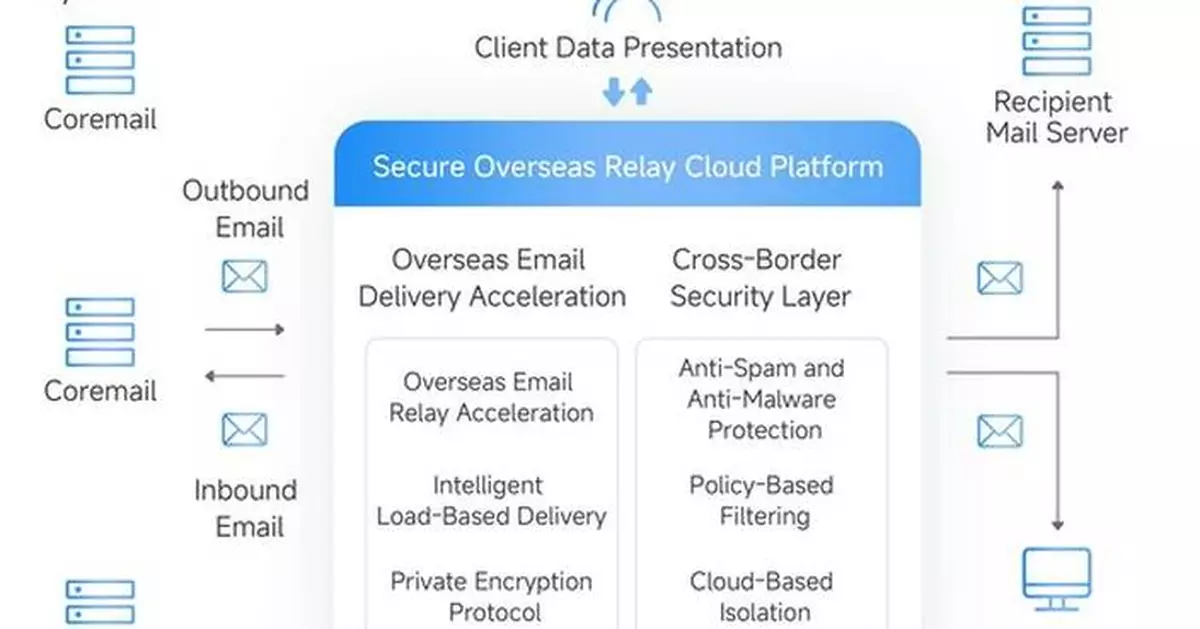
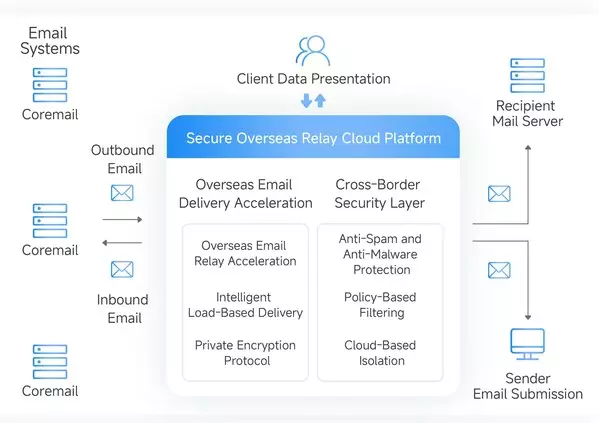
As Hong Kong–based companies deepen their presence in Mainland China and overseas markets, specialized solutions have emerged to address the twin challenges of reliability and security in cross-border email delivery. Coremail's Secure Email Relay is one such solution. Combining intelligent global routing with overseas threat filtering, it is designed to help enterprises keep email flowing smoothly and securely across regions.
"Email remains the backbone of cross-border business communication for Hong Kong enterprises,"said Leihua Chen, CEO of Coremail."By stabilising overseas delivery and strengthening protection against external threats, we aim to help organizations operate more smoothly and support their regional expansion."
Coremail's Secure Email Relay focuses on three persistent pain points: frequent bounce-backs and delays, the inefficiency of in-house relay infrastructure, and rising security risks from overseas emails. By ensuring stable delivery, optimizing costs and enhancing protection, it provides dependable support for organizations communicating across markets.
1.Global smart routing: fewer bounce-backs, less delay, and more reliable cross-border delivery
With more than 50 smart relay nodes worldwide, Coremail delivers the kind of dynamic routing that is difficult for individual enterprises to replicate. For example, an email travelling from Central Asia to the United States can be automatically redirected away from congested Asian nodes and routed through more efficient Middle Eastern paths. If a major node is disrupted, whether by network instability or a submarine cable fault, the system automatically shifts traffic to the nearest backup node, with no manual intervention required.
2.SDN–DNS smart routing: matching every email to the fastest path
Coremail leverages a patented SDN routing system and DNS-based link matching to determine the optimal path for each email. The system dynamically adapts to the email's destination and type, whether a large engineering file or a standard message, to improve delivery efficiency. This helps achieve faster, more reliable delivery than conventional in-house setups, while substantially reducing ongoing maintenance overheads.
3. CAC anti-spam engine: 99.8% filtering accuracy for overseas threats
Coremail's CAC cloud anti-spam engine blocks up to 99.8% of spam and phishing attempts originating overseas, while keeping the false-positive rate below 0.02%. This not only reduces the risk of a company's IP address being blacklisted, but also strengthens the security posture of legacy email platforms such as Exchange. Supported by a specialist team that continually monitors and fine-tunes the system, enterprises gain far tighter control over email-borne security risks.
Beyond smoother delivery, the secure relays are reshaping operational efficiency
Industry observers note that improving the reliability of international email does more than enhance communication quality, it can also deliver meaningful savings in operating costs and management time. Coremail's Secure Email Relay illustrates this shift. Rather than functioning as a simple transmission channel, it combines stable delivery, stronger security and simplified administration to help enterprises maintain dependable email exchanges in diverse and often volatile network environments.
For SMEs at an early stage of global expansion, as well as for larger organizations with branches across Mainland China and overseas markets, a robust cross-border email framework ensures that mission-critical messages arrive on time, sensitive data travels more securely and IT teams spend less time dealing with bounce-backs, delays or security incidents.
More than 20,000 companies are already using Coremail's Secure Email Relay solution to address issues such as rejected mail, latency and IP blacklisting. For Hong Kong–based trading houses, financial institutions, multinational headquarters, and other such enterprises, the ability to maintain reliable cross-border email flows is increasingly seen as a prerequisite for safeguarding operational continuity and managing risk as their regional and global businesses grow.
For more information, please visit: www.coremail.ai
About Coremail
Coremail is a leading enterprise email and collaboration solutions provider with over 26 years of innovation in secure communication technologies. Serving over 20,000 enterprise customers and supporting over 1 billion end users, Coremail is recognized for its stability, scalability, and AI-driven capabilities, with solutions widely adopted across government, finance, education, healthcare, and energy sectors.
** The press release content is from PR Newswire. Bastille Post is not involved in its creation. **
Cross-Border Email Becomes an Operational Imperative: How Coremail Helps Hong Kong Enterprises Navigate Global Communication Challenges