SEOUL, South Korea (AP) — South Korea’s Constitutional Court on Thursday formally removed the country’s impeached police chief for deploying hundreds of officers to support ousted former President Yoon Suk Yeol's brief imposition of martial law in December 2024.
The court said Cho Ji-ho “actively disrupted” legislative activities by sending police forces to the National Assembly and trying to block lawmakers from reaching the main chamber to vote to lift Yoon’s decree.
Cho also infringed upon the independence of the National Election Commission, the court said, by dispatching police to help the military’s seizure of two NEC offices. Yoon said the actions were intended to investigate unsubstantiated claims of election fraud.
Cho, who was impeached by lawmakers and arrested a week after Yoon’s power grab, is the first commissioner general of the National Police Agency to be removed by the Constitutional Court. He was granted bail in January after a Seoul criminal court cited his need for cancer treatment and faces a separate criminal trial on charges of assisting a rebellion.
Yoon imposed martial law on Dec. 3, 2024, describing the action as necessary to suppress an “anti-state” liberal opposition controlling the legislature. Hours later a quorum of lawmakers managed to break through the military and police blockade and unanimously voted to revoke the order.
Lawmakers later in December voted to impeach Yoon, suspending his powers and placing his fate with the Constitutional Court, which formally removed him from office in April. He was rearrested in July and faces a slew of serious charges including rebellion, which is punishable by life imprisonment or the death penalty.
In its ruling on Cho’s impeachment motion, the Constitutional Court said he cannot remain as the national police chief when he carried out Yoon’s orders despite being clearly aware they were “unconstitutional, unlawful.”
The ruling noted Cho and the Seoul metropolitan police chief were summoned by Yoon to a safe house hours before the declaration of martial law, where they discussed plans to carry it out with Yoon’s then defense minister.
Following Yoon’s declaration, Yoon and the Seoul police chief deployed about 300 officers around the entrances of the National Assembly, which also was swarmed by heavily armed troops, including special operations units with Blackhawk helicopters, in what the court described as an effort to block the legislative vote.
After protests by lawmakers and civilians at the National Assembly, police briefly allowed lawmakers and legislative staff to enter before sealing the grounds for more than two hours later that night after the military’s martial law command announced the suspension of political activities. A quorum of lawmakers still managed to enter with some, including current President Lee Jae Myung, climbing fences to reach the main chamber.
Cho argued his actions did not constitute support for Yoon’s martial law, claiming he sent police to the Assembly to maintain order and prevent accidental clashes.
“Considering that lawmakers and others had no choice but to enter the National Assembly by abnormal means, such as climbing over fences, due to the respondent’s order to block the entrances, the respondent’s claim is not acceptable,” the court said in a statement.
FILE - South Korea's National Police Agency Commissioner General Cho Ji Ho speaks at the National Assembly in Seoul, South Korea, Dec. 9, 2024. (Ryu Hyung-seok/Yonhap via AP, File)
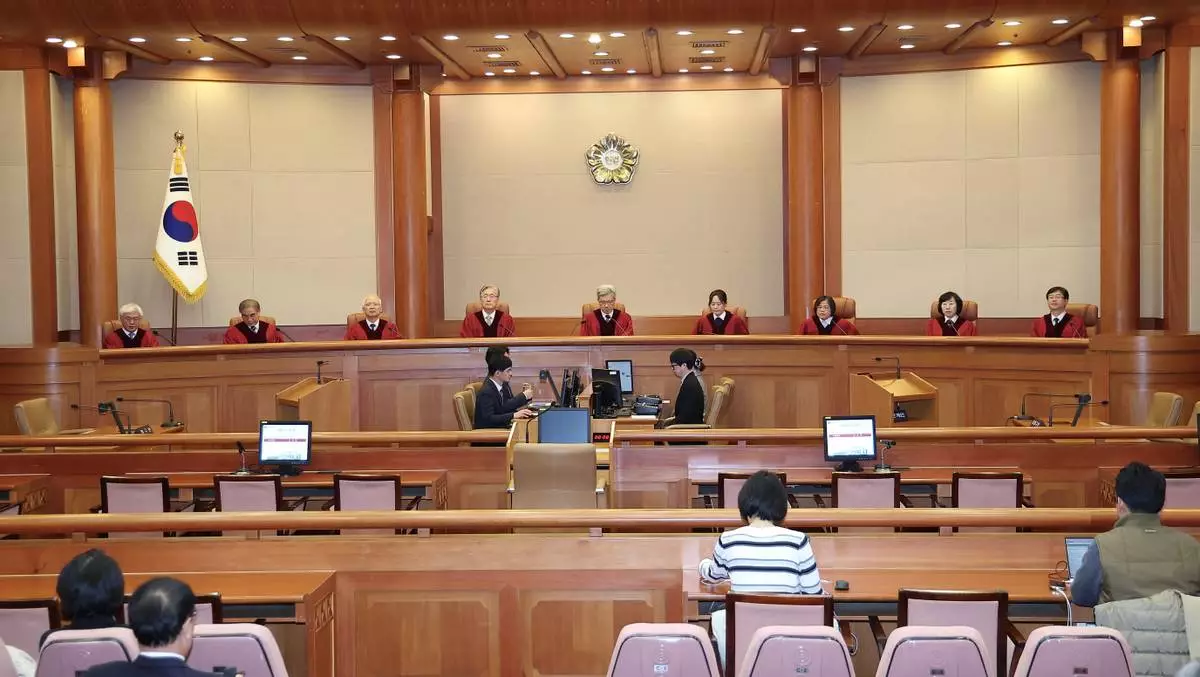
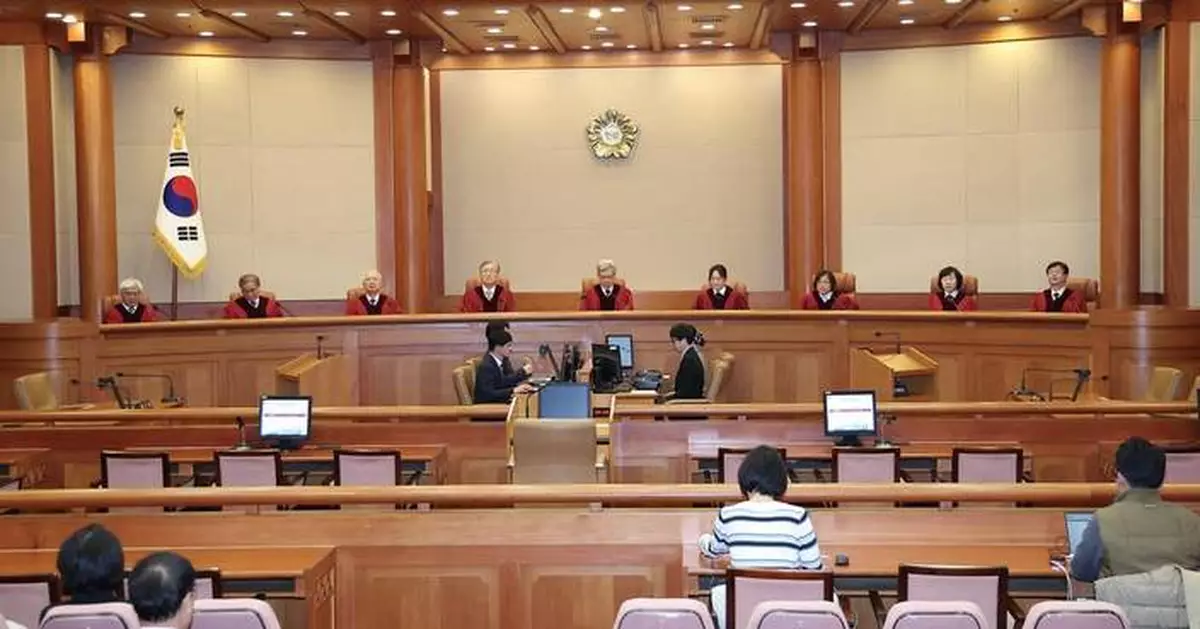
Kim Sang-hwan, top center, chief justice of the Constitutional Court and the court's other justices attend a hearing to deliver a verdict on impeached police chief Cho Ji-ho at the court in Seoul, South Korea, Thursday, Dec. 18, 2025. (Kim Sung-min/Yonhap via AP)

BRUSSELS (AP) — Belgium insisted on Thursday that its European Union partners must provide ironclad guarantees that it will be protected from Russian retaliation before it would back a massive loan for Ukraine.
At a high-stakes EU summit in Brussels, the 27-nation bloc’s leaders are set to decide on whether to use tens of billions of euros in frozen Russian assets to underwrite a loan to meet Ukraine’s military and financial needs over the next two years.
The bulk of the assets — some 193 billion euros ($227 billion) as of September — are held in the Brussels-based financial clearing house Euroclear. Russia’s Central Bank sued Euroclear last week.
“Give me a parachute and we’ll all jump together,” De Wever told members of the Belgian parliament just before the summit began. “If we have confidence in the parachute that shouldn’t be a problem.”
Belgium fears that Russia will strike back and would prefer that the bloc borrow the money on international markets. It wants frozen assets held in other European countries to be thrown into the pot as well, and for its partners to guarantee that Euroclear will have the funds it needs should it come under legal attack.
European officials say Russia is waging a campaign of sabotage and disruption across the continent. The Central Bank lawsuit ramped up pressure on Belgium and its European partners ahead of the summit.
The “reparations loan” plan would see the EU give 90 billion euros ($106 billion) to Ukraine. Countries like the U.K., Canada and Norway would make up any shortfall.
Russia's claim to the assets would still stand, but the assets would remain locked away at least until the Kremlin ends its war on Ukraine and pays for the massive damage it's caused over four years of war.
In mapping out the loan plan, the European Commission set up safeguards to protect Belgium, but De Wever remains unconvinced.
“I have not yet seen a text that could satisfactorily address Belgium’s concerns," he said. "I hope to see one today.”
De Wever insisted that Belgium remains “a faithful ally” of Ukraine and wants to continue to help.
Whatever method they use, the leaders have pledged to meet most of Ukraine's needs for the next two years. The International Monetary Fund estimates that would amount to 137 billion euros ($160 billion). The war-ravaged country is at risk of bankruptcy and needs the money by spring.
“We have to find a solution today," European Commission President Ursula von der Leyen told reporters. "We will not leave the European Council without a solution for the funding of Ukraine for the next two years.” EU Council President António Costa, who is chairing the meeting, has vowed to keep leaders negotiating until an agreement is reached, even if it takes days.
Polish Prime Minister Donald Tusk said: “Now we have a simple choice. Either money today or blood tomorrow." He insisted that "all European leaders have to rise to the occasion.”
EU envoys have worked around the clock in recent weeks to flesh out the details and narrow differences among the 27 member countries. If enough countries object, the plan could be blocked. There is no majority support for a plan B of raising the funds on international markets.
German Chancellor Friedrich Merz said that he hopes Belgium's concerns can be addressed.
"The reactions of the Russian president in recent hours show how necessary this is. In my view, this is indeed the only option. We are basically faced with the choice of using European debt or Russian assets for Ukraine, and my opinion is clear: we must use the Russian assets.”
Hungary and Slovakia oppose von der Leyen’s plan for a reparations loan. Apart from Belgium, Bulgaria, Italy and Malta are also undecided.
“I would not like a European Union in war," said Hungarian Prime Minister Viktor Orbán, who sees himself as a peacemaker. He’s also Russian President Vladimir Putin’s closest ally in Europe. “To give money means war.”
Orbán described the loan plan as “a dead end,” and said that “the whole idea is a stupid one.”
Associated Press Writer Kirsten Grieshaber in Berlin contributed to this report.
Hungary's Prime Minister Viktor Orban speaks with the media as he arrives for the EU Summit in Brussels, Thursday, Dec. 18, 2025. (AP Photo/Geert Vanden Wijngaert)
Hungary's Prime Minister Viktor Orban, right, arrives for the EU Summit in Brussels, Thursday, Dec. 18, 2025. (AP Photo/Omar Havana)
Italy's Prime Minister Giorgia Meloni, center, is greeted as she arrives for a round table meeting on migration at the EU Summit in Brussels, Thursday, Dec. 18, 2025. (AP Photo/Olivier Hoslet, Pool Photo via AP)
European Commission President Ursula von der Leyen, right, and Germany's Chancellor Friedrich Merz, left, attend a round table meeting on migration at the EU Summit in Brussels, Thursday, Dec. 18, 2025. (AP Photo/Olivier Hoslet, Pool Photo via AP)
FILE - A view of the headquarters of Euroclear in Brussels, on Oct. 23, 2025. (AP Photo/Geert Vanden Wijngaert, File)