|
PANAMA CITY, Dec. 18, 2025 /PRNewswire/ -- HTX Research, the dedicated research arm of leading global crypto exchange HTX, has released a new report titled The Pre-Market Asset Trading Ecosystem: Mechanism Evolution, Market Structure, and Future Trends Behind Its Multi-Billion Scale. The report provides a systematic analysis of how pre-market trading has emerged, how different asset structures function before a Token Generation Event (TGE), and how this ecosystem is reshaping project launches and exchange listing pathways.
The study focuses on a trend that is becoming increasingly visible across the crypto industry: as fundraising becomes more difficult and token issuance timelines stretch out, trading activity before TGE is evolving from fragmented experimentation into a distinct "1.5-level market" sitting between the primary and secondary markets.
From the Pre-TGE "Vacuum" to a New Market Layer
According to the report, the rise of the pre-market ecosystem is closely tied to structural shifts following the market downturn that began in late 2022. With primary market funding tightening and issuance cycles extending, many projects turned to points systems, airdrop expectations, testing access, and early participation programs to sustain operations and community engagement before launching a token.
At the same time, issuance costs fell and token creation tools lowered barriers dramatically, leading to a surge in the number of new tokens and a constant dilution of market attention. In this environment, attention itself became a scarce resource. Pre-market trading mechanisms—built around future value, expectations, and redeemable rights—naturally emerged, forming an "in-between layer" that previously existed largely behind closed doors between venture funds and exchanges. This layer is now widely referred to as the Pre-Market, or the 1.5-level market.
Three Asset Types Defining the Pre-Market Ecosystem
HTX Research categorizes pre-market assets into three core types by how their future value is anchored.
Token-value-anchored assets revolve around future token prices and include pre-market OTC transactions, pre-market spot trading, and pre-market perpetual futures. These assets are most directly linked to post-listing spot markets and concentrate on early price discovery.
Points-anchored assets are built around user behavior points that later map to airdrops. Through OTC trading and yield-splitting mechanisms, points increasingly function as early expressions of assetized expectations under today's airdrop-driven tokenomics.
Rights-anchored assets package future redeemable rights—such as whitelist access, early participation slots, or future token allocations—into tradable forms like NFTs, access passes, or BuildKey-style vouchers. These structures transform non-standard entitlements into marketable claims.
Together, these three types cover the full chain from user contribution and market expectation to entitlement assignment and final settlement, turning the pre-market into a multi-layered system rather than a single speculative tool.
HTX's Practice on Pre-Market Perpetual Futures
As demand has grown, pre-market trading has expanded beyond OTC and spot formats into derivatives. Pre-market perpetual futures allow users to express leveraged views on a token's future price before it is listed, pushing price discovery further forward in time. According to the report, pre-market perpetuals have already become one of the highest-volume pre-market trading formats.
In this context, HTX launched a WLFI/USDT pre-market perpetual futures ahead of WLFI (World Liberty Financial)'s official listing. This allowed users to participate in price discovery and manage risk prior to TGE, illustrating a broader trend identified in the report: exchanges are extending their role from the listing moment into the pre-issuance phase, making pre-market trading an increasingly important part of exchange product systems.
Scale Potential and Structural Challenges
The pre-market has already reached a meaningful scale. For major projects, pre-market trading can easily generate hundreds of millions of dollars in turnover, while flagship names such as WLFI and Monad have seen cumulative pre-market volumes exceed $1 billion. As a result, the pre-market has become a stable multi-billion-dollar segment with room to expand further.
At the same time, clear structural risks remain. Liquidity is naturally thinner, prices can be moved by large players, and settlement often depends heavily on project teams. Information asymmetry is persistent, and different asset types still lack unified standards for rules, settlement, and risk allocation. Whether the pre-market can continue scaling will depend on its ability to move from an opportunity-driven market toward more institutionalized and coordinated structures.
Conclusion
HTX Research concludes that pre-market trading is not a temporary phenomenon. Driven by changes in funding conditions, user participation models, and exchange product design, it is reshaping how projects launch tokens, how exchanges structure listings, and how users engage with early-stage markets.
As the pre-market evolves from a grey zone before issuance into a core layer connecting primary and secondary markets, it is likely to become a long-term, increasingly institutionalized feature of the crypto market landscape.
About HTX Research
HTX Research is the dedicated research arm of HTX Group, responsible for conducting in-depth analyses, producing comprehensive reports, and delivering expert evaluations across a broad spectrum of topics, including cryptocurrency, blockchain technology, and emerging market trends. Committed to providing data-driven insights and strategic foresight, HTX Research plays a pivotal role in shaping industry perspectives and supporting informed decision-making within the digital asset space. Through rigorous research methodologies and cutting-edge analytics, HTX Research remains at the forefront of innovation, driving thought leadership and fostering a deeper understanding of evolving market dynamics. Visit us.
PANAMA CITY, Dec. 18, 2025 /PRNewswire/ -- HTX Research, the dedicated research arm of leading global crypto exchange HTX, has released a new report titled The Pre-Market Asset Trading Ecosystem: Mechanism Evolution, Market Structure, and Future Trends Behind Its Multi-Billion Scale. The report provides a systematic analysis of how pre-market trading has emerged, how different asset structures function before a Token Generation Event (TGE), and how this ecosystem is reshaping project launches and exchange listing pathways.
The study focuses on a trend that is becoming increasingly visible across the crypto industry: as fundraising becomes more difficult and token issuance timelines stretch out, trading activity before TGE is evolving from fragmented experimentation into a distinct "1.5-level market" sitting between the primary and secondary markets.
From the Pre-TGE "Vacuum" to a New Market Layer
According to the report, the rise of the pre-market ecosystem is closely tied to structural shifts following the market downturn that began in late 2022. With primary market funding tightening and issuance cycles extending, many projects turned to points systems, airdrop expectations, testing access, and early participation programs to sustain operations and community engagement before launching a token.
At the same time, issuance costs fell and token creation tools lowered barriers dramatically, leading to a surge in the number of new tokens and a constant dilution of market attention. In this environment, attention itself became a scarce resource. Pre-market trading mechanisms—built around future value, expectations, and redeemable rights—naturally emerged, forming an "in-between layer" that previously existed largely behind closed doors between venture funds and exchanges. This layer is now widely referred to as the Pre-Market, or the 1.5-level market.
Three Asset Types Defining the Pre-Market Ecosystem
HTX Research categorizes pre-market assets into three core types by how their future value is anchored.
Token-value-anchored assets revolve around future token prices and include pre-market OTC transactions, pre-market spot trading, and pre-market perpetual futures. These assets are most directly linked to post-listing spot markets and concentrate on early price discovery.
Points-anchored assets are built around user behavior points that later map to airdrops. Through OTC trading and yield-splitting mechanisms, points increasingly function as early expressions of assetized expectations under today's airdrop-driven tokenomics.
Rights-anchored assets package future redeemable rights—such as whitelist access, early participation slots, or future token allocations—into tradable forms like NFTs, access passes, or BuildKey-style vouchers. These structures transform non-standard entitlements into marketable claims.
Together, these three types cover the full chain from user contribution and market expectation to entitlement assignment and final settlement, turning the pre-market into a multi-layered system rather than a single speculative tool.
HTX's Practice on Pre-Market Perpetual Futures
As demand has grown, pre-market trading has expanded beyond OTC and spot formats into derivatives. Pre-market perpetual futures allow users to express leveraged views on a token's future price before it is listed, pushing price discovery further forward in time. According to the report, pre-market perpetuals have already become one of the highest-volume pre-market trading formats.
In this context, HTX launched a WLFI/USDT pre-market perpetual futures ahead of WLFI (World Liberty Financial)'s official listing. This allowed users to participate in price discovery and manage risk prior to TGE, illustrating a broader trend identified in the report: exchanges are extending their role from the listing moment into the pre-issuance phase, making pre-market trading an increasingly important part of exchange product systems.
Scale Potential and Structural Challenges
The pre-market has already reached a meaningful scale. For major projects, pre-market trading can easily generate hundreds of millions of dollars in turnover, while flagship names such as WLFI and Monad have seen cumulative pre-market volumes exceed $1 billion. As a result, the pre-market has become a stable multi-billion-dollar segment with room to expand further.
At the same time, clear structural risks remain. Liquidity is naturally thinner, prices can be moved by large players, and settlement often depends heavily on project teams. Information asymmetry is persistent, and different asset types still lack unified standards for rules, settlement, and risk allocation. Whether the pre-market can continue scaling will depend on its ability to move from an opportunity-driven market toward more institutionalized and coordinated structures.
Conclusion
HTX Research concludes that pre-market trading is not a temporary phenomenon. Driven by changes in funding conditions, user participation models, and exchange product design, it is reshaping how projects launch tokens, how exchanges structure listings, and how users engage with early-stage markets.
As the pre-market evolves from a grey zone before issuance into a core layer connecting primary and secondary markets, it is likely to become a long-term, increasingly institutionalized feature of the crypto market landscape.
About HTX Research
HTX Research is the dedicated research arm of HTX Group, responsible for conducting in-depth analyses, producing comprehensive reports, and delivering expert evaluations across a broad spectrum of topics, including cryptocurrency, blockchain technology, and emerging market trends. Committed to providing data-driven insights and strategic foresight, HTX Research plays a pivotal role in shaping industry perspectives and supporting informed decision-making within the digital asset space. Through rigorous research methodologies and cutting-edge analytics, HTX Research remains at the forefront of innovation, driving thought leadership and fostering a deeper understanding of evolving market dynamics. Visit us.
** The press release content is from PR Newswire. Bastille Post is not involved in its creation. **

HTX Research Releases New Report on How the Pre-Market Ecosystem Is Reshaping Token Launches
PARIS, April 2, 2026 /PRNewswire/ -- The Korea Carbon Industry Promotion Agency (Kcarbon), in collaboration with Gyeongsangbuk-do, successfully concluded its participation in JEC World 2026, the world's largest composites exhibition, held from March 10 to 12 in Paris, France. Through the operation of the Korea Pavilion, the agency strengthened the global presence of Korea's carbon materials and advanced application technologies.
The Korea Pavilion featured 12 leading small and medium-sized enterprises specializing in carbon materials and components. The exhibition showcased a wide range of high-value materials, including carbon fiber composites, recycled carbon fiber, carbon nanotubes, and graphene, as well as their applications in thermal management products, electric aircraft batteries, wind turbine blade components, and water treatment systems.
Participating companies—Neomond, Daesung Metal, Daeshin Techgen, VSPACE, Shinsung Materials, CTCM, FRT Robotics, O2NB, Il Sung Composites, Cartech H, and Taerim Industry—demonstrated capabilities spanning from raw materials to finished products for aerospace, medical devices, and environmental systems. Leveraging differentiated manufacturing technologies and stable production capabilities, the companies engaged in extensive business discussions with buyers from Europe, the Americas, and the Middle East, achieving tangible outcomes.
Notably, Daeshin Techgen and O2NB secured export contracts totaling $450,000 with international buyers. Daeshin Techgen signed supply agreements with U.S.-based PBS International and N-Water, valued at $200,000 for electromagnetic shielding composites and $100,000 for CNT nanofilters. O2NB concluded a $150,000 contract with Kayo Partners in Gabon for water purification systems, marking a new entry into the African market.
Other participating companies also leveraged the exhibition to explore global opportunities. VSPACE presented solutions for urban air mobility (UAM), FRT Robotics showcased robotic exoskeleton technologies, and Cartech H introduced innovations in recycled carbon fiber technologies, all aiming to expand partnerships in European and global markets.
During the exhibition, the agency operated a dedicated B2B meeting zone in cooperation with the Korea Carbon and Nano Industry Association
(KCANIA) and the World Federation of Overseas Korean Economic And Trade Associations(OKTA). The initiative provided buyer matching, interpretation support for technical discussions, and on-site assistance for exhibitors, contributing to meaningful business outcomes.
Park Gyu-soon, Acting President of the Korea Carbon Industry Promotion Agency, stated, "JEC World 2026 provided an excellent opportunity to present the innovative technologies of Korean carbon companies to the global market. We will continue to identify global partnership opportunities and support companies in strengthening their export competitiveness."
The successful conclusion of the Korea Pavilion at JEC World 2026 underscores Korea's growing competitiveness in advanced carbon materials and its commitment to expanding its footprint in the global composites market.
** This press release is distributed by PR Newswire through automated distribution system, for which the client assumes full responsibility. **
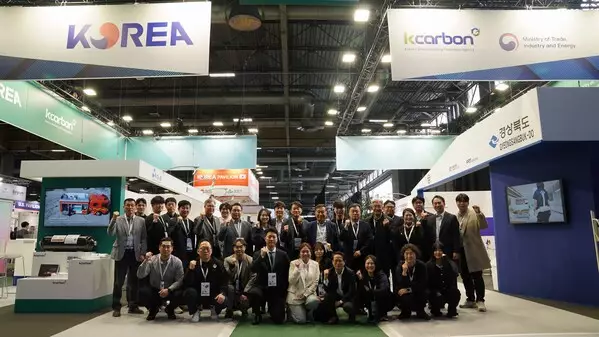
THE KOREA INDUSTRY DAILY: Korea Pavilion Concludes Successful Showcase at JEC World 2026, Secures $450,000 in Export Deals and Expands Global Partnerships