Belarus' authoritarian president said Thursday that Russia had deployed its latest nuclear-capable Oreshnik missile system to the country, a move that comes as talks to end the war in Ukraine have entered a crucial phase.
President Alexander Lukashenko said the Oreshnik, an intermediate range ballistic missile system, arrived in the country on Wednesday and is entering combat duty. He didn't say how many missiles have been deployed or give any other details.
Russian President Vladimir Putin said Wednesday that the Oreshnik will enter combat duty this month but didn't give any other details. Putin made the statement at a meeting with top Russian military officers, where he warned that Moscow will seek to extend its gains in Ukraine if Kyiv and its Western allies reject the Kremlin’s demands in peace talks.
U.S. President Donald Trump has unleashed an extensive diplomatic push to end nearly four years of fighting following Russia’s full-scale invasion of Ukraine in February 2022, but Washington’s efforts have run into sharply conflicting demands by Moscow and Kyiv.
Russia previously has deployed tactical nuclear weapons to the territory of its Belarus, whose territory it used to launch a full-scale invasion of Ukraine in February 2022. Lukashenko has earlier said that his country has several dozen Russian tactical nuclear weapons.
Russia first tested a conventionally armed version of the Oreshnik — Russian for hazelnut tree — to strike a Ukrainian factory in November 2024, and Putin has boasted that it’s impossible to intercept. He has warned the West that Russia could use it next against allies of Kyiv that allowed it to strike inside Russia with their longer-range missiles.
The Russian leader has bragged that Oreshnik’s multiple warheads plunge at speeds of up to Mach 10 and can’t be intercepted, and that several of them used in a conventional strike could be as devastating as a nuclear attack. Russian state media boasted that it would take the missile only 11 minutes to reach an air base in Poland and 17 minutes to reach NATO headquarters in Brussels. There’s no way to know whether it’s carrying a nuclear or a conventional warhead before it hits the target.
Intermediate-range missiles can fly between 500 to 5,500 kilometers (310 to 3,400 miles). Such weapons were banned under a Soviet-era treaty that Washington and Moscow abandoned in 2019.
Putin and Lukashenko have previously said that the Oreshnik will be deployed to Belarus before the year’s end.
While signing a security pact with Lukashenko in December 2024, Putin said that even with Russia controlling the Oreshniks, Moscow would allow Minsk to select the targets. He noted that if the missiles are used against targets closer to Belarus, they could carry a significantly heavier payload.
In 2024, the Kremlin released a revised nuclear doctrine, noting that any nation’s conventional attack on Russia that is supported by a nuclear power will be considered a joint attack on his country. The threat was clearly aimed at discouraging the West from allowing Ukraine to strike Russia with longer-range weapons and appears to significantly lower the threshold for the possible use of Russia’s nuclear arsenal.
The revised Russian doctrine also placed Belarus under the Russian nuclear umbrella.
Lukashenko has ruled the nation of 9.5 million with an iron fist for more than three decades. His government has been repeatedly sanctioned by the West for its crackdown on human rights and for allowing Moscow to use its territory during the 2022 invasion of Ukraine.
While maintaining strong ties with Moscow, Lukashenko also has sought a rapprochement with the U.S. On Saturday, Lukashenko freed 123 political prisoners, including Nobel Peace Prize laureate Ales Bialiatski, as part of a deal with Washington that lifted U.S. sanctions against the Belarusian potash industries, a key source of export earnings.
Belarusian opposition leader Sviatlana Tsikhanouskaya told The Associated Press on Thursday that the deployment of Oreshnik to Belarus deepens the country's military and political dependence on Russia.
“The deployment of Oreshnik turns Belarus into a target and militarizes the country, and we stand categorically against it,” Tsikhanouskaya said. “Putin is using Lukashenko as a tool for the Kremlin's games.”
This story has been corrected to note that Putin and Lukashenko have previously said the Oreshnik missile system will be deployed to Belarus, not Ukraine, by year's end.

FILE - Belarusian President Alexander Lukashenko, left, and Russian President Vladimir Putin pose for a photo prior to the talks in Bishkek, Kyrgyzstan, on Wednesday, Nov. 26, 2025. (Alexei Nikolsky, Sputnik, Kremlin Pool Photo via AP, File)

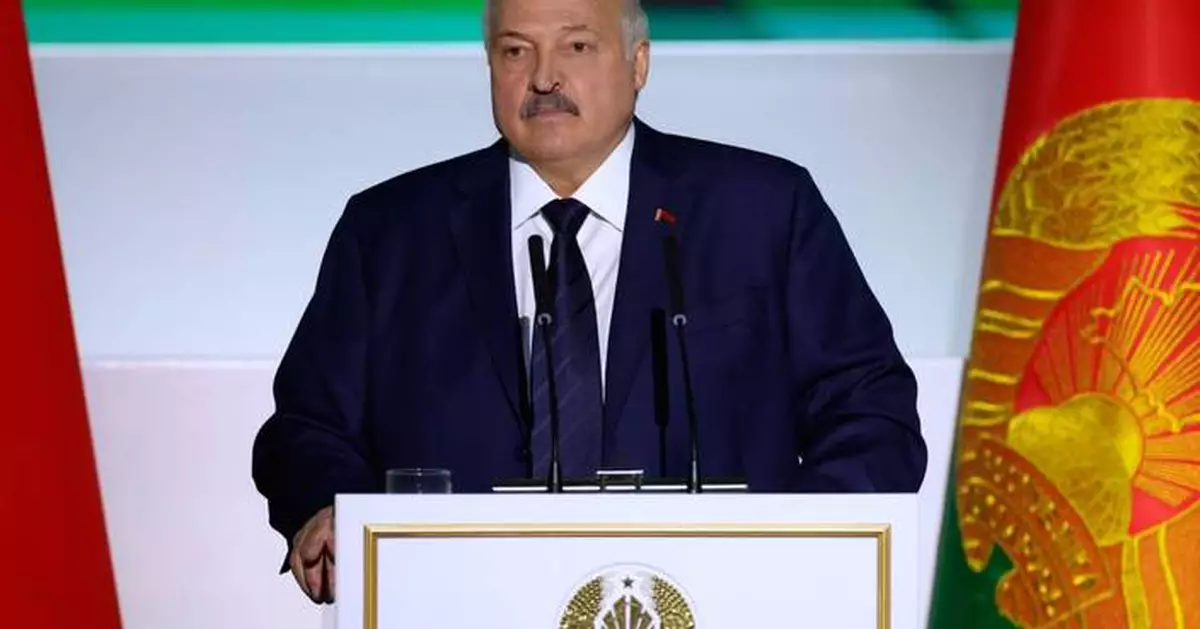
In this photo provided by Belarusian Presidential Press Service, Belarusian President Alexander Lukashenko addresses the meeting of the All-Belarusian People's Assembly in Minsk, Belarus, Thursday, Dec. 18, 2025.(Belarusian Presidential Press Service via AP)
NEW YORK (AP) — U.S. stocks are jumping on Thursday following an encouraging report on inflation that could help the Federal Reserve keep cutting interest rates next year. A strong profit report from Micron Technology also helped AI stocks halt their sharp slides, at least for now.
The S&P 500 rallied 0.9% and is on track for its best day in three weeks, coming off a four-day losing streak. The Dow Jones Industrial Average was up 124 points, or 0.3%, as of 2:07 p.m. Eastern time, and the strength for tech stocks had the Nasdaq composite up a market-leading 1.5%.
Some relief came from a report showing that inflation was less bad last month than economists expected. That could soothe nerves at the Fed, which is responsible for keeping inflation low and for keeping the job market strong.
Inflation is still higher than anyone would like, at 2.7% last month, but if it creeps closer to the Fed’s target of 2%, Fed officials could feel more free to cut interest rates to help a slowing job market. Wall Street loves lower interest rates because they can boost the economy and prices for investments, even if they may also worsen inflation.
To be sure, some along Wall Street said Thursday’s inflation update may not move the needle much at the Fed given how noisy economic reports have been following the U.S. government’s earlier shutdown. Next month’s update on inflation could provide a better gauge of what’s actually happening. But a better-than-expected report on inflation is nevertheless better than the alternative.
Also helping to drive the U.S. stock market was Micron Technology, the seller of memory and storage for computers, which rallied 12.8% after reporting stronger profit and revenue for the latest quarter than analysts expected. CEO Sanjay Mehrotra said each of the company’s business units enjoyed stronger revenue and made more in profit off each $1 of that revenue.
Micron also gave encouraging forecasts for upcoming financial results, and Mehrotra credited its position as an “AI enabler,” among other things.
Billions of dollars are flowing into artificial-intelligence technology, which helped superstar stocks like Nvidia lead the market for years.
But questions are rising about whether those stock prices shot too high and whether customers will get a good-enough return on AI investments through bigger profits and productivity. Worries are also weighing on companies that are borrowing lots of money to pay for AI investments.
Oracle and Broadcom have been at the center of such worries recently, and their stock prices have been falling sharply since last week despite both reporting better profits for the latest quarter than analysts expected. On Thursday, Oracle rose 0.4%, and Broadcom added 1.1%.
Nvidia, the chip company that’s become Wall Street’s most influential because of its immense size, gained 2.2%.
Another winner was Trump Media & Technology Group, which jumped 39% to carve into some of its steep loss for the year so far, 69.3% coming into the day. The company, which began with President Donald Trump’s Truth Social platform and then moved into cryptocurrencies and various other lines of business, is now moving into nuclear power.
It’s merging with TAE Technologies in an all-stock deal, and each company will own roughly half of the combined business. The companies said the deal would pair TMTG’s ability to raise significant money by attracting investors with TAE’s technology. They hope to get TAE’s nuclear-fusion reactors, which would create power in a similar way as the sun does, running commercially.
Cintas rose 0.9% after the provider of work uniforms and cleaning supplies reported stronger profit for the latest quarter than analysts expected, while also announcing a program to send up to $1 billion to shareholders by buying back its own stock.
Darden Restaurants, the company behind Olive Garden and LongHorn Steakhouse, rose 0.4% even though its profit for the latest quarter fell short of analysts’ expectations. Its growth in revenue topped forecasts, benefiting from both the opening of new restaurants and increased revenue at its older locations.
CarMax swung sharply between gains and losses and was most recently down 3.9%. The auto retailer reported a stronger profit for the latest quarter than analysts expected. But it also said it may make less profit from each $1 of revenue in sales of used autos during the current quarter, as it tries to get more competitive in the market. It also plans to increase spending on marketing to drive customers to lots.
In stock markets abroad, indexes rose 0.6% in London, 0.8% in France and 1% in Germany after the Bank of England cut its key interest rate and the European Central Bank kept its steady.
Asian indexes were mixed, with stocks falling 1.5% in South Korea but adding 0.2% in Shanghai.
In the bond market, Treasury yields sank following the encouraging report on U.S. inflation.
The yield on the 10-year Treasury fell to 4.12% from 4.16% late Wednesday.
AP Business Writers Matt Ott and Elaine Kurtenbach contributed.
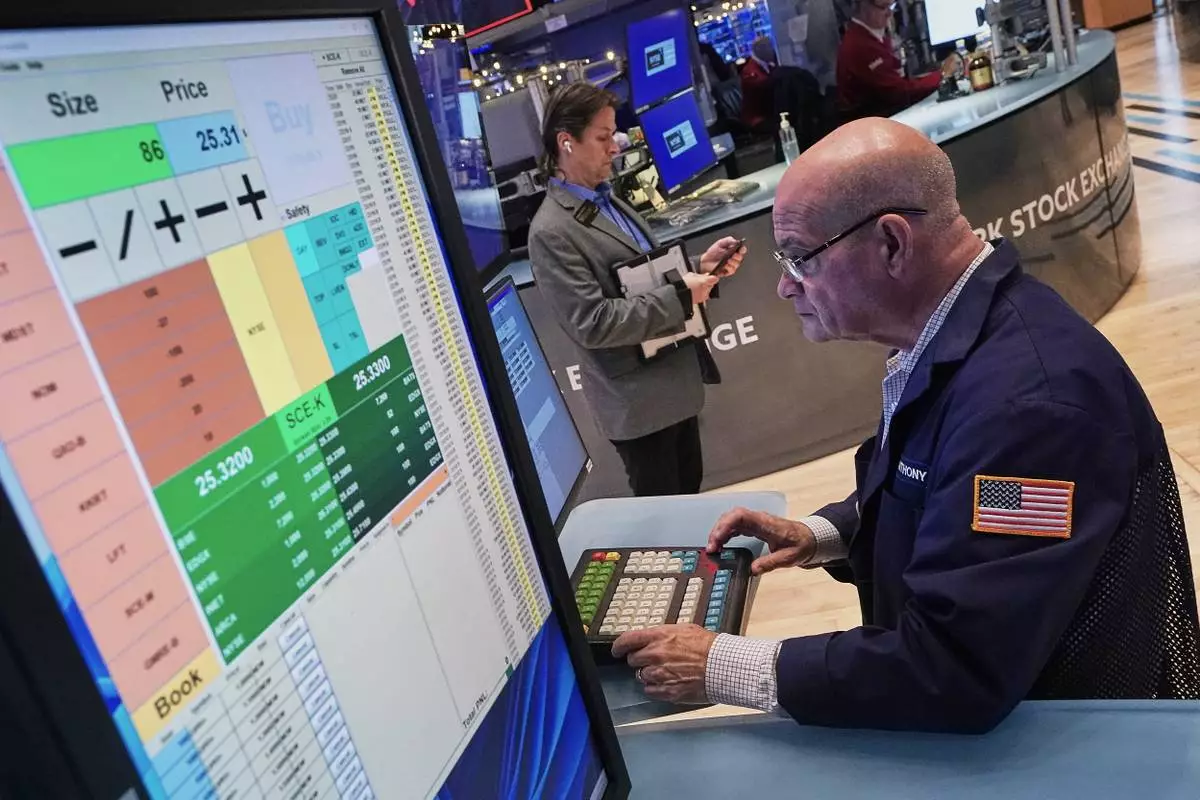
Trader Anthony Confusione works on the floor of the New York Stock Exchange, Thursday, Dec. 11, 2025. (AP Photo/Richard Drew)
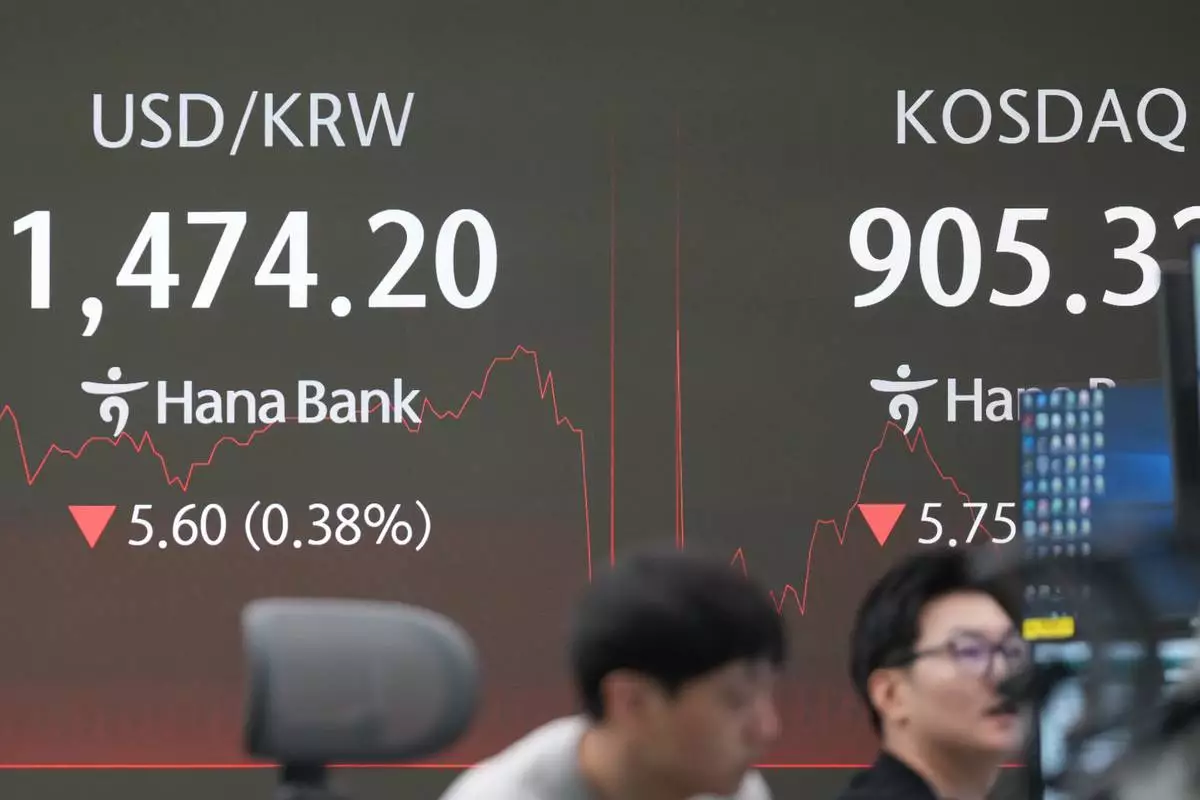
Dealers work near the screens showing the foreign exchange rate between U.S. dollar and South Korean won, left, and the Korean Securities Dealers Automated Quotations (KOSDAQ) at a dealing room of Hana Bank in Seoul, South Korea, Thursday, Dec. 18, 2025. (AP Photo/Lee Jin-man)

Jim Boyle, CEO of Medline Industries, poses for a picture outside the Nasdaq MarketSite, Wednesday, Dec. 17, 2025, in New York. (AP Photo/Yuki Iwamura)
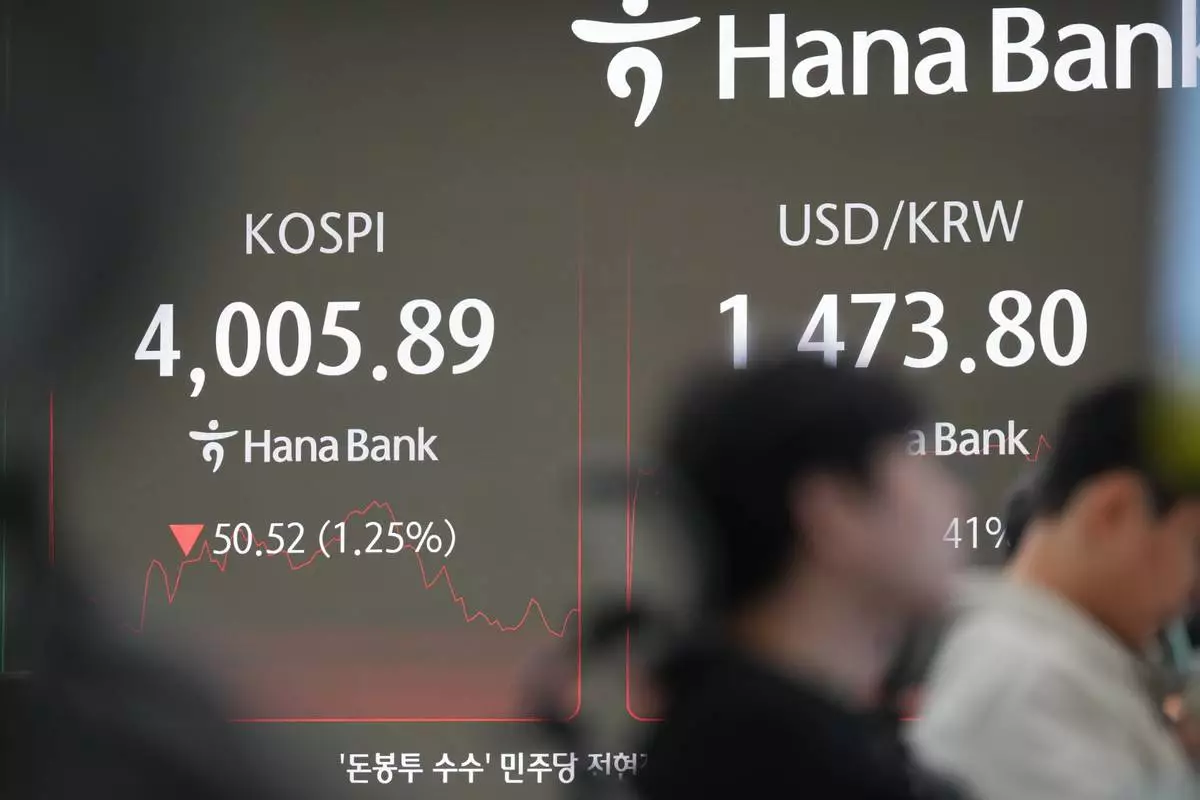
Dealers work near the screens showing the Korea Composite Stock Price Index (KOSPI), left, and the foreign exchange rate between U.S. dollar and South Korean won at a dealing room of Hana Bank in Seoul, South Korea, Thursday, Dec. 18, 2025. (AP Photo/Lee Jin-man)

A dealer watches computer monitors at a dealing room of Hana Bank in Seoul, South Korea, Thursday, Dec. 18, 2025. (AP Photo/Lee Jin-man)