WASHINGTON (AP) — U.S. forces on Saturday stopped an oil tanker off the coast of Venezuela for the second time in less than two weeks as President Donald Trump continues to ramp up pressure on Venezuelan President Nicolás Maduro.
The pre-dawn operation comes days after Trump announced a “blockade” of all sanctioned oil tankers coming in and out of the South American country and follows the Dec. 10 seizure by American forces of an oil tanker off Venezuela’s coast.
Homeland Security Secretary Kristi Noem confirmed that the U.S. Coast Guard with help from the Defense Department stopped the oil tanker that was last docked in Venezuela. She also posted on social media an unclassified video of a U.S helicopter landing personnel on a vessel called Centuries.
A crude oil tanker flying under the flag of Panama operates under the name and was recently spotted near the Venezuelan coast, according to MarineTraffic, a project that tracks the movement of vessels around the globe using publicly available data. It was not immediately clear if the vessel was under U.S. sanctions.
“The United States will continue to pursue the illicit movement of sanctioned oil that is used to fund narco terrorism in the region,” Noem wrote on X. “We will find you, and we will stop you.”
The action was a “consented boarding,” with the tanker stopping voluntarily and allowing U.S. forces to board it, according to a U.S. official who was not authorized to comment publicly and spoke on the condition of anonymity.
Pentagon and White House officials did not immediately respond to a requests for comment.
Trump following the first tanker seizure, of a vessel named the Skipper, this month vowed that the U.S. would carry out a blockade of Venezuela. It all comes as Trump has ratcheted up his rhetoric toward Maduro and warned that the longtime Venezuelan leader’s days in power are numbered.
And the president this week demanded that Venezuela return assets that it seized from U.S. oil companies years ago, justifying anew his announcement of a “blockade” against oil tankers traveling to or from the South American country that face American sanctions.
Trump cited the lost U.S. investments in Venezuela when asked about his newest tactic in a pressure campaign against Maduro, suggesting the Republican administration’s moves are at least somewhat motivated by disputes over oil investments, along with accusations of drug trafficking. Some sanctioned tankers already are diverting away from Venezuela.
"We’re not going to be letting anybody going through who shouldn’t be going through,” Trump told reporters earlier this week. “You remember they took all of our energy rights. They took all of our oil not that long ago. And we want it back. They took it — they illegally took it.”
U.S. oil companies dominated Venezuela’s petroleum industry until the country’s leaders moved to nationalize the sector, first in the 1970s and again in the 21st century under Maduro and his predecessor, Hugo Chávez. Compensation offered by Venezuela was deemed insufficient, and in 2014 an international arbitration panel ordered the country’s socialist government to pay $1.6 billion to ExxonMobil.
The targeting of tankers comes as Trump has ordered the Defense Department to carry out a series of attacks on vessels in the Caribbean and eastern Pacific Ocean that his administration alleges are smuggling fentanyl and other illegal drugs into the United States and beyond.
At least 104 people have been killed in 28 known strikes since early September.
The strikes have faced scrutiny from U.S. lawmakers and human rights activists, who say the administration has offered scant evidence that its targets are indeed drug smugglers and that the fatal strikes amount to extrajudicial killings.
The Coast Guard, sometimes with help from the Navy, had typically interdicted boats suspected of smuggling drugs in the Caribbean Sea, searched for illicit cargo, and arrested the people aboard for prosecution.
The administration has justified the strikes as necessary, asserting it is in “armed conflict” with drug cartels aimed at halting the flow of narcotics into the United States. Maduro faces federal charges of narcoterrorism in the U.S.
The U.S. in recent months has sent a fleet of warships to the region, the largest buildup of forces in generations, and Trump has stated repeatedly that land attacks are coming soon.
Maduro has insisted the real purpose of the U.S. military operations is to force him from power.
White House chief of staff Susie Wiles said in an interview with Vanity Fair published this week that Trump “wants to keep on blowing boats up until Maduro cries uncle.”
Madhani reported from West Palm Beach, Florida.

President Nicolas Maduro addresses supporters during a rally marking the anniversary of the Battle of Santa Ines, which took place during Venezuela's 19th-century Federal War, in Caracas, Venezuela, Wednesday, Dec. 10, 2025. (AP Photo/Ariana Cubillos)

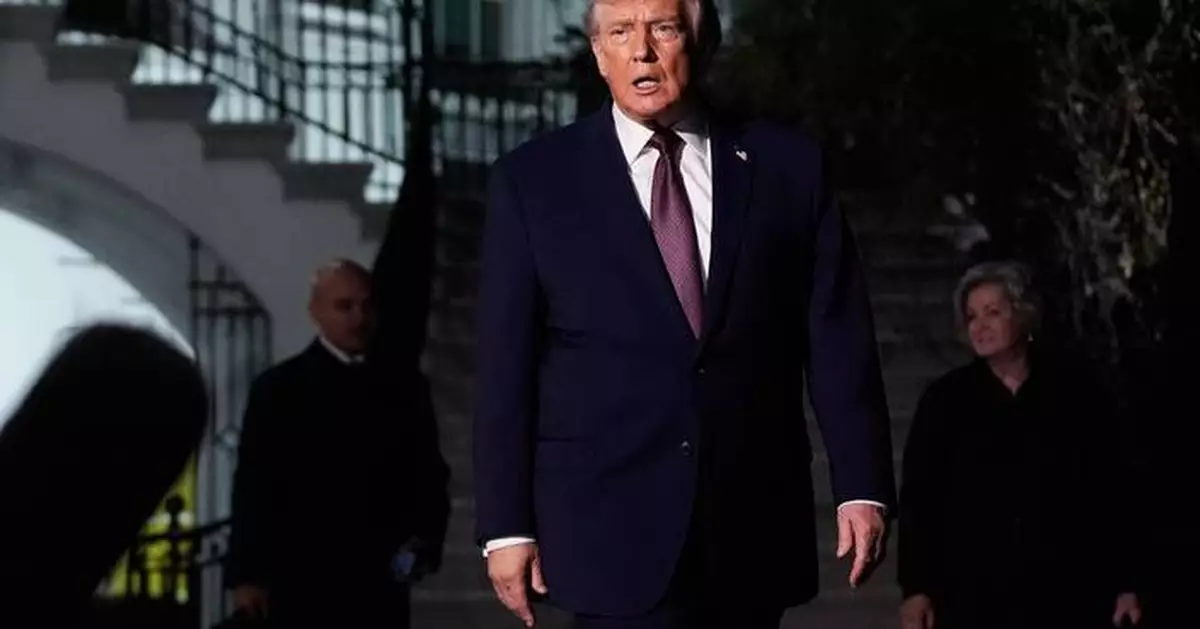
President Donald Trump walks to speak with reporters while departing the White House as chief of staff Susie Wiles, right, looks on, Friday, Dec. 19, 2025, in Washington. (AP Photo/Julia Demaree Nikhinson)
NEW YORK (AP) — At least 16 files disappeared from the Justice Department’s public webpage for documents related to Jeffrey Epstein — including a photograph showing President Donald Trump — less than a day after they were posted, with no explanation from the government and no notice to the public.
The missing files, which were available Friday and no longer accessible by Saturday, included images of paintings depicting nude women, and one showing a series of photographs along a credenza and in drawers. In that image, inside a drawer among other photos, was a photograph of Trump, alongside Epstein, Melania Trump and Epstein's longtime associate Ghislaine Maxwell.
The Justice Department did not say why the files were removed or whether their disappearance was intentional. A spokesperson for the department did not immediately respond to a request for comment.
Online, the unexplained missing files fueled speculation about what was taken down and why the public was not notified, compounding long-standing intrigue about Epstein and the powerful figures who surrounded him. Democrats on the House Oversight Committee pointed to the missing image featuring a Trump photo in a post on X, writing: “What else is being covered up? We need transparency for the American public.”
The episode deepened concerns that had already emerged from the Justice Department’s much-anticipated document release. The tens of thousands of pages made public offered little new insight into Epstein’s crimes or the prosecutorial decisions that allowed him to avoid serious federal charges for years, while omitting some of the most closely watched materials, including FBI interviews with victims and internal Justice Department memos on charging decisions.
Some of the most consequential records expected about Epstein are nowhere to be found in the Justice Department's initial disclosures, which span tens of thousands of pages.
Missing are FBI interviews with survivors and internal Justice Department memos examining charging decisions — records that could have helped explain how investigators viewed the case and why Epstein was allowed in 2008 to plead guilty to a relatively minor state-level prostitution charge.
The gaps go further.
The records, required to be released under a recent law passed by Congress, hardly reference several powerful figures long associated with Epstein, including Britain’s former Prince Andrew, renewing questions about who was scrutinized, who was not, and how much the disclosures truly advance public accountability
Among the fresh nuggets: insight into the Justice Department’s decision to abandon an investigation into Epstein in the 2000s, which enabled him to plead guilty to that state-level charge, and a previously unseen 1996 complaint accusing Epstein of stealing photographs of children.
The releases so far have been heavy on images of Epstein’s homes in New York City and the U.S. Virgin Islands, with some photos of celebrities and politicians.
There was a series of never-before-seen photos of former President Bill Clinton but fleetingly few of Trump. Both have been associated with Epstein, but both have since disowned those friendships. Neither has been accused of any wrongdoing in connection with Epstein and there was no indication the photos played a role in the criminal cases brought against him.
Despite a Friday deadline set by Congress to make everything public, the Justice Department said it plans to release records on a rolling basis. It blamed the delay on the time-consuming process of obscuring survivors' names and other identifying information. The department has not given any notice when more records might arrive.
That approach angered some Epstein accusers and members of Congress who fought to pass the law forced the department to act. Instead of marking the end of a yearslong battle for transparency, the document release Friday was merely the beginning of an indefinite wait for a complete picture of Epstein’s crimes and the steps taken to investigate them.
“I feel like again the DOJ, the justice system is failing us,” said Marina Lacerda, who alleges Epstein started sexually abusing her at his New York City mansion when she was 14.
Federal prosecutors in New York brought sex trafficking charges against Epstein in 2019, but he killed himself in jail after his arrest.
The documents just made public were a sliver of potentially millions of pages records in the department’s possession. In one example, Deputy Attorney General Todd Blanche said Manhattan federal prosecutors had more than 3.6 million records from sex trafficking investigations into Epstein and Maxwell, though many duplicated material already turned over by the FBI.
Many of the records released so far had been made public in court filings, congressional releases or freedom of information requests, though, for the first time, they were all in one place and available for the public to search for free.
Ones that were new were often lacking necessary context or heavily blacked out. A 119-page document marked “Grand Jury-NY," likely from one of the federal sex trafficking investigations that led to the charges against Epstein in 2019 or Maxwell in 2021, was entirely blacked out.
Trump’s Republican allies seized on the Clinton images, including photos of the Democrat with singers Michael Jackson and Diana Ross. There were also photos of Epstein with actors Chris Tucker and Kevin Spacey, and even Epstein with TV newscaster Walter Cronkite. But none of the photos had captions and was no explanation given for why any of them were together.
The meatiest records released so far showed that federal prosecutors had what appeared to be a strong case against Epstein in 2007 yet never charged him.
Transcripts of grand jury proceedings, released publicly for the first time, included testimony from FBI agents who described interviews they had with several girls and young women who described being paid to perform sex acts for Epstein. The youngest was 14 and in ninth grade.
One had told investigators about being sexually assaulted by Epstein when she initially resisted his advances during a massage.
Another, then 21, testified before the grand jury about how Epstein had hired her when she was 16 to perform a sexual massage and how she had gone on to recruit other girls to do the same.
“For every girl that I brought to the table he would give me $200,” she said. They were mostly people she knew from high school, she said. “I also told them that if they are under age, just lie about it and tell him that you are 18.”
The documents also contain a transcript of an interview Justice Department lawyers did more than a decade later with the U.S. attorney who oversaw the case, Alexander Acosta, about his ultimate decision not to bring federal charges.
Acosta, who was labor secretary during Trump’s first term, cited concerns about whether a jury would believe Epstein’s accusers.
He also said the Justice Department might have been more reluctant to make a federal prosecution out of a case that straddled the legal border between sex trafficking and soliciting prostitution, something more commonly handled by state prosecutors.
“I’m not saying it was the right view,” Acosta added. He also said that the public today would likely view the survivors differently.
“There’s been a lot of changes in victim shaming,” Acosta said.
Associated Press journalists Ali Swenson, Christopher L. Keller, Aaron Kessler and Mike Catalini contributed to this report.

Pages that show New York grand jury subpoenas being issued into the Jeffrey Epstein and Ghislaine Maxwell investigation, then pages of redactions that follow, in this document released by the U.S. Justice Department, are photographed, Friday, Dec. 19, 2025, in Washington. (AP Photo/Jon Elswick)

Pages from a totally redacted New York grand jury file into Jeffrey Epstein and Ghislaine Maxwell, released by the U.S. Justice Department, is photographed Friday, Dec. 19, 2025, in Washington. (AP Photo/Jon Elswick)