|
- Cuts carbon dioxide emissions from its production by 50%—equivalent to planting 1.3 million trees annually.
- Boosts durability by up to three times for secure information recognition even with long-term use.
- Mass production tailored to global customers starts in November, accelerating customer acquisition.
SEOUL, South Korea, Dec. 22, 2025 /PRNewswire/ -- LG Innotek (CEO Moon Hyuksoo) announced on December 22 that the company has successfully developed a 'Next-Generation Smart IC (integrated circuit) Substrate' featuring enhanced performance and reducing carbon emissions generated in its production by half.
The smart IC substrate is an essential component for mounting IC chips that store information on smart cards, such as those in credit cards, electronic passports, and USIMs. When users place a smart card in an ATM or on a passport reader, the IC chip's information is transmitted to the device via electronic signals.
- Carbon emissions from its production cut by 50%, durability boosted by three times, and secure information recognition enabled
This 'Next-Generation Smart IC Substrate' is an eco-friendly product that reduces the carbon emissions generated in its production by half. The product will cut annual carbon dioxide emissions by 8,500 tons—equivalent to planting about 1.3 million trees, the company explained.
LG Innotek applied a new material to this product for the first time in the world, achieving high performance without precious metal plating processes.
Existing smart IC substrates require plating with precious metals such as palladium and gold (Au) on their surfaces. This process prevents corrosion where the substrate makes contact with readers and ensures effective electronic signal transmission.
However, the mining of palladium and gold generates massive amounts of greenhouse gases, and the prices of these metals remain high. Thus, the industry has sought new materials or processes to replace them. By eliminating surface plating, LG Innotek's 'Next-Generation Smart IC Substrate' is thus attracting industry attention.
With environmental regulations tightening in Europe, home to major customers, LG Innotek is poised to gain a competitive edge in the global market with this 'Next-Generation Smart IC Substrate.'
Furthermore, this product's durability is three times greater than existing products. This minimizes information reading errors caused by wear from frequent external contact and long-term smart card use, delivering both higher performance and enhanced user convenience.
- Mass production for global customers began in November, tailored to customer needs, accelerating customer acquisition
LG Innotek aims to accelerate its global market penetration with this 'Next-Generation Smart IC Substrate'. In November, the company began mass production to supply leading global smart card manufacturers.
LG Innotek holds 20 domestic patents related to the 'Next-Generation Smart IC Substrate' and is pursuing patent registrations in the United States, Europe, and China. The company plans to secure additional global customers through active overseas promotions, leveraging its exclusive technology.
Cho Jitae(Jeffrey Cho), executive vice president and head of LG Innotek's Package Solution Business, said: "The 'Next-Generation Smart IC Substrate' both satisfies customers' ESG requirements and offers technological competitiveness. We will continue presenting innovative products that create differentiated customer value, making us a partner that realizes our customers' visions."
According to market research firm Mordor Intelligence, the global smart card market—currently valued at USD 20.3 billion—is projected to reach USD 30.6 billion by 2030, with an annual growth rate of 8.6%.
In particular, the smart card industry is increasingly adopting dual cards that support both insertion into devices and contactless transactions, boosting demand for replacing existing cards. Additionally, rising credit card issuance in emerging markets such as Africa and India is projected to drive continued growth in the smart card market.
[Glossary]
Smart card
A smart card is a card with a built-in IC chip that offers data storage, provides encryption, and transmits and receives electronic signals to and from readers for information authentication and payment. It is used across various sectors, including finance, transportation, and communication.
- Cuts carbon dioxide emissions from its production by 50%—equivalent to planting 1.3 million trees annually.
- Boosts durability by up to three times for secure information recognition even with long-term use.
- Mass production tailored to global customers starts in November, accelerating customer acquisition.
SEOUL, South Korea, Dec. 22, 2025 /PRNewswire/ -- LG Innotek (CEO Moon Hyuksoo) announced on December 22 that the company has successfully developed a 'Next-Generation Smart IC (integrated circuit) Substrate' featuring enhanced performance and reducing carbon emissions generated in its production by half.
The smart IC substrate is an essential component for mounting IC chips that store information on smart cards, such as those in credit cards, electronic passports, and USIMs. When users place a smart card in an ATM or on a passport reader, the IC chip's information is transmitted to the device via electronic signals.
- Carbon emissions from its production cut by 50%, durability boosted by three times, and secure information recognition enabled
This 'Next-Generation Smart IC Substrate' is an eco-friendly product that reduces the carbon emissions generated in its production by half. The product will cut annual carbon dioxide emissions by 8,500 tons—equivalent to planting about 1.3 million trees, the company explained.
LG Innotek applied a new material to this product for the first time in the world, achieving high performance without precious metal plating processes.
Existing smart IC substrates require plating with precious metals such as palladium and gold (Au) on their surfaces. This process prevents corrosion where the substrate makes contact with readers and ensures effective electronic signal transmission.
However, the mining of palladium and gold generates massive amounts of greenhouse gases, and the prices of these metals remain high. Thus, the industry has sought new materials or processes to replace them. By eliminating surface plating, LG Innotek's 'Next-Generation Smart IC Substrate' is thus attracting industry attention.
With environmental regulations tightening in Europe, home to major customers, LG Innotek is poised to gain a competitive edge in the global market with this 'Next-Generation Smart IC Substrate.'
Furthermore, this product's durability is three times greater than existing products. This minimizes information reading errors caused by wear from frequent external contact and long-term smart card use, delivering both higher performance and enhanced user convenience.
- Mass production for global customers began in November, tailored to customer needs, accelerating customer acquisition
LG Innotek aims to accelerate its global market penetration with this 'Next-Generation Smart IC Substrate'. In November, the company began mass production to supply leading global smart card manufacturers.
LG Innotek holds 20 domestic patents related to the 'Next-Generation Smart IC Substrate' and is pursuing patent registrations in the United States, Europe, and China. The company plans to secure additional global customers through active overseas promotions, leveraging its exclusive technology.
Cho Jitae(Jeffrey Cho), executive vice president and head of LG Innotek's Package Solution Business, said: "The 'Next-Generation Smart IC Substrate' both satisfies customers' ESG requirements and offers technological competitiveness. We will continue presenting innovative products that create differentiated customer value, making us a partner that realizes our customers' visions."
According to market research firm Mordor Intelligence, the global smart card market—currently valued at USD 20.3 billion—is projected to reach USD 30.6 billion by 2030, with an annual growth rate of 8.6%.
In particular, the smart card industry is increasingly adopting dual cards that support both insertion into devices and contactless transactions, boosting demand for replacing existing cards. Additionally, rising credit card issuance in emerging markets such as Africa and India is projected to drive continued growth in the smart card market.
[Glossary]
Smart card
A smart card is a card with a built-in IC chip that offers data storage, provides encryption, and transmits and receives electronic signals to and from readers for information authentication and payment. It is used across various sectors, including finance, transportation, and communication.
** The press release content is from PR Newswire. Bastille Post is not involved in its creation. **

LG Innotek Launches World's First 'Next-Generation Smart IC Substrate'
|
- Resumes services to Fukuoka, Japan from September 2026 after nearly two decades
- Expands China footprint with new direct services to Shenzhen and Changsha, commencing July 2026
- "MAG Arena" showcases Asia's Largest Airline Pavilion at MATTA Fair 2026, featuring the region's premier sports partnership activation by an airline
- Increases frequencies across ASEAN, South Asia, Australia and New Zealand and Europe to further strengthen global connectivity
SINGAPORE, April 5, 2026 /PRNewswire/ -- Malaysia Airlines is significantly expanding its East Asia footprint with the return of direct flights to Fukuoka, Japan, and the launch of new services to Shenzhen and Changsha, China. Commencing between July and September 2026, these additions bring the airline's China network to nine key gateways and reinforce its commitment to providing greater travel flexibility across the region.
As part of this expansion, the airline will introduce new services between Kuala Lumpur and Shenzhen (SZX) and Changsha (CSX) in China, alongside the resumption of services to Fukuoka (FUK) in Japan, which the airline last operated in September 2006. With the launch of these destinations, Malaysia Airlines consolidates its presence across a total of nine strategic destinations in China, including Beijing (PKX), Shanghai (PVG), Guangzhou (CAN), Xiamen (XMN), Hong Kong (HKG), Taipei (TPE), and Chengdu Tianfu (TFU). Ticket sales for the new services commence today, supporting the growing travel demand and strengthening connectivity between Malaysia and these high-growth regional hubs.
Captain Nasaruddin A. Bakar, President and Group Chief Executive Officer of Malaysia Aviation Group (MAG), said, "This expansion reflects our strategic focus on scaling our presence in key growth markets across East Asia while cementing Kuala Lumpur's position as a key strategic gateway. Both Shenzhen and Changsha align perfectly with our network strategy, driven by robust demand across both business and leisure segments. The return to Fukuoka further enhances our network depth. As the only carrier operating direct flights on this route, we are proud to offer passengers a seamless non-stop experience that eliminates the need for transit. These developments demonstrate our ongoing commitment to optimising our network and delivering a more integrated travel experience for our customers."
Beyond the East Asia expansion, Malaysia Airlines is increasing flight frequencies across key routes namely Brisbane, Australia; Manila, Philippines and Colombo, Sri Lanka to meet rising demand while supporting growing tourism and trade links. In addition, the airline will operate ad-hoc Kuala Lumpur–London flights on 18 and 22 April 2026 to accommodate passengers affected by recent Middle Eastern carrier disruptions.
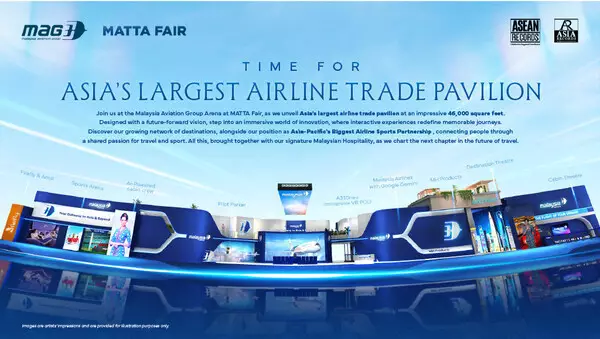
As the returning Official Airline Partner and Premier Sponsor of MATTA Fair 2026, MAG unveiled its most ambitious presence yet with the launch of the MAG Arena, recognised by both the Asia Records and ASEAN Records as Asia's Largest Airline Trade Pavilion at a consumer travel fair.
Spanning approximately 46,000 square feet, nearly three times the scale of its participation in September last year, the expanded pavilion transforms the MATTA Fair experience into a fully immersive destination showcasing curated experiences and next-generation travel technology that brings journeys to life before travellers even board the aircraft. Visitors will be able to explore destinations, discover travel innovations and experience the warmth of Malaysian Hospitality through interactive engagements designed to inspire their next journey.
In addition, the pavilion will host Asia's largest sports partnership activation by an airline, celebrating Malaysia Airlines' collaborations with global clubs like Manchester United and national sporting icons Datuk Azizulhasni Awang and others. The dedicated sports experience zone will allow football fans and travellers to engage with legends and their favourite sports personalities — reinforcing how sport and travel connect people across borders and generations.
Through the expansion of its network and increased flight frequencies, the airline continues to strengthen Kuala Lumpur's position as a key gateway to Asia and beyond, while supporting Malaysia's tourism ambitions under Visit Malaysia 2026 and advancing its journey towards becoming one of the world's Top 10 global airlines by 2030.
-ENDS-
New Routes
| Airline | Route | Frequency | Date Open for Sale | Inaugural Flight |
| Malaysia Airlines | Kuala Lumpur – Shenzhen (SZX) | 7x weekly (Mon-Sun) | 3 April 2026 | 1 July 2026 |
| Kuala Lumpur – Changsha (CSX) | 7x weekly (Mon-Sun) | 3 April 2026 | 8 July 2026 |
| Kuala Lumpur -Fukuoka (FUK) | 5x weekly (Mon, Wed, Fri, Sat, Sun) | 3 April 2026 | 2 Sept 2026 |
Malaysia Airlines' Additional Frequencies
| Region | Route | Frequency (Before Increase) | Frequency
(After Increase) | Effective Date |
| Europe | KUL/London (LHR) | 14x weekly | 16x weekly | 18 & 22 Apr 2026 |
| Australia and New Zealand | KUL/Brisbane (BNE) vv | 5x weekly | 6x weekly 7x weekly | 16 Aug 2026 25 Oct 2026 |
| ASEAN | KUL/Manila (MNL) vv | 21x weekly | 28x weekly | 1 Jul 2026 |
| South Asia | KUL/Colombo (CMB) vv | 7x weekly | 8x weekly 9x weekly 10x weekly | 3 Apr 2026 3 May 2026 20 May 2026 |
About Malaysia Aviation Group
Malaysia Aviation Group (MAG) is a global aviation organisation comprising three core business portfolios: Airline Business, Loyalty & Travel Services, and Aviation Services.
The Airline Business portfolio serves global, domestic, and segmented markets through Malaysia Airlines – the national carrier; Firefly – the regional airline focused on connecting communities across Malaysia and ASEAN; and Amal by Malaysia Airlines – the leading one-stop pilgrimage travel solutions centre.
The Aviation Services portfolio offers a full suite of capabilities, comprising MAB Engineering, the maintenance, repair and overhaul services provider; MASkargo, the cargo and logistics solutions provider; AeroDarat Services, the ground handling services provider; MAG Culinary Solutions, overseeing all F&B-related strategies, operations and services across MAG; and MAB Academy, the centre of excellence for aviation and hospitality training.
The Loyalty & Travel Services portfolio delivers end-to-end travel solutions and loyalty programmes, strengthening MAG's core expertise in airline and aviation services. It includes Journify – an integrated digital platform offering travel and lifestyle experiences; Enrich – Malaysia Airlines' award-winning travel and lifestyle loyalty programme; and MHholidays – the Group's dedicated flight and hotel package platform.
With its clear business portfolios, MAG is committed to realising its vision of becoming Asia's Leading Travel and Aviation Services Group by delivering exceptional customer experiences, nurturing a culture that empowers its people, and ensuring sustainable, profitable growth.
For more information, visit www.malaysiaaviationgroup.com.my
Issued by Group Communications, Malaysia Aviation Group.
- Resumes services to Fukuoka, Japan from September 2026 after nearly two decades
- Expands China footprint with new direct services to Shenzhen and Changsha, commencing July 2026
- "MAG Arena" showcases Asia's Largest Airline Pavilion at MATTA Fair 2026, featuring the region's premier sports partnership activation by an airline
- Increases frequencies across ASEAN, South Asia, Australia and New Zealand and Europe to further strengthen global connectivity
SINGAPORE, April 5, 2026 /PRNewswire/ -- Malaysia Airlines is significantly expanding its East Asia footprint with the return of direct flights to Fukuoka, Japan, and the launch of new services to Shenzhen and Changsha, China. Commencing between July and September 2026, these additions bring the airline's China network to nine key gateways and reinforce its commitment to providing greater travel flexibility across the region.
As part of this expansion, the airline will introduce new services between Kuala Lumpur and Shenzhen (SZX) and Changsha (CSX) in China, alongside the resumption of services to Fukuoka (FUK) in Japan, which the airline last operated in September 2006. With the launch of these destinations, Malaysia Airlines consolidates its presence across a total of nine strategic destinations in China, including Beijing (PKX), Shanghai (PVG), Guangzhou (CAN), Xiamen (XMN), Hong Kong (HKG), Taipei (TPE), and Chengdu Tianfu (TFU). Ticket sales for the new services commence today, supporting the growing travel demand and strengthening connectivity between Malaysia and these high-growth regional hubs.
Captain Nasaruddin A. Bakar, President and Group Chief Executive Officer of Malaysia Aviation Group (MAG), said, "This expansion reflects our strategic focus on scaling our presence in key growth markets across East Asia while cementing Kuala Lumpur's position as a key strategic gateway. Both Shenzhen and Changsha align perfectly with our network strategy, driven by robust demand across both business and leisure segments. The return to Fukuoka further enhances our network depth. As the only carrier operating direct flights on this route, we are proud to offer passengers a seamless non-stop experience that eliminates the need for transit. These developments demonstrate our ongoing commitment to optimising our network and delivering a more integrated travel experience for our customers."
Beyond the East Asia expansion, Malaysia Airlines is increasing flight frequencies across key routes namely Brisbane, Australia; Manila, Philippines and Colombo, Sri Lanka to meet rising demand while supporting growing tourism and trade links. In addition, the airline will operate ad-hoc Kuala Lumpur–London flights on 18 and 22 April 2026 to accommodate passengers affected by recent Middle Eastern carrier disruptions.
As the returning Official Airline Partner and Premier Sponsor of MATTA Fair 2026, MAG unveiled its most ambitious presence yet with the launch of the MAG Arena, recognised by both the Asia Records and ASEAN Records as Asia's Largest Airline Trade Pavilion at a consumer travel fair.
Spanning approximately 46,000 square feet, nearly three times the scale of its participation in September last year, the expanded pavilion transforms the MATTA Fair experience into a fully immersive destination showcasing curated experiences and next-generation travel technology that brings journeys to life before travellers even board the aircraft. Visitors will be able to explore destinations, discover travel innovations and experience the warmth of Malaysian Hospitality through interactive engagements designed to inspire their next journey.
In addition, the pavilion will host Asia's largest sports partnership activation by an airline, celebrating Malaysia Airlines' collaborations with global clubs like Manchester United and national sporting icons Datuk Azizulhasni Awang and others. The dedicated sports experience zone will allow football fans and travellers to engage with legends and their favourite sports personalities — reinforcing how sport and travel connect people across borders and generations.
Through the expansion of its network and increased flight frequencies, the airline continues to strengthen Kuala Lumpur's position as a key gateway to Asia and beyond, while supporting Malaysia's tourism ambitions under Visit Malaysia 2026 and advancing its journey towards becoming one of the world's Top 10 global airlines by 2030.
-ENDS-
New Routes
Airline
Route
Frequency
Date Open for Sale
Inaugural Flight
Malaysia Airlines
Kuala Lumpur –
Shenzhen (SZX)
7x weekly
(Mon-Sun)
3 April 2026
1 July 2026
Kuala Lumpur –
Changsha (CSX)
7x weekly
(Mon-Sun)
3 April 2026
8 July 2026
Kuala Lumpur -Fukuoka (FUK)
5x weekly
(Mon, Wed, Fri, Sat, Sun)
3 April 2026
2 Sept 2026
Malaysia Airlines' Additional Frequencies
| Region | Route | Frequency (Before Increase) | Frequency
(After Increase) | Effective Date |
| Europe | KUL/London (LHR) | 14x weekly | 16x weekly | 18 & 22 Apr 2026 |
| Australia and New Zealand | KUL/Brisbane (BNE) vv | 5x weekly | 6x weekly 7x weekly | 16 Aug 2026 25 Oct 2026 |
| ASEAN | KUL/Manila (MNL) vv | 21x weekly | 28x weekly | 1 Jul 2026 |
| South Asia | KUL/Colombo (CMB) vv | 7x weekly | 8x weekly 9x weekly 10x weekly | 3 Apr 2026 3 May 2026 20 May 2026 |
Region
Route
Frequency
(Before Increase)
Frequency
(After Increase)
Effective Date
Europe
KUL/London (LHR)
14x weekly
16x weekly
18 & 22 Apr 2026
Australia and New Zealand
KUL/Brisbane (BNE) vv
5x weekly
6x weekly 7x weekly
16 Aug 2026
25 Oct 2026
ASEAN
KUL/Manila
(MNL) vv
21x weekly
28x weekly
1 Jul 2026
South Asia
KUL/Colombo (CMB) vv
7x weekly
8x weekly
9x weekly 10x weekly
3 Apr 2026
3 May 2026
20 May 2026
About Malaysia Aviation Group
Malaysia Aviation Group (MAG) is a global aviation organisation comprising three core business portfolios: Airline Business, Loyalty & Travel Services, and Aviation Services.
The Airline Business portfolio serves global, domestic, and segmented markets through Malaysia Airlines – the national carrier; Firefly – the regional airline focused on connecting communities across Malaysia and ASEAN; and Amal by Malaysia Airlines – the leading one-stop pilgrimage travel solutions centre.
The Aviation Services portfolio offers a full suite of capabilities, comprising MAB Engineering, the maintenance, repair and overhaul services provider; MASkargo, the cargo and logistics solutions provider; AeroDarat Services, the ground handling services provider; MAG Culinary Solutions, overseeing all F&B-related strategies, operations and services across MAG; and MAB Academy, the centre of excellence for aviation and hospitality training.
The Loyalty & Travel Services portfolio delivers end-to-end travel solutions and loyalty programmes, strengthening MAG's core expertise in airline and aviation services. It includes Journify – an integrated digital platform offering travel and lifestyle experiences; Enrich – Malaysia Airlines' award-winning travel and lifestyle loyalty programme; and MHholidays – the Group's dedicated flight and hotel package platform.
With its clear business portfolios, MAG is committed to realising its vision of becoming Asia's Leading Travel and Aviation Services Group by delivering exceptional customer experiences, nurturing a culture that empowers its people, and ensuring sustainable, profitable growth.
For more information, visit www.malaysiaaviationgroup.com.my
Issued by Group Communications, Malaysia Aviation Group.
** This press release is distributed by PR Newswire through automated distribution system, for which the client assumes full responsibility. **
Malaysia Airlines Strengthens East Asia Network with Return to Fukuoka, Launch of New Routes and Increased Frequencies Across Key Markets