Skip to Content Facebook Feature Image

Cui Jianchun: Jimmy Lai case shows the world HK's commitment to rule of law

HK

Cui Jianchun: Jimmy Lai case shows the world HK's commitment to rule of law
HK

HK

Cui Jianchun: Jimmy Lai case shows the world HK's commitment to rule of law

2025-12-22 19:37 Last Updated At:20:23

Cui Jianchun, commissioner of the Chinese Foreign Ministry in the Hong Kong Special Administrative Region (HKSAR), on Sunday published an op-ed article on the verdict of Jimmy Lai's case in the local newspaper South China Morning Post titled "Jimmy Lai case shows the world HK's commitment to rule of law."

On December 15, Jimmy Lai Chee-yingwas found guilty on two charges of conspiring to collude with external forces and a charge of conspiracy to publish seditious materials by the High Court of Hong Kong.

The verdict was welcomed in the city and, as expected, prompted another round of outcries from some Western countries. As Commissioner of the Ministry of Foreign Affairs of the People’s Republic of China in the Hong Kong Special Administrative Region, I feel obliged to set the record straight and reaffirm our commitment to the rule of law.

First, why was Lai convicted? Putting on a thin veneer of journalistic professionalism, he deeply involved himself in and even masterminded a series of anti-China incidents, as proved by the evidence presented during the trial.
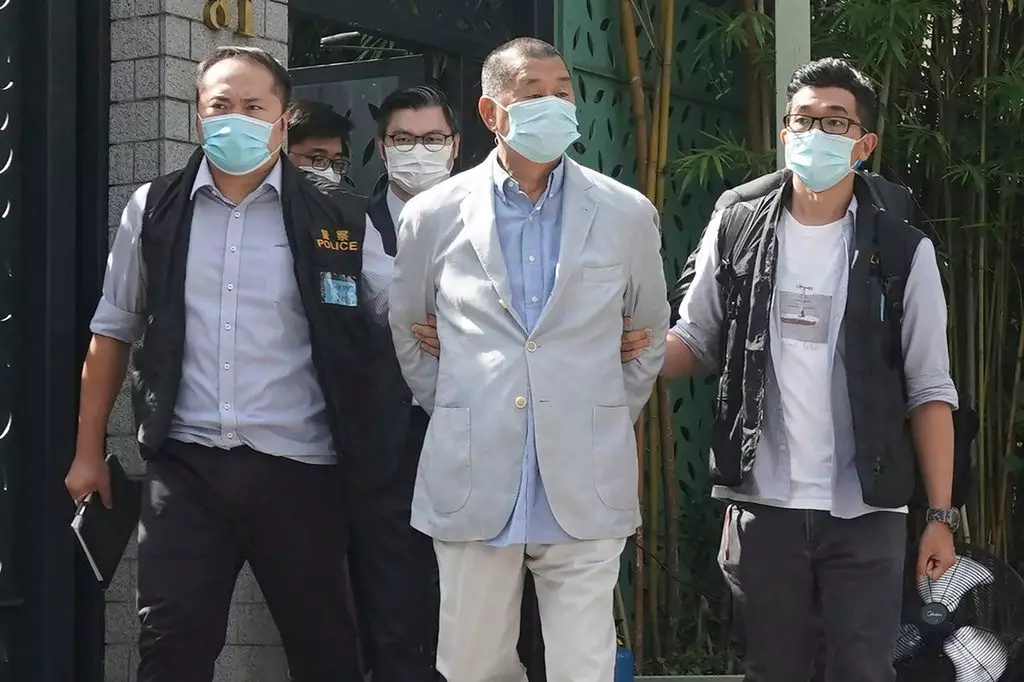
Jimmy Lai case shows the world HK's commitment to rule of law.

Jimmy Lai case shows the world HK's commitment to rule of law.

Acting as a proxy for external anti-China forces, Lai abused his media influence to incite social hatred and confrontation, actively promoted violent unrest and played a central role behind the 2019 “black violence” in Hong Kong.He openly pleaded with foreign powers toimpose sanctions on China and Hong Kong. Such actions seriously endangered national security, severely harmed Hong Kong’s social stability and inflicted lasting trauma on its citizens. It was therefore not only necessary but imperative for him to face legal consequences.

In any jurisdiction, Lai’s actions would constitute serious criminal offences. To draw a parallel: if someone from a Western country used his influence to incite violence against his own government, colluded with foreign officials and called for sanctions to be imposed against his own nation, would that country’s judicial system allow such behaviourto go unpunished? The answer is obvious.

Second, was Lai treated unfairly? Absolutely not. He received a trial conducted in strict accordance with the law, during which his legal rights were fully safeguarded. Hong Kong’s judicial process is fair, transparent and adheres rigorously to legal procedures. The publicly available court records confirm that due process was meticulously followed at every stage.
Office of the Commissioner of the Ministry of Foreign Affairs of the People's Republic of China in the Hong Kong Special Administrative Region.

Office of the Commissioner of the Ministry of Foreign Affairs of the People's Republic of China in the Hong Kong Special Administrative Region.

As for his treatment in detention, the facts are clear. Hong Kong’s Correctional Services Department has provided him withappropriate and lawful medical care throughout his custody, ensuring his well-being. Notably, Lai’s own defence lawyer stated in open court that he had not been subjected to unfair treatment. These points collectively demonstrate that Hong Kong has consistently upheld the rule of law and respected humanitarian standards throughout this case.

Third, what does the interference by some Western countries in Lai’s case reveal? Certain Western countries have openly interfered in Hong Kong’s judicial process throughout Lai’s trial,calling for his release and even threatening sanctions against judges and prosecutors who were carrying out their lawful duties. In seeking to sway judicial outcomes through political pressure, do these nations not discredit themselves, undermining the very “judicial independence” that they profess to uphold?

The irony deepens when politicians invoke “human rights” and “freedom” to criticise Hong Kong while ignoring their own countries’ legal frameworks. The United States, for instance, maintains multiple national security laws – including the National Security Act of 1947 and the USA Patriot Act. Likewise, the United Kingdom passed a heavy-handedNational Security Act two years ago.

When these countries enforce such laws, they describe them as “defending the rule of law”. Yet, when Hong Kong takes legally comparable measures to safeguard national security, the same actions are labelled as “suppressing freedom”. Is this not a clear example of double standards and a departure from the fundamental norms of international relations?

Hong Kong has now entered a new stage of pursuing sustained prosperity on the basis of social stability. A law-based, thriving and secure Hong Kong benefits not only its 7.5 million residents but also the wider international community. We warmly welcome friends from across the world to visit Hong Kong and see for themselves the vitality and stability that the rule of law protects and promotes.


Relaunch of invitation for quotations on harbourfront event space in Hung Hom for short-term use

The Development Bureau (DEVB) announced today (December 22) the relaunch of the invitation for quotations for the short-term use of the Former Hung Hom Railway Freight Yard Pier as harbourfront event space (location plan in Annex). The invitation is open from today until January 22, 2026. The successful bidder shall be responsible for the development, operation, management and maintenance of the said event space while making it available for public enjoyment for approximately three years.

The Pier is currently a vacant site. The DEVB earlier announced the long-term development proposal for sites around the Hung Hom waterfront areas (including the Pier) with a view to transforming these areas into a new harbourfront landmark. The DEVB also indicated that, before the long-term development thereon, the Pier site will be revitalised, as a short-term measure, into a character-filled event space and public open space.

The DEVB had invited open quotations mid-year for the aforesaid short-term revitalisation project. However, in view of the availability of an additional piece of land adjacent to the Pier site, which can be included in the project in one go, and the Government's wish to strengthen the provisions on venue management, the DEVB has decided to cancel the aforesaid quotation exercise and relaunch it after strengthening the relevant terms and requirements.

For the land adjacent to the waterbody to the right of the Pier, it will become part of the event space site, expanding its area from approximately 1.5 hectares to 1.8 hectares.

Furthermore, in response to the incident at the Central Harbourfront Event Space this September regarding the cancellation of the passenger-carrying hot air balloon ride after the sale of tickets due to the failure to secure the relevant permit, the DEVB has beefed up the terms and requirements in the quotation documents to place a heavier onus on the venue operator (i.e. the successful bidder of this quotation exercise) in monitoring future event organisers and to regularise the communication and alert mechanisms so as to enable the DEVB, as the venue owner, to intervene in a timely manner. These strengthened provisions are aimed at better leveraging harbourfront resources to bring positive experiences for visitors as well as to better safeguard consumer rights. Relevant terms and requirements include:

(1) The venue operator is required to assess the credentials and experience of the applicants, their capability in hosting events, the feasibility of the proposed events, etc, before confirming approval of venue applications from event organisers. The venue operator shall submit regular assessment reports to the DEVB;

(2) The venue operator shall closely monitor the progress of event preparation and alert the DEVB in a timely manner, such as whether the event is in alignment with the original proposal, whether the relevant licenses or permits have been applied for and obtained in a timely manner, and whether the ticketing arrangement is proper; and

(3) In addition to the abovementioned alert mechanism, the venue operator and event organisers are required to hold a tripartite meeting with the DEVB prior to the events to confirm the progress of the final stage preparation and the arrangements made.

A two-envelope approach is adopted in this quotation exercise, under which the weighting for the technical proposal is 70 per cent and the price proposal is 30 per cent. Factors for assessing the technical proposals include whether the proposals would involve the hosting of any landmark events or installations, the availability of catering and entertainment facilities, and the development of night-time activities. Details of the quotation exercise are available on the website of the DEVB (www.devb.gov.hk). The DEVB will complete the quotation assessment as promptly as possible after the close of the invitation in January next year. Meanwhile, the Government is carrying out basic improvement works at the Pier and will hand over the Pier to the successful bidder as the venue operator. The Pier is anticipated to be open to the public in phases starting from the first quarter of next year.

Source: AI-found images

Source: AI-found images

Recommended Articles