Skip to Content Facebook Feature Image

U.S. dollar ticks down

HotTV

HotTV

HotTV

U.S. dollar ticks down

2025-12-23 10:53 Last Updated At:15:13

The U.S. dollar softened in late trading on Monday.

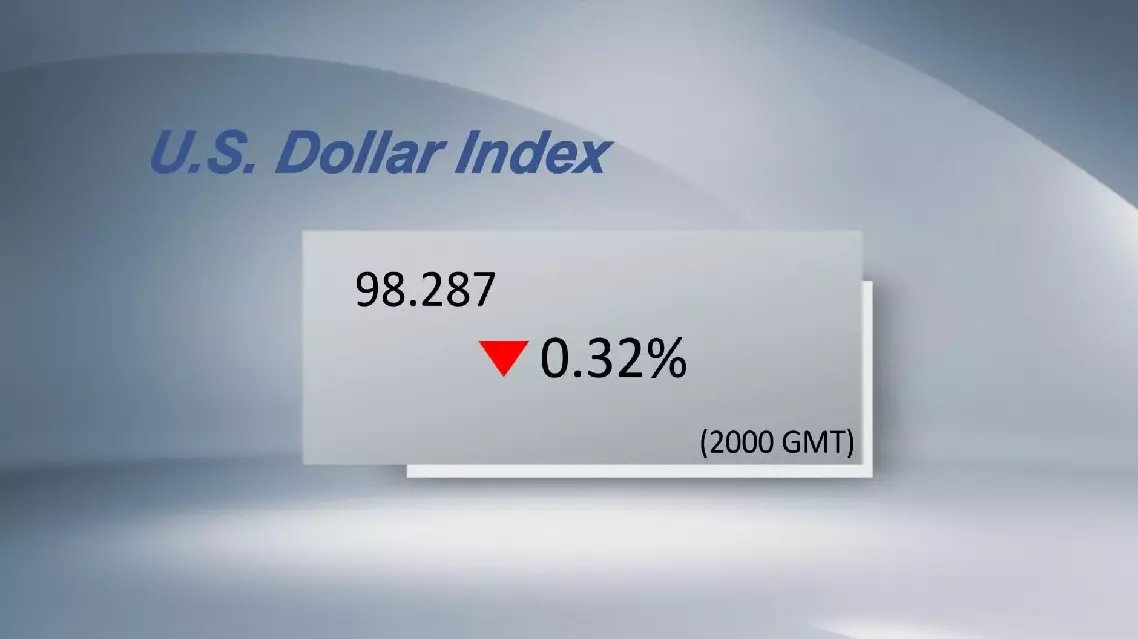
The dollar index, which measures the greenback against six major peers, dropped 0.32 percent to 98.287 at 15:00. (2000 GMT).

In late New York trading, the euro advanced to 1.1755 dollars from 1.1724 dollars in the previous session, and the British pound added to 1.3458 dollars from 1.3391 dollars in the previous session.

The U.S. dollar bought 156.92 Japanese yen, lower than 157.51 Japanese yen in the previous session. The U.S. dollar decreased to 0.7918 Swiss francs from 0.7946 Swiss francs, and it fell to 1.3747 Canadian dollars from 1.3786 Canadian dollars. The U.S. dollar dropped to 9.2396 Swedish kronor from 9.2556 Swedish kronor.
U.S. dollar ticks down

U.S. dollar ticks down

Japan's attempt to possess nuclear weapons is highly dangerous and could lead itself into war, Japan's historical researcher Masahiko Yamabe said on Monday in Tokyo.

"Japan's adherence to its current Three Non-Nuclear Principles is a fundamental requirement for the trust other countries place in Japan. However, the current administration is jeopardizing this. That is dangerous and the government should halt this trend," said Yamabe.

Last month, the Japanese media quoted government sources as saying that as the Japanese government gears up to revise the country's key national security documents by the end of 2026, Prime Minister Sanae Takaichi is considering reviewing the third of the Three Non-Nuclear Principles, which prohibits nuclear weapons from entering Japan's territory, raising strong doubts and concerns at home.

Last week, a Japanese official responsible for security policy talked to the press corps at the Prime Minister's Office about the idea that "Japan should possess nuclear weapons."

The remarks, after being disclosed, have sparked criticism within Japan.

As an expert who has been studying the war history exhibits in "peace" museums across Japan since the 1980s, Yamabe said that the core content addressing Japan's responsibility for initiating war has nearly vanished in its museums.

That shift is a typical manifestation of the rise of Japan's historical revisionism, he noted.

Yamabe said the Japanese government's accelerated increase in defense spending could lead Japan step by step towards war.

"I believe we should not accelerate the increase in defense spending. I do not think increasing the defense budget is for the sake of peace. It seems more like strengthening defense capabilities to enable Japan to wage war. This signifies a change in Japan's fundamental stance towards war, which it ought to maintain. This is a significant issue. Such actions could lead Japan step by step into war. I believe this is dangerous," he said.

Japan has accelerated its military expansion at an unprecedented scale and intensity in recent years. Defense spending has increased for 13 consecutive years, making Japan's defense budget the second largest among Western nations.

Yamabe said peace memorial halls in many parts of Japan have been quietly changing in recent years, with much of the content showcasing Japan's history of aggression and revealing the truth of the war being intentionally weakened, reduced, or even deleted.

"The Osaka International Peace Center once meticulously displayed content related to Japan's acts of aggression. However, these exhibits came under attack and were ultimately discontinued around 1990. Since then, the focus was shifted to the display of the damage from air raids on places like Osaka. After all, Japan was originally the aggressor in the war. Setting aside this fact and emphasizing only the harm Japan suffered is problematic," he said.

Japan's attempt to possess nuclear weapons could lead itself into war: historical researcher

Japan's attempt to possess nuclear weapons could lead itself into war: historical researcher

Recommended Articles