Skip to Content Facebook Feature Image

Trump says he's inviting Kazakhstan and Uzbekistan to next year's G20 summit in Miami

News

Trump says he's inviting Kazakhstan and Uzbekistan to next year's G20 summit in Miami
News

News

Trump says he's inviting Kazakhstan and Uzbekistan to next year's G20 summit in Miami

2025-12-24 00:28 Last Updated At:00:30

WEST PALM BEACH, Fla. (AP) — President Donald Trump said he will be extending invitations to next year's U.S.-hosted Group of 20 summit to Kazakhstan and Uzbekistan as the Republican administration looks to deepen its relationship with the Central Asian nations.

Trump announced the plan on Tuesday after holding separate phone calls with Kazakhstan President Kassym-Jomart Tokayev and Uzbekistan President Shavkat Mirziyoyev.

Neither country is a member of the G20, but the host country of the annual leaders’ gathering of major economies often invites non-members to attend the summit. The 2026 gathering is planned for Trump's golf club in Doral, Florida, near Miami.

“The relationship with both Countries is spectacular,” Trump said in a social media post about the calls. Trump is currently on vacation at his Mar-a-Lago resort in Florida.

The Kazakh and Uzbek leaders visited Washington last month along with the leaders of Kyrgyzstan, Tajikistan, and Turkmenistan for talks with Trump.

The administration is giving greater attention to Central Asia, which holds deep reserves of minerals and produces roughly half the world’s uranium, as it intensifies the hunt for rare earth metals needed for high-tech devices, including smartphones, electric vehicles and fighter jets.

Central Asia’s critical mineral exports have long tilted toward China and Russia.

During last month's visit, Tokayev announced that his Muslim-majority country will join the Abraham Accords, the Trump administration effort to strengthen ties between Israel and Arab and Muslim majority countries.

The largely symbolic move came as the administration is trying to revive an initiative that was the signature foreign policy achievement of Trump’s first term, when his administration forged diplomatic and commercial ties between Israel and the United Arab Emirates, Bahrain and Morocco.

Trump last month announced that he is barring South Africa from participating in next year's summit at his Miami-area club and will stop all payments and subsidies to the country over its treatment of a U.S. government representative at this year’s meeting.

Trump chose not to have an American government delegation attend this year's summit hosted by South Africa, saying he did so because its white Afrikaners were being violently persecuted. It is a claim that South Africa, which was mired for decades in racial apartheid, has rejected as baseless.
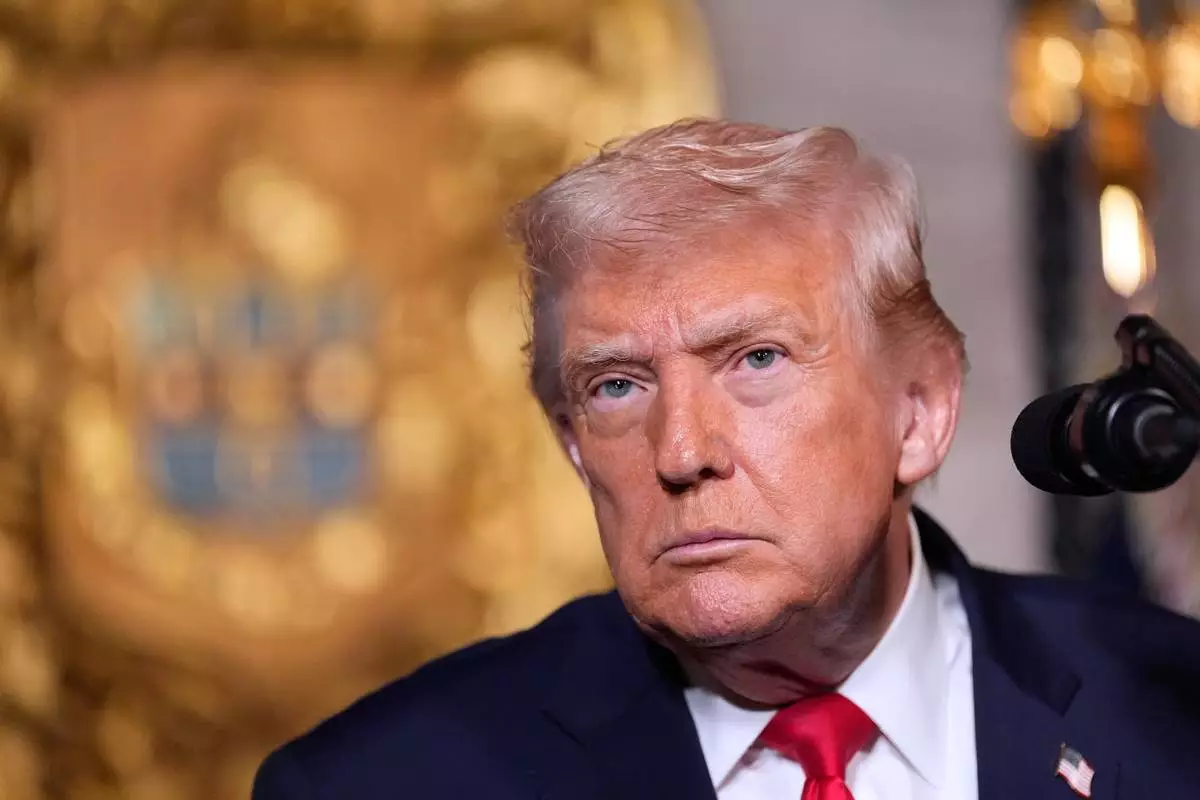
President Donald Trump speaks at his Mar-a-Lago club, Monday, Dec. 22, 2025, in Palm Beach, Fla. (AP Photo/Alex Brandon)
President Donald Trump speaks at his Mar-a-Lago club, Monday, Dec. 22, 2025, in Palm Beach, Fla. (AP Photo/Alex Brandon)

WASHINGTON (AP) — The U.S. economy grew at a surprisingly strong 4.3% annual rate in the third quarter, the most rapid expansion in two years, as government and consumer spending, as well as exports, all increased.

U.S. gross domestic product from July through September — the economy’s total output of goods and services — rose from its 3.8% growth rate in the April-June quarter, the Commerce Department said Tuesday in a report delayed by the government shutdown. Analysts surveyed by the data firm FactSet forecast growth of 3% in the period.

However, inflation remains higher than the Federal Reserve would like. The Fed’s favored inflation gauge — called the personal consumption expenditures index, or PCE — climbed to a 2.8% annual pace last quarter, up from 2.1% in the second quarter.

Excluding volatile food and energy prices, so-called core PCE inflation was 2.9%, up from 2.6% in the April-June quarter.

Economists say that persistent and potentially worsening inflation could make a January interest rate cut from the Fed less likely, even as central bank official remain concerned about a slowing labor market.

“If the economy keeps producing at this level, then there isn’t as much need to worry about a slowing economy,” said Chris Zaccarelli, chief investment officer for Northlight Asset Management, adding that inflation could return as the greatest concern about the economy.

In a slow holiday trading week, U.S. markets on Wall Street turned lower following the GDP report, likely due to growing doubts that another Fed rate cut is coming next month.

Consumer spending, which accounts for about 70% of U.S. economic activity, rose to a 3.5% annual pace last quarter, up from 2.5% in the April-June period.

Consumption and investment by the government grew by 2.2% in the quarter after contracting 0.1% in the second quarter. The third quarter figure was boosted by increased expenditures at the state and local levels and federal government defense spending.

Private business investment fell 0.3%, led by declines in investment in housing and in nonresidential buildings such as offices and warehouses. However, that decline was much less than the 13.8% slide in the second quarter.

Within the GDP data, a category that measures the economy’s underlying strength grew at a 3% annual rate from July through September, up slightly from 2.9% in the second quarter. This category includes consumer spending and private investment, but excludes volatile items like exports, inventories and government spending.

Exports grew at an 8.8% rate, while imports, which subtract from GDP, fell another 4.7%.

Tuesday’s report is the first of three estimates the government will make of GDP growth for the third quarter of the year.

Outside of the first quarter, when the economy shrank for the first time in three years as companies rushed to import goods ahead of President Donald Trump’s tariff rollout, the U.S. economy has continued to expand at a healthy rate. That’s despite much higher borrowing rates the Fed imposed in 2022 and 2023 in its drive to curb the inflation that surged as the United States bounced back with unexpected strength from the brief but devastating COVID-19 recession of 2020.

Though inflation remains above the Fed’s 2% target, the central bank cut its benchmark lending rate three times in a row to close out 2025, mostly out of concern for a job market that has steadily lost momentum since spring.

Last week, the government reported that the U.S. economy gained a healthy 64,000 jobs in November but lost 105,000 in October. Notably, the unemployment rate rose to 4.6% last month, the highest since 2021.

The country’s labor market has been stuck in a “low hire, low fire” state, economists say, as businesses stand pat due to uncertainty over Trump’s tariffs and the lingering effects of elevated interest rates. Since March, job creation has fallen to an average 35,000 a month, compared to 71,000 in the year ended in March. Fed Chair Jerome Powell has said that he suspects those numbers will be revised even lower.

FILE - A person carries a shopping bag in Philadelphia, Wednesday, Dec. 10, 2025. (AP Photo/Matt Rourke, File)

FILE - A person carries a shopping bag in Philadelphia, Wednesday, Dec. 10, 2025. (AP Photo/Matt Rourke, File)

A television on the floor at the New York Stock Exchange in New York, display a news conference with Fed chairman Jerome Powell, Wednesday, Dec. 10, 2025. (AP Photo/Seth Wenig)

A television on the floor at the New York Stock Exchange in New York, display a news conference with Fed chairman Jerome Powell, Wednesday, Dec. 10, 2025. (AP Photo/Seth Wenig)

FILE - People shop at the Christmas Village in Philadelphia, in Philadelphia, Wednesday, Dec. 10, 2025. (AP Photo/Matt Rourke, File)

FILE - People shop at the Christmas Village in Philadelphia, in Philadelphia, Wednesday, Dec. 10, 2025. (AP Photo/Matt Rourke, File)

Roofers work atop a house in Anna, Texas, Thursday, Dec. 18, 2025. (AP Photo/LM Otero)

Roofers work atop a house in Anna, Texas, Thursday, Dec. 18, 2025. (AP Photo/LM Otero)

Recommended Articles