CHICAGO (AP) — The Department of Justice filed a lawsuit Monday against Illinois Gov. JB Pritzker over new state laws aimed at protecting immigrants at courthouses, hospitals and day cares.
Pritzker signed a set of laws earlier this month that ban civil arrests at and around courthouses statewide and require hospitals, day care centers and public universities to have procedures for handling civil immigration operations and protecting personal information.
The laws, which took effect immediately, also provide legal steps for people whose constitutional rights were violated during the federal enforcement action in the Chicago area, including $10,000 in damages for someone unlawfully arrested while attempting to attend a court proceeding.
Immigration and legal advocates have applauded the legislation, saying many immigrants were avoiding courthouses, hospitals and schools out of fear of being detained.
Lawrence Benito, executive director of the Illinois Coalition for Immigrant and Refugee Rights, called the laws “a brave choice.”
“Our collective resistance to ICE and CBP’s violent attacks on our communities goes beyond community-led rapid response — it includes legislative solutions as well,” he said at the time.
The Justice Department argues that Pritzker and Attorney General Kwame Raoul, who are both named in the lawsuit and both Democrats, violated the U.S. Constitution with the laws, which they say “threaten the safety of federal officers,” according to a statement Monday evening. The lawsuit is part of an effort by U.S. Attorney General Pam Bondi to identify state and local laws the agency says impede federal immigration operations.
A spokesperson said Raoul and his staff are reviewing the complaint. Pritzker's office did not immediately respond to a request for comment.
When signing the bills, Pritzker acknowledged that they might be challenged in court.
“No doubt, they have the ability to go to court about it, but I believe this is not just a good law, but a great law,” Pritzker said.
The U.S. Immigration and Customs Enforcement’s “Operation Midway Blitz,” which appears to have largely wound down for now, arrested more than 4,000 people. Data on those arrested from early September through mid-October showed only 15% had criminal records, with traffic offenses, misdemeanors or nonviolent felonies comprising the vast majority.
Associated Press writer John O'Connor contributed from Springfield, Illinois.

Border Patrol Cmdr. Gregory Bovino walks alongside his agents after they detain an individual near West 27th Street and South Ridgeway Avenue in the Little Village neighborhood of Chicago, Tuesday, Dec. 16, 2025. (Anthony Vazquez/Chicago Sun-Times via AP)
WASHINGTON (AP) — The U.S. economy grew at a surprisingly strong 4.3% annual rate in the third quarter, the most rapid expansion in two years, driven by consumers who continue to spend in the face of ongoing inflation.
U.S. gross domestic product from July through September — the economy’s total output of goods and services — rose from its 3.8% growth rate in the April-June quarter, the Commerce Department said Tuesday in a report delayed by the government shutdown. Economists surveyed by the data firm FactSet forecast growth of just 3% in the period.
As has been the case for most of this year, the consumer is providing the fuel that is powering the U.S. economy. Consumer spending, which accounts for about 70% of U.S. economic activity, rose to a 3.5% annual pace last quarter. That's up from 2.5% in the April-June period.
A number of economists, however, believe the growth spurt may be short-lived with the extended government shutdown dragging on the economy in the fourth quarter, as well as a growing number of Americans fatigued by stubbornly high inflation.
A survey published by the Conference Board Tuesday showed that consumer confidence slumped close to levels not seen since the U.S. rolled out broad tariffs on its trading partners in April.
“The jump in consumer spending reminds me a lot of last year’s (fourth quarter),” said Stephen Stanley, chief U.S. economist at Santander. “Consumers were stretching. So, as was the case entering this year, households probably need to take a breather soon.”
The seemingly divergent paths between how consumers say they are feeling and how much money continues to be spent may be more evidence of what is known as a a “ K-shaped economy ” In that situation, the income of wealthier Americans is on the rise, due to stock market gains and growing investments, while lower-income households struggle with stagnant pay and higher prices.
“The latest data on household spending indicates continued strong gains in consumer spending, particularly on services,” wrote Michael Pearce, chief U.S. economist for Oxford Economics. “We think that reflects the K-shaped consumer recovery, with spending growth driven by older, wealthier households while those on low and more moderate incomes struggle.”
Tuesday's GDP report also showed that inflation remains higher than the Federal Reserve would like. The Fed’s favored inflation gauge — called the personal consumption expenditures index, or PCE — climbed to a 2.8% annual pace last quarter, up from 2.1% in the second quarter.
Excluding volatile food and energy prices, so-called core PCE inflation was 2.9%, up from 2.6% in the April-June quarter.
Economists say that persistent and potentially worsening inflation could make a January interest rate cut from the Fed less likely, even as central bank official remain concerned about a slowing labor market.
“If the economy keeps producing at this level, then there isn’t as much need to worry about a slowing economy,” said Chris Zaccarelli, chief investment officer for Northlight Asset Management, adding that inflation could return as the greatest threat to the economy.
Another consistent driver in the U.S. economy, spending on artificial intelligence, was also evident in the latest data.
Investment in intellectual property, the category that covers AI, grew 5.4% in the third quarter, following an even bigger jump of 15% in the second quarter. That figure was 6.5% in the first quarter.
Consumption and investment by the government grew by 2.2% in the quarter after contracting 0.1% in the second quarter. The third quarter figure was boosted by increased expenditures at the state and local levels and federal government defense spending.
Private business investment fell 0.3%, led by declines in investment in housing and in nonresidential buildings such as offices and warehouses. However, that decline was much less than the 13.8% slide in the second quarter.
Within the GDP data, a category that measures the economy’s underlying strength grew at a 3% annual rate from July through September, up slightly from 2.9% in the second quarter. This category includes consumer spending and private investment, but excludes volatile items like exports, inventories and government spending.
Exports grew at an 8.8% rate, while imports, which subtract from GDP, fell another 4.7%.
Tuesday’s report is the first of three estimates the government will make of GDP growth for the third quarter of the year.
Outside of the first quarter, when the economy shrank for the first time in three years as companies rushed to import goods ahead of President Donald Trump’s tariff rollout, the U.S. economy has continued to expand at a healthy rate. That’s despite much higher borrowing rates the Fed imposed in 2022 and 2023 in its drive to curb the inflation that surged as the United States bounced back with unexpected strength from the brief but devastating COVID-19 recession of 2020.
Though inflation remains above the Fed’s 2% target, the central bank cut its benchmark lending rate three times in a row to close out 2025, mostly out of concern for a job market that has steadily lost momentum since spring.
Last week, the government reported that the U.S. economy gained a healthy 64,000 jobs in November but lost 105,000 in October. Notably, the unemployment rate rose to 4.6% last month, the highest since 2021.
The country’s labor market has been stuck in a “low hire, low fire” state, economists say, as businesses stand pat due to uncertainty over Trump’s tariffs and the lingering effects of elevated interest rates. Since March, job creation has fallen to an average 35,000 a month, compared to 71,000 in the year ended in March. Fed Chair Jerome Powell has said that he suspects those numbers will be revised even lower.
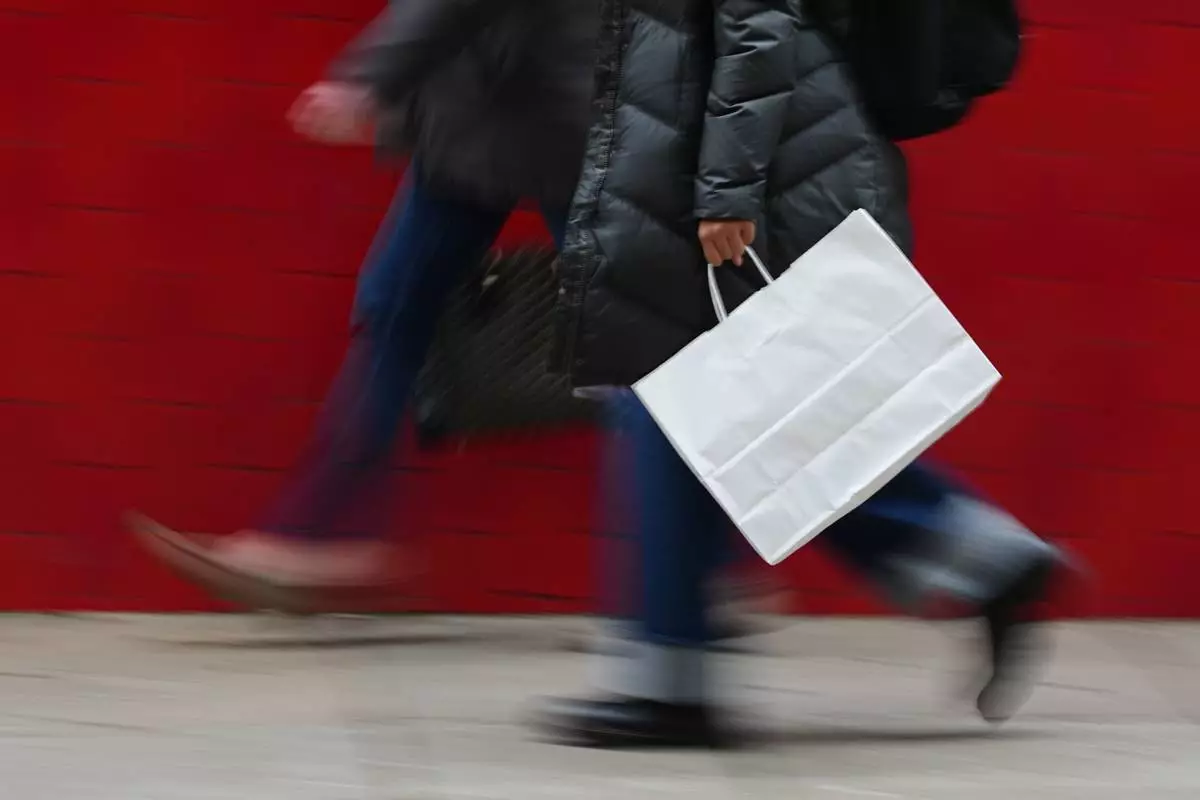
FILE - A person carries a shopping bag in Philadelphia, Wednesday, Dec. 10, 2025. (AP Photo/Matt Rourke, File)
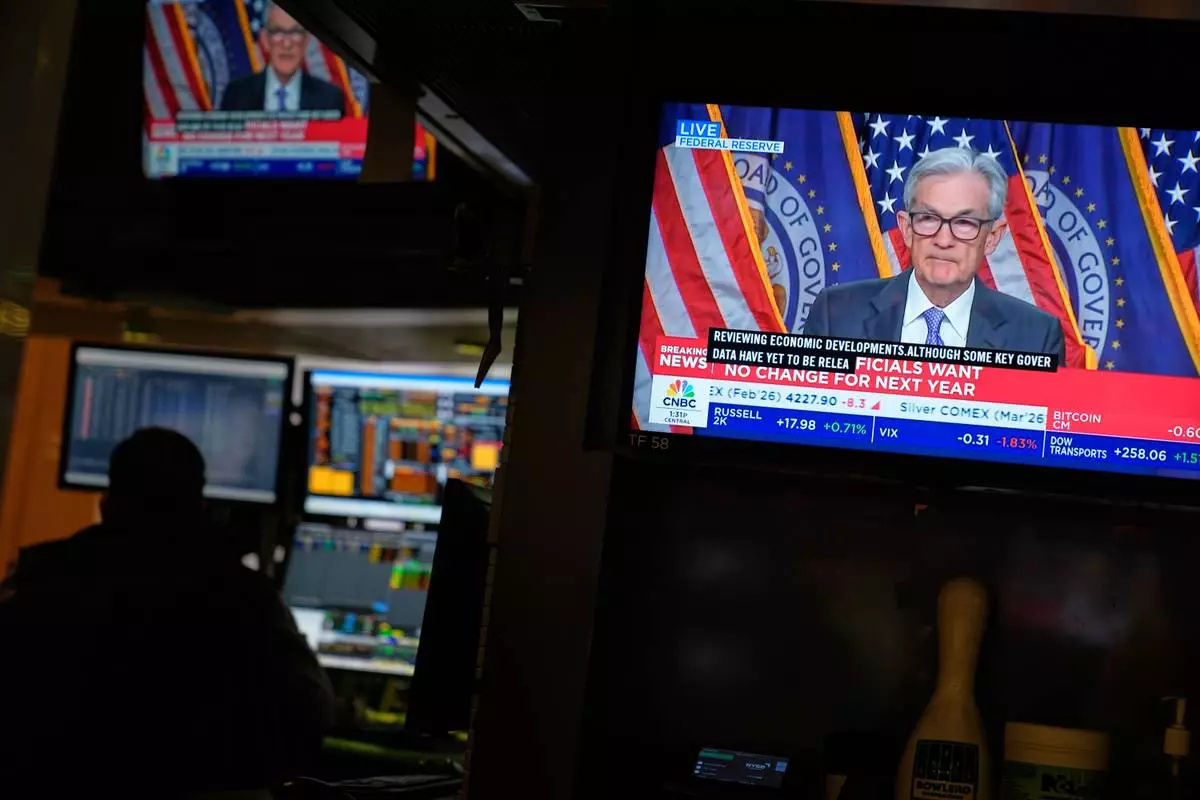
A television on the floor at the New York Stock Exchange in New York, display a news conference with Fed chairman Jerome Powell, Wednesday, Dec. 10, 2025. (AP Photo/Seth Wenig)
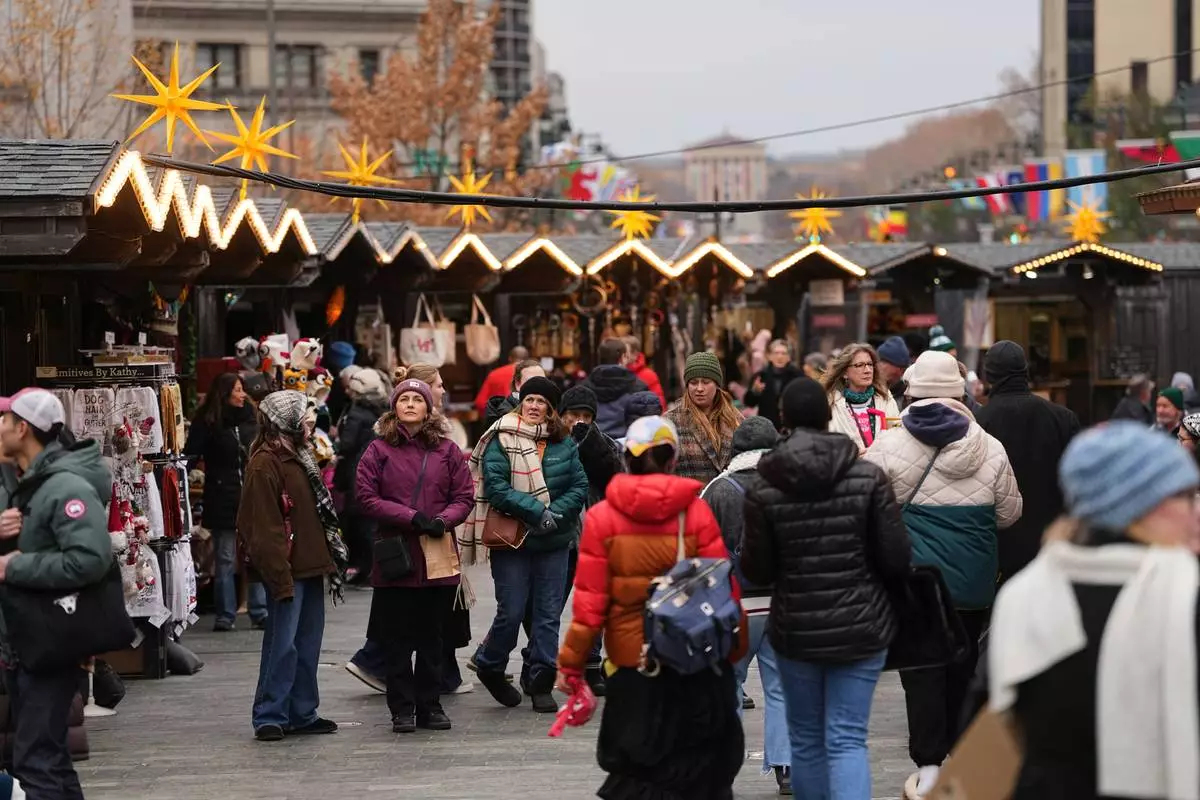
FILE - People shop at the Christmas Village in Philadelphia, in Philadelphia, Wednesday, Dec. 10, 2025. (AP Photo/Matt Rourke, File)

Roofers work atop a house in Anna, Texas, Thursday, Dec. 18, 2025. (AP Photo/LM Otero)