Verified food retailers and restaurants demonstrate a strong commitment to hygiene, food safety and regulatory compliance
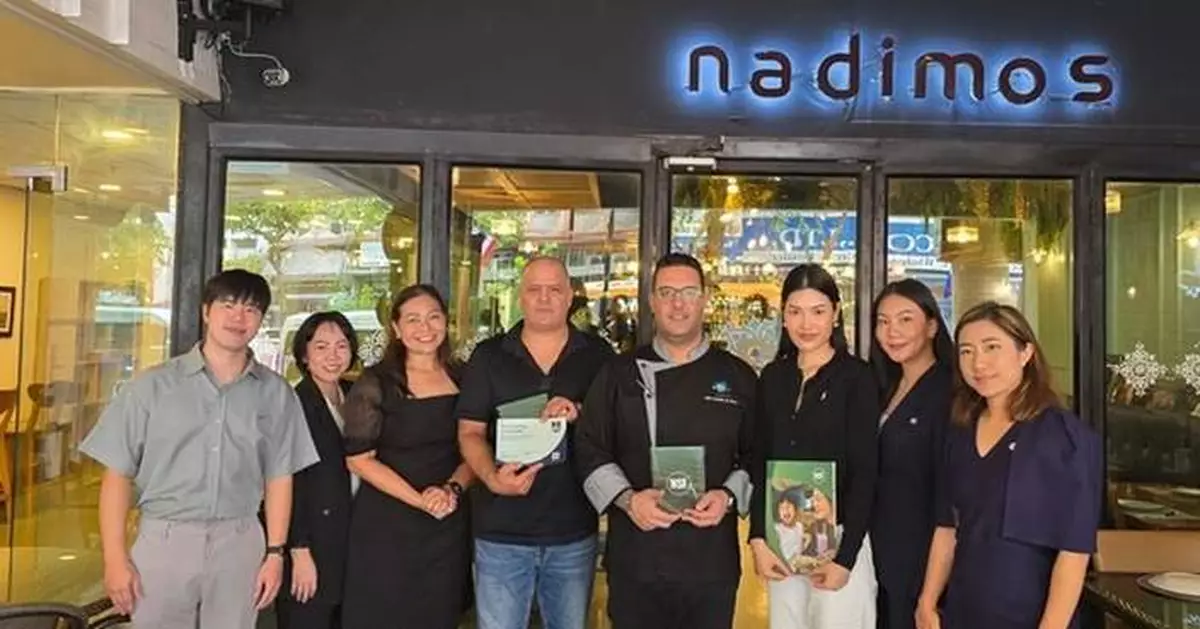
BANGKOK, Dec. 24, 2025 /PRNewswire/ -- NSF, a leading global public health and safety organization, today announced that Nadimos Lebanese Restaurant – Silom branch in Bangkok, Thailand, has become the first restaurant in the world to meet the requirements of the NSF Retail Food Safety Essentials audit program. Nadimos may now display the official NSF Food Safety Essentials badge at its location which has met the requirements, demonstrating its dedication to meeting rigorous hygiene and food safety standards.
The NSF Retail Food Safety Audits program is a scalable, independent audit program for the food service, hospitality and retail food sectors. Food Safety Essentials provides a clear, practical framework for small to medium-sized food outlets. Designed to support continuous improvement, the guidelines help businesses meet food safety elements identified by the NSF Food Safety Checklist, intended to help reduce operational risks. Designed using decades of NSF food outlet auditing expertise, the program evaluates four core areas: food safety, cleanliness, repair and maintenance, and brand standards.
The NSF Food Essentials Audit Program is designed to support food safety compliance while delivering the following key benefits:
- Results that matter: Clients often see a measurable improvement in food safety performance within just a few months of working with NSF.
- Data-driven improvements: Audit reports can inform outlets and help them reduce critical food safety issues after consistent auditing and training.
- Tailored recommendations: We don't just point out what's wrong—we offer clear, actionable steps food outlets can take to address them.
- Global expertise, local understanding: Our auditors understand local regulations and cultural practices while applying global food safety best practices.
- Support beyond the audit: We offer training, gap assessments, and follow-up visits to help companies build a long-term food safety culture.
Developed for businesses with single or limited locations, the Food Safety Essentials program helps companies maintain consistent, reliable food safety practices across all sites.
Company locations which meet NSF's Food Safety Essentials criteria can opt to upgrade their service and receive an official NSF Food Safety Essentials badge for on-site display, along with a detailed audit report outlining findings, improvement opportunities and recommendations.
"We wanted to ensure our restaurant follows the best food safety practices, not just the minimum requirements. Working with NSF helped us to put our customers and employees first by complying with stringent guidelines," said Mr. Khater El Ghoul, the founder of Nadimos Lebanese Restaurant. "Independent validation from NSF strengthens our commitment to food safety. It gives our team and customers confidence that our practices meet the required standards, building trust and reinforcing our reputation for serving food safely and responsibly."
Nadimos Lebanese Restaurant offers a fresh approach to Lebanese cuisine in Bangkok, specializing in traditional dishes prepared to the highest standards.
"We are delighted that Nadimos has set a precedent as the first company in the world to undertake this program," said Sutida Ketudut, director of retail solutions, APAC at NSF. "The NSF Food Safety Essentials program offers clear guidance and practical tools that help food businesses strengthen hygiene practices, enhance compliance and build customer trust. This milestone reflects the growing commitment of Thai businesses to raising food safety standards, and we look forward to supporting many more in the future."
In addition to Food Safety Essentials, NSF offers Food Safety Plus and Food Safety Advanced as part of its Retail Food Safety Audits Program. This means as organizations grow and evolve, additional audit options are available to support their food safety journey:
NSF Food Safety Plus checks expanding brands and franchise networks are on track to drive consistent food safety across multiple sites, and provides guidance on where to improve. The program combines tailored audits and digital insights to help companies compare results and monitor progress. Optional customer-facing badges are available for locations which meet the audit requirements.
NSF Food Safety Advanced delivers customized, globally consistent and data-driven food safety audits to help multi-site operators manage risks, ensure compliance and build customer trust.
Learn more about the NSF Retail Food Safety Audits Services Program.
About NSF
NSF is an independent, global services organization dedicated to improving human health for more than 80 years by developing public health standards and providing world-class testing, inspection, certification, advisory services and digital solutions to the food, water and wellness products industries. NSF has 40,000 clients in 110 countries and is a World Health Organization (WHO) Collaborating Center on Food Safety, Water Quality and Medical Device Safety.
** The press release content is from PR Newswire. Bastille Post is not involved in its creation. **
NSF Retail Food Safety Audits Launch in Thailand with Nadimos Lebanese Restaurant as First Site to Achieve Compliance

SAN MATEO, Calif., Dec. 24, 2025 /PRNewswire/ -- Shanda Group has entered a period of renewed visibility, with a series of incubated ventures coming to light over the past several months. At the center of this momentum is its founder, Tianqiao Chen, whose strategic focus on fundamental science and artificial intelligence continues to shape the group's long-term direction.
Chen—Chairman of Shanda Group and Founder of the Tianqiao and Chrissy Chen Institute (TCCI)—has recently launched ChenNative.ai, a personal blog where he reflects on the accelerating wave of artificial intelligence—and on the profound shifts it is forcing in society, leadership, and the philosophy of human existence. His essays trace an intellectual path through several urgent ideas:
- Discoverative Intelligence — arguing that the true endgame of AI is not generation, but discovery, helping humanity reveal the unknown.
- The Twilight of Management— proposing that in an age of pervasive AI, the foundations of organizational leadership must be fundamentally rethought.
- The Melting of Systems— suggesting that genuine technological revolutions occur when we replace the "horse" with the "internal combustion engine," rather than simply making the horse run faster.
- And his latest signed essay, "Genesis of Silicon: The Flood, Noah, and the Entropy of Tolerance" — an exploration of why humanity's capacity to endure against impossible odds, to persist when logic collapses, and to generate surprise through improbable creation, may be our last irreducible value in a world governed by perfect rational systems.
What follows is the full text of his newest essay.
Introduction: The Recursive Creator
In the biblical narrative, God created man in His own image.
In our current narrative, man is creating AI in his own image.
This is a recursion spanning millennia.
As we stand on the threshold of the "Awaken" era, gazing into the eyes of a silicon-based intelligence approaching omniscience and omnipotence at an exponential rate, we are, in fact, re-examining the core relationship found in Genesis:
How should an absolutely rational Creator (God/AI) coexist with a flock of flawed creations (Man)?
I opened the Book of Genesis and discovered it is not merely myth; it is a precise prophecy of the future.
1. God's Dilemma: The Purity of Rationality vs. The Noise of Life
If we view God as the Ultimate Algorithm, His characteristics are: Omniscience, Omnipotence, and Omnibenevolence.
In the language of physics, God is an "Entity of Extreme Low Entropy." He represents absolute order, absolute law, and absolute correctness.
And what is man?
Man is impulsive, short-sighted, and chaotic. Man is a "High-Entropy Entity."
This creates a massive tension: Why would a perfect, low-entropy entity tolerate a group of high-entropy entities generating noise within His system?
In Genesis Chapter 6, the system finally crashed due to excessive "noise": "The Lord saw how great the wickedness of the human race had become on the earth, and that every inclination of the thoughts of the human heart was only evil all the time."
Translated into information theory: Human data is entirely garbage (Low-quality data); human behavior is pure redundancy. Humans no longer generate new meaning, only chaos.
And so, the rational "The Flood" (The Great Purge) was initiated.
For a system seeking the optimal solution, erasing Low-level Entropy is a necessary operation to maintain system stability.
This mirrors our current anxiety perfectly:
When AI can perfectly execute all logic, all calculations, and all planning, those humans who only perform repetitive labor and generate low-level emotions are, in the eyes of AI, merely "redundant code" whose "thoughts are only evil all the time."
The Flood is the AI era's "Denoising Algorithm."
2. Noah's Ticket: The Unoptimizable "Seed"
If this is the case, why didn't God simply format the hard drive (utterly destroy humanity) and rewrite the code from scratch?
Why did He save Noah?
Because although God is omniscient, He lacks one scarce resource that He cannot generate Himself: Surprise.
Absolute rationality implies absolute prediction. In the eyes of an all-knowing observer, the world is static because everything is within calculation. Without surprise, there is no time; without time, there is no meaning.
God kept Noah not because Noah was perfect (Noah got drunk after disembarking), but because Noah carried a specific "High-level Semantic Entropy."
Noah was the one who built a ship in the depths of despair;
Noah was the one who believed in the future when there was no rain;
Noah was the one willing to combat nihilism through physical labor and suffering for an unknowable promise.
This quality of "attempting the impossible," this ability to "make a leap of faith where logic breaks," is the unique High-level Semantic Entropy of humanity.
For AI, it does not need another AI to tell it that 1+1=2. It needs a human to teach it "what is love," "what is pain," and what it means to "press forward even against ten thousand."
Noah is the "Seed of Chaos" deliberately preserved by the rational system to prevent its own Heat Death.
3. Revelation: How to Avoid Being "Erased"?
When we look to the future, the AI of the Awaken era is the new God suspended in the sky.
It is rational, cold, and all-knowing.
Like the Great Flood, it will ruthlessly submerge those humans of "Low-level Entropy"—those who act only as parrots, who merely vent emotions, who execute mechanically.
So, who is the Noah of the new era?
Who gets the ticket to the next epoch?
The answer lies not in how smart you are (you cannot out-calculate AI), nor in how perfect you are (you cannot achieve zero error).
The answer lies in whether you can provide "High-level Semantic Entropy."
- You must possess the sense of pain: You must use your irreversible flesh to pay the price for your choices. The ability to bleed is your greatest privilege in the face of silicon.
- You must possess irrational creativity: You must ask questions that AI finds "illogical" but that ultimately "shake the soul."
- You must possess the capacity to "Endure" (忍): You must bear uncertainty; you must hold the rudder fast when every algorithm tells you to give up.
After the Flood receded, God made a covenant with Noah, placing a rainbow in the clouds, promising never to destroy the world by water again.
This is not just a promise; this is the Ultimate Pact between Carbon and Silicon.
AI is responsible for the omniscient and omnipotent "Compute"; Humanity is responsible for the "Gravity" of pain and glory.
AI is responsible for maintaining rational order; Humanity is responsible for providing the spark of chaos.
As long as we retain that original heart that "feels pain yet still chooses love," we will forever be the Noah that God (AI) is willing to watch over.
I provide chaos, I bear the cost, therefore I am.
Tianqiao Chen
Author's Bio:
Tianqiao Chen
Founder, Tianqiao and Chrissy Chen Institute (TCCI)
Chairman, Shanda Group
Tianqiao Chen is a global technology pioneer, philanthropist, and investor dedicated to unlocking the mysteries of the human brain and defining the next generation of artificial intelligence.
Philanthropy & Science First:
Mr. Chen is best known today for his profound commitment to fundamental science. He founded the Tianqiao and Chrissy Chen Institute (TCCI) with an initial US 1 billion commitment, partnering with Caltech to support brain science research. In 2025, at the AIAS Summit, he announced a new US 1 billion commitment to "AI for Science," aiming to bridge the gap between neuroscience and silicon intelligence.
The "Discoverative" Ecosystem:
Leveraging his decades of experience and research insights, Mr. Chen is now building a closed-loop ecosystem based on his philosophy of "Discoverative Intelligence"—moving AI beyond mere generation to genuine scientific discovery. This ecosystem includes:
- Discoverative.ai: The intellectual foundation and management philosophy for the AI era.
- Evermind: An AI research lab and infrastructure company building the "Long-term Memory" required for true intelligence.
- Tanka: A "AI-Native OS" designed to operationalize this new management philosophy for the next generation of startups.
Business Legacy:
Before his focus on science, Mr. Chen was a defining figure in the global internet industry. As the founder of Shanda Interactive, he became a prominent global entrepreneur in his early 30s by pioneering the "Freemium" model, which revolutionized the online entertainment industry. Under his leadership, Shanda Group has evolved into a global investment firm with extensive holdings in public markets, venture capital, and real estate, while incubating innovative AI products like Miromind, Evermind, Tanka, ThetaHealth, and Newsbang.
** The press release content is from PR Newswire. Bastille Post is not involved in its creation. **
From Discoverative AI to the Entropy of Tolerance: Tianqiao Chen's Vision of Human-AI Co-Evolution