FSTB and SFC publish consultation conclusions on legislative proposals for regulating virtual asset dealing and custodian services
The Financial Services and the Treasury Bureau (FSTB) and the Securities and Futures Commission (SFC) today (December 24) jointly published the consultation conclusions on the legislative proposals for establishing licensing regimes for virtual asset (VA) dealing and custodian service providers. The FSTB and the SFC also launched a further public consultation today for one month on establishing separate licensing regimes for VA advisory and management service providers.
During the two-month public consultation period completed this August, 101 and 93 submissions were received on the proposed licensing regimes for VA dealing service providers and VA custodian service providers respectively. The majority of respondents, including market participants, industry associations, business and professional organisations, expressed clear support for expanding the regulatory scope to cover VA dealing and custodian services, following the introduction of the licensing regime for the VA trading platform in June 2023. This is considered a critical step to promote the steady and sustainable development of the digital asset (Note) ecosystem in Hong Kong. The respondents also indicated support for the overall direction of the proposed regulatory requirements and implementation arrangements, while suggesting enhancements and seeking clarifications on certain aspects.
The proposed licensing regime for VA dealing service providers will largely align with that for Type 1 (dealing in securities) regulated activity under the Securities and Futures Ordinance (Cap. 571) as applicable to conventional securities dealing activities. As for VA custodian service providers, the proposed licensing regime will focus on managing risks relating to safekeeping private keys of client VAs in Hong Kong, which is the core risk area of VA custody, with a view to enhancing the security of client assets.
The Secretary for Financial Services and the Treasury, Mr Christopher Hui, said, "The proposed establishment of licensing regimes for VA dealing and custodian service providers marks a significant step in enhancing our legal framework for digital assets. The proposed licensing regimes strike a prudent balance among fostering market development, managing risks and protecting investors. They will help realise our vision for building a trusted and sustainable digital asset ecosystem, with a view to establishing Hong Kong as a global hub for digital asset innovation."
The Chief Executive Officer of the SFC, Ms Julia Leung, said, "The significant progress in our VA regulatory framework ensures Hong Kong remains at the global forefront of digital asset market developments by fostering a trusted, competitive and sustainable ecosystem. With an unwavering commitment to responsible innovation, we are laying the foundation for a vibrant yet resilient ecosystem that may bring vast benefits to Hong Kong's financial markets and the broader economy in the long run."
Meanwhile, in response to the feedback received, the FSTB and the SFC also launched a further publicconsultation today on establishing separate licensing regimes for VA advisory and management service providers, instead of covering the relevant VA activities under the licensing regime for VA dealing service providers as originally proposed. This revised regulatory approach will model itself on the regulatory framework applicable to the conventional securities market, and will provide better clarity as regards the scope of activities regulated under different VA licensing regimes. The further consultation will last for one month, ending on January 23, 2026.
The FSTB and the SFC welcome views from the public on the proposed licensing regimes for VA advisory and management service providers. Submissions should be sent by post (24/F, Central Government Offices, 2 Tim Mei Avenue, Tamar, Hong Kong) or by email (vadealing-consult@fstb.gov.hk) to the FSTB.
Details of the consultation conclusions, as well as the further public consultation for licensing regimes for VA advisory and management service providers, are available on the webpages of the FSTB and the SFC:
*Consultation Conclusions on Legislative Proposal to Regulate Dealing in VA and Further Public Consultation on Legislative Proposal to Regulate VA Advisory Service Providers and VA Management Service Providers (www.fstb.gov.hk/fsb/en/publication/consult/doc/VAdealing_consultation_conclusion_e.pdf /apps.sfc.hk/edistributionWeb/gateway/EN/consultation/conclusion?refNo=25CP6)
*Consultation Conclusions on Legislative Proposal to Regulate VA Custodian Services (www.fstb.gov.hk/fsb/en/publication/consult/doc/Custodian_consultation_conclusion_e.pdf /apps.sfc.hk/edistributionWeb/gateway/EN/consultation/conclusion?refNo=25CP7)
With broad market support, and taking into account the feedback to be received in the further consultation, the FSTB and the SFC will finalise the legislative proposals for the licensing regimes, with a target of introducing the relevant bill into the Legislative Council in 2026.
Note: "Digital asset" is a general term with a broad scope, covering, among others, "virtual asset", which is a legally defined term under the existing Anti-Money Laundering and Counter-Terrorist Financing Ordinance (Cap. 615).

Source: AI-found images
Speech by FS at UK-Hong Kong Innovation Dialogue (with photos/video)
Following is the speech by the Financial Secretary, Mr Paul Chan, at the UK-Hong Kong Innovation Dialogue,a roundtableco-organised by the Hong Kong Trade Development Council and the Cambridge Institute for Sustainability Leadership, in Cambridge today (November 23):
Fred (Chairman of the Hong Kong Trade Development Council, Professor Frederick Ma), Mr James Cole (Chief Innovation Officer of the Cambridge Institute for Sustainability Leadership),distinguished guests,ladies and gentlemen,
Good morning. My thanks to the Cambridge Institute for Sustainability Leadership for receiving us, and to the Hong Kong Trade Development Council for bringing us together.
This building began life in the 1930s as a telephone exchange, built to connect people who had something to say to each other. Ninety years later, I am pleased to see it doing the same job.
Most of my delegation from Hong Kong are founders of young technology companies, members of the Legislative Council, and with them are colleagues from our science parks, Cyberport, OASES (Office for Attracting Strategic Enterprises), InvestHK, Hong Kong Productivity Council, ASTRI (Hong Kong Applied Science and Technology Research Institute) and the Hong Kong Investment Corporation. We have come to listen as much as to speak.
Hong Kong and Britain already do a good deal of science together. Under InnoHK, our flagship research programme, more than 30 universities and institutes from around the world work with ours in joint laboratories. Eight of them are from Britain. The University of Cambridge is a partner in three centres, in fields from stem cell biology to advanced manufacturing.
UK Companies have taken the same path. For instance, AstraZeneca, headquartered in this city, has a research centre in Hong Kong. It manages more than 60 clinical trials there, and is incubating more than 30 young biotechnology companies separately. GSK and the University of Hong Kong have agreed to study the long-term benefits of the shingles vaccine.
The traffic runs both ways. Ecoinno, a Hong Kong company that makes plant-fibre alternatives to plastic, has taken partnership rather literally. Its office for Britain and Europe is under this roof.
Many of you know Hong Kong as a financial centre, and as a connector between the Chinese Mainland and the world. Our first Five-Year Plan, published in September, takes that role further. It puts innovation at its heart, so that Hong Kong becomes a source of new technologies in its own right.
What, then, can Hong Kong add to an idea born in Cambridge? I would point to three things: capital, connection and people.
First, capital. Deep technology takes time and needs to be funded at every stage. Our offer is complete fund-raising options, from the laboratory to the public markets.
The chain begins with private capital. Private equity and venture capital funds in Hong Kong manage about 250 billion US dollars. Proving a technology takes years, and that calls for patient capital. This is the role of the Hong Kong Investment Corporation. It leads a patient capital ecosystem. It has invested in more than 250 projects, and each dollar it commits draws in more than eight from the market.
The chain continues on our stock exchange. In 2018, we allowed biotechnology companies to list before they had earned any revenue. That asked investors to value a company by its science rather than its sales, something Cambridge has been doing for some time. Since then, more than 90 such companies have listed on our Stock Exchange, raising about 14 billion pounds.
Second, connection, and it runs in two directions.
One direction leads into the Chinese Mainland. The Greater Bay Area (GBA), of which Hong Kong is part, has 88 million people, a top notch innovation cluster, and a major base of advanced manufacturing. For a new technology, GBA is a testing ground, a production base and a market.
The closest link is at Hetao, where a science park in Hong Kong and its sister park in Shenzhen work together across the Shenzhen River. Our park is open since last December, and more than 100 companies and institutions have already moved in.
Life sciences show how this special gateway works. Our Five-Year Plan sets the aim of making Hong Kong the foremost centre in Asia for early-phase clinical trials. At Hetao, a joint platform lets researchers use data and biological samples on both sides of the boundary. A trial can then draw on a much larger pool of patients.
The route to market is opening as well. Hong Kong recognises Britain's regulator when registering medicines. So a medicine approved in this country can apply to us on the strength of that one approval, supported by local clinical data. Once registered, it may be approved for use in designated hospitals across the GBA. So far, 79 medicines and 100 medical devices have been approved under this scheme. And clinical data from Hong Kong is recognised by the Chinese national regulator, so it can support an application for approval across the Mainland.
The other direction leads from the Mainland to the world. Many Mainland technology companies are making Hong Kong their international base. As they enter new markets, they need partners who know how a product is certified and sold in Britain and in Europe. So Hong Kong is where innovation in Britain and China can meet, under the common law and with strong protection for intellectual property.
Third, people. Research follows talent, and talent looks for a place that is safe, open, well resourced, and with great potential. Hong Kong has five universities among the world's top hundred, and a growing number of leading scientists are choosing to work here. In the past year alone, two Nobel laureates in physics have joined the University of Hong Kong: Ferenc Krausz, the 2023 winner, and Andre Geim, known as the father of graphene.
Let me close with an invitation.
Begin with a partnership. The founders in my delegation are here to find research collaborators, customers, investors and opportunities to invest, and I hope you will meet them over lunch.
When the time is right, consider an office, a research base or a clinical development team in Hong Kong. Our Science Park would be glad to help, and the Hong Kong Investment Corporation would welcome the chance to invest side by side with Cambridge funds.
And when you come to raise capital for growth, consider a listing in Hong Kong, whether a primary listing or a secondary listing. We mark the occasion by striking a gong. It is louder than a bell, and far more satisfying.
Cambridge has long known how to turn curiosity into knowledge. Hong Kong can help to turn that knowledge into enterprise, and to carry it to a wider market. I believe the two strengths belong together.
Thank you. I look forward to the discussion.
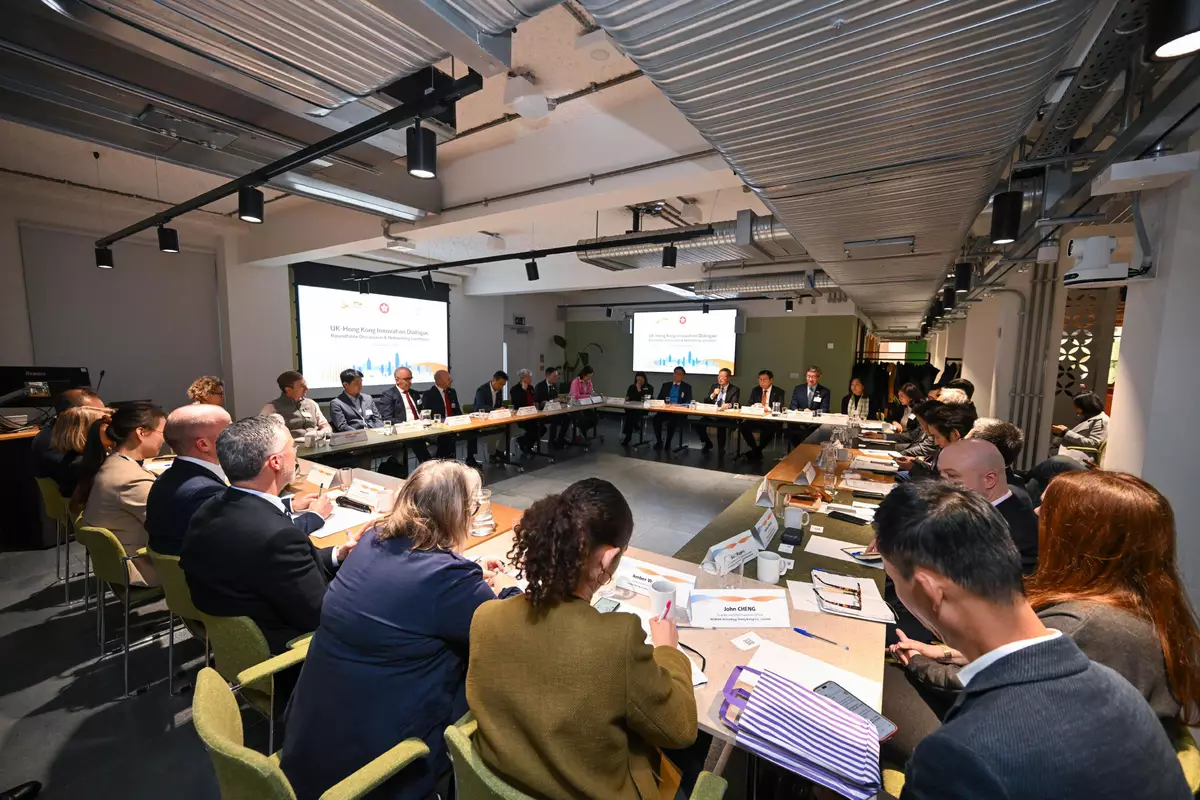
Speech by FS at UK-Hong Kong Innovation Dialogue Source: HKSAR Government Press Releases
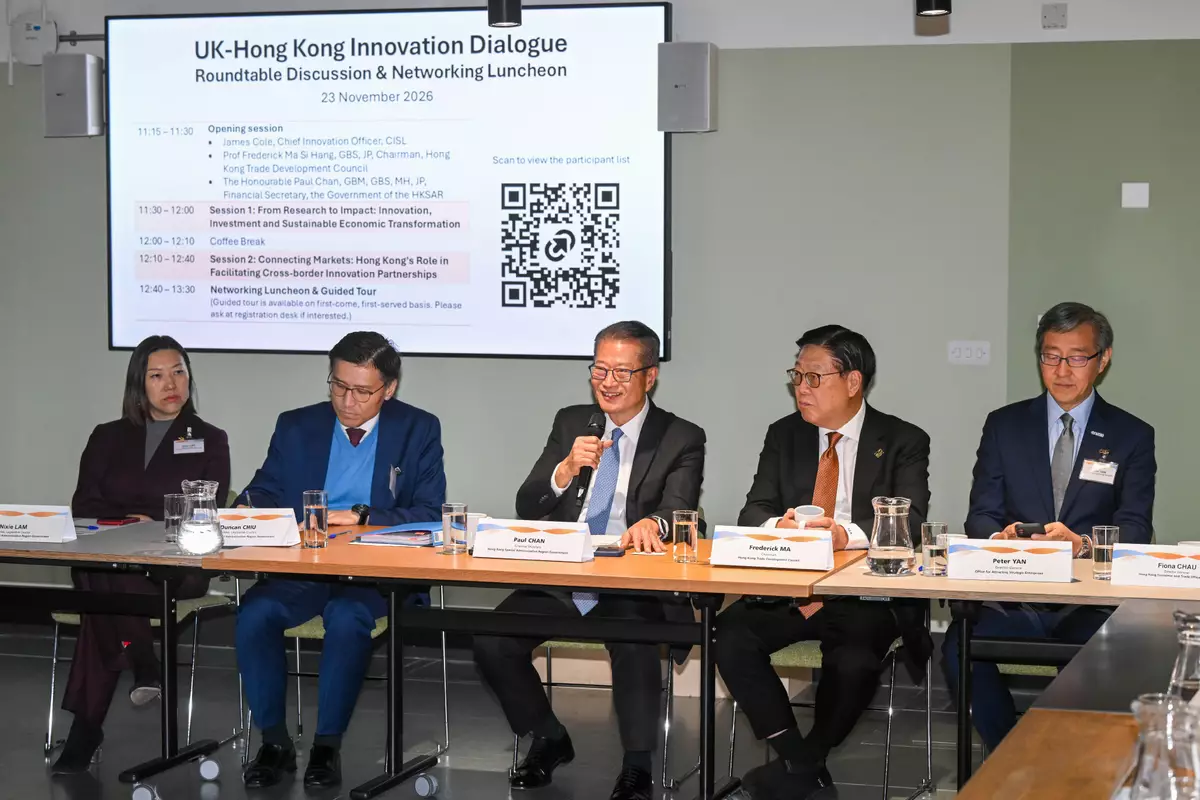
Speech by FS at UK-Hong Kong Innovation Dialogue Source: HKSAR Government Press Releases