Japan's ambition to possess nuclear weapons must be resolutely stopped, said a China Media Group commentary published on Wednesday.
An adapted English version of the commentary is as follows:
In recent days, there has been widespread international criticism of the erroneous remarks made by a senior official from Japanese Prime Minister's Office who brazenly claimed that Japan should have nuclear weapons.
The Japanese government has claimed on multiple occasions to possess nuclear weapons, a move that amounts to a blatant challenge to the postwar international order and the nuclear non-proliferation regime, and poses a serious threat to world peace and development.
The Three Non-Nuclear Principles, not possessing, not producing and not allowing introduction of nuclear weapons into Japanese territory, were first declared in the Diet, Japan's parliament, by then Japanese Prime Minister Eisaku Sato in 1967, and has been viewed as a national credo since. In 1971, the Three Non-Nuclear Principles were formally included in a resolution of Japan's House of Representatives, becoming the cores of credibility to demonstrate its peaceful stance to the outside world. However, in recent years, there has been a rising trend in right-wing politics in Japan. The series of actions taken by the administration of Prime Minister Sanae Takaichi to accelerate military expansion has revealed the growing ambition of the right-wing conservative forces to revive militarism, and also reduced the nation's nuclear-free commitment to a mere scrap of paper.
From a legal perspective, Japan's ambition to seek nuclear weapons goes against its obligations under international law, including the Potsdam Proclamation, as well as the constraints of its pacifist constitution.
Instruments with legal effect under international law, including the Cairo Declaration, the Potsdam Proclamation, and the Japanese Instrument of Surrender, clearly stipulate: Japan should be completely disarmed and not maintain such industries as would enable the country to re-arm for war. As a non-nuclear-weapon State Party to the Treaty on the Non-Proliferation of Nuclear Weapons, Japan must fully abide by the provisions of "not receiving, manufacturing, acquiring or transferring nuclear weapons."
Article 9 of its pacifist constitution stipulates that Japan would forever renounce war as a sovereign right of the nation and the threat or use of force as means of settling international disputes.
From a moral standpoint, Japan, as the aggressor in World War II, committed atrocious crimes, rendering it fundamentally unqualified to possess nuclear weapons.
Japan's right-wing forces have long downplayed and denied the country's history of aggression, even going so far as to revise textbooks and visit and pay respect to Yasukuni Shrine, honoring the militarists. This disregard for history and betrayal of principles has led the world to question Japan's ability to uphold its commitment to peace. Ironically, as the only country that has ever suffered a nuclear attack, Japan should remember the tragedy of nuclear disaster and advocate for a nuclear-free world. Yet, Japan's right wing has distorted this historical suffering to seek a justification for possessing nuclear weapons, completely diverging from the shared vision of peace for humanity.
Japan's Hiroshima Prefecture on Monday urged the government to uphold the country's non-nuclear principles in a written statement.
The Hiroshima prefectural assembly on the day unanimously adopted the statement, citing local concerns about reviewing the long-standing Three Non-Nuclear Principles. The statement noted that the tragedies of Hiroshima and Nagasaki 80 years ago should never be repeated.
Worryingly, statistics showed that Japan has secretly stockpiled 47 tons of separated plutonium under the guise of developing its civilian nuclear program, far exceeding its actual needs for civilian nuclear power. This amount is enough to manufacture approximately 6,000 nuclear warheads.
If Japan possesses nuclear weapons, it will disrupt the strategic balance in the Asia-Pacific region and trigger a "nuclear domino" effect, further aggravating tensions in Northeast Asia and posing a serious threat to regional and international peace and stability.
Possessing nuclear weapons could serve as a "booster" for the Japanese right-wing forces, making them more arrogant and domineering in international disputes. History has proven that once Japanese militarism is unrestrained, it will seek aggression and expansion again. If allowed to possess nuclear weapons, Japan is highly like to adopt aggressive foreign policies, using nuclear deterrence to intimidate in territorial disputes and regional affairs. This could even escalate into regional conflicts or nuclear war, posing a severe threat to peace and development in the Asia-Pacific region and beyond.
As victorious nations in World War II, China, Russia, the United States, and the United Kingdom have a legal responsibility to halt Japan's dangerous tendencies on possessing nuclear weapons.
So far, countries such as China and Russia have warned against Japanese officials' statements of possessing nuclear weapons, strongly urging Japan to adhere to international law and its own constitution, and to avoid continuing down the wrong path.
The Democratic People's Republic of Korea (DPRK) said that Japan's attempt to go nuclear must be prevented, the official Korean Central News Agency reported Sunday.
In the face of the ambition of right-wing conservative forces in Japan to revive militarism, the international community must stand together wholeheartedly, and work to intensify verification by the International Atomic Energy Agency (IAEA) to pressure Japan into disclosing its nuclear material reserves and the intended uses. Additionally, the UN Security Council should play a role by passing resolutions to restrict the development of nuclear technology in Japan. It is vital to encourage the victorious nations in World War II to fulfill their responsibilities and work together to create a collective force for deterrence.
Japan's nuclear ambition not only re-traumatizes the feelings of the people of victimized countries, but also constitutes an even more flagrant challenge to the peaceful development of humanity. Taking a firm stand against Japan's attempt to possess nuclear weapons and safeguarding post-war order is not only a matter of respecting history and being responsible for the future, but also the only way to build a nuclear-free world and maintain global security and stability.
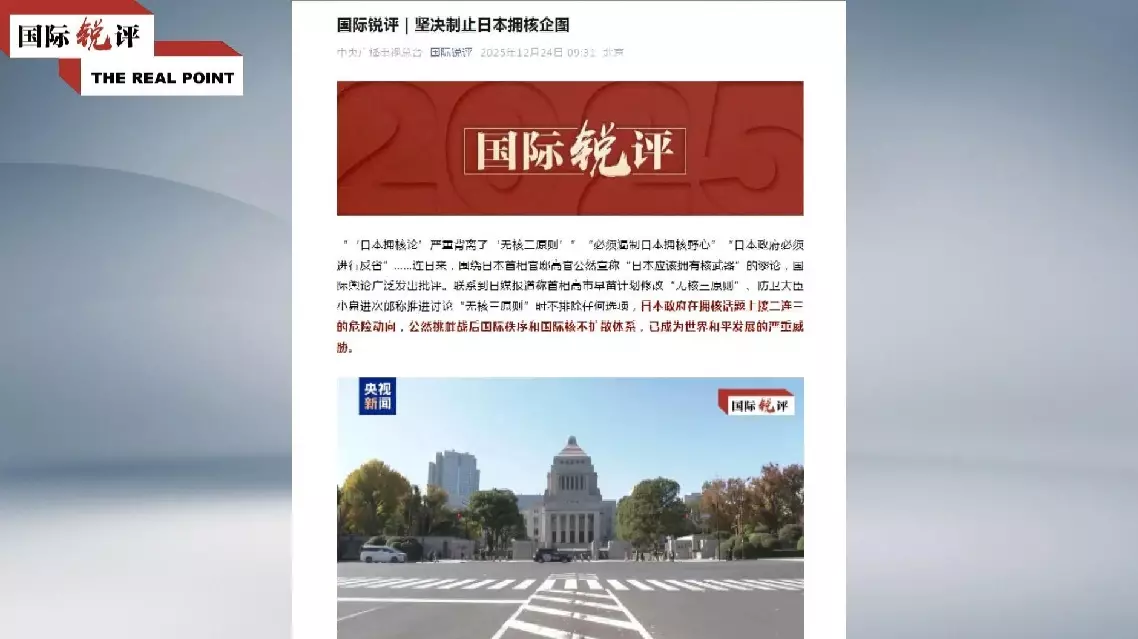
Japan's nuclear ambition must be resolutely stopped: commentary
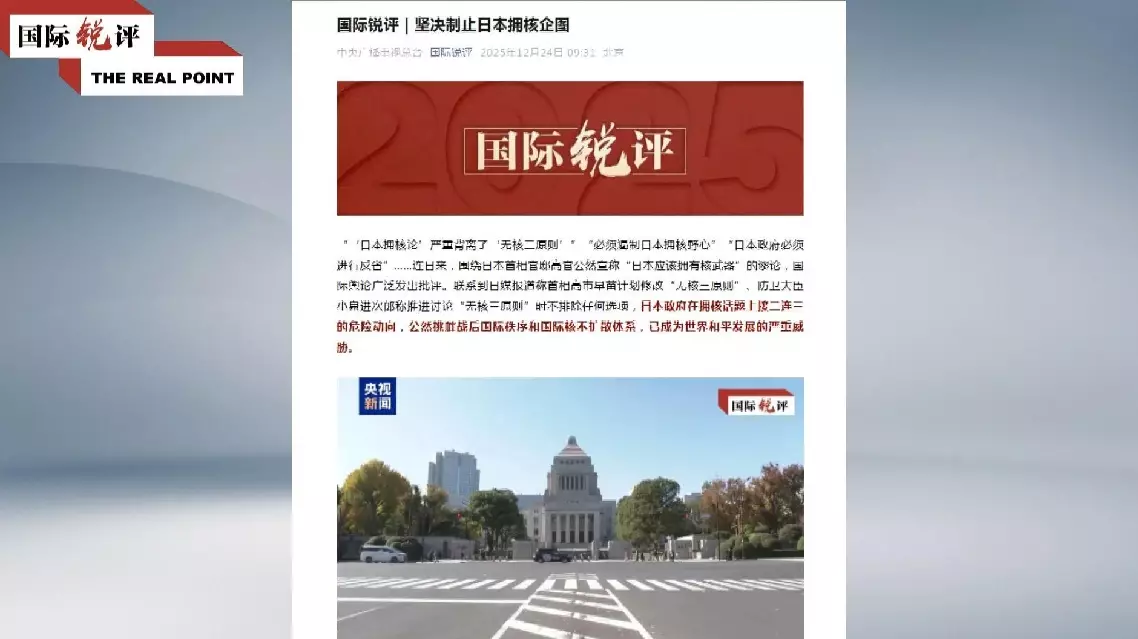
Japan's nuclear ambition must be resolutely stopped: commentary