China's output of additive manufacturing equipment, commonly known as 3D printing, increased by over 100 percent year on year in November, with the industry making remarkable progress during the 14th Five-Year Plan (2021-2025) period, according to official data released on Wednesday.
The latest data from the Ministry of Industry and Information Technology show that in November, the production of additive manufacturing equipment rose by 100.5 percent compared with the same month last year. The annual output value for the sector is projected to reach 70 billion yuan (about 9.96 billion U.S. dollars), reflecting an increase of over 30 percent for the full year of 2025.
From January to September this year, the output of such equipment already rose by 40.5 percent year on year, demonstrating sustained strong growth momentum throughout the year.
These figures underscore a fundamental shift in the industry's role within the broader manufacturing landscape.
"China's additive manufacturing industry has significantly enhanced its independent capabilities across the entire supply chain since the start of the 14th Five-Year Plan (in 2021). Its applications have continued to expand, evolving from an optional tool into an essential component for empowering manufacturing transformation," said Li Fangzheng, deputy secretary general of Additive Manufacturing Alliance of China.
This foundational progress has not only fueled domestic expansion but also propelled the industry onto the global stage with renewed strength.
Experts noted that China's additive manufacturing sector has made remarkable achievements in going overseas this year. In November alone, the export value of additive manufacturing equipment surged by 135.7 percent year on year. From January to November, the total export value of equipment and related products exceeded 10 billion yuan.
"Moving forward, we will continue to deepen the large-scale application of additive manufacturing in aerospace, new energy vehicles, biomedical fields and other fields, so as to leverage high-value application demands to drive technological iteration and enhance our overall competitiveness," Li said.
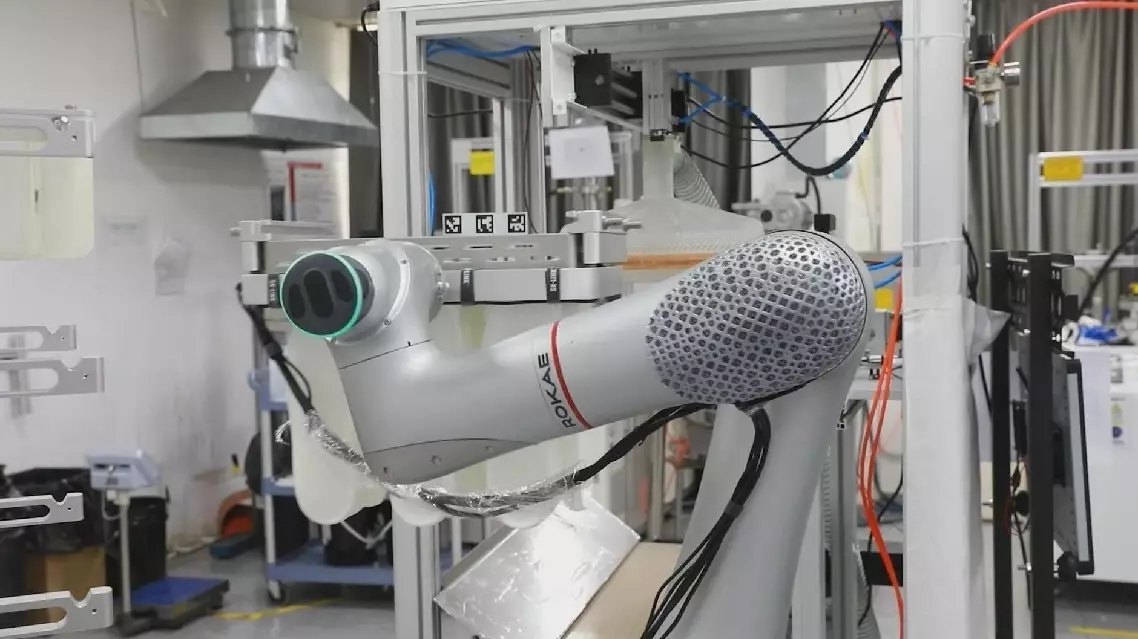
China's 3D printing equipment output surges by 100 pct

Smart technologies have reshaped China's ecological and environmental monitoring system, Huang Runqiu, minister of Ecology and Environment, said Thursday in Beijing on the sidelines of the fourth session of the 14th National People's Congress(NPC).
"Regarding ecological and environmental monitoring, we have been promoting the digitalization, informatization, and intelligentization of the entire monitoring process in recent years, reshaping the ecological and environmental monitoring system. For instance, in water environment monitoring and sampling, we have used intelligent drones which can quickly locate sampling points, collect samples accurately, return rapidly, and they are safe and reliable, improving work efficiency by over 70 percent. They are particularly advantageous for sampling during flood seasons and in remote areas," Huang told the press.
"In terms of environmental sample analysis, we have developed 'lights-out laboratories' in recent years. As the name suggests, these labs operate without lights and are unattended. Through robotic arms, robots, and intelligent management systems, they achieve full-process automation and intelligence from sample handover, testing, and analysis to report generation. This has significantly enhanced work efficiency, increasing it by more than eightfold compared to traditional labs. More importantly, it reduces human interference, human error, and even data falsification," he said.
Thanks to the improved ecological and environmental supervision capabilities, the number of environmental violation cases nationwide has decreased from 130,000 five years ago to 43,000 last year, representing a decline of 68 percent, Huang said.
The minister said China has already applied environmental DNA technology in the biodiversity monitoring work.
"In the field of biodiversity monitoring, monitoring aquatic organisms remains a weak point. However, significant progress has been made in recent years as we have developed environmental DNA technology. Although this chip is very small in size, it contains DNA detection information for aquatic organisms, including the finless porpoise and the Chinese sucker, from 19 state-controlled sections in the Jiangsu segment of the Yangtze River. The results showed that over the past five years, more than 20 species of aquatic organisms have increased in this river section, fully demonstrating the tangible effectiveness of the ten-year fishing ban in the Yangtze River," Huang said while showing a chip to reporters.
The 14th NPC, China's national legislature, concluded its fourth session on Thursday.
Smart technologies reshape China's ecological, environmental monitoring system: minister