As China continues to expand its high-speed rail network, railway authorities are refining train schedules and innovating passenger services to significantly enhance both transport capacity and service quality.
With the opening of the Xi'an–Yan'an high-speed railway on Friday, China's high-speed rail mileage has topped 50,000 km, exceeding the total of all other countries combined.
The country now operates a fleet of 5,233 Electric Multiple Unit (EMU) trains, including 2,248.75 Fuxing high-speed EMU trains, a rise of about 34 percent and 117 percent, respectively, compared to the end of the 13th Five-Year Plan period (2016-2020).
The Fuxing train can reach up to 350 km/h.
"High-speed rail now accounts for 80 percent of China's total railway passenger volume and 69 percent of passenger-kilometers, making it the backbone of medium- and long-distance travel. On average, 9,346 high-speed trains run daily, delivering 9.36 million passenger trips, equivalent to the population of a megacity moving across the country via high-speed rail every single day. This robust network has significantly alleviated pressure during peak travel periods such as the Spring Festival travel rush," said Zhang Zhike, a senior executive at China State Railway Group, the country's national railway operator.
During the 14th Five-Year Plan period (2021–2025), EMU trains have operated a cumulative 12.8 billion passenger trips, a 39.2-percent increase compared to the 13th Five-Year Plan period.
China has built the world's largest railway ticketing system, 12306, which handles over 20 million ticket sales per day and has achieved near-universal e-ticket coverage.
A suite of passenger-friendly services has been introduced, including online meal ordering, high-speed rail pet transport, and age-friendly service options, profoundly transforming how people travel across the nation.
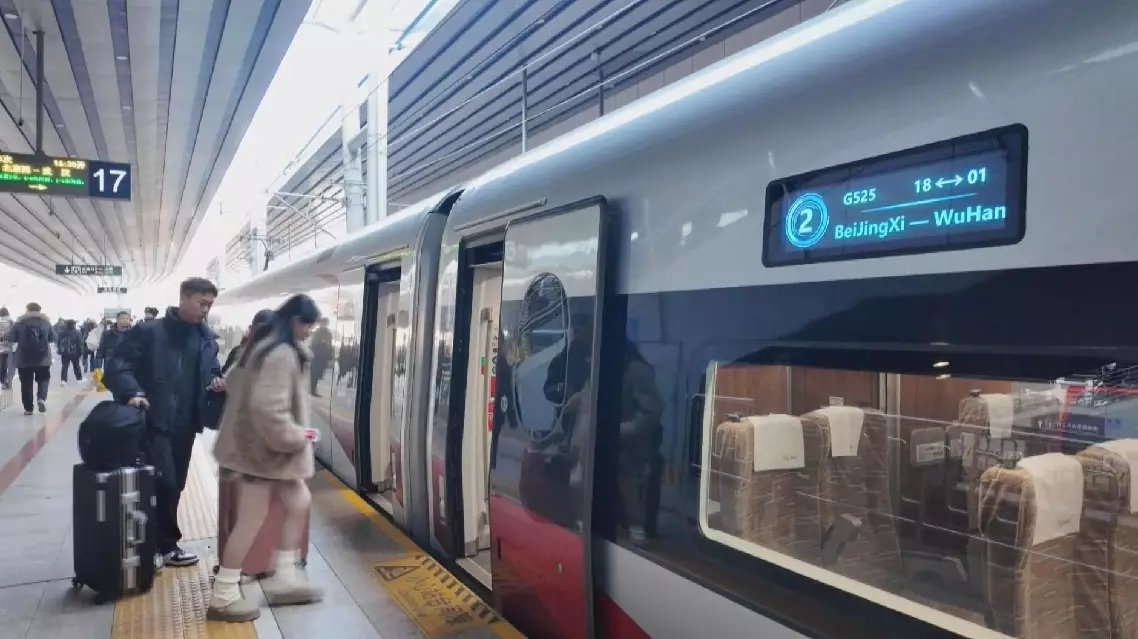
China's high-speed rail sees major leap in both capacity, service quality