NEW YORK (AP) — Asmik Grigorian is reaching a new low — in a positive way — and doing it on one of the world’s top stages.
A star soprano, she will sing the title role next summer in Georges Bizet’s “Carmen,” a mezzo-soprano touchstone, at the Salzburg Festival.
“I thought if I want to do ‘Carmen’ I need to do it now because I don’t want to do when I will be 54,” the 44-year-old Grigorian said ahead of a concert this weekend at New York's Carnegie Hall.
Maria Callas, Leontyne Price, Jessye Norman and Angela Gheorghiu all recorded Carmen but never sang the complete role on stage.
Ana María Martinez and Danielle de Niese are the most notable sopranos in recent years to have sung live performances of the famous seductress, while Victoria de los Ángeles took it on late in her career in the 1970s, and Geraldine Farrar and Rosa Ponselle performed it decades earlier.
Grigorian is to sing eight “Carmen” performances starting July 26 in a new production by Gabriela Carrizo with Jonathan Tetelman as Don José, Kristina Mkhitaryan as Micaëla, with Teodor Currentzis conducting the Utopia Orchestra.
“I would not bet against her,” Metropolitan Opera's general manager Peter Gelb said. “She’s very much of a kind of old-school singer. She’s kind of fearless when it comes to taking on new repertoire.”
Grigorian will be singing at Carnegie Hall on Saturday alongside Thomas Hampson, Sondra Radvanovsky, Nadine Sierra, Brian Jagde and Anita Monserrat, an unusually timed performance during a period when peripatetic singers often are home for the holidays. She is to join Hampson in the final scene from Pyotr Tchaikovsky’s “Eugene Onegin,” an opera she is to perform at the Met starting April 20.
Promoter Eugene Wintour, arranging his first U.S. event, wanted to pair stars who hadn't sung together before. Advance ticket sales at Carnegie were slow, and Wintour said he is planning another star-filled concert next year but before the holidays.
“In Europe, Christmas and New Year’s concerts are sold out instantly," he said through a translator. “It’s a learning curve working here in the states.”
Grigorian traveled Friday from Vilnius, Lithuania; to Zurich and then to New York, going straight from JFK International Airport to a rehearsal at Riverside Church.
“I really promised myself that I’m not going to be away during Christmas because it’s the only day when all the family, we kind of collect ourselves to be in one place and this is a very, very important day for me,” she said.
A daughter of tenor Gegham Grigorian, she made her opera debut in 2004 as Donna Anna in Mozart’s “Don Giovanni” in Norway and has since become one of the world’s leading dramatic sopranos. Her current season includes the title roles in Giacomo Puccini’s “Turandot” and “Manon Lescaut,” and in Richard Strauss’ “Salome,” and she has tentatively planned Richard Wagner's “Tristan und Isolde” for the first time at the Vienna State Opera in 2029.
While she has sung Micaëla, Carmen has a lower tessitura and breaking vocal fach boundaries can spark controversy. When Ponselle headlined “Carmen” at the Met for the first time in 1935, Olin Downes wrote in The New York Times: “We have never heard Miss Ponselle sing so badly.”
“If you feel that you have the notes and you have the personality and you have the desire and you’re a star like Asmik or you’re a star like Ana María Martínez and a theater will give it to you, hallelujah,” soprano Lisette Oropesa said.
Martínez made her debut as Carmen in 2014 at the Houston Grand Opera at the behest of Anthony Freud, the company's general director from 2006-11.
“The most intimidating aspect of ‘Carmen’ is nothing vocal. ... It’s much more about commanding the stage." Martínez said. "Asmik is going to just be incredible in the role simply because of her presence on stage and her magnetism.”
Grigorian's first performance as Carmen is expected to draw considerable attention in the classical music world.
"I started to live that role day by day a bit,” she said. “I never know if I can sing something before I start to do it, so maybe it will be my failure? Who knows? Let’s see.”

Baritone Thomas Hampson and soprano Asmik Gregorian rehearse at Riverside Church in New York on Friday, Dec. 26, 2025. (AP Photo/Ron Blum)
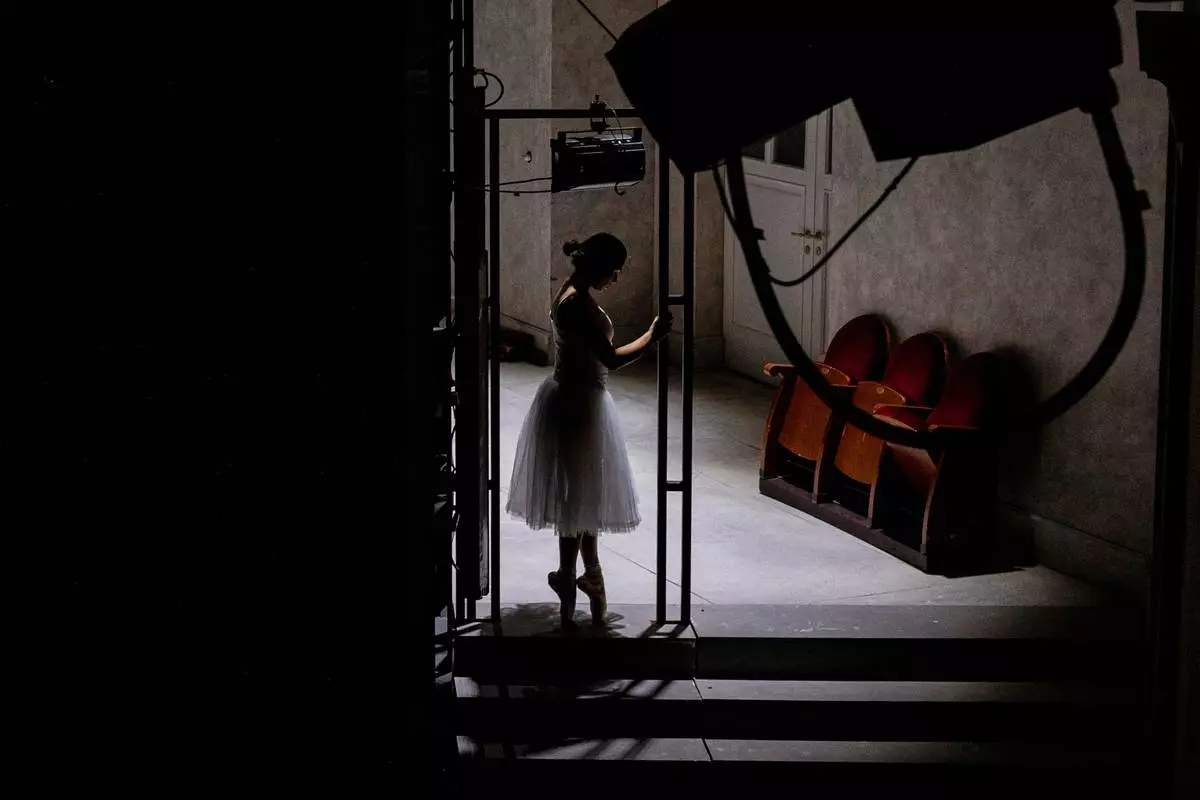
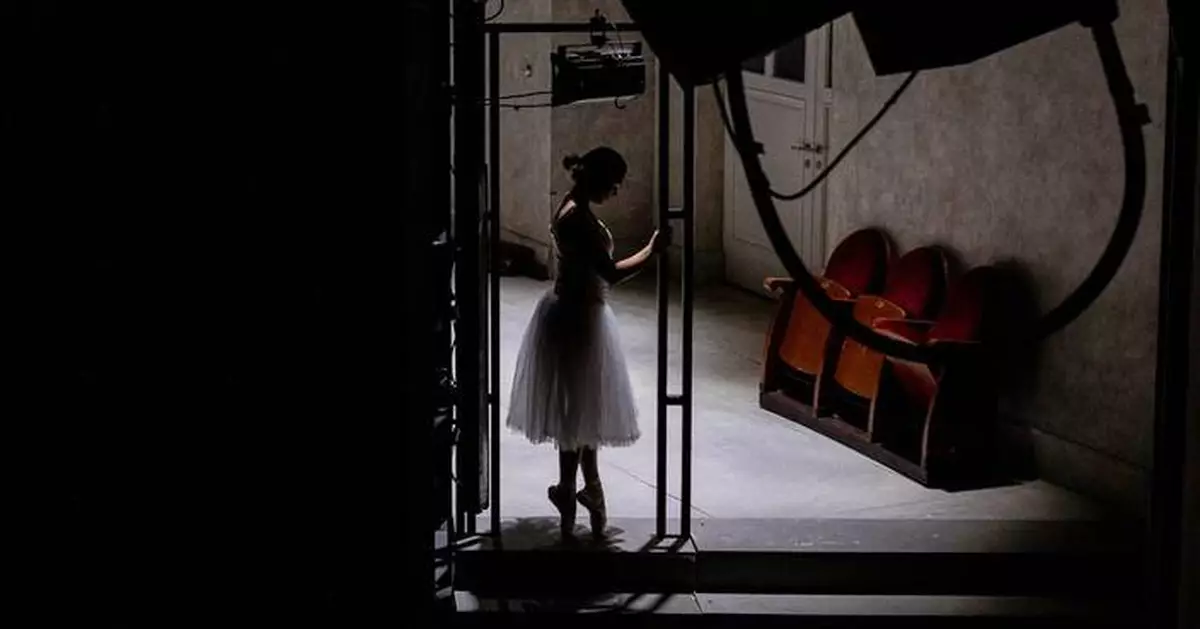
FILE - Lithuanian soprano Asmik Grigorian performs in the opera, "Rusalka," at the Teatro Real in Madrid, Spain, on Thursday, Nov. 12, 2020. (AP Photo/Bernat Armangue, File)
IDLIB, Syria (AP) — A bombing at a mosque in the Syrian city of Homs during Friday prayers killed at least eight people and wounded 18 others, authorities said, as long-standing sectarian, ethnic and political fault lines continue to destabilize the country, even as large-scale fighting has subsided.
Images released by Syria’s state-run Arab News Agency showed blood on the mosque’s carpets, holes in the walls, shattered windows and fire damage. The Imam Ali ibn Abi Talib Mosque is located in Homs, Syria's third-largest city, in an area of the Wadi al-Dhahab neighborhood dominated by the Alawite minority.
SANA, citing a security source, said that preliminary investigations indicate that explosive devices were planted inside the mosque. Authorities were searching for the perpetrators, who have not yet been identified, and a security cordon was placed around the building, Syria’s Interior Ministry said in a statement.
A little-known group calling itself Saraya Ansar al-Sunna claimed responsibility for the attack in a statement posted on its Telegram channel. The same group had previously claimed a suicide attack in June in which a gunman opened fire and then detonated an explosive vest inside a Greek Orthodox church in Dweil’a, on the outskirts of Damascus, killing 25 people as worshippers prayed on a Sunday.
The Syrian government blamed the church attack on a cell of the Islamic State group, saying IS had also planned to target a Shiite Muslim shrine. IS did not claim responsibility for the attack. The group follows an extreme interpretation of Sunni Islam and considers Shiites to be infidels.
Syria recently joined the global coalition against IS and has launched a crackdown on IS cells, particularly after an attack on U.S. forces earlier this month that killed two service members and a civilian translator.
U.N. Secretary-General Antonio Guterres “unequivocally condemns the deadly terrorist attack," and stresses that those responsible must be identified and brought to justice, U.N. spokesman Stephane Dujarric said. The U.N. chief also noted Syria's commitment to combat terrorism and hold perpetrators accountable.
The country has experienced several waves of sectarian clashes since the fall of President Bashar Assad last year. Assad, himself an Alawite, fled the country to Russia. Members of his sect have been subjected to crackdowns.
In March, an ambush carried out by Assad’s supporters against security forces triggered days of violence that left hundreds of people dead, most of them Alawites.
In a statement, the Supreme Alawite Islamic Council in Syria and the Diaspora described the attack as “a continuation of the organized extremist terrorism specifically targeting the Alawite community, and increasingly other Syrian groups as well.”
The council held the Syrian government “fully and directly responsible for these crimes,” adding that “these criminal acts will not go unanswered.”
Local officials condemned Friday's attack, saying it came “within the context of repeated desperate attempts to undermine security and stability and sow chaos among the Syrian people.”
“Syria reiterates its firm stance in combating terrorism in all its forms and manifestations,” the Ministry of Foreign Affairs added in a statement.
“Remnants of the former regime, IS militants and collaborators have converged on a single goal: obstructing the path of the new state by undermining stability, threatening civil peace, and eroding the shared coexistence and common destiny of Syrians throughout history,” the Syrian information minister said in a post on X.
The mosque’s deputy imam — a religious official who helps lead prayers — told Syria’s state-run Al-Ikhbariyah television that worshippers were praying when they “heard a loud explosion that knocked us to the ground. Fire broke out in one corner of the mosque. Those of us who were not wounded rushed to help get the injured out. Within minutes, general security forces and the Red Crescent arrived.”
“The explosion was huge,” he said. “It shattered the mosque’s windows and caused a fire that burned copies of the Holy Quran.”
Neighboring countries, including Saudi Arabia, Jordan and Lebanon, also condemned the attack. In a statement, Lebanese President Joseph Aoun reaffirmed “Lebanon’s support for Syria in its fight against terrorism.”
On Monday, clashes erupted intermittently between Syrian government forces and Kurdish-led fighters of the Syrian Democratic Forces, in mixed neighborhoods in the northern city of Aleppo, forcing temporary closures of schools and public institutions and prompting civilians to shelter indoors. A late-evening ceasefire was then announced by both sides amid ongoing de-escalation efforts.
Tensions flared again on Friday between government security forces and Kurdish forces in Aleppo, with the two sides trading blame.
The head of internal security in Aleppo province, Col. Mohammad Abdul Ghani in a statement said snipers from the SDF opened fire on a Ministry of Interior checkpoint, wounding an officer, and security forces returned fire.
The SDF in a statement said that “factions affiliated with the Damascus government” targeted a checkpoint manned by Kurdish forces with rocket-propelled grenades and they returned fire.
———
Abou Aljoud contributed from Beirut.

Syrian security forces inspect the damage after an explosion in the Imam Ali bin Abi Talib Mosque in a predominantly Alawite area of the Wadi al-Dhahab neighborhood in Homs, Syria Friday, Dec. 26, 2025.(AP Photo)

Syrian security forces secure the area outside the Imam Ali bin Abi Talib Mosque in the predominantly Alawite Wadi al-Dhahab neighborhood after an explosion inside the mosque, in Homs, Syria, Friday, Dec. 26, 2025. (AP Photo)

Syrian security forces inspect the damage after an explosion in the Imam Ali bin Abi Talib Mosque in a predominantly Alawite area of the Wadi al-Dhahab neighborhood in Homs, Syria Friday, Dec. 26, 2025.(AP Photo)
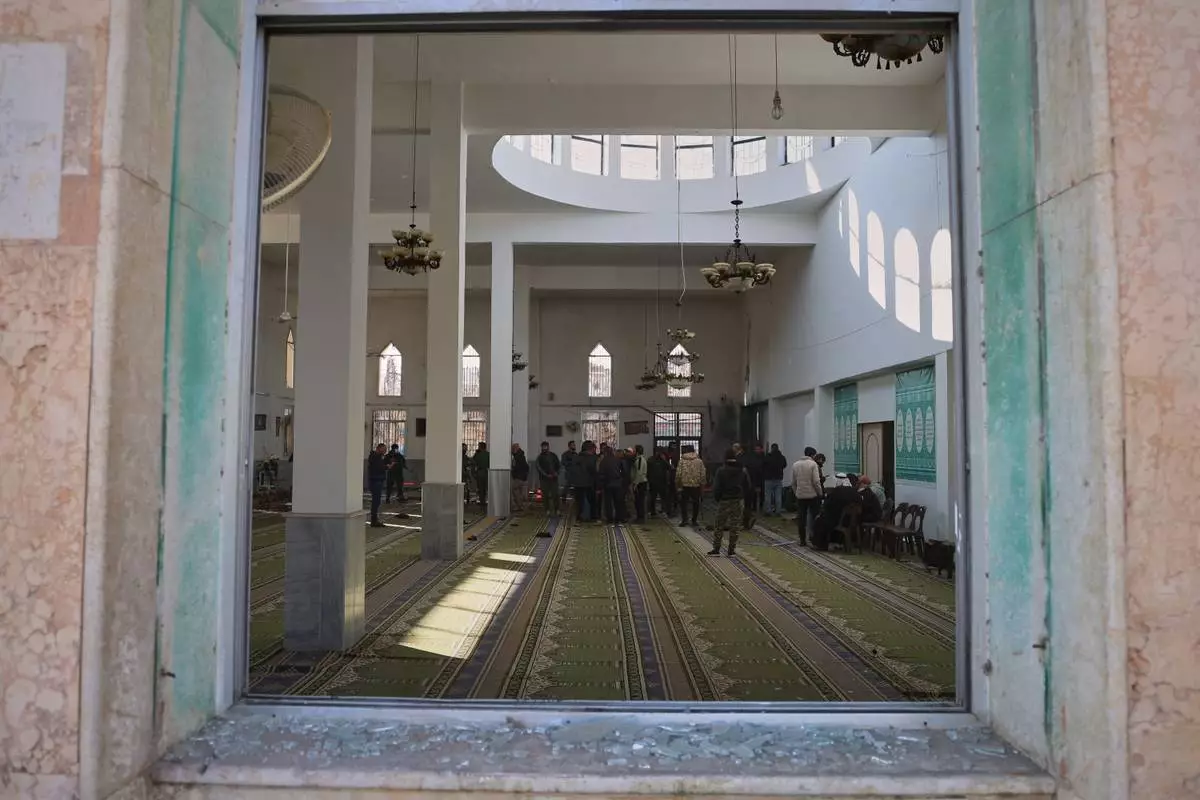
Syrian security forces inspect the damage after an explosion in the Imam Ali bin Abi Talib Mosque in a predominantly Alawite area of the Wadi al-Dhahab neighborhood in Homs, Syria Friday, Dec. 26, 2025.(AP Photo)

Syrian security forces inspect the damage after an explosion in the Imam Ali bin Abi Talib Mosque in a predominantly Alawite area of the Wadi al-Dhahab neighborhood in Homs, Syria Friday, Dec. 26, 2025.(AP Photo)