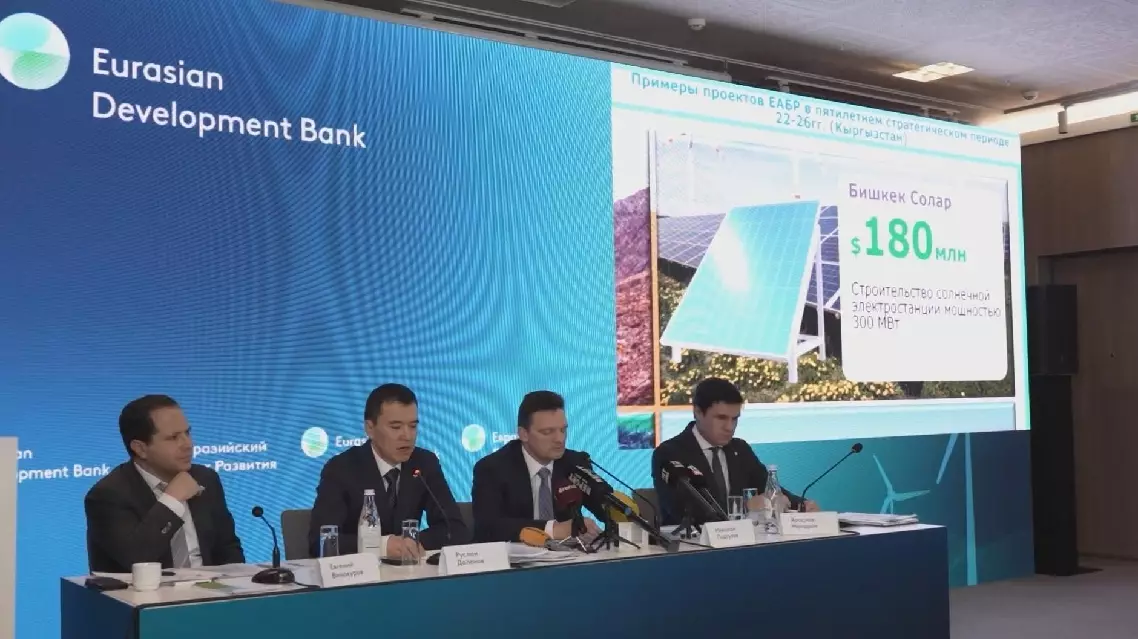
Chinese investment in Eurasia is growing significantly amid a general decline in global investment activity over the past decade, according to the Eurasian Development Bank's annual report released on Thursday.
The Eurasian Development Bank, headquartered in Almaty, Kazakhstan, was founded in 2006 at the initiative of Russia and Kazakhstan. Its purpose is to facilitate major investment projects in its member countries, currently including Armenia, Belarus, Kyrgyzstan and Tajikistan.
The bank has been monitoring mutual investments in the region since 2016. Over the past decade, China's investment has surged by 80 percent, reaching a record 66 billion U.S. dollars by the end of the first half of 2025.
The report also indicates that Chinese investment has increased by 13 percent, or nearly 7.5 billion U.S. dollars, over the past 18 months.
Chinese investment in industry and energy is growing, demonstrating the maturity of Chinese business and its willingness to transfer its technologies, according to the bank's executives.
"Previously, Chinese companies sought to acquire existing production facilities or deposits and upgrade them, a practice known as brownfield investments. Now, however, they are increasingly making greenfield investments, building factories and establishing production capacities from the ground up. This trend also reflects the maturity and development of their own technological foundation. In Uzbekistan, their share has increased. While Kazakhstan remains the largest recipient of Chinese investment, attracting over 11 billion U.S. dollars, Uzbekistan has also received more than 10 billion U.S. dollars," said Evgeny Vinokurov, Vice Chairman and Chief Economist at the Eurasian Development Bank.
"We probably can't do without Chinese companies, especially in our region, and indeed anywhere in the world. They're highly active and make substantial investments. And in virtually all Central Asian countries, including Belarus, Chinese companies are significantly involved. What projects are these? They span the petrochemical sector, transportation and energy," said Nikolai Podguzov, Chairman of the Management Board of the Eurasian Development Bank.
The bank predicts further growth in Chinese investment in Central Asia, given the region's economic potential and proximity to China.
Chinese investment in Eurasia grows significantly over past decade: bank report
The Urumqi–Yuli Expressway, which traverses the Tianshan Mountains in northwest China's Xinjiang Uygur Autonomous Region, opened to traffic on Friday after more than five years of construction, significantly enhancing regional connectivity and enabling faster, more efficient movement of goods and services across the region.
The expressway is a core component of the G0711 national highway network, spanning 324.7 kilometers.
Stretching 2,500 kilometers, the Tianshan Mountains span central Xinjiang, separating Urumqi, the largest city in the north, from Korla, the largest city in the south. With the opening of the expressway, travel time between these two cities is reduced from seven hours to about three hours.
As a key component of the expressway and the world's longest expressway tunnel, the 22.13-km Tianshan Shengli Tunnel officially opened to traffic on the same day.
The tunnel's construction incorporated multiple cutting-edge technologies and innovations, including advanced survey and design methods for ultra-long tunnels and intelligent construction techniques.
"We have established a relatively systematic, comprehensive, and highly efficient management system for major engineering technological innovation across the entire expressway, and have accumulated extensive construction and management experience in delivering mega-projects under extreme environmental conditions," said Song Hailiang, chairman of the China Communications Construction Group.
The expressway connects Urumqi with the northern city belt and the southern urban clusters of Xinjiang, linking the Junggar Basin and the Tarim Basin. It enables rapid transportation between Urumqi, Kashgar, and Khorgos, strengthening Xinjiang’s role as a strategic hub for both the domestic market and international trade.
"With the expressway now operational, business opportunities are flowing in, and many inland companies are coming to sign agreements with us," said Yu Ruihong, chairwoman and general manager of the Xinjiang Ruiyuan Dairy.
"The Urumqi–Yuli Expressway significantly improves Xinjiang's connectivity with the eastern coastal regions and the New International Land–Sea Corridor, supporting the development of a modern, comprehensive, three-dimensional transportation network and high-quality Belt and Road cooperation," said Zhou Rongfeng, director general of the Highway Bureau of the Ministry of Transport.

Urumqi-Yuli Expressway boosts Xinjiang's trade connectivity, strengthens regional integration