SANTA CLARA, Calif. (AP) — Brock Purdy and the San Francisco offense did everything they could for the first 58 minutes in a nearly flawless performance. At the end, they were just spectators when the beleaguered defense finally came through with a stop.
Purdy threw a 38-yard touchdown pass to Jauan Jennings with 2:15 left, and the 49ers forced an incomplete pass on the final play from the 2 to beat the Chicago Bears 42-38 on Sunday night and set up a Week 18 showdown for the top seed in the NFC.
Click to Gallery
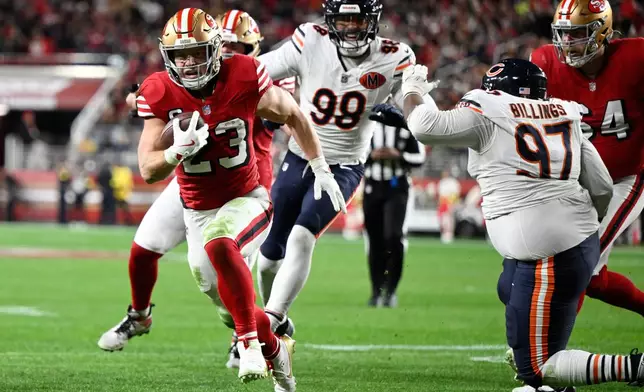
San Francisco 49ers running back Christian McCaffrey (23) runs toward the end zone to score against the Chicago Bears during the first half of an NFL football game in Santa Clara, Calif., Sunday, Dec. 28, 2025. (AP Photo/Eakin Howard)
Chicago Bears tight end Colston Loveland, top, catches a touchdown pass in front of San Francisco 49ers linebacker Tatum Bethune during the first half of an NFL football game in Santa Clara, Calif., Sunday, Dec. 28, 2025. (AP Photo/Jed Jacobsohn)
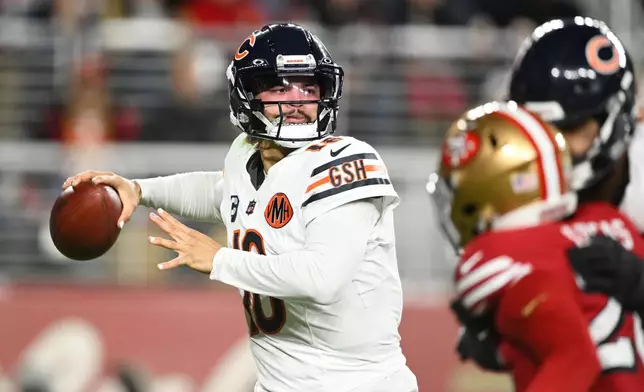
Chicago Bears quarterback Caleb Williams passes against the San Francisco 49ers during the second half of an NFL football game in Santa Clara, Calif., Sunday, Dec. 28, 2025. (AP Photo/Eakin Howard)
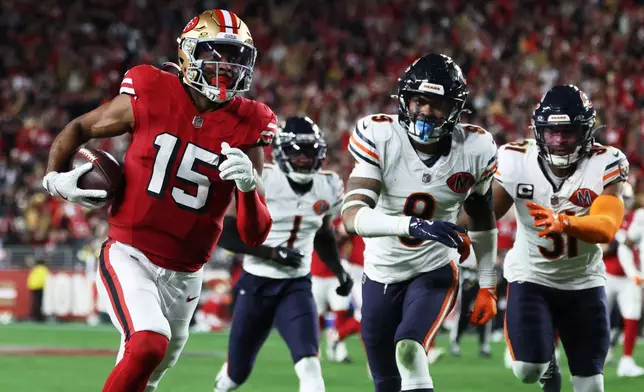
San Francisco 49ers wide receiver Jauan Jennings (15) runs toward the end zone to score against the Chicago Bears during the second half of an NFL football game in Santa Clara, Calif., Sunday, Dec. 28, 2025. (AP Photo/Jed Jacobsohn)
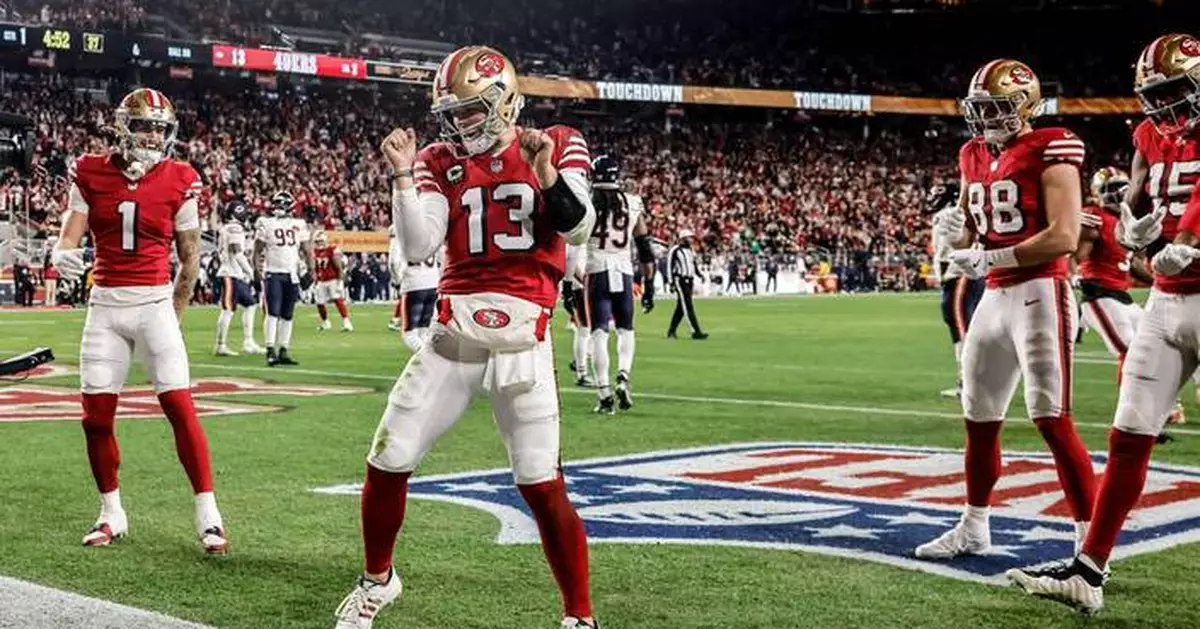
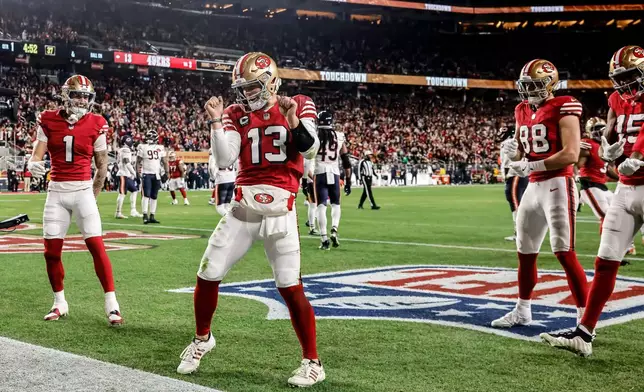
San Francisco 49ers' Brock Purdy (13) dances in the end zone after scoring a touchdown during the first half of an NFL football game against the Chicago Bears in Santa Clara, Calif., Sunday, Dec. 28, 2025. (Carlos Avila Gonzalez/San Francisco Chronicle via AP)
Caleb Williams drove the Bears (11-5) down the field in the closing seconds and had one last shot for the win. But Bryce Huff forced him out of the pocket and his throw short-hopped Jahdae Walker in the end zone to seal a sixth straight victory for the 49ers (12-4).
“For them to finish out the game like that, I was so happy for them. I was sitting there not being able to do anything but watch,” Purdy said. “To be able to celebrate was a cool team win. There’s nothing like that. It was pretty special.”
That gave the 49ers a chance to win the NFC West and get a bye by beating Seattle (13-3) in the season finale on Saturday night. A win would give San Francisco home-field advantage and a chance to stay home all postseason, with the Super Bowl set to be played at Levi’s Stadium on Feb. 8.
“We’ve earned this,” coach Kyle Shanahan said. "This is the game we want. We love that it’s here. We have an opportunity to never leave here again this year.”
The loss ends the Bears’ hopes of earning the top seed. Chicago has already clinched the NFC North and can earn the No. 2 seed by beating Detroit next Sunday.
Purdy followed his career-high five TD-pass performance last week against Indianapolis by throwing for three scores and running for two to become the sixth player since the AFL-NFL merger with back-to-back games with at least five touchdowns.
Purdy finished 24 for 33 for 303 yards, while Christian McCaffrey ran for 140 yards and a score and added 41 more receiving.
Williams went 25 for 42 for 330 yards and two TDs but couldn’t deliver at the end after already leading the Bears to an NFL-record six comeback wins after trailing in the final two minutes of regulation.
“It’s frustrating,” Williams said. “You don’t want to lose a game ever. And then also, in that position, having a shot at the end is all you can ask for on this moment.”
Neither defense could slow down the opposing offense for most of the night after a pick-6 by Chicago’s T.J. Edwards on the first play. The Niners led 28-21 at halftime.
The teams then traded touchdowns on the first three drives of the second half, with D’Andre Swift scoring on two runs for Chicago and Purdy delivering a highlight-reel play for San Francisco. He rolled to his right on a play from the 6, eluded two pass rushers and then flipped an easy TD pass to Kyle Juszczyk on a play that lasted longer than 8 seconds.
“I was hoping he'd throw it away and we'd have a couple more downs,” Shanahan said. “Then I started watching him like every fan does. He made me extremely nervous and then he made my extremely happy.”
The Bears finally forced a punt and went ahead 38-35 on a short field goal by Cairo Santos with 5:22 to play when they couldn’t convert on third down in the red zone.
The Bears’ opportunistic defense struck on the first play when Edwards caught a deflected pass and returned it 34 yards for Chicago’s first defensive score on the opening play in at least 45 years, according to the Elias Sports Bureau.
“It was early in the game so you do have to flush it and be ready to play a whole game after that,” Purdy said.
Purdy answered his big mistake to start the game with a 65-yard touchdown drive capped by a 1-yard pass to Jake Tonges, and San Francisco moved the ball with ease all half.
Purdy added two touchdown runs and McCaffrey also scored on the ground to give the 49ers a 28-21 lead at the break despite allowing two deep TD passes by Williams.
Bears: LB Noah Sewell left in the third quarter with an ankle injury. ... DE Joe Tryon-Shoyinka (concussion) left the game. ... WR Olamide Zaccheaus was a late scratch with an illness.
49ers: LT Trent Williams (hamstring) left after getting hurt on the opening play and never returned. ... CB Upton Stout (concussion) left in the second half. ... TE George Kittle (ankle) was inactive.
Bears: Host Detroit on Sunday.
49ers: Host Seattle on Saturday night.
AP NFL: https://apnews.com/hub/nfl
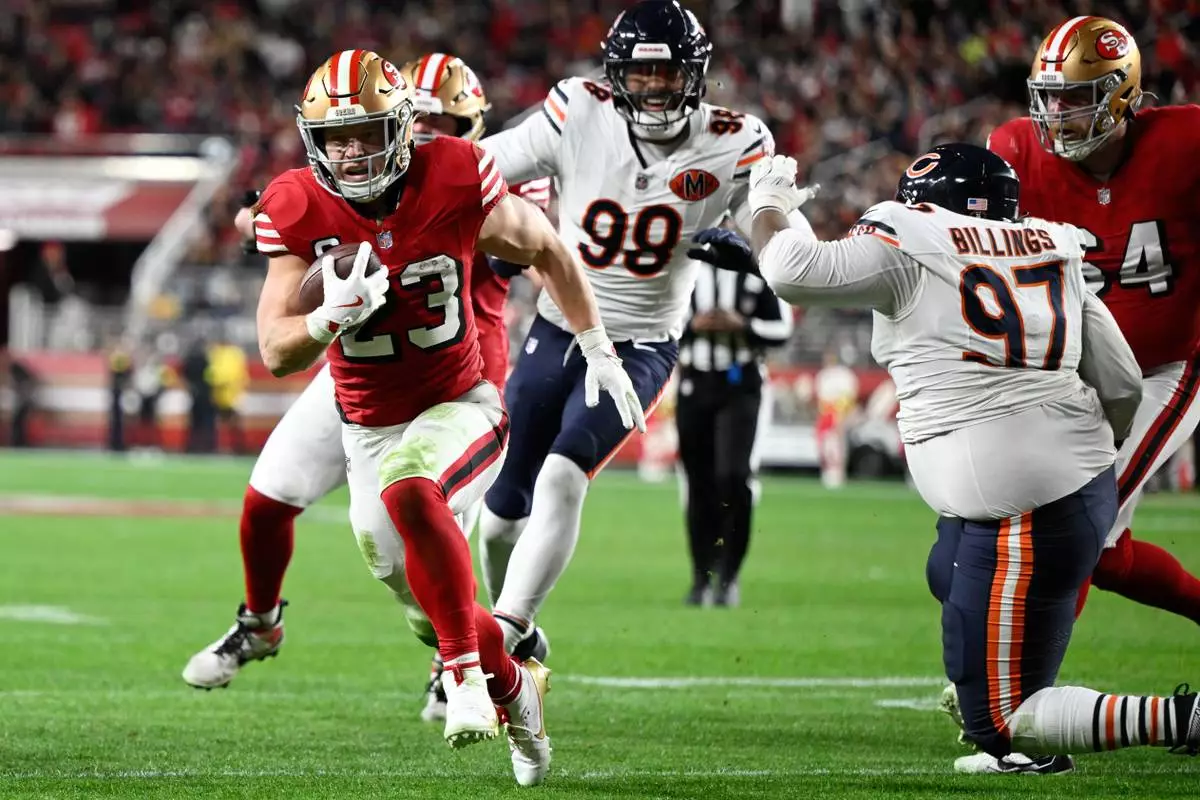
San Francisco 49ers running back Christian McCaffrey (23) runs toward the end zone to score against the Chicago Bears during the first half of an NFL football game in Santa Clara, Calif., Sunday, Dec. 28, 2025. (AP Photo/Eakin Howard)

Chicago Bears tight end Colston Loveland, top, catches a touchdown pass in front of San Francisco 49ers linebacker Tatum Bethune during the first half of an NFL football game in Santa Clara, Calif., Sunday, Dec. 28, 2025. (AP Photo/Jed Jacobsohn)
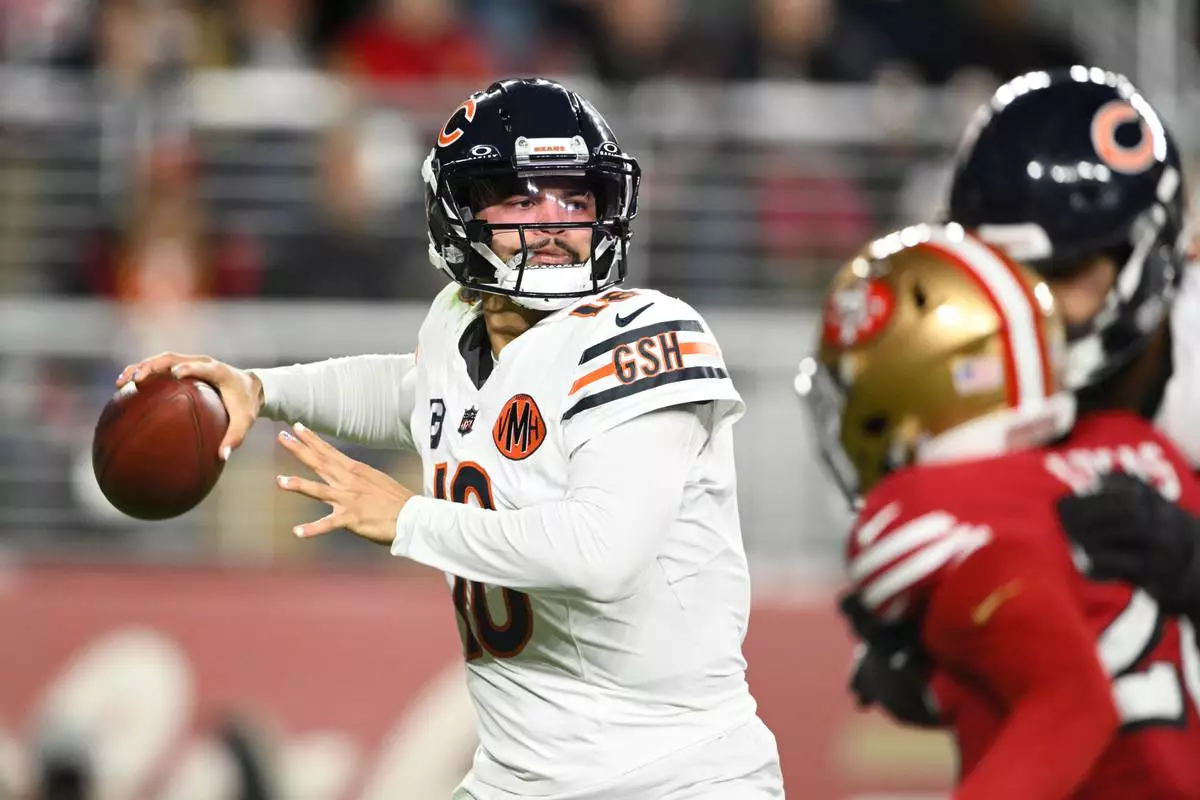
Chicago Bears quarterback Caleb Williams passes against the San Francisco 49ers during the second half of an NFL football game in Santa Clara, Calif., Sunday, Dec. 28, 2025. (AP Photo/Eakin Howard)
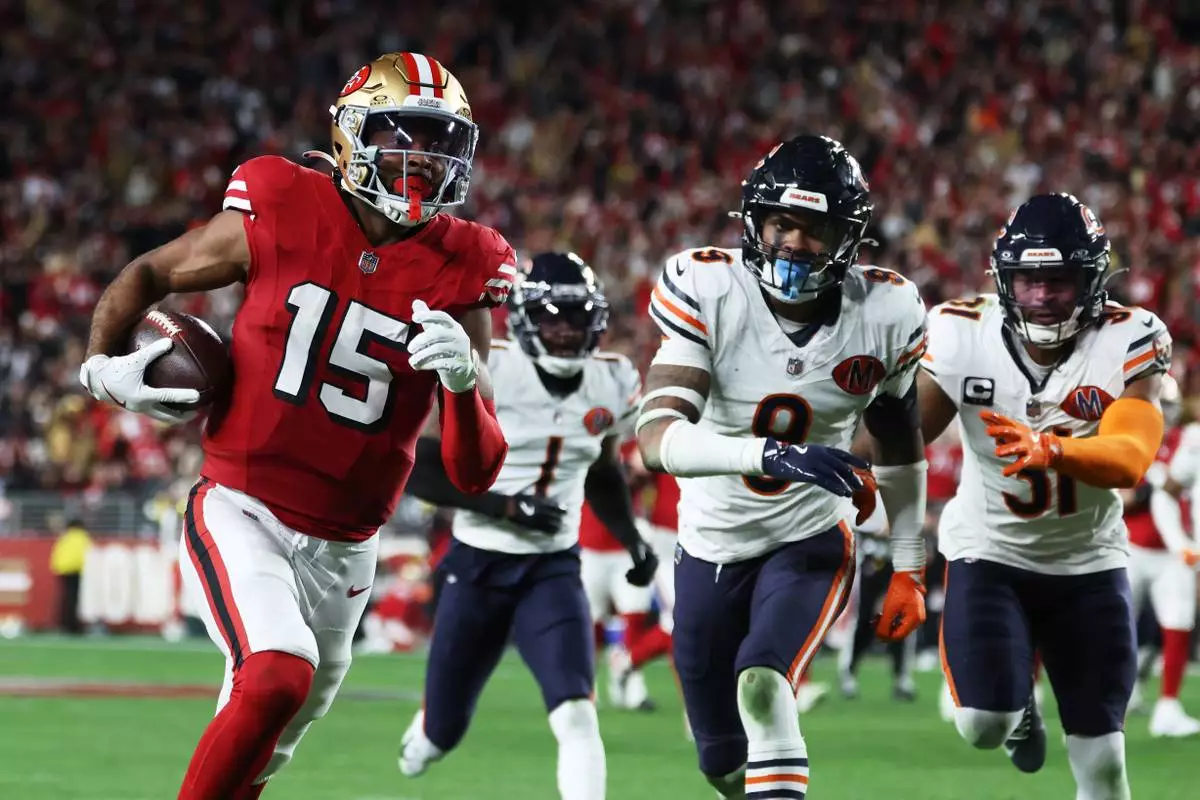
San Francisco 49ers wide receiver Jauan Jennings (15) runs toward the end zone to score against the Chicago Bears during the second half of an NFL football game in Santa Clara, Calif., Sunday, Dec. 28, 2025. (AP Photo/Jed Jacobsohn)
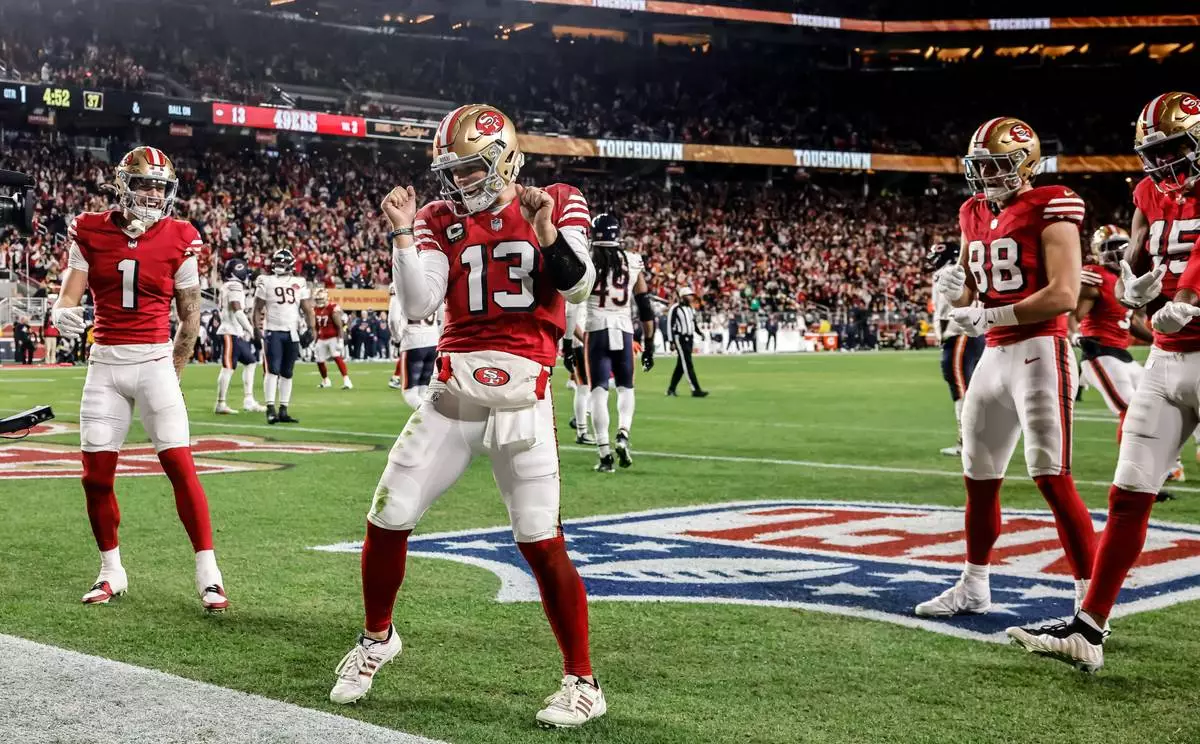
San Francisco 49ers' Brock Purdy (13) dances in the end zone after scoring a touchdown during the first half of an NFL football game against the Chicago Bears in Santa Clara, Calif., Sunday, Dec. 28, 2025. (Carlos Avila Gonzalez/San Francisco Chronicle via AP)
NEW YORK (AP) — It's that time — December's waning days, when we prepare to turn the calendar page. Many Americans take stock, review goals accomplished and unmet, ponder hopes and plans. How's our health? What's up with our money? What about the country? Will the coming year look like the departing one year, or be something entirely different?
Are we ready?
It can be an overwhelming period. So The Associated Press reached out to professionals with varying expertises — home organization, risk management, personal training, personal finance, and political science — to talk about their perspectives on changes and transitions.
And for something a little different, we gave each interviewee a chance to ask a question of one of the others.
So let's talk endings and beginnings.
Transitions are professional organizer Laura Olivares' working life. As co-founder of Silver Solutions, she works with senior adults and their families to help make sure they're in safe environments, whether that means decluttering a lifetime of possessions, downsizing to another home, or helping families clear a house after a loved one's passing.
She offers this: Changes, even exciting ones, can unearth sadness or grief over places, things and people left behind. Acknowledging those feelings can help smooth the move from one chapter to another.
“When you let go of something that was meaningful to you, it deserves a moment,” she says. “Whatever that moment is, could be a second, could just be an acknowledgement of it. Or maybe you set it on the on the mantle and you think about it for a while and when you’re ready to let it go, you let it go.”
NEXT QUESTION: Certified personal trainer Keri Harvey asked: “What small weekly habits can I build that will help me stay organized during the year?” Olivares' tips: In December, do a brain dump of thoughts, ideas, and goals. Then, before Jan. 1, schedule out tasks that move those priorities forward over the course of 2026. Olivares suggests three tasks on each of three days, so nine tasks per week.
Probably no group of people think more about the future than actuaries. Using data, statistics and probabilities, they devise models on how probable it is that certain events happen, and what it could cost to recover from them. Their work is vital to organizations like insurance companies.
Listen to R. Dale Hall talk, though, and he sounds almost ... philosophical. He's managing director of research at the Society of Actuaries. Asked how the general public could think about a new year, he readily brings up strategies like mapping out risk scenarios and how to respond.
There's a balance to be struck, he says: We can't control or predict everything and must accept the possibility of something unexpected. And the past isn't always a perfect guide; just because something happened doesn't mean it must again.
“It’s the nature of taking risk, right? That yeah, there are going to be uncontrollable things," Hall says. “There are ways to maybe diversify those risks or mitigate those risks, but no one has that perfect crystal ball that’s going to see three, six, nine, 12 months into the future.”
NEXT QUESTION: From personal finance educator Dana Miranda: “Thinking about the variables we consider when making decisions or plans, how might the juxtaposition of the holiday season with the new year affect the way people are evaluating their finances and setting goals at the beginning of each year? ... What do you recommend they do to ensure the holiday experience doesn’t skew financial goal-setting?”
Hall's advice: Keep 'em separate. He recommends people enjoy the holidays and hold off on financial goals until January.
In her work as a financial writer and a personal finance educator, Miranda encourages people to make conscious choices around their spending and saving, and understand that there's no absolute rule.
Miranda, author of “You Don't Need a Budget,” says details are key. What works for one person may not work for another. And it's something Americans should consider as another year of goals and resolutions approaches. Insisting that the same technique works for everybody can leave people feeling stuck, Miranda says.
“We tend to be not good at talking about the nuances and that leaves people with, ‘Here’s the one right rule. It’s not possible for me to achieve that perfection, so I’m just going to feel ashamed of every move that I make that is not moving toward that perfect goal.’"
NEXT QUESTION: From Jeanne Theoharis, a political science professor, who asked how Miranda gets people to look beyond the micro and consider the larger system of capitalism. “How does she also get people to think about more collective solutions—like union organizing, pressing City Council or Congress for changes?”
Miranda is quick to make it clear she's not an organizer but says she tries to evoke larger systemic issues when discussing personal finance. “The way that I try to move that needle just a little bit is to always bring in that political aspect to whatever conversation we’re having ... to make the systemic and the cultural impact visible.”
When it comes to changes and new years, one of the most popular areas is fitness, the subject of many a (failed) resolution. Personal trainer Harvey, of Form Fitness Brooklyn, says you can make positive, lasting change in fitness (and generally) with one philosophy: Start small and build.
“We want to be mindful of making sure that we’re not asking too much or trying to overcompensate for what we feel like we left behind this past year or what we feel like we left on the table this past year,” she says. “It’s very reasonable to try and have the goal of getting to the gym twice a week, maybe three times a week, and then building from there instead of saying ‘Jan. 1, I’m starting, I’m gonna be at the gym five days a week, two hours a day.' That’s not realistic and it’s not kind to ourselves."
NEXT QUESTION: From Hall: “What advice do you have for me to transition to an even more robust workout schedule in 2026 without falling into the risk of injuring myself by doing too much too soon?”
Harvey emphasized warming up and having a mobility routine, and making the goal attainable by making it fun. “Find things that you actually enjoy doing and try and fit those in as well so that the idea of starting something new or adding to it isn’t one that comes with a negative like, ‘Oh, I don’t want to have to do this,’ where you’re dragging yourself into it.”
It's not just as individuals that we think about transitions. Nations and cultures have them, too.
We can learn from them if we look at our history honestly and not through the guise of trying to hide the ugly parts, says Theoharis, professor of political science and history at Brooklyn College and the City University of New York Graduate Center.
She points to the story of Rosa Parks, remembered as the catalyst of the Montgomery bus boycotts 70 years ago. But when Parks chose to resist, she didn't know what her arrest would mean or what the outcome would be. Theoharis sees a lesson there for people looking to make change in today's world and even individuals wanting to evolve.
“A number of us would be willing to do something brave if we knew that it would work,” Theoharis says. “And we might even be willing to have some consequences. But part of what looking at the actual history of Rosa Parks or the actual history of the Montgomery bus boycott is in fact you have to make these stands with no sense that they will work.”
NEXT (AND LAST) QUESTION: From Olivares, who wanted Theoharis' thoughts on today's civil rights battles. Theoharis referenced voting rights, which have been eroded in recent years. At the same time, remembrances of the turmoil during the Civil Rights years have become glossed over by a mythology of America overcoming its injustices.
There's a lesson there about what it takes to make real change for individuals, too, Theoharis says: It's difficult to move forward if you're not honestly addressing what's come before. “Part of how we’ve gotten here is by that ... lack of reckoning with ourselves, lack of reckoning with where we are, lack of reckoning with history.”

Girls film their dance at a Christmas fair opened prior to Christmas and New Year festivities in St. Petersburg, Russia, Thursday, Dec. 25, 2025, with a statue of Soviet Union founder Vladimir Lenin in the background. (AP Photo/Dmitri Lovetsky)

Workers prepare a display welcoming 2026 in the lobby of the LG Towers in Beijing, Saturday, Dec. 27, 2025. (AP Photo/Ted Anthony)
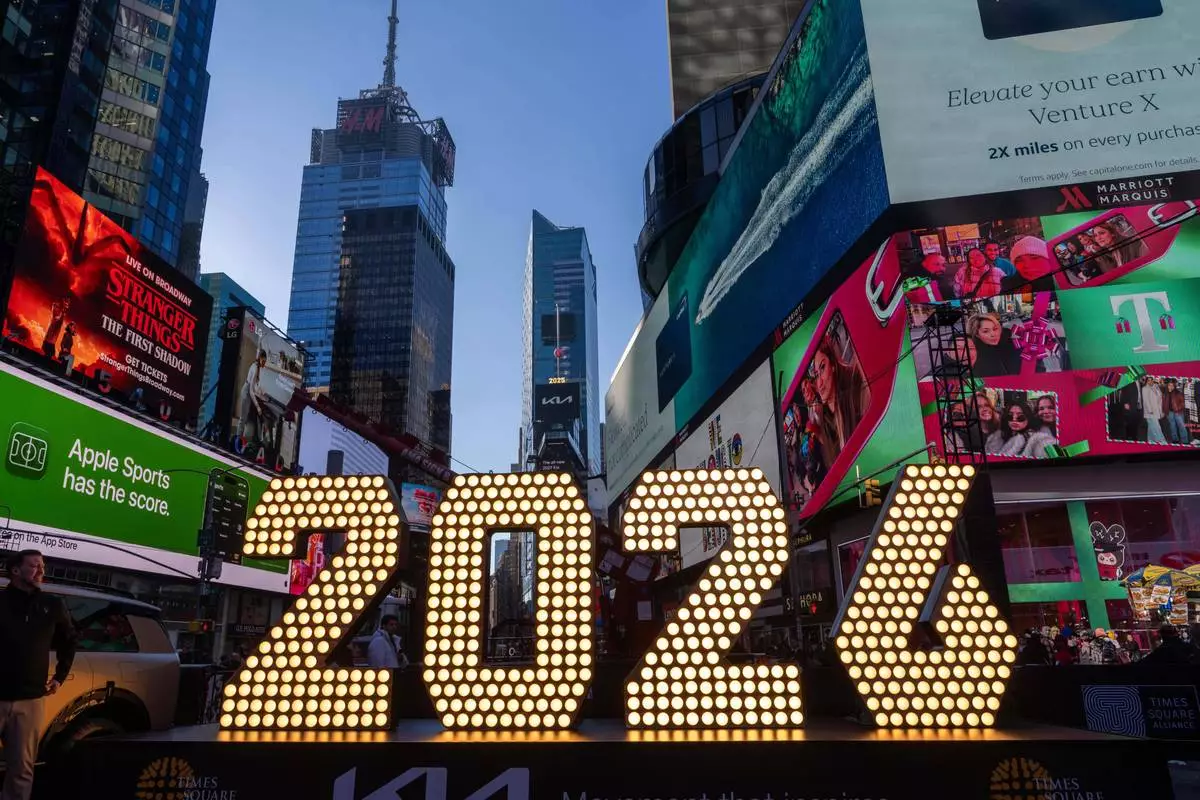
FILE - The 7-foot tall "2026" numerals are displayed at an illumination ceremony in Times Square, Thursday, Dec. 18, 2025, in New York. (AP Photo/Adam Gray, File)