ANKARA, Turkey (AP) — A Turkish court on Monday ordered the release of veteran journalist Fatih Altayli from prison pending the outcome of his appeal against a conviction for allegedly threatening President Recep Tayyip Erdogan.
Altayli, 63, a longtime columnist whose YouTube programs drew hundreds of thousands of viewers daily, was sentenced last month to four years and two months in prison. He had been arrested in June on charges of threatening the president during one of his broadcasts — a case critics described as an attempt to silence a prominent government opponent.
The regional appeals court ruled for his release from prison, citing the absence of any flight risk, the fact that evidence had already been collected, and the time he had already spent in detention, according to state-run Anadolu Agency.
Altayli’s arrest stemmed from remarks on his program “Fatih Altayli Comments,” in which he discussed a survey showing more than 70% of the public opposed a lifetime presidency for Erdogan, who has ruled for over two decades. Altayli said he was not surprised by the result, noting that Turkish society favored checks on authority.
“Look at the history of this nation,” he said. “This is a nation which strangled its sultan when they didn’t like him or want him. There are quite a few Ottoman sultans who were assassinated, strangled, or whose deaths were made to look like suicide.”
Altayli has strongly denied that his comments amounted to a threat against Erdogan.
Following his arrest, he continued to provide commentary through letters relayed by his lawyers, though he later suspended the program.
With much of Turkey’s mainstream media owned by pro-government businesses or directly controlled by the state, many independent journalists have turned to YouTube as a platform for uncensored reporting.

FILE - An empty chair takes center stage at a TV studio set where at the time imprisoned Turkish journalist Fatih Altayli continued to deliver news on his YouTube show through letters read by his assistant, in Istanbul, Wednesday, Oct. 1, 2025. (AP Photo/Francisco Seco, File)
WASHINGTON (AP) — The Cuban government has refused a request by the U.S. Embassy in Havana to allow it to import diesel for its generators while the Trump administration continues to impose a fuel blockade on the island, according to two U.S. officials familiar with the matter.
The Cuban government turned down the request as the U.S. State Department has been weighing a reduction in staffing at the embassy in Havana because of the lack of diesel. Such a move would likely lead to a U.S. demand for a similar reduction in staffing at the Cuban Embassy in Washington, say the officials, who spoke on condition of anonymity to discuss the sensitive matter.
The Cuban government rejection was first reported by The Washington Post.
Cuba has struggled with dwindling oil since the U.S. removed Venezuela’s leader, halting critical petroleum shipments from the nation. President Donald Trump then threatened tariffs on any country selling or supplying Cuba with oil.
The island is relying on its own natural gas, solar power and its own oil to run thermoelectric plants, but that hasn’t been enough to meet demand.
The standoff on diesel comes as Trump has been pressing for dramatic change in government led by Cuban President Miguel Díaz-Canel.
Trump has suggested that top Cuban leaders would be smart to avoid the fate of former Venezuelan President Nicolás Maduro, who was ousted and arrested in a U.S. military operation in January. Venezuela had been Cuba's closest ally and provided it with heavily subsidized oil.
Any potential staffing reduction at the embassy is not expected to come immediately because the U.S. believes it has enough diesel in reserve to last for another month, according to one official.
Díaz-Canel said last week that Cuba has held talks with the U.S. government. It marked the first time the Caribbean country had confirmed widespread speculation about discussions with the Trump administration in the midst of the Republican administration's pressure campaign.
Humanitarian organizations began delivering aid to Cuba by air Friday, including solar panels, food and medicine.
Cuba has been preparing to receive a shipment of Russian oil later this month, which would be its first shipment in the past three months.
Trump and U.S. Secretary of State Marco Rubio have said they see the island nation as the next country where the U.S. can expand its influence.
The Trump administration is looking for Díaz-Canel to leave as the U.S. continues negotiating with the Cuban government, The Associated Press previously reported. No detail has been offered about who the administration might like to see come to power.
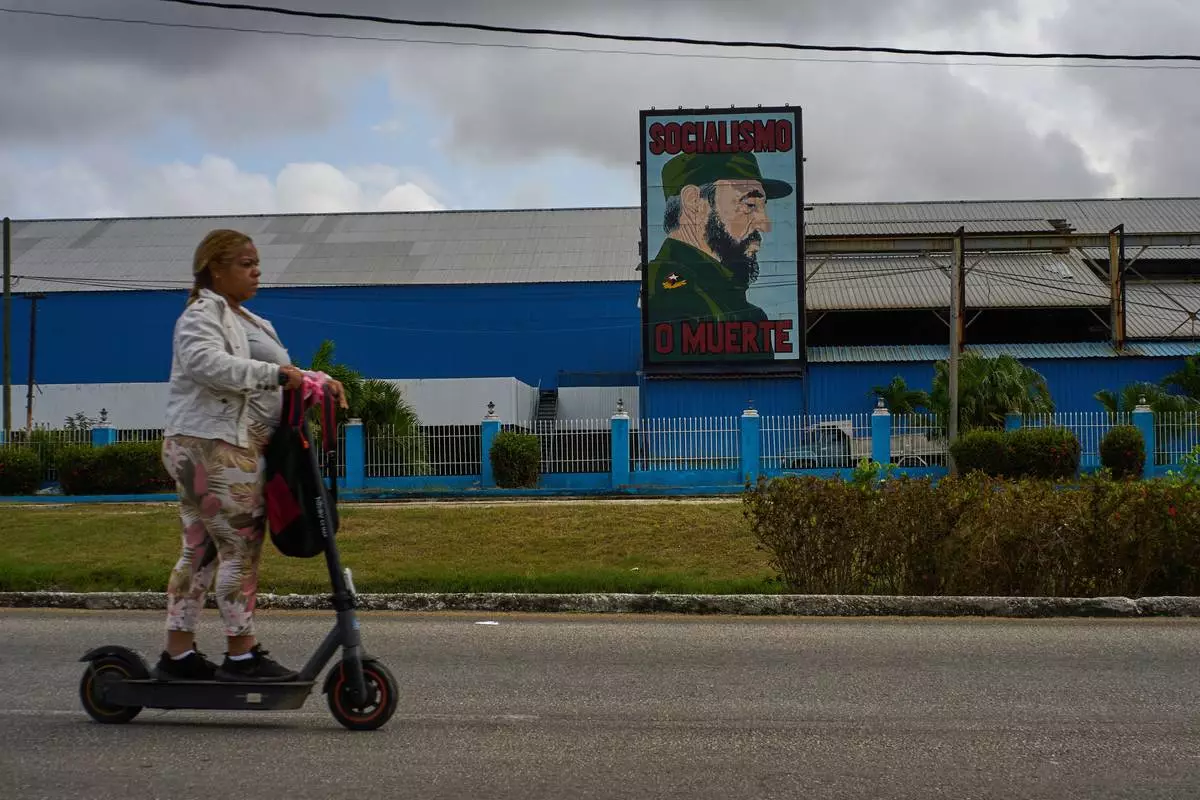
A woman rides an electric scooter past a factory displaying an image depicting the late Cuban leader Fidel Castro, bearing the words "Socialism or Death", in Havana, Cuba, Thursday, March 19, 2026. (AP Photo/Ramon Espinosa)