Skip to Content Facebook Feature Image

A look at how Trump-era work requirements could impact people who receive public benefits

News

A look at how Trump-era work requirements could impact people who receive public benefits
News

News

A look at how Trump-era work requirements could impact people who receive public benefits

2025-12-30 01:07 Last Updated At:01:10

The Trump administration made work requirements for low-income people receiving government assistance a priority in 2025.

The departments of Health and Human Services, Agriculture and Housing and Urban Development have worked to usher in stricter employment conditions to receive health care, food aid and rental assistance benefits funded by the federal government.

The idea is that public assistance discourages optimal participation in the labor market and that imposing work requirements not only leads to self-sufficiency, but also benefits the broader economy.

“It strengthens families and communities as it gives new life to start-ups and growing businesses,” the cabinet secretaries wrote in a New York Times essay in May about work requirements.

Yet many economists say there is no clear evidence such mandates have that effect. There’s concern these new policies that make benefits contingent on work could ultimately come at a cost in other ways, from hindering existing employment to heavy administrative burdens or simply proving unpopular politically.

Here is a look at how work requirements could impact the millions of people who rely on the Supplemental Nutrition Assistance Program, Medicaid and HUD-subsidized housing:

President Donald Trump’s “One Big Beautiful Bill” in July expanded the USDA’s work requirements policy for SNAP recipients who are able-bodied adults without dependents.

Previously, adults older than 54, as well as parents with children under age 18, at home were exempted from SNAP’s 80-hours monthly work requirement. Now, adults up to age 64 and parents of children between the age of 14 and 17 have to prove they’re working, volunteering or job training if they are on SNAP for more than three months.

The new law also cuts exemptions for people who are homeless, veterans and young people who have aged out of foster care. There are also significant restrictions on waivers for states and regions based on how high the local unemployment rates are.

The Pew Research Center, citing the most recent Census survey data from 2023, notes 61% of adult SNAP recipients had not been employed that year, and that the national average benefit as of May 2025 was $188.45 per person or $350.89 per household.

Ismael Cid Martinez, an economist at the Economic Policy Institute, said the people who qualify for SNAP are likely working low-wage jobs that tend to be less stable because they are more tied to the nation’s macroeconomics. That means when the economy weakens, it’s the low-wage workers whose hours are cut and jobs are eliminated, which in turn heightens their need for government support. Restricting such benefits could threaten their ability to get back to work altogether, Martinez said.

“These are some of the matters that tie in together to explain the economy and (how) the labor market is connected to these benefits,” Martinez said. “None of us really show up into an economy on our own.”

Angela Rachidi, a researcher at the conservative think tank American Enterprise Institute, said she expects the poverty rate to decline as a result of the work requirements but even that wouldn't ultimately affect the labor force.

“(E)ven if every nonworking SNAP adult subject to a work requirement started working, it would not impact the labor market much,” Rachidi said by email.

Trump’s big bill over the summer also created new requirements, starting in 2027, for low-income 19- to 64-year-olds enrolled in Medicaid through the Affordable Care Act’s Medicaid expansion or through a waiver program to complete 80 hours of work, job training, education or volunteering per month. There are several exemptions, including for those who are caregivers, have disabilities, have recently left prison or jail or are pregnant or postpartum.

The nonpartisan Congressional Budget Office has predicted that millions of people will lose health care because of the requirements.

Nationally, most people on Medicaid already work. The majority of experts on a Cornell Health Policy Center panel said that new national requirements won’t lead to large increases in employment rates among working adults on Medicaid, and that many working people would lose health care because of administrative difficulties proving they work.

Georgia is currently the only state with a Medicaid program that imposes work requirements, which Gov. Brian Kemp created instead of expanding Medicaid. The program, called Georgia Pathways, has come under fire for enrolling far fewer people than expected and creating large administrative costs.

Critics say many working people struggle to enroll and log their hours online, with some getting kicked out of coverage at times because of administrative errors.

And research released recently from the United Kingdom-based research group BMJ comparing Georgia with other states that did not expand Medicaid found Georgia Pathways did not increase employment during the first 15 months, nor did it improve access to Medicaid.

Kemp's office blames high administrative costs and startup challenges on delays due to legal battles with former President Joe Biden’s administration. A spokesperson said 19,383 Georgians have received coverage since the program began.

HUD in July also proposed a rule change that would allow public housing authorities across the country to institute work requirements, as well as time limits.

In a leaked draft of that rule change, HUD spells out how housing authorities can choose to opt in and voluntarily implement work requirements of up to 40 hours a week for people getting rental assistance, including adult tenants in public housing and Section 8 voucher-holders.

HUD also identified two states — Arkansas and Wisconsin — where it could trigger implementation based on existing state laws if and when the HUD rule change is approved. The proposal remains in regulatory review and would be subject to a public comment period.

HUD spokesman Matthew Maley declined to comment on the leaked documents, which broadly define the age of work-eligible people being up to age 61, with exemptions for people with disabilities and those who are in school or are pregnant. Primary caregivers of disabled people and children under 6 years old are also exempted.

HUD’s proposed rule change also notes that it is only defining the upper limits of the policy, allowing flexibility for local agencies to further define their individual programs with additional exemptions.

In a review of how housing authorities have tested work requirements over time, researchers at New York University found few successful examples, noting only one case where there were modest increases in employment — in Charlotte, North Carolina — as compared to seven other regions where work requirements were changed or discontinued “because they were deemed punitive or hard to administer.”
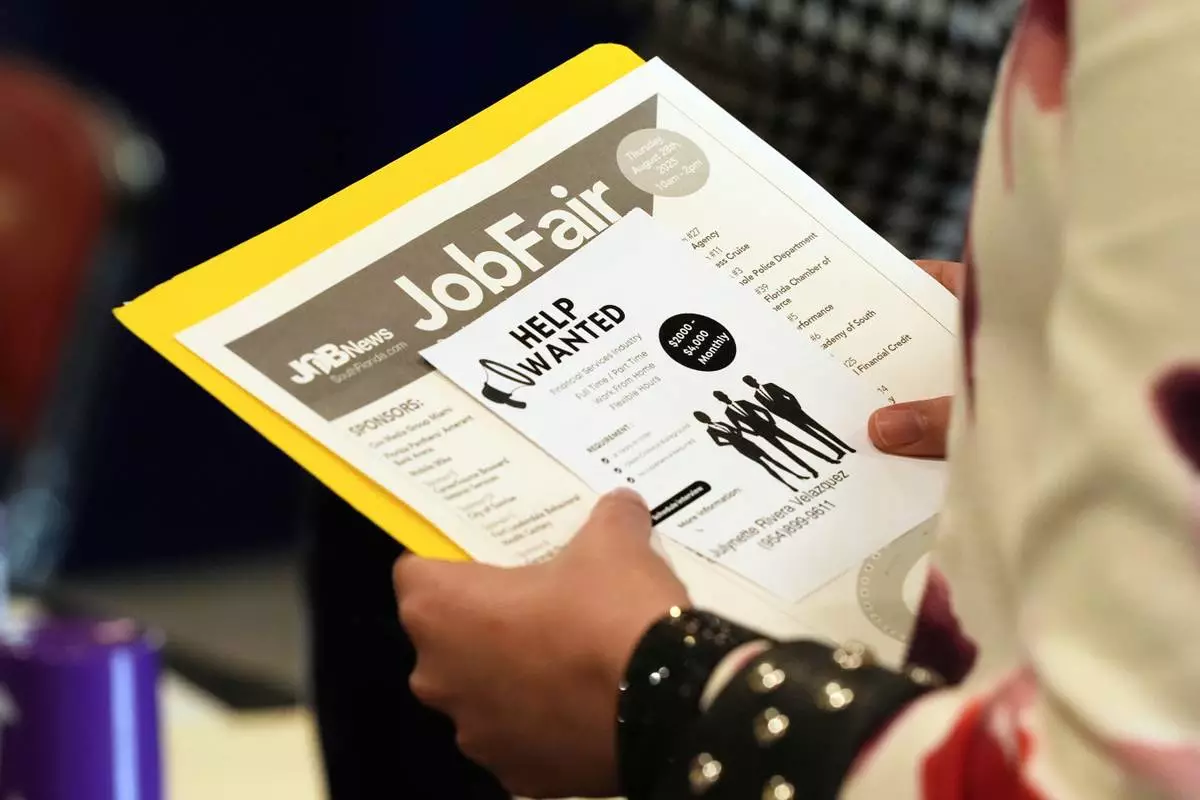
FILE - A job seeker waits to talk to a recruiter at a job fair Aug. 28, 2025, in Sunrise, Fla. (AP Photo/Marta Lavandier, File)


FILE - A job seeker waits to talk to a recruiter at a job fair Aug. 28, 2025, in Sunrise, Fla. (AP Photo/Marta Lavandier, File)

NEW YORK (AP) — Find inspiration for achieving your financial resolutions and money goals in 2026

The start of a new year usually brings new motivation to achieve goals like eating healthier or finally cleaning your basement. Many resolutions also focus on financial goals, such as paying off credit card debt, saving for a new house, or simply getting more educated about money.

“New Year’s is a really good time to review and realign your financial goals overall,” said Erica Grundza, certified financial planner at Betterment, an investing and savings app.

When building your goals for 2026, Grundza recommends focusing less on the past and more on an optimistic, yet realistic, vision for the future. She recommends that you focus on reestablishing the “why” behind your approach to money and how you want to make it work for your life. This can be as simple as saving $10 each week in a savings account, or a bigger goal like saving to buy a house in the coming years. It’s all about your own journey.

The Associated Press spoke with people who are making financial resolutions for 2026. Here’s a look at what they’re planning and how you can draw inspiration for your own resolutions:

Resolutions can easily turn into unattainable goals that feel more like a dream, said MarieYolaine Toms, a coach and founder of Focused Fire, a financial coaching company. To avoid setting unrealistic expectations, Toms follows a “no resolutions” mindset and instead focuses on making an actionable plan.

“What I say every year is that I am not making resolutions, I’m making plans that can be tracked forward, traced back, and tweaked until completion,” Toms said.

Recently, Toms encouraged her clients to check their credit report with the three credit bureaus and, based on their credit reports, make an attainable plan to start a savings account. For example, adding $25 to their savings account every week.

Whether you’re trying to pay off debt or save for a vacation abroad, the first step towards making a plan can be creating a budget. When making a budget, it’s best to find a technique that works for you, whether it’s the classic 50/30/20 plan or another budgeting style.

If you’re building a budget for the first time, you can find some expert recommendations here.

After losing her job as a magazine editor in September, Rachel Pelovitz, 33, had to take a closer look at her finances. Having acquired a significant amount of debt over the last few years due to her husband’s year-and-a-half-long unemployment, Pelovitz explored several options to pay it off. Ultimately, Pelovitz and her husband chose to sell their house and work with a debt consolidation organization.

“Rather than rely on getting more debt, we are currently selling our house,” Pelovitz said.

Pelovitz’s main goal for 2026 is to pay off half of her credit card debt. And, with some of the money from selling the house, start investing moderately.

If you’ve also experienced a layoff, you can read expert recommendations to help you take care of your finances and your mental health here.

For Jenni Lee, 27, this is going to be the year when she gets strict about building her savings account. While Lee considers herself generally good with money, over the last six months she has overspent and wants to rein it in. The long-term goal for her savings journey is for Lee to buy a house.

“I’m now in my late 20s, I’m starting to really think about where I pinch now so it won’t hurt later when I finally decide to purchase and own a place,” said Lee, a tech worker and lifestyle TikTok creator based in Chicago.

As she saves for her future home and possibly a trip to South Korea, Lee wants to cut unnecessary spending on clothing items and eating out.

Social media microtrends are a common influence on people’s shopping decisions, and this can lead to overspending. If you’re looking to avoid spending money on microtrends, you can find experts’ recommendations here.

If you are in a position to do so, having multiple financial goals you’re working towards at the same time can be a great way to speed up your progress. For Worcester resident Melanie Duarte, 23, her New Year’s money goals include paying off her student loans and credit card debt while building an emergency fund.

“I made sure to include it in my budget, even if it’s something as small as like $50. I just want to make sure I still put something in (my emergency fund) so that it eventually multiplies,” said Duarte, who owns a marketing agency.

Duarte’s family didn’t speak openly about finances when she was growing up. But, since she opened her own business, Duarte has been slowly working on rewriting her relationship with money.

If you’re looking to start an emergency fund or create better habits while you save, you can read some experts’ recommendations here.

Finding a balance between saving for your long-term goals while also making sure you enjoy your money is important, but it can also be challenging. After the death of her grandfather just a few years after retirement, Tiana Stewart, 26, felt that he didn’t get to enjoy the fruits of his labor. So, this past year, Stewart decided to enjoy her life and travel.

“I do understand saving for retirement is important, but I also want to enjoy my life and the money that I work for at this time, especially being in my 20s,” said Stewart, who lives in Maryland.

But now, as she reflects on her financial future, Stewart wants to focus on paying off debt, saving, and investing. Having a healthy balance between enjoying life and saving for the future is what she wants to work toward.

For some, participating in budgeting challenges such as the no-buy year can be a great way to set boundaries on your spending and set aside money towards your financial goals. Many people start such challenges at the beginning of the year and commit to keep going until the end, but others start with a no-buy month.

__

The Associated Press receives support from Charles Schwab Foundation for educational and explanatory reporting to improve financial literacy. The independent foundation is separate from Charles Schwab and Co. Inc. The AP is solely responsible for its journalism.

FILE - A canning jar filled with money sits on a shelf in East Derry, N.H., June 15, 2018. (AP Photo/Charles Krupa, File)

FILE - A canning jar filled with money sits on a shelf in East Derry, N.H., June 15, 2018. (AP Photo/Charles Krupa, File)

Recommended Articles