DUBAI, United Arab Emirates (AP) — Saudi Arabia bombed Yemen's port city of Mukalla on Tuesday over what it described as a shipment of weapons for a separatist force there that arrived from the United Arab Emirates. The kingdom later directly linked the UAE to the separatists' recent advances in Yemen and warned Abu Dhabi its actions were “extremely dangerous.”
The attack signals a new escalation in tensions between the kingdom and the separatist forces of the Southern Transitional Council, which is backed by the Emirates.
It also further strains ties between Riyadh and Abu Dhabi, which had been backing competing sides in Yemen’s decadelong war against the Iranian-backed Houthi rebels amid a moment of unease across the wider Red Sea region. The two nations, while closely aligned on many issues in the wider Mideast, increasingly have competed with each other over economic issues and the region's politics.
Yemen’s anti-Houthi forces later declared a state of emergency Tuesday, ending its cooperation with the UAE and ordering all Emirati forces within its territory to evacuate within 24 hours. It issued a 72-hour ban on all border crossings in territory they hold, as well as entries to airports and seaports, except those allowed by Saudi Arabia.
A military statement carried by the state-run Saudi Press Agency announced the strikes, which it said came after ships arrived there from Fujairah, a port city on the UAE’s eastern coast.
“The ships’ crew had the disabled tracking devices aboard the vessels, and unloaded a large amount of weapons and combat vehicles in support of the Southern Transitional Council’s forces,” it said.
“Considering that the aforementioned weapons constitute an imminent threat, and an escalation that threatens peace and stability, the Coalition Air Force has conducted this morning a limited airstrike that targeted weapons and military vehicles offloaded from the two vessels in Mukalla,” it added.
It wasn't immediately clear if there were any casualties from the strike or if any other military besides Saudi Arabia's took part. The Saudi military said it conducted the attack overnight to make sure “no collateral damage occurred.”
The UAE did not immediately respond to a request for comment from the AP. Abu Dhabi's English-language state-linked newspaper The National reported on the strike.
The Council's AIC satellite news channel acknowledged the strikes, without offering details.
The attack likely targeted a ship identified by analysts as the Greenland, a roll-on, roll-off vessel flagged out of St. Kitts. Tracking data analyzed by the AP showed the vessel had been in Fujairah on Dec. 22 and arrived in Mukalla on Sunday. The second vessel could not be immediately identified.
Mohammed al-Basha, a Yemen expert and the founder of the Basha Report, a risk advisory firm, cited social media videos which purported to show new armored vehicles rolling through Mukalla after the ship's arrival. The ship's owners, based in Dubai, could not be immediately reached.
“I expect a calibrated escalation from both sides. The UAE-backed Southern Transitional Council is likely to respond by consolidating control,” al-Basha said. “At the same time, the flow of weapons from the UAE to the STC is set to be curtailed following the port attack, particularly as Saudi Arabia controls the airspace.”
Footage later aired by Saudi state television, which appeared to be filmed by a surveillance aircraft, purportedly showed the armored vehicles moving through Mukalla to a staging area. The types of vehicles corresponded to the social media footage.
Mukalla is in Yemen's Hadramout governorate, which the Council had seized in recent days. The port city is some 480 kilometers (300 miles) northeast of Aden, which has been the seat of power for anti-Houthi forces in Yemen after the rebels seized the capital, Sanaa, back in 2014.
The strike in Mukalla comes after Saudi Arabia targeted the Council in airstrikes Friday that analysts described as a warning for the separatists to halt their advance and leave the governorates of Hadramout and Mahra.
The Council had pushed out forces there affiliated with the Saudi-backed National Shield Forces, another group in the coalition fighting the Houthis.
Those aligned with the Council have increasingly flown the flag of South Yemen, which was a separate country from 1967-1990. Demonstrators have been rallying for days to support political forces calling for South Yemen to secede again from Yemen.
The actions by the separatists have put pressure on the relationship between Saudi Arabia and the UAE, which maintain close relations and are members of the OPEC oil cartel, but also have competed for influence and international business in recent years.
There has also been an escalation of violence in Sudan, another nation on the Red Sea, where the kingdom and the Emirates support opposing forces in that country’s ongoing war.
A statement Tuesday from Saudi Arabia's Foreign Ministry directly linked the Council's advance to the Emiratis for the first time.
“The kingdom notes that the steps taken by the sisterly United Arab Emirates are extremely dangerous,” it said.
Meanwhile, Israel has acknowledged Somalia’s breakaway region of Somaliland as an independent nation, the first to do so in over 30 years. That's sparked concern from the Houthis, who have threatened to attack any Israeli presence in Somaliland.

This frame grab from video broadcast by Saudi state television on Tuesday, Dec. 30, 2025, shows what the kingdom describes as a shipment of weapons and armored vehicles coming from the United Arab Emirates, at Mukalla, Yemen. (Saudi state television via AP)
DHAKA, Bangladesh (AP) — Former Bangladeshi Prime Minister Khaleda Zia, whose archrivalry with another former premier defined the country’s politics for a generation, has died, her Bangladesh Nationalist Party said in a statement Tuesday. She was 80.
Zia was the first woman elected prime minister of Bangladesh.
Bangladesh's interim government announced a three-day mourning period. A general holiday also was announced for Wednesday when Zia’s funeral prayers are scheduled be held in front of the country's national Parliament building in Dhaka.
Indian Prime Minister Narendra Modi offered condolences in a statement Tuesday, noting that “as the first woman Prime Minister of Bangladesh, her important contributions toward the development of Bangladesh, as well as India-Bangladesh relations, will always be remembered.”
Sajeeb Wazed, son of former Bangladesh Prime Minister Sheikh Hasina, said in a statement Tuesday that Zia’s demise “will leave a deep impact on the country’s (democratic) transition.”
“She will be remembered for her contributions in nation building but her death is a blow to stabilize Bangladesh,” said Wazed, whose mother was Zia’s greatest political rival.
Zia had faced corruption cases she said were politically motivated, but in January 2025 the Supreme Court acquitted Zia in the last corruption case against her, which would have let her run in February’s general election.
The BNP said that after she was released from prison due to illness in 2020, her family sought permission for treatment abroad at least 18 times from Hasina's administration, but the requests were rejected.
Following Hasina’s ouster in 2024, an interim government headed by Nobel Peace Prize laureate Muhammad Yunus finally allowed her to go. She went to London in January and returned to Bangladesh in May.
Bangladesh’s early years of independence, gained in a bloody 1971 war against Pakistan, were marked by assassinations, coups and countercoups as military figures and secular and Islamic leaders jockeyed for power.
Zia’s husband, President Ziaur Rahman, had grabbed power as a military chief in 1977 and a year later formed the Bangladesh Nationalist Party. He was credited with opening democracy in the country, but he was killed in a 1981 military coup. Zia’s uncompromising stance against the military dictatorship helped build a mass movement against it, culminating with the ousting of dictator and former army chief H.M. Ershad in 1990.
Zia’s opponent when she won her first term in 1991 and in several elections after that was Hasina, the daughter of independence leader Sheikh Mujibur Rahman, who was assassinated in a 1975 coup.
Zia was criticized over an early 1996 election in which her party won 278 of the 300 parliamentary seats during a wide boycott by other leading parties including Hasina’s Awami League, which demanded an election-time caretaker government. Zia’s government lasted only 12 days before a nonpartisan caretaker government was installed and the new election was held that June.
Zia returned to power in 2001 in a government shared with the country’s main Islamist party, Jamaat-e-Islami, which had a dark past involving Bangladesh’s independence war.
Zia’s Bangladesh Nationalist Party was previously closely allied with the party, and her government maintained the confidence of the business community by following pro-investment, open market policies. Zia was known to have a soft spot for Pakistan and used to deliver anti-Indian political speeches. India alleged insurgents were allowed to use Bangladesh’s soil to destabilize India’s northeastern states under Zia, especially during her term from 2001-2006.
During that term, Zia was also tainted by allegations that her elder son, Tarique Rahman, was running a parallel government and was involved in widespread corruption.
In 2004, Hasina blamed Zia’s government and Rahman for grenade attacks in Dhaka that killed 24 members of her Awami League party and wounded hundreds of people. Hasina narrowly escaped the attack, which she characterized as an assassination attempt, and subsequently won the 2008 general election.
Zia’s party and its partners boycotted the 2014 election in a dispute over a caretaker government, giving a one-sided victory to the increasingly authoritarian regime of Hasina. Her party joined the national elections in 2018 but boycotted again in 2024, allowing Hasina to return to power for a fourth consecutive time through controversial elections.
Zia was sentenced to 17 years in jail in two separate corruption cases for misuse of power in embezzling funds meant for a charity named after her late husband. Her party said the charges were politically motivated to weaken the opposition, but the Hasina government said it did not interfere and the case was a matter for the courts.
Hasina was bitterly criticized by both her opponents and independent critics for sending Zia to jail.
Zia was released from jail by Hasina’s government in 2020 and was moved to a rented home, from where she regularly visited a private hospital. Her family repeatedly requested Hasina’s administration to allow Zia to travel abroad for medical treatment, but was refused.
After 15 years in power, Hasina was ousted in a mass uprising in August 2024 and fled the country. Zia was given permission to travel abroad by an interim government led by Nobel Peace Prize laureate Muhammad Yunus.
Zia was silent about politics for years and did not attend political rallies, but she remained the BNP chairperson until her death. Rahman has been the party’s acting chair since 2018.
She was last seen at an annual function of the Bangladesh military in Dhaka Cantonment on Nov. 21, when Yunus and other political leaders met her. She was in a wheelchair and appeared pale and tired.
She is survived by Rahman, her elder son and heir apparent in the political dynasty. Her younger son, Arafat, died in 2015.
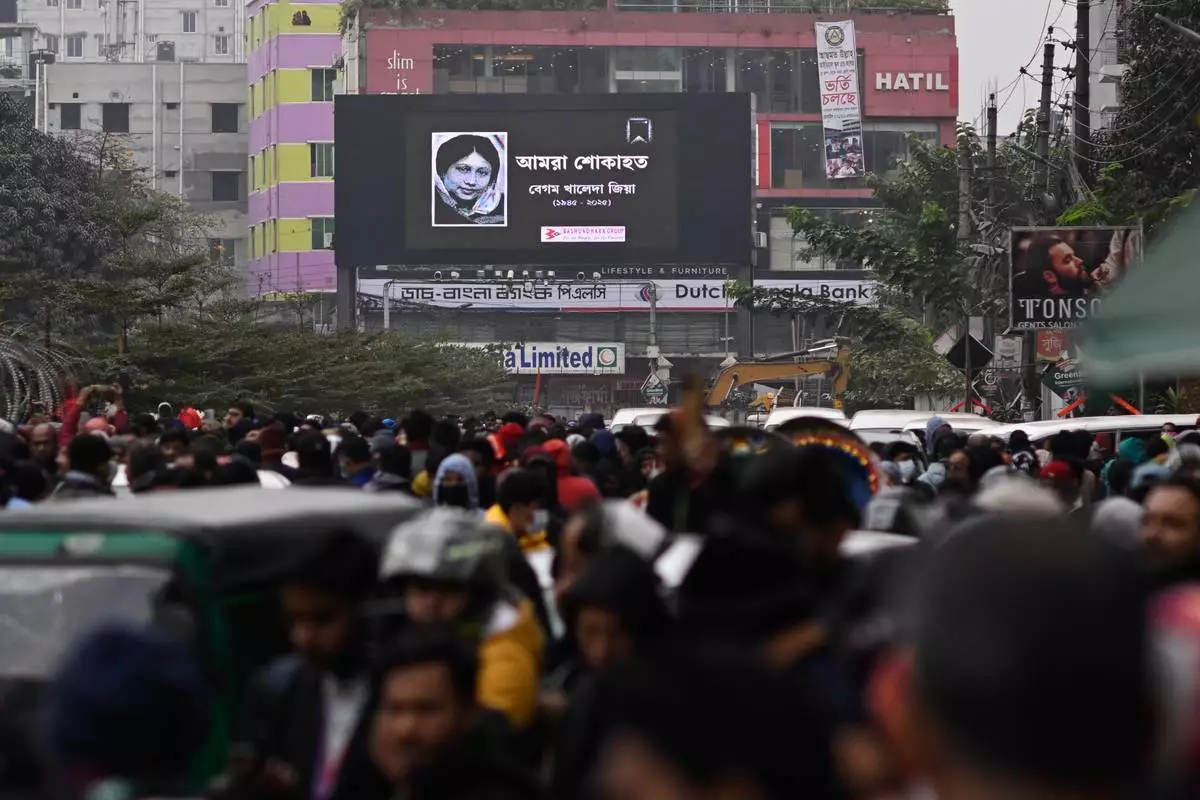
A portrait of former Bangladeshi Prime Minister Khaleda Zia is displayed on a digital screen near the hospital where she died, in Dhaka, Bangladesh, Monday, Dec. 30, 2025. (AP Photo/Mahmud Hossain Opu)
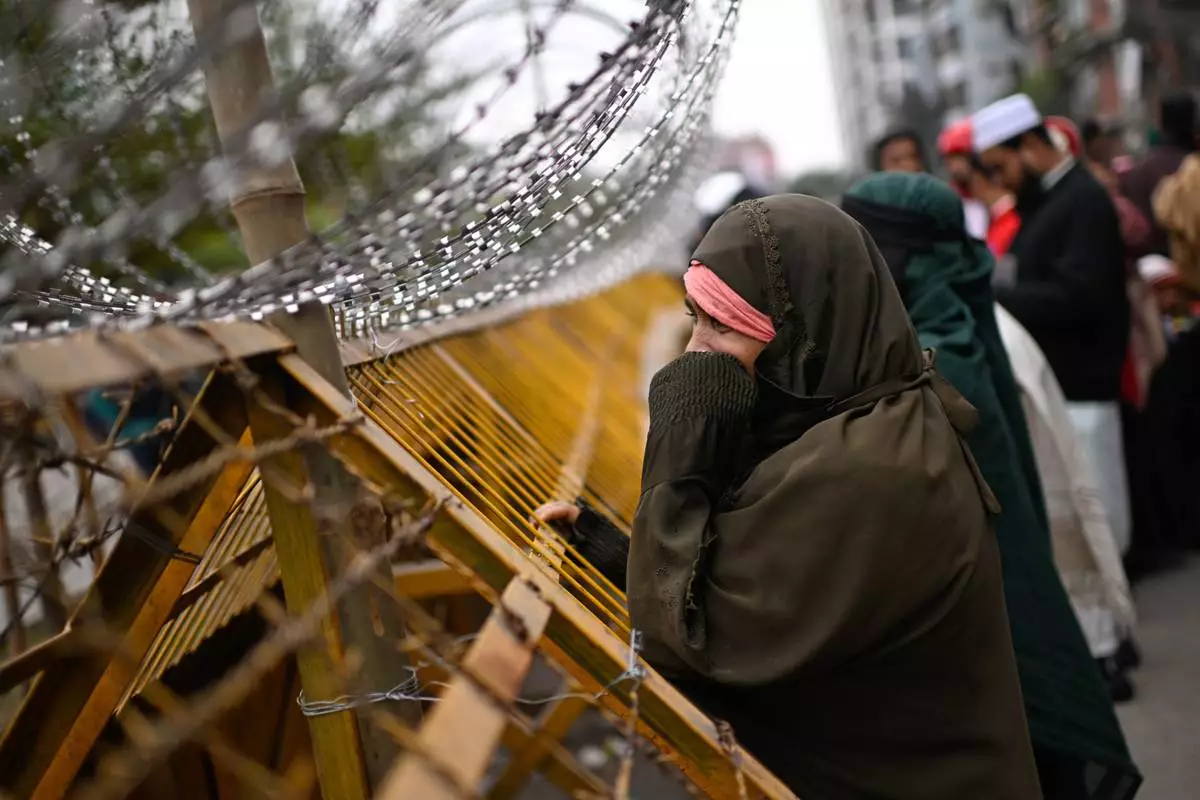
A woman reacts while waiting behind barricades outside the hospital where former Bangladeshi Prime Minister Khaleda Zia died, in Dhaka, Bangladesh, Monday, Dec. 30, 2025. (AP Photo/Mahmud Hossain Opu)
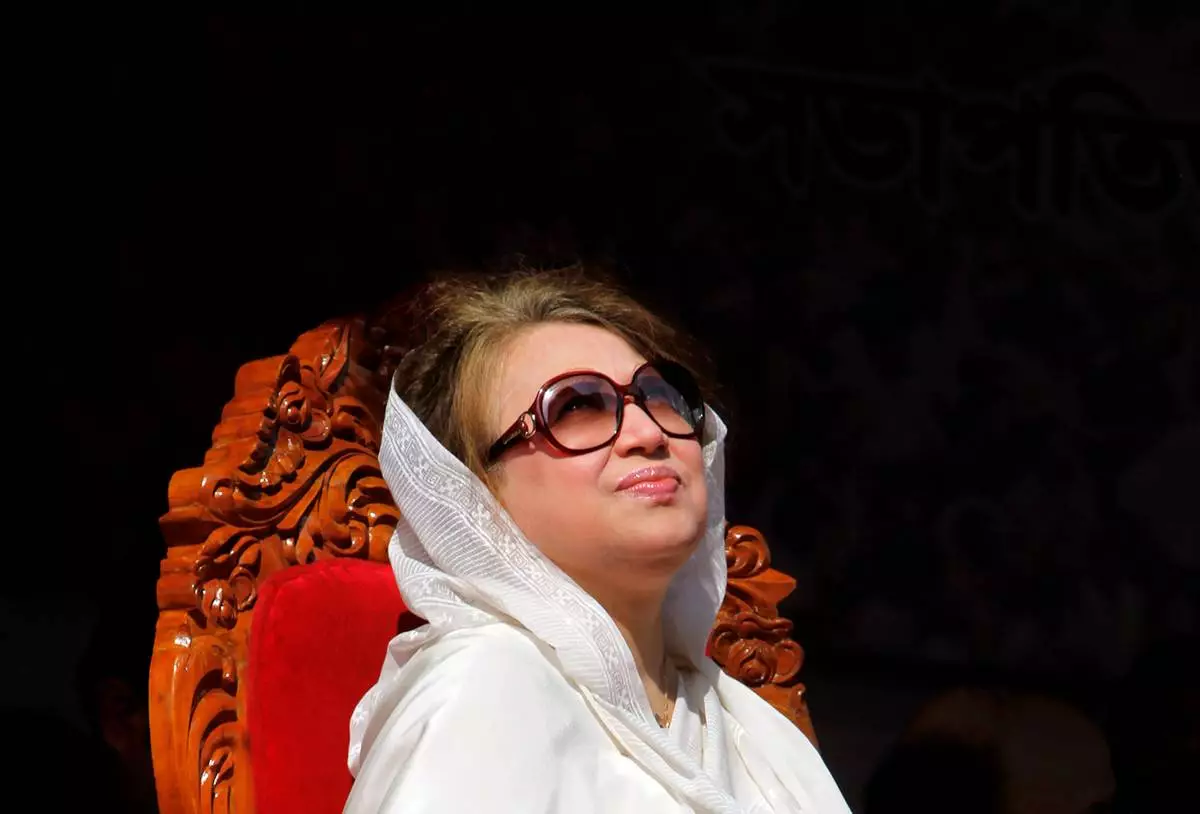
FILE - Bangladesh's main opposition Bangladesh Nationalist Party chief and former Prime Minister Khaleda Zia looks upwards as she attends a rally of her supporters outside their party headquarters in Dhaka, Bangladesh, Monday, March 12, 2012. (AP Photo/Aijaz Rahi, File)
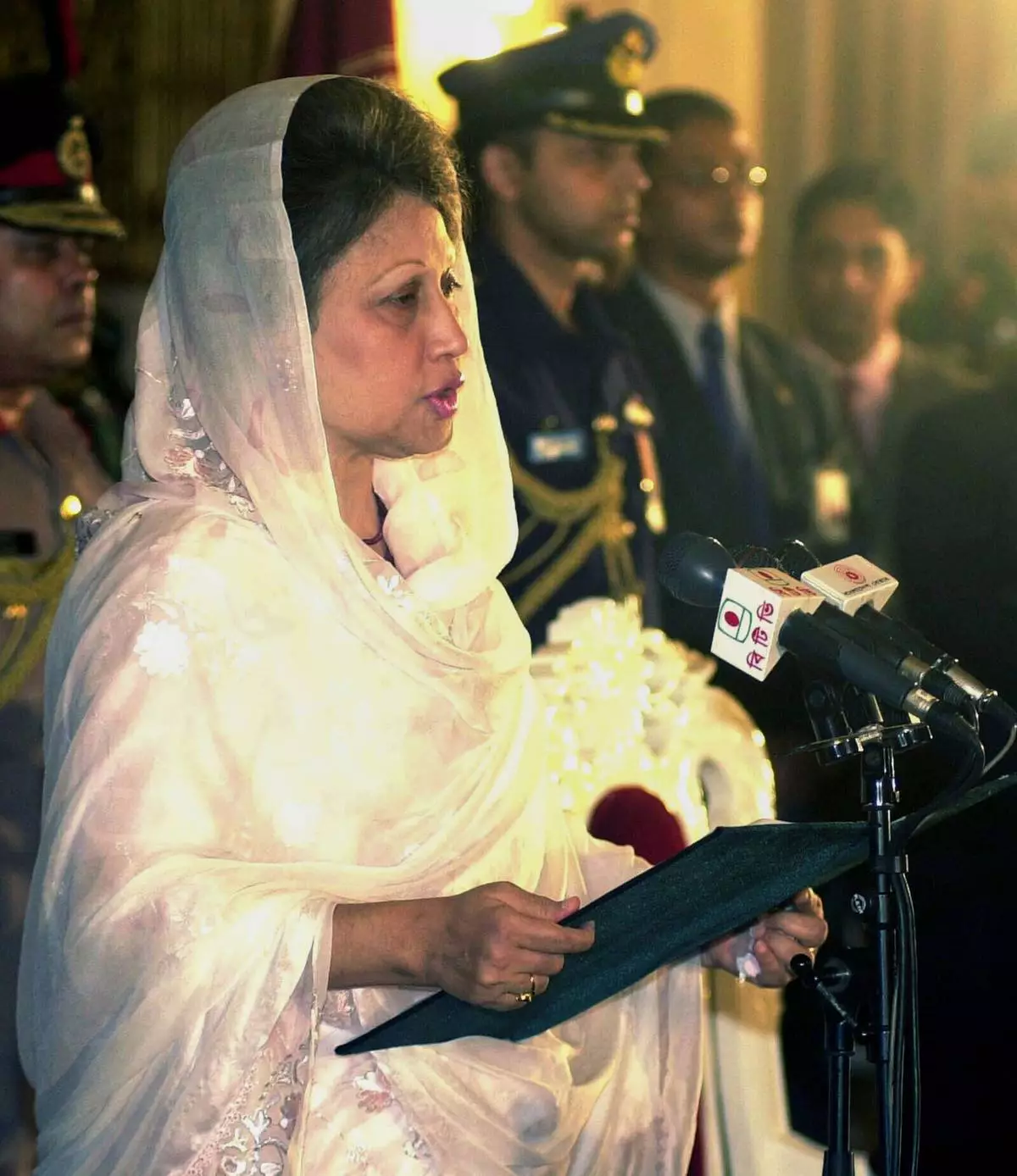
FILE - Khaleda Zia takes an oath of office as the prime minister in Dhaka, Bangladesh, Oct. 10, 2001. (AP Photo/Pavel Rahman, File)

FILE - Bangladesh's former prime minister and Bangladesh Nationalist Party leader Khaleda Zia, center, leaves court after a hearing in Dhaka, Bangladesh, Aug. 10, 2016. (AP Photo, File)

FILE - Bangladesh's ailing former Prime Minister Khaleda Zia leaves the airport in a car after arriving from London, May 6, 2025, in Dhaka, Bangladesh. (AP Photo/Mahud Hossain Opu, File)
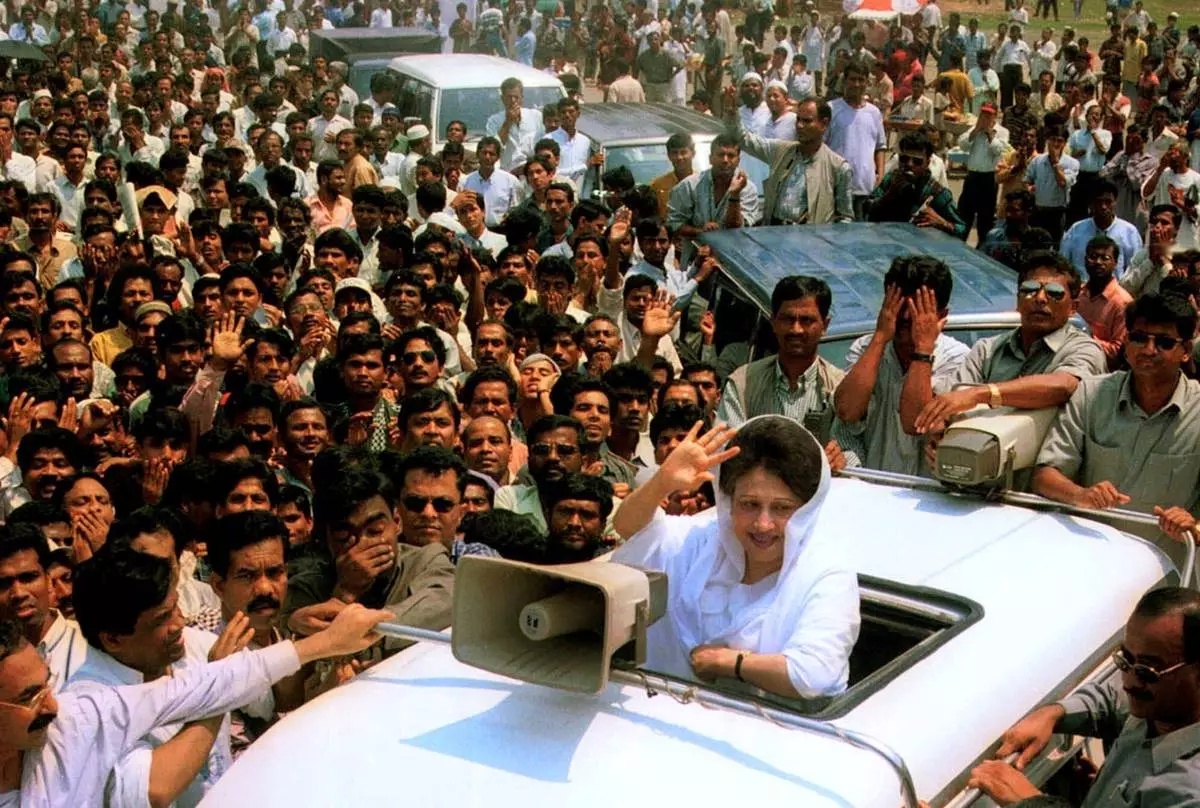
FILE - Khaleda Zia, Bangladeshi opposition leader and former prime minister, waves at the start of a 400-kilometer protest march from Dhaka to the northern village of Dinajpur, May 16, 1999. (AP Photo/Pavel Rahman, File)

FILE - Former Bangladesh Prime Minister Khaleda Zia waves to supporters after she was arrested, in Dhaka, Bangladesh, Sept. 3, 2007. (AP Photo/Pavel Rahman, File)