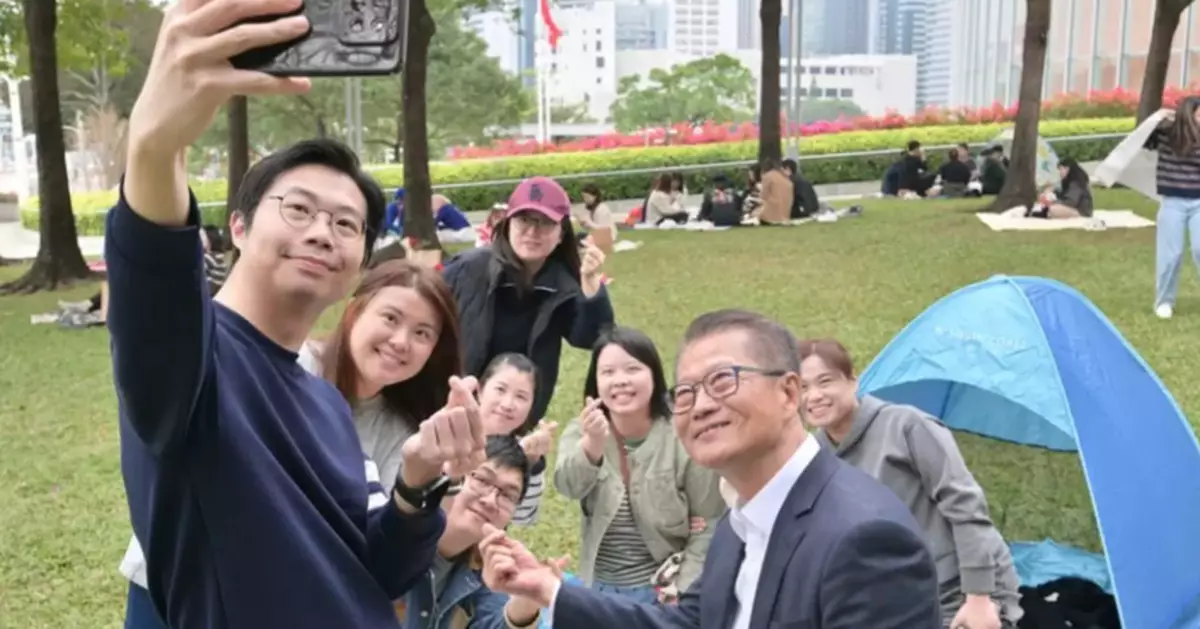
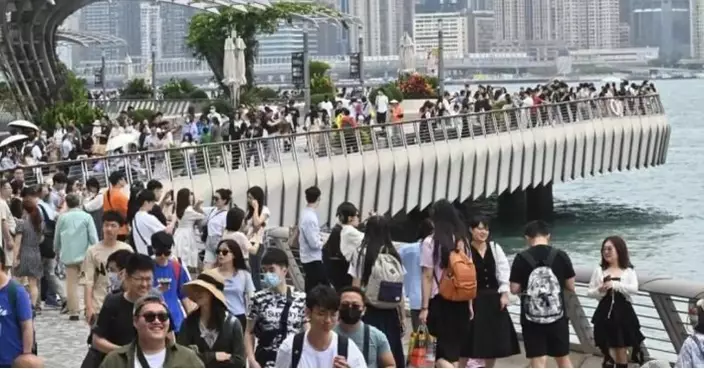
Mr Paul Chan, the Financial Secretary, stated in his blog that, tracing back to 2025, despite the uncertain external circumstances, the development of the local asset market has further improved, with a continuous inflow of funds, an increased number of visitors to Hong Kong, a fine manifestation of total exports and fixed capital investment, and stabilized local consumption. It's estimated that Hong Kong's economic growth will accelerate to 3.2% in 2026, the third consecutive year that the local economy has maintained a growth momentum. The good performance in exports and investment is the main driving force for boosting the economy. The simultaneous rise in both the price and transaction volume of the stock and property markets has consolidated the positive expectations of the market.

Photo source: FB of Paul Chan
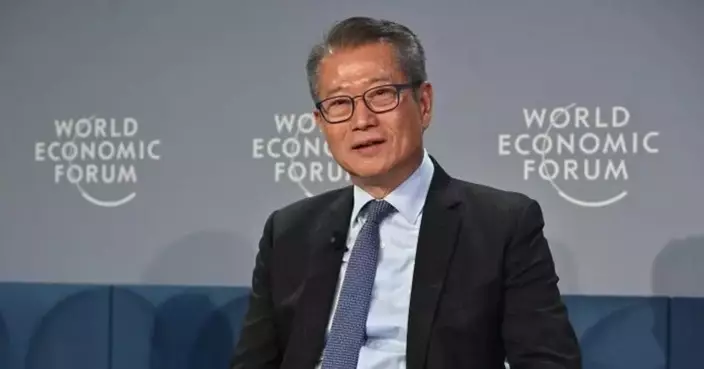
Looking forward to 2026, Mr Paul Chan said that although new challenges would be inevitable, greater new development opportunities would also arise. He said that Hong Kong's economy is expected to maintain a good momentum, better integrate into the country's development continuously, and create more high-quality positions for the public. The market generally expects that the global economy can still maintain a moderate expansion even in the face of slowing growth impetus. As for the main growth engines in the next year, he expected the Chinese Mainland and Asia as a whole would be the key drivers, continuing to provide important support for Hong Kong's economy. Moreover, the cut of interest rate generally expected by the market would be beneficial to the development of local business and investment atmosphere.
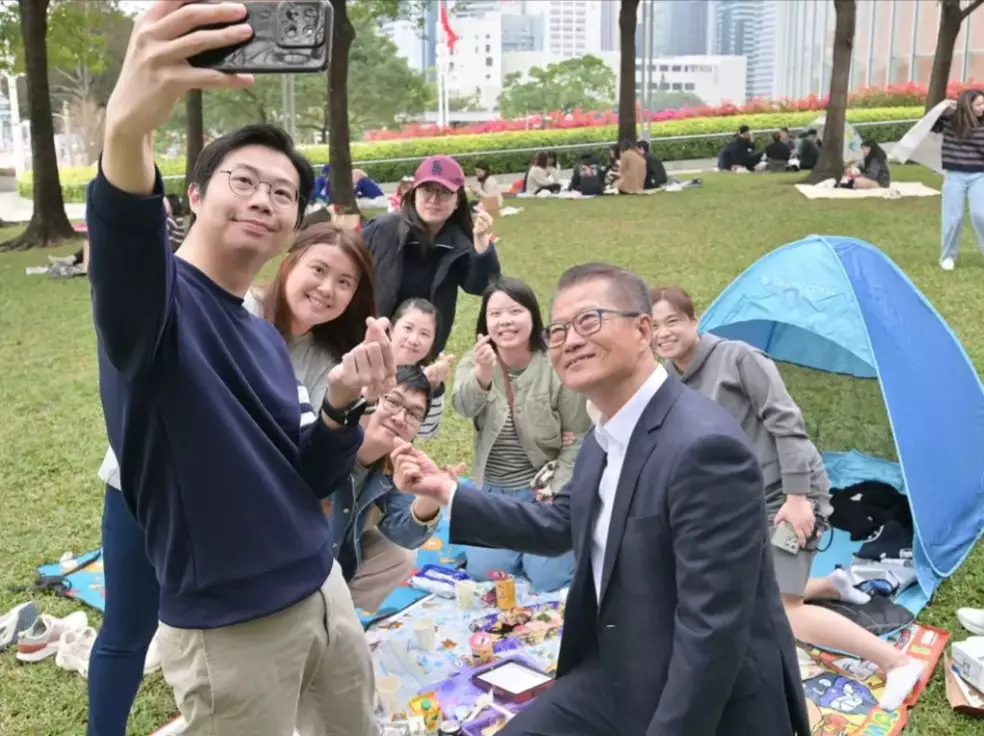
Photo source: FB of Paul Chan
He said that the government would remain highly vigilant, preventing all kinds of "black swan" and "gray rhino" situations in the volatile external environment as well as balancing the two main axes of "security" and "development" to ensure that Hong Kong can continue to develop steadily in both society and economy next year.

Photo source: FB of Paul Chan
Mr Paul Chan also stated that since 2026 is the opening year of China's 15th Five-Year Plan, Hong Kong will be more proactive in aligning with national development strategies. Finance, innovation & technology, and trade will be the three key development engines for Hong Kong. Meanwhile, Hong Kong is accelerating the cultivation of artificial intelligence as a local core industry and empowering the upgrading and transformation of traditional industries with the "AI+" strategy. The development of the AI industry in Hong Kong will be promoted from six aspects: computing power, algorithms, data, application development, financial support, and talent cultivation. He said that Hong Kong will continue to play its role as a "super connector" and a "super value-adder" in the face of the new international economic and trade pattern and the reshaping of industrial and supply chains.
Hong Kong has overtaken Switzerland as the world's top cross-boundary wealth management centre, according to the latest Global Wealth Report 2026 published by the Boston Consulting Group. Industry professionals, academics, and researchers believe Hong Kong is pulling away from Switzerland and is likely to maintain its top position. They suggest authorities should actively expand the range of investment products, such as RMB-denominated and Islamic financial products, and strengthen external ties, including exploring Central Asian markets.
The latest Global Wealth Report 2026 published by the Boston Consulting Group
In 2025, Hong Kong managed US$2.95 trillion in cross-border wealth, ranking first in the world for the first time, slightly higher than Switzerland's US$2.94 trillion. Though the margin between Hong Kong and Switzerland is slim in 2025, according to estimates by the Boston Consulting Group, the gap between the two is widening. The Boston Consulting Group estimates that by 2030, Hong Kong will manage US$4.6 trillion in cross-border wealth, while Switzerland will manage US$4 trillion.
Hong Kong's cross-border wealth management scale increased by US$284 billion in 2025, a growth of 10.7%, while Switzerland's increased by US$207 billion, a growth of 7.6%.
The report by the Boston Consulting Group indicates that from 2025 to 2030, Hong Kong's cross-border wealth management scale will grow at a compound annual growth rate of 9%, while Switzerland's will be 6%.
Singapore, ranking third, achieved cross-border wealth management scale of US$2.1 trillion in 2025, an increase of US$196 billion or 10.3%. The Boston Consulting Group estimates that by 2030, Singapore's cross-border wealth management scale will reach US$3.3 trillion.
The U.S. and the U.K. rank fourth and fifth, respectively, with cross-border wealth management scales of US$1.6 trillion and US$1 trillion in 2025. The Boston Consulting Group estimates that the scales will reach US$2.1 trillion and US$1.3 trillion respectively by 2030.
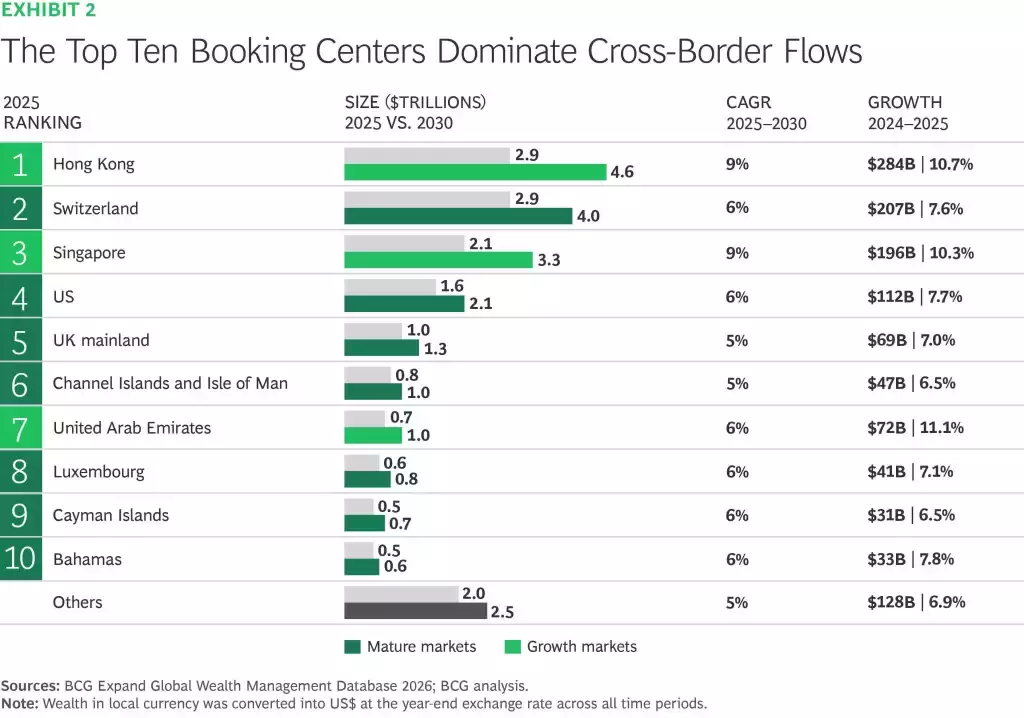
The top ten booking centers dominate cross-border flows shown in the report
Prof. Billy Mak, Associate Professor of Accountancy, Economics and Finance at Hong Kong Baptist University's School of Business, said in an interview with Bastille Post that, unless a black swan event occurs, Hong Kong is increasingly pulling away from Switzerland at its current pace. Switzerland also has a significant gap over the third-ranked country, he noted. For any lower-ranked competitor to rise to the top, its growth rate would need to outperform Hong Kong's, which is quite difficult. As a result, he is confident that Hong Kong can retain its crown in cross-border wealth management.
Russia-Ukraine War Drives Capital Flows from Switzerland to Asia
The Russia-Ukraine war and the Iraq war are objective factors behind the significant increase in Hong Kong's cross-border wealth management scale in recent years, Prof. Mak explained. He also noted that Switzerland has always been a wealth management centre in Europe, while Dubai in the UAE is the wealth management centre in the Middle East. Switzerland has long prided itself on strict neutrality, which helped it become a global wealth hub. However, after the outbreak of the Russia-Ukraine war, the EU imposed sanctions on Russia requiring Switzerland to freeze Russian assets, not just government assets, but also the private assets of wealthy individuals. Since then, funds have gradually withdrawn from Switzerland because it is no longer safe.
Furthermore, Europe's economic recession over the past two decades has limited investment channels for funds deposited in Switzerland, hindering significant capital appreciation.
The attack on Dubai, the Middle Eastern wealth management centre, by Iran during the Iraq war also led to some capital outflows from the Middle East, according to Prof. Mak.
Asia is a likely destination for capital flowing out of Switzerland and the Middle East. Asia's rapid economic growth in recent years is conducive to wealth accumulation. Both Hong Kong and Singapore, as Asian wealth management centres, have no foreign exchange controls, allowing free capital flows, and operate under the common law.
Prof. Mak noted that Hong Kong has international arbitration institutions, no capital gains tax, a simple tax system, and more than 80 of the world's top 100 banks maintain offices or branches in the city, which are all factors that appeal to cross-border wealth management and family offices.
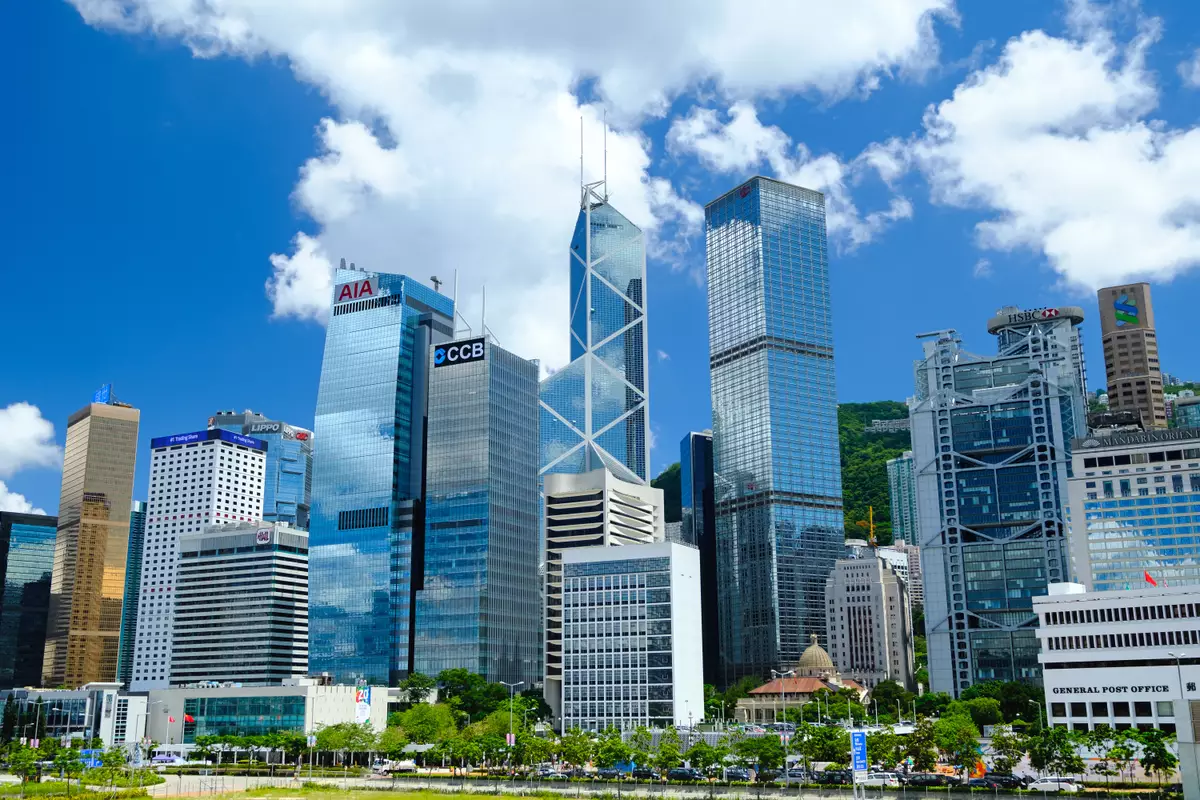
Hong Kong, Photo source: reference image
Banking Professionals: Europe's Wealthy Population is Shrinking
Banking professionals point out that this is an irreversible trend, as the number of wealthy individuals in Europe is decreasing, while the number in the Asia-Pacific region will continue to rise alongside the economic development of ASEAN countries.
Moreover, the Hong Kong government's efforts to promote family offices in the city are accelerating this trend.
The report by the Boston Consulting Group cites a robust IPO market and a large influx of Mainland capital as reasons for Hong Kong's top ranking in 2025, while also suggesting other factors were at play.
Mr. Alex Mak, Head of Greater Bay Area Development of Our Hong Kong Foundation, said Hong Kong's leading position in cross-border wealth management is primarily driven by the rapid overall wealth growth in Asia. He mentioned that the number of high-net-worth individuals in Asia grew by 5 per cent in 2024, higher than in Switzerland. From an economic perspective, Asia is a growth region, while Switzerland is facing saturation. Nevertheless, he also indicated that Hong Kong is unlikely to be number one in IPO fundraising in 2026 due to several mega-IPOs in the U.S., including on SPACEEX, but added that this has not shaken Hong Kong's status as a wealth management centre.
Government Policies Bearing Fruits
Mr. Alex Mak noted that the HKSAR Government's efforts in recent years to build the city into a wealth management and family office centre have yielded results. A series of government policies and tax breaks have been implemented, and the results are now reaping the rewards. Last year, the number of single-family offices reached 3,384, a 20 per cent year-on-year increase, compared with 440 in Switzerland.
Singapore, ranked third, recorded 10.3 per cent growth in 2025. The Boston Consulting Group estimates a 9 per cent annual growth in its cross-border wealth management assets over the five years to 2030. While its base is lower than Hong Kong and Switzerland, market analysts suggest Singapore would need significantly higher growth in the coming years to overtake them.
Analysts also pointed out that Singapore's investment market offers fewer product options and is geographically distant from China. Investing in RMB-related products is less convenient in Singapore. Furthermore, Singapore's close ties with the U.S. make some investors hesitant.
To cement its position as the world's leading cross-border wealth management hub, Prof. Mak believed Hong Kong should increase the variety of investment products, such as expanding the supply of RMB assets, broadening risk diversification, and introducing Islamic financial products, which would not only attract foreign capital, but also draw high-end financial talent and create jobs.
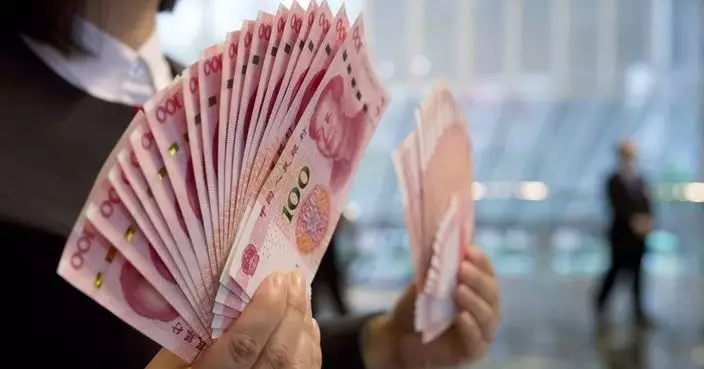
Scholar believed Hong Kong should increase the variety of investment products, such as expanding the supply of RMB assets, broadening risk diversification, and introducing Islamic financial products. Photo source: AP News
Hong Kong: A Platform of Diverse Asset Choices
Mr. Sam Yu, Chairman of the Hong Kong Investment Funds Association (HKIFA), said in the interview that Hong Kong offers over 3,000 tradable funds. In recent years, the addition of alternative asset investment funds and private equity funds has enriched investment products for wealth management and family offices. The HKSAR Government's financial policies, including tax incentives, have contributed to the flourishing development of the sector.
Besides, initiatives such as Cross-boundary WMC, Mutual Market Access, and ETF Connect provide Mainland investors with channels to invest in Hong Kong, resulting in ample capital and a diverse range of investment products in Hong Kong's financial market.
To strengthen Hong Kong's position as a wealth management centre, Mr. Yu believed a short-term, medium-term, and long-term approach is needed. In the short term, strengthening communication with Mainland regulatory agencies and the People's Bank of China is crucial to ensure funds enter Hong Kong through legal channels. In the medium term, strengthening ties with Southeast Asia is essential. He noted that Thailand and Hong Kong have had a mutual recognition of funds mechanism for many years. In the long term, expanding into the Middle East and Central Asia is vital to enhance financial and wealth management exchanges between the regions.
Mr. Alex Mak believed the HKSAR Government needs to expand its financial talent pool, especially for multi-skilled individuals, such as those combining finance and technology, or ESG specialists. Furthermore, he suggested exploring the Central Asian market. Kazakhstan, for example, has strong economic power and boasts 40,000 to 50,000 high-net-worth individuals, a figure projected to reach 60,000 by 2028.
Mr. Yu expressed his surprise that Hong Kong has become the world's leading cross-border wealth management hub sooner than expected. He said that this is the result of past efforts, highlighting government policies, including significant work on taxation and the successful attraction of numerous investors and talent.
To solidify its position as the world's number one, Mr. Yu said Hong Kong can continue to attract diverse capital by strengthening ties with the Mainland, Southeast Asia, and the Middle East, adding that Central Asian countries also hold considerable potential.