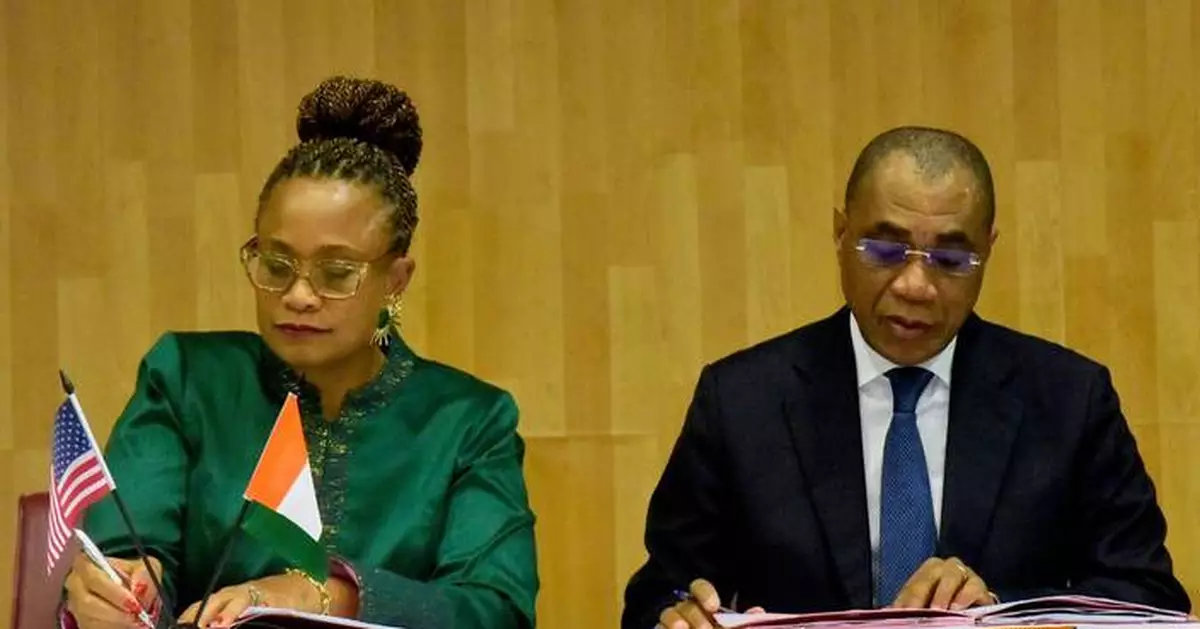
ABIDJAN, Ivory Coast (AP) — The United States and Ivory Coast signed a health deal Tuesday requiring the U.S. to commit $480 million to the West African nation’s health sector as part of “America First” global health funding pacts that mirror the Trump administration’s foreign policy.
The signing in Ivory Coast’s capital of Abidjan covers areas such as HIV, malaria, maternal and child health, and global health security. It is the latest agreement the U.S. has entered with more than a dozen African countries, most of them hit by U.S. aid cuts, including Ivory Coast.
U.S. aid cuts have crippled health systems across the developing world, including in Africa, where many countries relied on the funding for crucial programs, including those responding to outbreaks of disease.
The new health pact is based on the principle of shared responsibility with Ivory Coast committing to provide up to 163 billion CFA francs ($292 million) by 2030, representing 60% of the overall commitment, according to Ivorian Prime Minister Robert Beugré Mambé.
U.S. Ambassador to Ivory Coast Jessica Davis Ba said the U.S. government is moving “beyond the traditional aid approach toward a model focused on trade, innovation, and shared prosperity.”
“Today, our bilateral cooperation is entering a new phase. We are implementing the America First global health strategy,” the ambassador said.
The Trump administration says the new “America First” global health funding agreements are meant to increase self-sufficiency and eliminate what it says are ideology and waste from international assistance. The deals replace a patchwork of previous health agreements under the now-dismantled United States Agency for International Development.
In Ivory Coast, USAID had invested $115 million to support sectors such as health, education and aid for refugees mostly fleeing violence in neighboring Sahel states.
Analysts say the new approach to global health aligns with U.S. President Donald Trump’s pattern of dealing with other nations transactionally, using direct talks with foreign governments to promote his agenda abroad.
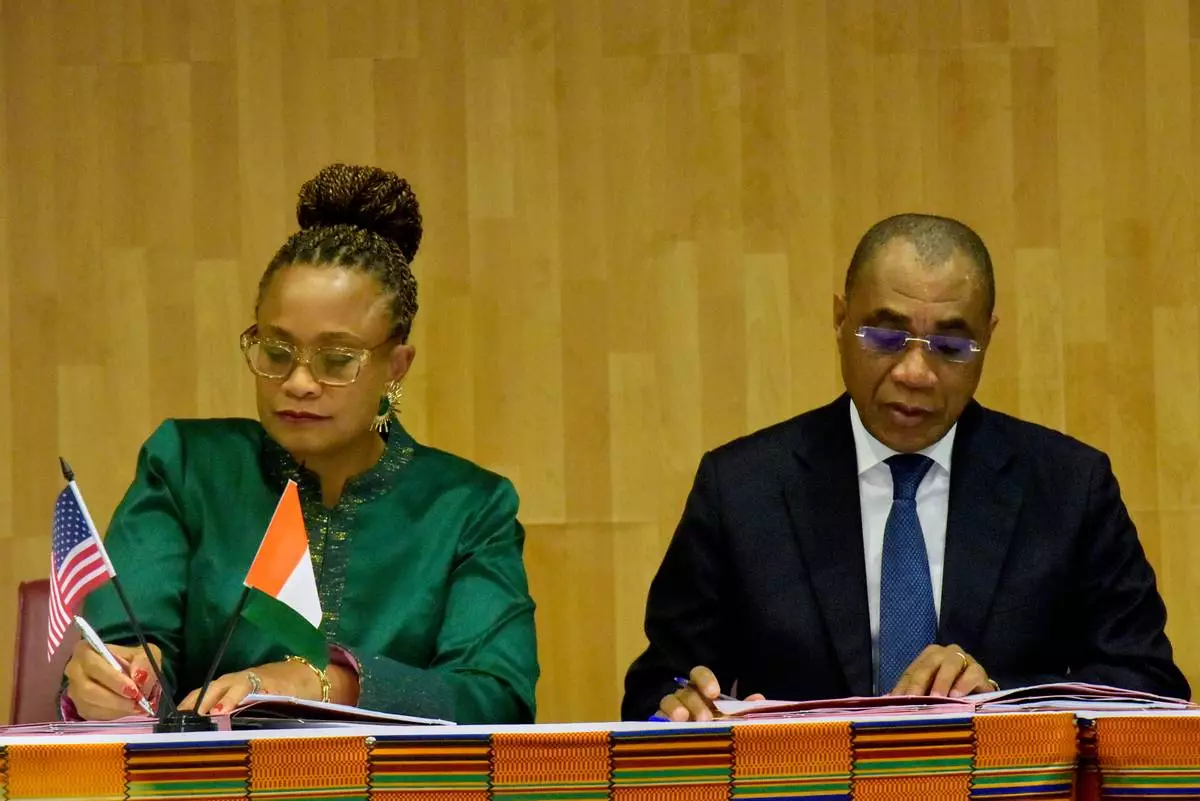
U.S. Ambassador to the Ivory Coast Jessica Davis Ba, left, and Adam Coulibaly, minister of finance and budget, sign a health agreement in Abidjan, Ivory Coast, Tuesday, Dec. 30, 2025. (AP Photo/Diomande Ble Blonde)
NASHVILLE, Tenn. (AP) — A newly unsealed order in the criminal case against Kilmar Abrego Garcia reveals that high-level Justice Department officials pushed for his indictment, calling it a “top priority,” only after he was mistakenly deported and then ordered returned to the U.S.
Abrego Garcia has pleaded not guilty in federal court in Tennessee to charges of human smuggling. He is seeking to have the case dismissed on the grounds that the prosecution is vindictive — a way for President Donald Trump's administration to punish him for the embarrassment of his mistaken deportation.
To support that argument, he has asked the government to turn over documents that reveal how the decision was made to prosecute him in 2025 for an incident that occurred in 2022. On Dec. 3, U.S. District Judge Waverly Crenshaw filed an order under seal that compelled the government to provide some documents to Abrego Garcia and his attorneys. That order was unsealed on Tuesday and sheds new light on the case.
Earlier, Crenshaw found that there was “some evidence” that the prosecution of Abrego Garcia could be vindictive. He specifically cited a statement by Deputy Attorney General Todd Blanche on a Fox News program that seemed to suggest that the Department of Justice charged Abrego Garcia because he had won his wrongful deportation case.
Rob McGuire, who was the Acting U.S. Attorney for the Middle District of Tennessee until late December, argued that those statements were irrelevant because he alone made the decision to prosecute, and he has no animus against Abrego Garcia.
In the newly unsealed order, Crenshaw writes, “Some of the documents suggest not only that McGuire was not a solitary decision-maker, but he in fact reported to others in DOJ and the decision to prosecute Abrego may have been a joint decision.”
DOJ officials did not immediately respond to a request for comment.
The human smuggling charges stem from a 2022 traffic stop in Tennessee where Abrego Garcia was pulled over for speeding. There were nine passengers in the car, and state troopers discussed the possibility of human smuggling among themselves. However, he was ultimately allowed to leave with only a warning. The case was turned over to Homeland Security Investigations, but there is no record of any effort to charge him until April 2025, according to court records.
The order does not give a lot of detail on what is in the documents that were turned over to Abrego Garcia, but it shows that Aakash Singh, who works under Blanche in the Office of the Deputy Attorney General, contacted McGuire about Abrego Garcia's case on April 27, the same day that McGuire received a file on the case from Homeland Security Investigations. That was several days after the U.S. Supreme Court ruled in Abrego Garcia's favor on April 10.
On April 30, Singh said in an email to McGuire that the prosecution was a “top priority” for the Deputy Attorney General's Office, according to the order. Singh and McGuire continued to communicate about the prosecution. On May 15, McGuire emailed his staff that Blanche “would like Garcia charged sooner rather than later,” Crenshaw writes.
On May 18, Singh wrote to McGuire and others to hold the draft indictment until they got “clearance” to file it. “The implication is that ‘clearance’ would come from the Office of the Deputy Attorney General,” Crenshaw writes.
A hearing on the motion to dismiss the case on the basis of vindictive prosecution is scheduled for Jan. 28.

Kilmar Abrego Garcia and his wife Jennifer Vasquez Sura leave the United States District Court District of Maryland, Monday, Dec. 22, 2025, in Greenbelt, Md. (AP Photo/Stephanie Scarbrough)