Designation of Domestic Systemically Important Authorized Institutions
The following is issued on behalf of the Hong Kong Monetary Authority:
The Hong Kong Monetary Authority (HKMA) has completed its annual assessment of the list of Domestic Systemically Important Authorized Institutions (D-SIBs). Based on the assessment results, the list of authorized institutions designated as D-SIBs remains unchanged compared to the list of D-SIBs published by the HKMA on December 31, 2024. The latest list of D-SIBs is shown in the Annex.
Under the D-SIB framework, each of the authorized institutions designated as a D-SIB will be required to include a Higher Loss Absorbency (HLA) requirement into the calculation of its regulatory capital buffers within a period of 12 months after the formal notification of its designation. The HLA requirement applicable to a D-SIB (expressed as a ratio of an authorized institution's Common Equity Tier 1 (CET1) capital to its risk-weighted assets as calculated under the Banking (Capital) Rules) ranges between 1 per cent and 3.5per cent (depending on the assessed level of the D-SIB's systemic importance). Compared to the list of D-SIBs published on December 31, 2024, there is no change to the HLA requirements applied to the designated D-SIBs.
Further details about the decision can be found on the HKMA website (Systemically Important Authorized Institutions (SIBs)).
Background
1. D-SIB framework in Hong Kong
The Banking (Capital) Rules and the HKMA's regulatory framework for D-SIBs follow the provisions in "A framework for dealing with domestic systemically important banks" issued by the Basel Committee on Banking Supervision in October 2012, by enabling the Monetary Authority (i) to designate an authorized institution as a D-SIB if the Monetary Authority considers the authorized institution to be of systemic importance in the context of the Hong Kong banking and financial system and (ii) to require an authorized institution designated as a D-SIB to be subject to an HLA capital buffer.
The rationale for imposing an HLA requirement on D-SIBs is to reduce any probability of them becoming non-viable. This is considered both prudent and justified in view of the greater impact that they could have, in the unlikely event of their failure, on the domestic financial system and the local economy more broadly.
2. HLA requirement for authorized institutions designated as D-SIBs
The Monetary Authority is empowered under sections 3U and 3V of the Banking (Capital) Rules to designate D-SIBs and to determine an HLA requirement for each of these D-SIBs by reference to the degree of domestic systemic importance which the Monetary Authority assesses them to bear. To achieve this aim, the HKMA's regulatory framework for D-SIBs provides for authorized institutions designated as D-SIBs to be allocated to different HLA "buckets". This differentiated approach reflects the diversified nature and varying degrees of systemic importance of authorized institutions in Hong Kong.
The designated D-SIBs must apply the HLA in the calculation of their regulatory capital buffers within 12 months of the formal notification of their designation. There are five HLA buckets in total ranging from 1per cent to 3.5 per cent. While only the first four buckets (i.e. from 1per cent to 2.5 per cent) have been populated so far, the framework includes an empty 3.5per cent bucket to encourage D-SIBs to refrain from becoming even more systemically important.
The HLA applied to a D-SIB serves (together with the Countercyclical Capital Buffer) as an extension of the Basel III Capital Conservation Buffer. Accordingly, if and when a D-SIB's CET1 capital ratio falls within the extended buffer range, the D-SIB will be subject to restrictions on the discretionary distributions it may make. The effect of this is that D-SIBs will be required to retain earnings in order to bolster their regulatory capital.
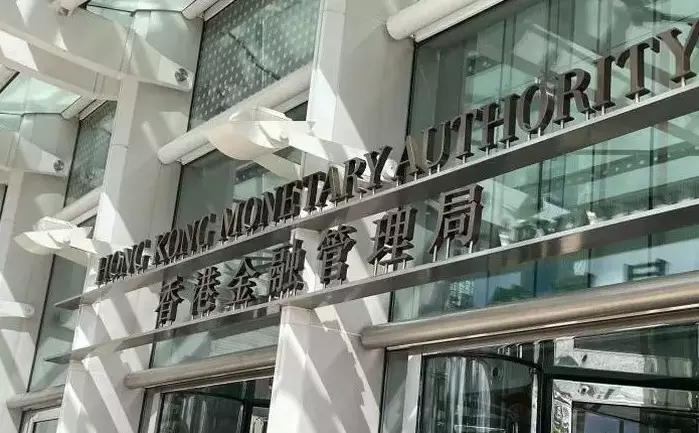
HKMA, Photo source: reference image
Online pre-registration for public observation for third round of evidential hearings of Independent Committee in relation to fire at Wang Fuk Court in Tai Po
The following is issued on behalf of the Independent Committee in relation to the fire at Wang Fuk Court in Tai Po:
The Independent Committee in relation to the fire at Wang Fuk Court in Tai Po announced today (April 2) that members of the public may pre-register for selected hearings of the third round of seven evidential hearings that they wish to observe via the online system from 10am on April 8 to 10am on April 11.
The Committee will hear evidence in the evidential hearings on matters in accordance with its terms of reference. The Committee aims to clarify the relevant facts through oral evidence, written submissions, and other forms of evidence presented by witnesses. This will provide an important basis for the preparation of its report and recommendations.
The evidential hearings will be conducted in Cantonese from 10am to 1pm and from 2.15pm to 4.30pm at the Multi-purpose Hall, 3/F, City Gallery, 3 Edinburgh Place, Central. Simultaneous interpretation in Putonghua and English will be provided in the City Gallery.
The schedule for the third round of seven evidential hearings as announced earlier is as follows:
Date |
1. |
April 20 (Monday) |
2. |
April 21 (Tuesday) |
3. |
April 22 (Wednesday) |
4. |
April 23 (Thursday) |
5. |
April 24 (Friday) |
6. |
April 27 (Monday) |
7. |
April 30 (Thursday) |
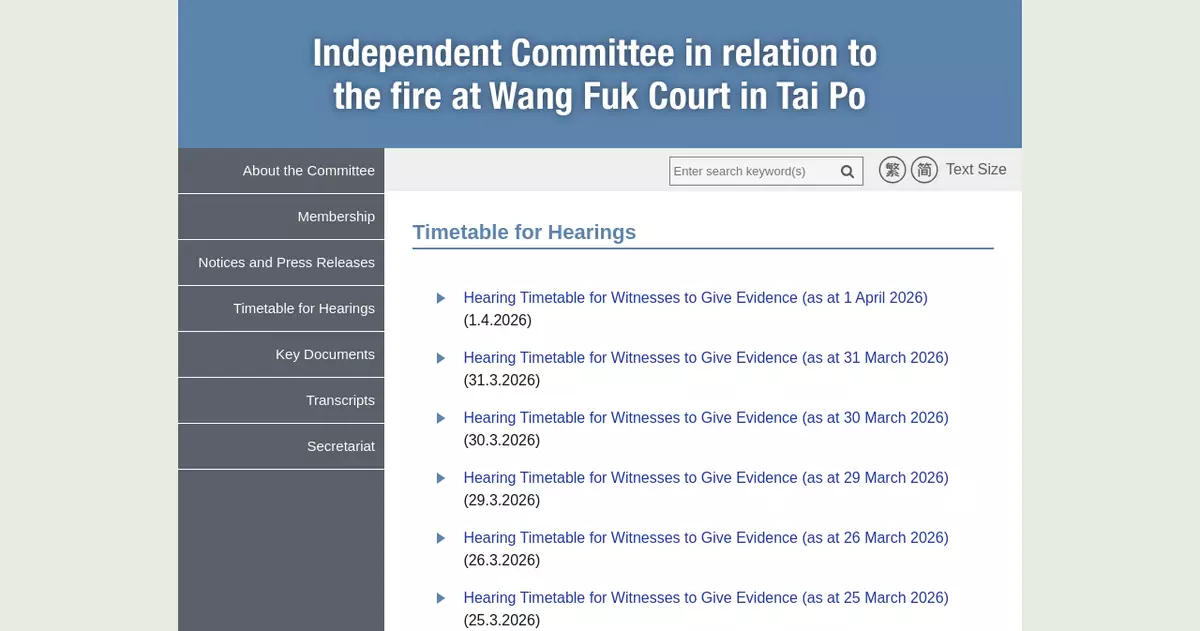
In the third round of evidential hearings, the Committee will continue to receive oral evidence from witnesses. The Committee will release the list of exact witnesses who will be giving evidence at each date of hearing on its website (www.ic-wangfukcourtfire.gov.hk/eng/timetable.html) nearer the time.
Some seats for the hearings will be reserved for the involved parties, and some seats will be open to the public to observe the proceedings. To allow more members of the public to attend the hearings, the proceedings will be broadcast simultaneously in transmission areas set up on the ground floor of the City Gallery and in the Lecture Theatre of the Hong Kong Central Library. Arrangements will be made for some members of the public to observe the hearings in these two areas. A total of about 360 seats will be available for public observation in the main venue and the two transmission areas. About half of the seats will be set aside for residents of Wang Fuk Court on a priority basis. Separate arrangements will be made for the media.
To avoid members of the public queuing outside the venue for a long time, and to allow those who wish to observe the hearings to have certainty of whether seats have been secured before the day of the hearings, for the third round of hearings, individuals (including Wang Fuk Court residents) are required to pre-register online (eform.cefs.gov.hk/form/ic-hearing/en/) from 10am on April 8 to 10am on April 11. Registrants should select on the online registration form the dates they wish to observe (one or more sessions can be selected) and submit the duly completed form. The Secretariat of the Committee will allocate seats on a first-come, first-served basis according to the system's record of the time the pre-registration forms are received.
Successful registrants will receive a "Confirmation of Successful Registration" for the third round of hearings issued by the Secretariat of the Committee by April 16. An SMS notification will be sent from the sender name "#IC-hearing". If an email address is also provided during pre-registration, an email notification will be sent from hearing@ic-wangfukcourtfire.gov.hk. Pre-registration will be considered unsuccessful for those who have not received a notification by that date. Each person can only pre-register for each day of hearing once. Duplicate registrations will not be processed.
According to the current plan, the Committee will continue to hold evidential hearings in May. Details (including the specific dates of the hearings, the witnesses who will be giving evidence, and the pre-registration arrangements for public observation) will be announced separately on a later date.
The Chief Executive established the Committee to review the causes of the fire at Wang Fuk Court and related issues, and to make recommendations to prevent similar incidents from occurring again. The Committee formally commenced its work on December 19, 2025, and the evidential hearings on March 19 to hear oral evidence from witnesses (including oral evidence from Wang Fuk Court residents and the involved parties).
Source: AI-found images