Skip to Content Facebook Feature Image

Qingdao Port deploys China’s first vacuum-based automated mooring system

China

China

China

Qingdao Port deploys China’s first vacuum-based automated mooring system

2026-01-01 17:45 Last Updated At:23:37

Qingdao Port, the largest port in northern China, deployed the country's first vacuum-based automated mooring system on the first day of 2026, completing its unmanned operation for a single vessel within 30 seconds.

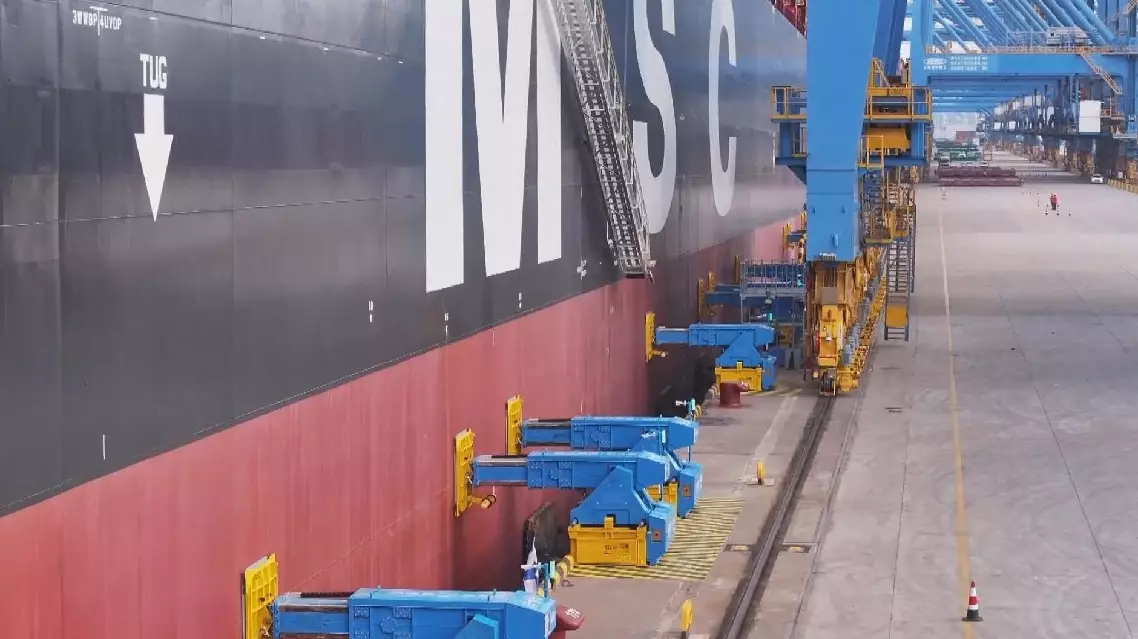
At 9 a.m. on Thursday, a container vessel measuring 366 meters in length and capable of carrying 16,000 TEUs slowly berthed at a quay equipped with the new mooring system. Unlike traditional berthing operations, no workers were required to secure mooring lines on site. Instead, the system automatically identified the vessel, positioned it, and used built-in vacuum suction pads to attach to the ship's hull. The entire mooring process took less than 30 seconds, firmly securing the vessel at the berth.

The vacuum-based automated mooring system not only enhances operational safety but also significantly boosts terminal efficiency.

"The vacuum-based automated mooring system attaches to the side of the vessel with suction pads. Thirteen mooring units can generate a combined holding force of 2,600 kilonewtons within 30 seconds. This shortens the mooring time for a single vessel from 20 to 30 minutes to under 30 seconds, firmly fixing the ship to the quay," said Liu Fangchao, Manager from the Engineering Technology Department of Qingdao Port Automated Terminal.

With its highly integrated automated system, comprising automated quay cranes, high-speed rail-mounted gantry cranes, and unmanned AGVs (Automated Guided Vehicles), Qingdao Port has set a world record for container-handling efficiency at automated terminals for the 13th time.

In addition, local customs have introduced intelligent systems to further streamline the inspection process for smoother customs clearance.

"The pre-inspection scanning equipment is deployed along the port's logistics routes. Each scanning process takes only a few seconds and does not interfere with container transportation. Expanding high-level opening-up and building smart ports are key goals China aims to achieve over the next five years," said Yu Ting, Deputy Director of the Inspection Division of Huangdao Customs under Qingdao Customs.
Qingdao Port deploys China’s first vacuum-based automated mooring system


Qingdao Port deploys China’s first vacuum-based automated mooring system

Bulgaria joined the eurozone and adopted the euro as its official currency on New Year's Day, becoming the 21st member of the euro area.

To ensure a smooth transition to the new currency, throughout January, the Bulgarian lev will remain in circulation alongside the euro. Starting Feb. 1, the euro will become the country's sole legal tender.

From Jan. 1 to June 30, the exchange of lev for euros is free of charge at banks and post offices. After this period, currency exchanges will be subject to a fee.

The Bulgarian National Bank has stated that it will exchange levs for euros indefinitely, continuing the process for as long as necessary. But it added that the mandatory dual pricing of goods and services in euro and lev will end on Aug. 8, 2026. Officials and experts have expressed their confidence in the transition process.

Vladimir Ivanov, chairman of Bulgaria's State Commission on Commodity Exchanges and Markets, described 2025 as a year of market stabilization in a brief meeting, saying he expected 2026 to begin similarly, "especially after transaction costs decrease with the introduction of the euro."

Nikolay Valkanov, executive director of the Association for Modern Trade, also said in an interview that retailers, from large chains to small shops, had made significant efforts to ensure a smooth transition to the new currency.

Eurozone accession has been a central priority for the Bulgarian government ever since the country joined the EU in 2007.

It was not until June 4, 2025, that the European Commission announced Bulgaria had met all convergence criteria. On July 8, 2025, the Council of the European Union formally approved Bulgaria's adoption of the euro, effective Jan. 1, 2026.

The eurozone came into existence with the official launch of the euro on Jan. 1, 1999, in 11 countries including France, Germany and Austria.

Currently among the 27 EU countries, there are still six members, namely Sweden, Poland, the Czech Republic, Hungary, Romania, and Denmark, that have not yet adopted the euro.

Bulgaria officially adopts euro with short transition period

Bulgaria officially adopts euro with short transition period

Recommended Articles