With the ice and snow tourism season in full swing, Harbin, the capital of northeast China's Heilongjiang Province, continues to attract a growing number of visitors due to its diverse winter activities, expanding attractions and local hospitality.
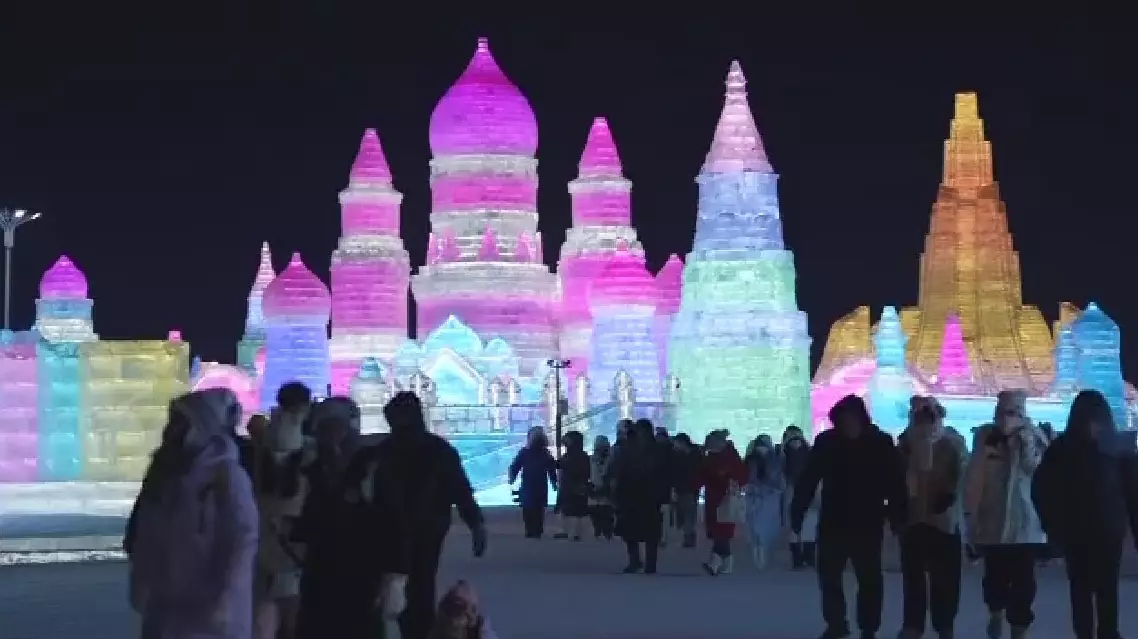
On dark winter nights, bright lights shine through at Harbin's Ice and Snow World, the city's most iconic winter attraction which opened on Dec 17. Temperatures can drop to minus 20 degrees Celsius, but the energy doesn't fade, carried by music, dancing, and the spirit of the winter season.
"I was sick just two days ago and even needed an IV drip. But I still decided to come today. I slid down the giant ice slides and watched the fantasy show of The King's Chariot. I'm very happy," said a visitor.
For some international visitors coming from temperate countries, the frigid air is an experience in itself.
"We're from Malaysia. It's freezing cold today," said a tourist.
This year, the Harbin Ice and Snow World was expanded by 20 percent, built with over 400,000 cubic meters of ice and snow, featuring landmark attractions, thoughtful services and magnificent ice sculptures across a record 1.2 million square meters of park area.
The Super Ice Slides retained their 24-lane layout and extended its longest track to 521 meters, while the 120-meter sky wheel gave visitors a bird's-eye view of every winter wonder in the park.
This year's ice sculptures showcase a dazzling blend of historical and contemporary marvels from around the globe.
Dazzling replicas of central China's Yellow Crane Tower and Harbin's Chinese Baroque-style buildings stand alongside Belgium's Manneken-Pis, while impressive aircraft carrier and submersible models captivate young visitors.
In addition to its sparkling attractions, the park has introduced an array of new performances and activities, including singing competitions, dance battles and fantasy indoor show.
Last winter, the park attracted a record-breaking 3.56 million tourist visits during its 68-day operation, boosting the market size of the ice and snow economy in Heilongjiang to reach more than 266 billion yuan (about 38 billion U.S. dollars), according to the provincial bureau of statistics.
A significant portion of visitor spending goes toward staying warm. One group of domestic tourists told a reporter that after arriving they stocked up on hats and face masks.
For some international visitors, the spending begins even before they even arrive.
"I'm from Cambodia. Before coming here, I bought winter clothes and travel guides," said an overseas tourist.
Harbin, called China's "ice city", has turned its long, cold winters into a major tourist attraction. Last winter, this capital city of Heilongjiang Province welcomed a record 90.36 million visitors, generating 137.22 billion yuan (about 19.44 billion US dollars) in revenue, a 16.6 percent increase year-on-year.
China is positioning the ice and snow economy as a key driver of development and consumption, with its scale expected to reach 1.2 trillion yuan by 2027 and 1.5 trillion yuan by 2030.
Harbin's winter tourism thrives with new experiences at Ice World
Harbin's winter tourism thrives with new experiences at Ice World