NEW YORK (AP) — Anthony Duclair recorded a hat trick for the first time in more than six years, Ilya Sorokin stopped all 44 shots he faced in his return from injury and the New York Islanders handed the New Jersey Devils a second consecutive defeat, routing them 9-0 on Tuesday night.
Back in the lineup after being a healthy scratch the past two games, Duclair scored three goals in a row during a stretch from 4:01 into the first period to 3:29 into the second and also had two assists for a five-point game. His fourth hat trick in the NHL was his first since Dec. 14, 2019, four teams ago when he was with the Ottawa Senators.
Click to Gallery
New Jersey Devils goaltender Jacob Markstrom (25) reacts as a puck shot by New York Islanders' Mathew Barzal gets past him for a goal during the first period of an NHL hockey game Tuesday, Jan. 6, 2026, in Elmont, N.Y. (AP Photo/Frank Franklin II)
New York Islanders' Anthony Duclair (11) shoots the puck past New Jersey Devils' Colton White (45) for a goal during the first period of an NHL hockey game Tuesday, Jan. 6, 2026, in Elmont, N.Y. (AP Photo/Frank Franklin II)
New Jersey Devils goaltender Jacob Markstrom (25) watchs New York Islanders' Anthony Duclair (11) after Duclair scored a goal during the first period of an NHL hockey game Tuesday, Jan. 6, 2026, in Elmont, N.Y. (AP Photo/Frank Franklin II)
New York Islanders goaltender Ilya Sorokin (30) stops a shot during the second period of an NHL hockey game against the New Jersey Devils Tuesday, Jan. 6, 2026, in Elmont, N.Y. (AP Photo/Frank Franklin II)
New York Islanders' Anthony Duclair (11) reacts after scoring a goal during the first period of an NHL hockey game against the New Jersey Devils Tuesday, Jan. 6, 2026, in Elmont, N.Y. (AP Photo/Frank Franklin II)
Sorokin was exceptional, showing no rust in his first game action since Dec. 19 as he became the franchise's career shutout leader with his 26th. He had been out with what the Islanders called a nagging lower-body injury.
At the other end of the rink, Devils goaltender Jacob Markstrom allowed goals on the first two shots he faced — from Mat Barzal and Duclair — and three on five, finishing with nine on 24. His teammates had little bounce back after losing at home to Carolina on Sunday in a game in which young defenseman Luke Hughes twice put the puck into his own net.
New Jersey has lost six of its past eight games. The Islanders have won two in a row and five of seven to keep pace with the Metropolitan Division-leading Hurricanes.
No. 1 pick and rookie of the year frontrunner Matthew Schaefer has points in four consecutive games. Schaefer, still playing sick after scoring the overtime winner Saturday night while battling the flu, had an assist on Barzal's goal 62 seconds in.
Simon Holmstrom, Casey Cizikas, Tony DeAngelo and Cal Ritchie also scored for New York.
Devils: Visit Pittsburgh on Thursday night.
Islanders: Begin a seven-game road trip Thursday night at Nashville.
AP NHL: https://apnews.com/hub/NHL

New Jersey Devils goaltender Jacob Markstrom (25) reacts as a puck shot by New York Islanders' Mathew Barzal gets past him for a goal during the first period of an NHL hockey game Tuesday, Jan. 6, 2026, in Elmont, N.Y. (AP Photo/Frank Franklin II)

New York Islanders' Anthony Duclair (11) shoots the puck past New Jersey Devils' Colton White (45) for a goal during the first period of an NHL hockey game Tuesday, Jan. 6, 2026, in Elmont, N.Y. (AP Photo/Frank Franklin II)

New Jersey Devils goaltender Jacob Markstrom (25) watchs New York Islanders' Anthony Duclair (11) after Duclair scored a goal during the first period of an NHL hockey game Tuesday, Jan. 6, 2026, in Elmont, N.Y. (AP Photo/Frank Franklin II)

New York Islanders goaltender Ilya Sorokin (30) stops a shot during the second period of an NHL hockey game against the New Jersey Devils Tuesday, Jan. 6, 2026, in Elmont, N.Y. (AP Photo/Frank Franklin II)

New York Islanders' Anthony Duclair (11) reacts after scoring a goal during the first period of an NHL hockey game against the New Jersey Devils Tuesday, Jan. 6, 2026, in Elmont, N.Y. (AP Photo/Frank Franklin II)
CARACAS, Venezuela (AP) — At the White House, President Donald Trump vows American intervention in Venezuela will pour billions of dollars into the country’s infrastructure, revive its once-thriving oil industry and eventually deliver a new age of prosperity to the Latin American nation.
Here at a sprawling street market in the capital, though, utility worker Ana Calderón simply wishes she could afford the ingredients to make a pot of soup.
“Food is incredibly expensive,” says Calderón, noting rapidly rising prices that have celery selling for twice as much as just a few weeks ago and a kilogram (2 pounds) of meat going for more than $10, or 25 times the country’s monthly minimum wage. “Everything is so expensive.”
Venezuelans digesting news of the United States’ brazen capture of former President Nicolás Maduro are hearing grandiose promises of future economic prowess even as they live through the crippling economic realities of today.
“They know that the outlook has significantly changed but they don’t see it yet on the ground. What they’re seeing is repression. They’re seeing a lot of confusion,” says Luisa Palacios, a Venezuelan-born economist and former oil executive who is a research scholar at the Center on Global Energy Policy at Columbia University. “People are hopeful and expecting that things are going to change but that doesn’t mean that things are going to change right now.”
Whatever hope exists over the possibility of U.S. involvement improving Venezuela’s economy is paired with the crushing daily truths most here live. People typically work two, three or more jobs just to survive, and still cupboards and refrigerators are nearly bare. Children go to bed early to avoid the pang of hunger; parents choose between filling a prescription and buying groceries. An estimated eight in 10 people live in poverty.
It has led millions to flee the country for elsewhere.
Those who remain are concentrated in Venezuela’s cities, including its capital, Caracas, where the street market in the Catia neighborhood once was so busy that shoppers bumped into one another and dodged oncoming traffic. But as prices have climbed in recent days, locals have increasingly stayed away from the market stalls, reducing the chaos to a relative hush.
Neila Roa, carrying her 5-month-old baby, sells packs of cigarettes to passersby, having to monitor daily fluctuations in currency to adjust the price.
“Inflation and more inflation and devaluation,” Roa says. “It’s out of control.”
Roa could not believe the news of Maduro’s capture. Now, she wonders what will come of it. She thinks it would take “a miracle” to fix Venezuela’s economy.
“What we don’t know is whether the change is for better or for worse,” she says. “We’re in a state of uncertainty. We have to see how good it can be, and how much it can contribute to our lives.”
Trump has said the U.S. will distribute some of the proceeds from the sale of Venezuelan oil back to its population. But that commitment so far largely appears to be focused on America’s interests in extracting more oil from Venezuela, selling more U.S.-made goods to the country and repairing the electricity grid.
The White House is hosting a meeting Friday with U.S. oil company executives to discuss Venezuela, which the Trump administration has been pressuring to open its vast-but-struggling oil industry more widely to American investment and know-how. In an interview with The New York Times, Trump acknowledged that reviving the country’s oil industry would take years.
“The oil will take a while,” he said.
Venezuela has the world's largest proven oil reserves. The country's economy depends on them.
Maduro's predecessor, the fiery Hugo Chávez, elected in 1998, expanded social services, including housing and education, thanks to the country’s oil bonanza, which generated revenues estimated at some $981 billion between 1999 and 2011 as crude prices soared. But corruption, a decline in oil production and economic policies led to a crisis that became evident in 2012.
Chávez appointed Maduro as his successor before dying of cancer in 2013. The country’s political, social and economic crisis, entangled with plummeting oil production and prices, marked the entirety of Maduro's presidency. Millions were pushed into poverty. The middle class virtually disappeared. And more than 7.7 million people left their homeland.
Albert Williams, an economist at Nova Southeastern University, says returning the energy sector to its heyday would have a dramatic spillover effect in a country in which oil is the dominant industry, sparking the opening of restaurants, stores and other businesses. What's unknown, he says, is whether such a revitalization happens, how long it would take and how a government built by Maduro will adjust to the change in power.
“That’s the billion-dollar question,” Williams says. “But if you improve the oil industry, you improve the country.”
The International Monetary Fund estimates Venezuela’s inflation rate is a staggering 682%, the highest of any country for which it has data. That has sent the cost of food beyond what many can afford. Venezuela’s monthly minimum wage of 130 bolivars, or $0.40, has not increased since 2022, putting it well below the United Nations’ measure of extreme poverty of $2.15 a day.
The currency crisis led Maduro to declare an “economic emergency” in April.
Usha Haley, a Wichita State University economist who studies emerging markets, says for those hurting the most, there is no immediate sign of change.
“Short-term, most Venezuelans will probably not feel any economic relief,” she says. “A single oil sale will not fix the country’s rampant inflation and currency collapse. Jobs, prices, and exchange rates will probably not shift quickly.”
In a country that has seen as much strife as Venezuela has in recent years, locals are accustomed to doing what they have to in order to get through the day, so much so that many utter the same expression
“Resolver,” they say in Spanish, or “figure it out," shorthand for the jury-rigged nature of life here, in which every transaction, from boarding a bus to buying a child's medicine, involves a delicate calculation.
Here at the market, the smell of fish, fresh onions and car exhaust combine. Calderon, making her way through, faces freshly skyrocketing prices, saying “the difference is huge,” as the country’s official currency has rapidly declined against its unofficial one, the U.S. dollar.
Unable to afford all the ingredients for her soup, she left with a bunch of celery but no meat.
Sedensky reported from New York. Associated Press writer Josh Boak in Washington contributed to this report.
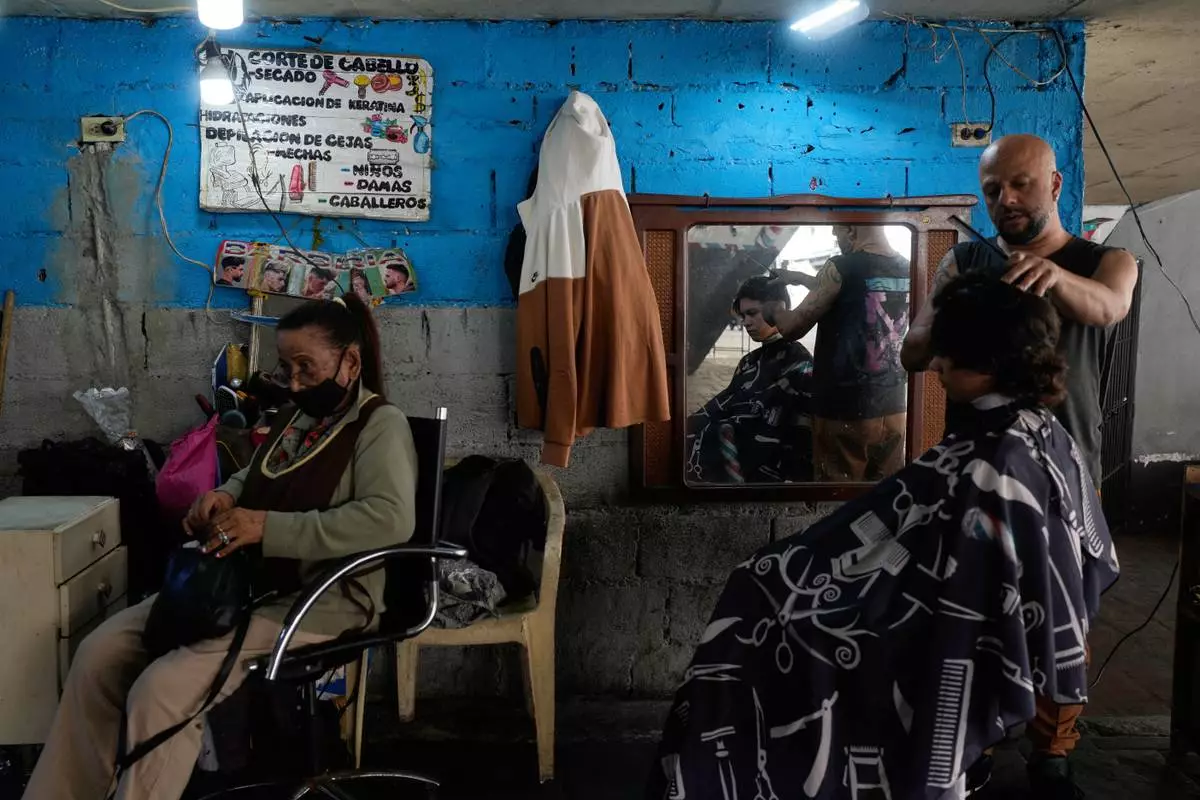
A barber cuts hair at a barbershop in Caracas, Venezuela, Tuesday, Jan. 6, 2026. (AP Photo/Matias Delacroix)
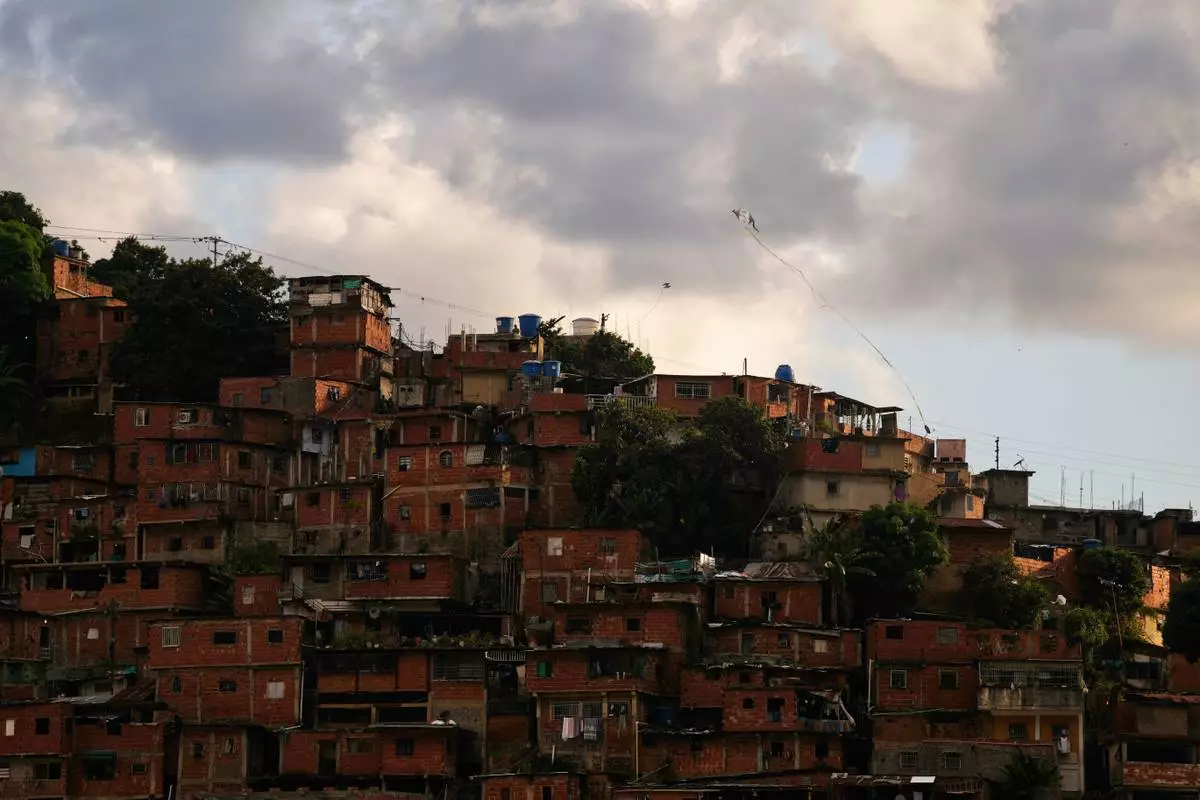
A kite flies over the Petare neighborhood of Caracas, Venezuela, Wednesday, Jan. 7, 2026. (AP Photo/Matias Delacroix)
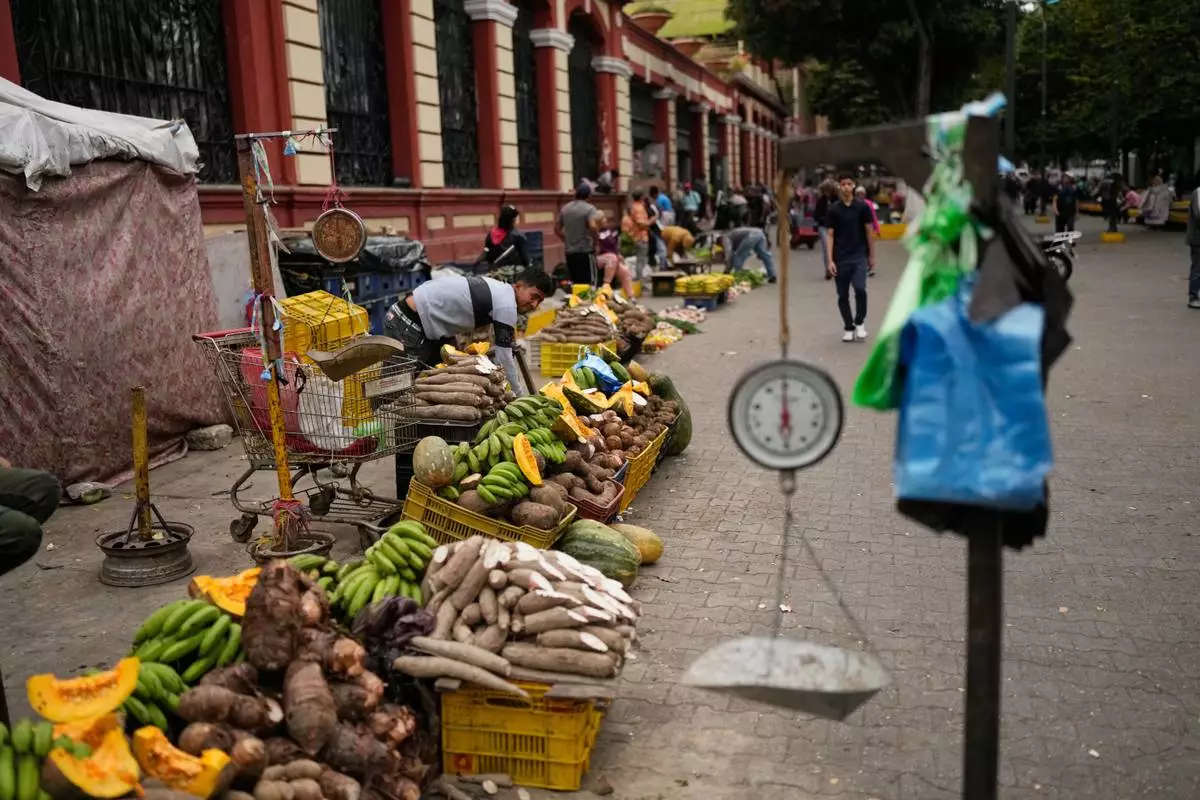
Vendors display vegetables at a street market in Caracas, Venezuela, Thursday, Jan. 8, 2026. (AP Photo/Matias Delacroix)
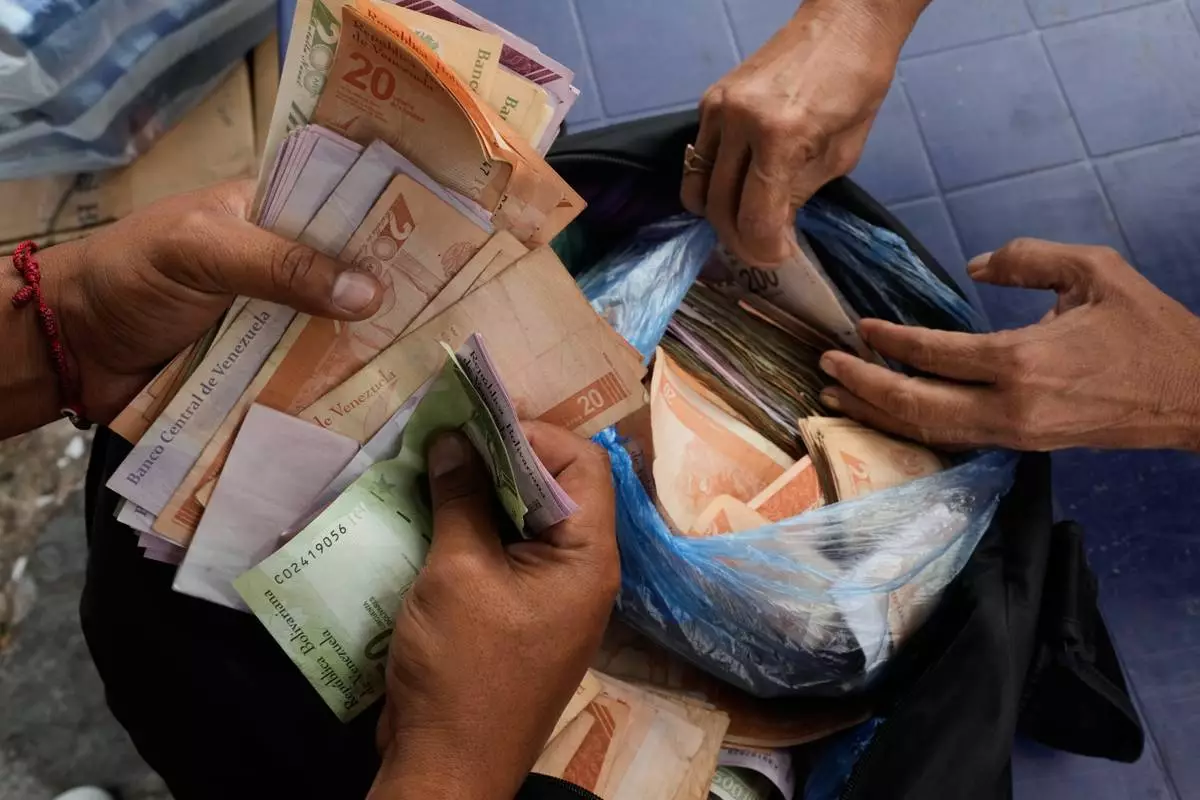
People exchange U.S. dollars for Venezuelan bolivars at a street market in Caracas, Venezuela, Thursday, Jan. 8, 2026. (AP Photo/Matias Delacroix)
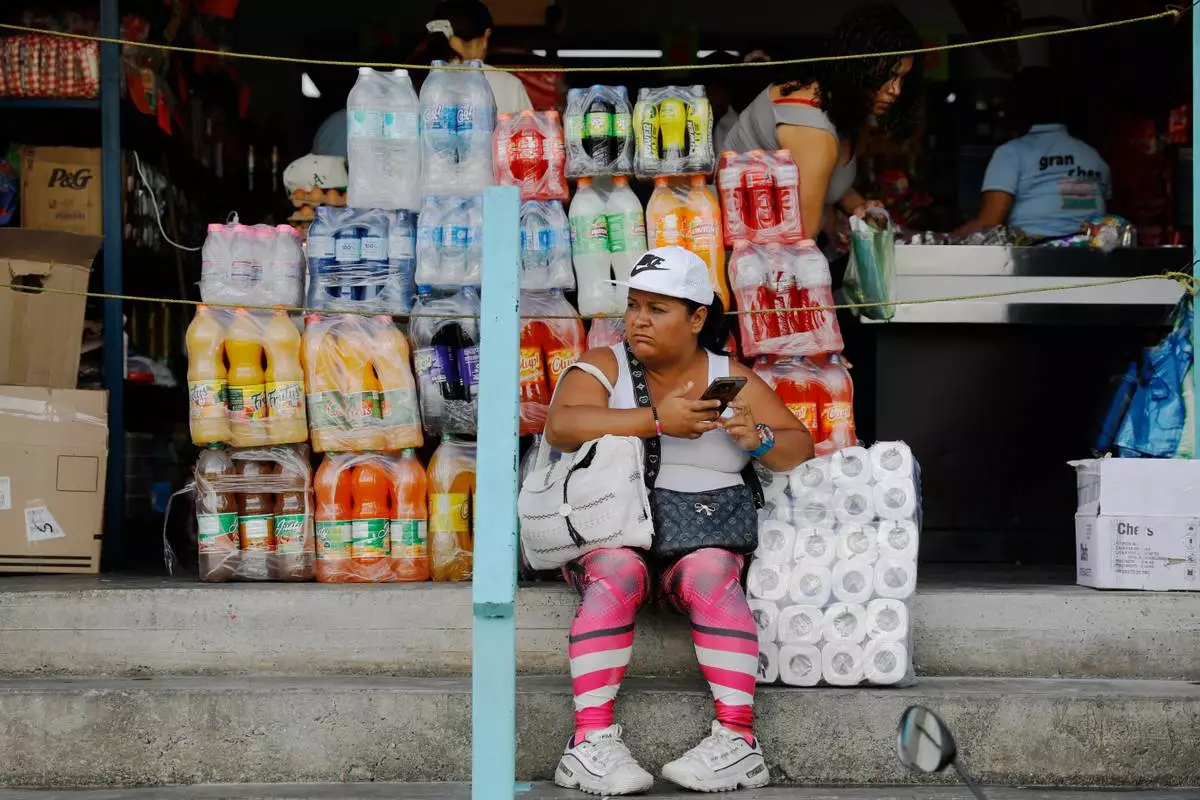
A woman sits in front of a store in the Petare neighborhood of Caracas, Venezuela, Wednesday, Jan. 7, 2026. (AP Photo/Cristian Hernandez)