Skip to Content Facebook Feature Image

XCharge North America and Energy Plus Partner to Build One of the Largest Battery-Backed EV Charging Depots in the U.S.

News

XCharge North America and Energy Plus Partner to Build One of the Largest Battery-Backed EV Charging Depots in the U.S.
News

News

XCharge North America and Energy Plus Partner to Build One of the Largest Battery-Backed EV Charging Depots in the U.S.

2026-01-07 20:30 Last Updated At:20:40

KYLE, Texas--(BUSINESS WIRE)--Jan 7, 2026--

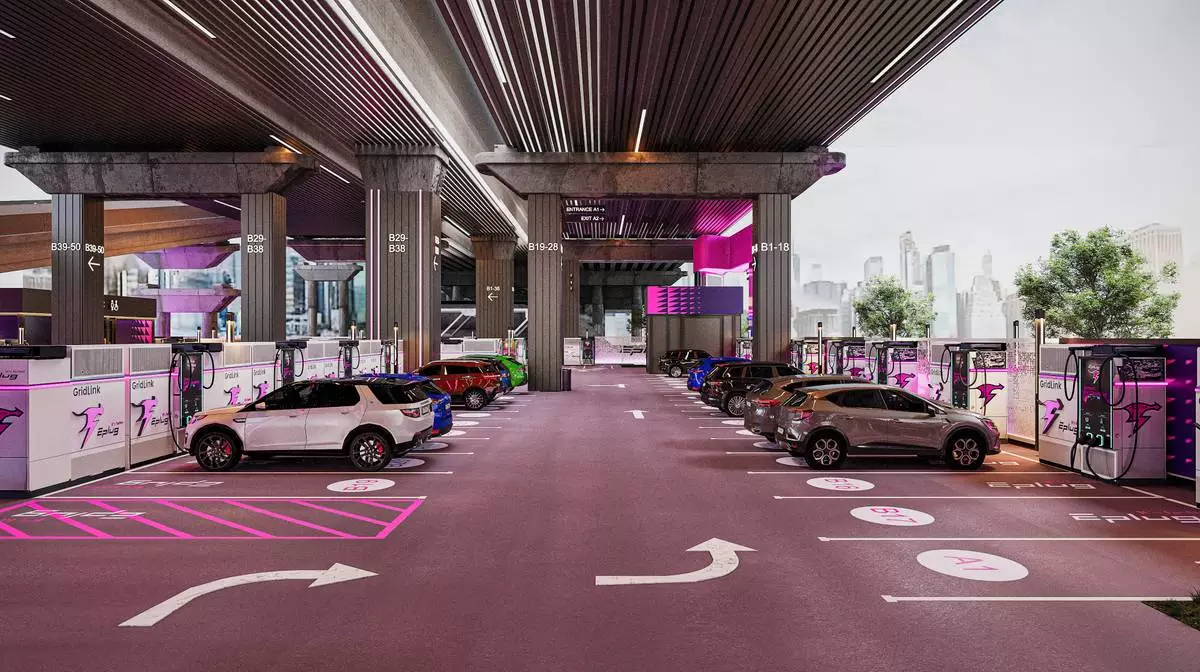
XCharge North America (“XCharge NA”), the North American subsidiary of XCHG Limited (NASDAQ: XCH, “XCharge”) and provider of high-power EV charging and battery-integrated solutions designed to strengthen the North American electrical grid, announced today that it has partnered with Energy Plus, a leading New York–based energy-efficiency and electrification contractor, to transform New York’s EV charging landscape. Slated to go live in Q2 2026, the new site in Williamsburg, Brooklyn, will serve as one of the largest battery-backed EV charging depots in the country. The 44 XCharge NA GridLink units will provide 9.46 MWh of energy storage and serve 88 parking spaces once complete. The site will operate under Energy Plus’ Eplug brand—a next-generation urban charging solution designed for dense, high-demand environments like New York City.

This press release features multimedia. View the full release here: https://www.businesswire.com/news/home/20260107371186/en/

By leveraging GridLink’s battery storage, the project mitigates the pressure of growing electrification while strengthening local resiliency by drawing energy at off-peak times and returning it when it is most in demand. This supports New York City’s energy-resiliency and affordability priorities, opening new pathways for affordable, diversified power across the city. GridLink’s proprietary technology and bidirectional energy flow provide decentralized power to bolster local infrastructure, increase energy resilience amid persistent peak-hour grid strain, and mitigate soaring electricity costs for citizens.

“Helping launch the East Coast’s largest battery-backed fast-charging depot is a defining moment for XCharge NA and for the EV industry,” said Aatish Patel, co-founder and president of XCharge NA. “Through this strategic alignment with Energy Plus, we’re proving that the EV transition can thrive domestically, setting a model for how public and private companies can come together to accelerate the clean energy transition and make urban energy cleaner, faster, and smarter.”

“This is what American-made electrification looks like in practice: XCharge North America provides the cutting-edge technology and hardware, and we build the infrastructure here with local American labor,” said Moshe Lefkowitz, founder of Energy Plus. “Together we’re not only creating a model that any U.S. city can replicate, but also laying the foundation for Eplug, a network designed for real urban life—one that’s dependable, familiar, and as easy to use as stepping into your local café to grab a cup of coffee.”

Energy Plus’ Eplug model emphasizes predictable operations, a minimal footprint, and a charging experience that meets New Yorkers where they already live, work, and travel. Energy Plus plans to expand New York’s model to other major U.S. cities, featuring transparent pricing and a forthcoming loyalty program with rewards and preferred rates, while each location will maintain a friendly local presence through partnerships with nearby businesses. In addition to everyday drivers, Eplug will also provide dedicated fleet solutions designed for predictable scheduling, fast turnarounds, and high uptime, supporting both daily operations and long-term electrification planning for commercial fleets.

To learn more about XCharge North America, visit xcharge.us. To learn more about Energy Plus, visit energyplusny.com

About Energy Plus

Energy Plus specializes in large-scale energy-efficiency upgrades, electrification, and EV infrastructure for multifamily, commercial, and industrial properties. The company delivers end-to-end engineering, installation, and compliance services that help buildings meet clean-energy mandates and lower operating costs. Energy Plus also develops and operates Eplug, an urban fast-charging network designed to provide reliable, accessible, and locally integrated EV charging across New York and other major U.S. cities.

About XCharge North America

XCharge NA specializes in high-power EV charging and battery-integrated solutions tailored to the North American electrical grid. With solutions that store energy, improve grid resilience, and create new revenue streams, XCharge NA is the first scalable open-access EV charging solution designed to strengthen the country’s electrical grid and broader energy infrastructure while providing charging solutions for EVs from individual to fleet.

About XCharge

XCharge (NASDAQ: XCH), founded in 2015, is an integrated EV charging and energy solutions company. With dual headquarters in Hamburg, Germany and Austin, Texas, XCharge offers comprehensive EV charging solutions, which primarily include the DC fast chargers and the advanced battery-integrated DC fast chargers as well as its accompanying services. Through the combination of XCharge’s proprietary charging technology, energy storage system technology and accompanying services, XCharge enhances EV charging efficiency and unlocks the value of energy storage and management. Committed to providing innovative and efficient EV charging solutions, XCharge is actively working toward establishing a global green future that is critical to long-term growth and development.

Safe Harbor Statement

This press release contains forward-looking statements. These statements are made under the "safe harbor" provisions of the U.S. Private Securities Litigation Reform Act of 1995. Statements that are not historical facts, including statements about the company's beliefs and expectations, are forward-looking statements. Forward-looking statements involve inherent risks and uncertainties, and a number of factors could cause actual results to differ materially from those contained in any forward-looking statement. In some cases, forward-looking statements can be identified by words or phrases such as "may," "will," "expect," "anticipate," "target," "aim," "estimate," "intend," "plan," "believe," "potential," "continue," "is/are likely to" or other similar expressions. Further information regarding these and other risks, uncertainties or factors is included in XCharge’s filings with the United States Securities and Exchange Commission.

All information provided in this press release is as of the date of this press release, and XCharge does not undertake any duty to update such information, except as required under applicable law.
Source: DREAM GREEN DESIGN NY

Source: DREAM GREEN DESIGN NY

Renderings of XCharge NA and Eplug's upcoming battery-backed EV charging depot in Williamsburg, Brooklyn. Source: DREAM GREEN DESIGN NY
Renderings of XCharge NA and Eplug's upcoming battery-backed EV charging depot in Williamsburg, Brooklyn. Source: DREAM GREEN DESIGN NY

BEIRUT (AP) — Lebanon's military said Thursday it had concluded the first phase of a plan to fully deploy across southern Lebanon and disarm non-state groups, notably Hezbollah.

Israel said the development was encouraging but “far from sufficient," and its Foreign Ministry said the group still has dozens of compounds and other infrastructure.

The effort to disarm Hezbollah comes after a Washington-brokered ceasefire ended a war between the group and Israel in 2024.

The military's statement, which did not name Hezbollah or any other armed groups, came before President Joseph Aoun met with Prime Minister Nawaf Salam and his government to discuss the deployment and disarmament plans. Both said disarming non-state groups was a priority upon beginning their terms not long after the ceasefire went into effect.

Lebanon's top officials have endorsed the military announcement.

A statement by Aoun’s office ahead of the Cabinet meeting called on Israel to stop its attacks, withdraw from areas it occupies, and release Lebanese prisoners. He called on friendly countries not to send weapons to Lebanon unless it's to state institutions — an apparent reference to Iran which for decades has sent weapons and munitions to Hezbollah.

Speaker Nabih Berri, a key ally of Hezbollah who played a leading role in ceasefire talks, issued a statement saying the people of southern Lebanon are “thirsty for the army's presence and protection."

Israel maintains that despite Lebanon’s efforts, Hezbollah is still attempting to rearm itself in southern Lebanon.

“The ceasefire agreement brokered by the United States between Israel and Lebanon states clearly, Hezbollah must be fully disarmed," a statement from Israeli Prime Minister Benjamin Netanyahu’s office read. “This is imperative for Israel’s security and Lebanon’s future.”

Israel's Foreign Ministry said in a later statement that the group is “rearming faster than it is being disarmed," and showed a map of alleged Hezbollah compounds, launch sites, and underground networks south of the Litani River.

The text of the ceasefire agreement is vague as to how Hezbollah’s weapons and military facilities north of the Litani River should be treated, saying Lebanese authorities should dismantle unauthorized facilities starting with the area south of the river.

Hezbollah insists that the agreement only applies south of the Litani, while Israel maintains that it applies to the whole country. The Lebanese government has said it will eventually remove non-state weapons throughout the country.

Information Minister Paul Morcos said after the Cabinet meeting that the army will start working on a plan for disarmament north of the Litani river that will be discussed by the government in February. He added that the army will also continue the process of weapons “containment” in other parts of Lebanon, meaning that they will not be allowed to be used or moved.

The agreement is seen as a procedure to implement prior United Nations Security Council agreements that call for disarmament of non-state groups and the withdrawal of all occupying forces, and for the Lebanese state to have full control of its territory.

The Lebanese military has been clearing tunnels, rocket-launching positions, and other structures since its disarmament proposal was approved by the government and went into effect in September.

The government had set a deadline of the end of 2025 to clear the area south of the Litani River of non-state weapons.

“The army confirms that its plan to restrict weapons has entered an advanced stage, after achieving the goals of the first phase effectively and tangibly on the ground,” the military statement read. “Work in the sector is ongoing until the unexploded ordnance and tunnels are cleared ... with the aim of preventing armed groups from irreversibly rebuilding their capabilities.”

Hezbollah did not immediately comment on the Lebanese announcement.

Officials have said the next stage of the disarmament plan is in segments of southern Lebanon between the Litani and the Awali rivers, which include Lebanon’s port city of Sidon, but they have not set a timeline for that phase.

Israel continues to strike Lebanon near daily and occupies five strategic hilltop points along the border, the only areas south of the Litani where the military said it has yet to control.

Regular meetings have taken place between the Lebanese and the Israelis alongside the United States, France, and the U.N. peacekeeping forces in southern Lebanon, known as UNIFIL, to monitor developments after the ceasefire.

Lebanon’s cash-strapped military has since been gradually dispersing across wide areas of southern Lebanon between the Litani and the U.N.-demarcated “Blue Line” that separates the tiny country from Israel. The military has also been slowly confiscating weapons from armed Palestinian factions in refugee camps.

Israel accuses Hezbollah of trying to rebuild its battered military capacity and has said that the Lebanese military’s efforts are not sufficient, raising fears of a new escalation. Lebanon, meanwhile, said Israel's strikes and control of the hilltops were an obstacle to the efforts.

Lebanon also hopes that disarming Hezbollah and other non-state groups will help to bring in money needed for reconstruction after the 2024 war.

Hezbollah says it has been cooperative with the army in the south but will not discuss disarming elsewhere before Israel stops its strikes and withdraws from Lebanese territory.

The latest Israel-Hezbollah conflict began the day after the Oct. 7, 2023, Hamas-led attack on Israel triggered the war in Gaza. The militant group Hezbollah, largely based in southern Lebanon, began firing rockets into Israel in support of Hamas and the Palestinians.

Israel responded with airstrikes and shelling. The low-level conflict escalated into full-scale war in September 2024. Israeli strikes killed much of Hezbollah's senior leadership and left the group severely weakened.

Hezbollah still has political clout, holding a large number of seats in parliament representing the Shiite Muslim community and two cabinet ministers.

People check the site where an Israeli strike destroyed a building at a commercial district, in the southern port city of Sidon, Lebanon, Tuesday, Jan. 6, 2026. (AP Photo/Mohammed Zaatari)

People check the site where an Israeli strike destroyed a building at a commercial district, in the southern port city of Sidon, Lebanon, Tuesday, Jan. 6, 2026. (AP Photo/Mohammed Zaatari)

FILE - Lebanese army soldiers walk through a tunnel dug into a mountain that was used by Hezbollah militants as a clinic and storage facility near the Lebanese-Israeli border in the Zibqin Valley, southern Lebanon, Nov. 28, 2025. (AP Photo/Bilal Hussein, File)

FILE - Lebanese army soldiers walk through a tunnel dug into a mountain that was used by Hezbollah militants as a clinic and storage facility near the Lebanese-Israeli border in the Zibqin Valley, southern Lebanon, Nov. 28, 2025. (AP Photo/Bilal Hussein, File)

Recommended Articles